Thank you for publishing the article about the Vatican's investigation of U.S. religious sisters ("Vatican Inquiries Into Sisters Causing Trepidation," July 3). Being a Catholic today has much in common with being in an abusive marriage. Do you stick it out and work for change, or do you leave? Many have left, and those who have stayed are being "investigated."
People in an abusive marriage can go to counseling. The counselor creates a safe place to discuss differences. Some abusive spouses will not go to counseling, and neither will the official church.
There is no safe forum for discussing the ordination of women, which many believe is the key issue behind the Vatican's move. The official church has a three-step monologue process for those who disagree: (1) write official documents telling people what to believe, (2) failing to convince, apply sanctions, and (3) when people will not be silenced, tell them that they have "placed themselves outside the church."
If Catholics speak out about the ordination of women, they risk being removed from their religious communities, their ministries or their jobs, which can mean loss of financial supports and benefits.
I speak about this from the inside having been told in public print that I have put myself out of the church. No personal letter, no phone call, no counseling, no discussion, no dialogue, just "out"; however, I will not be abused, and I will not leave my church. The result of my taking this stand is that I have found myself in the best of company.
JOAN CLARK HOUK McCandless The writer was among women ordained by Roman Catholic Womenpriests in July 2006.
Gary Macy, scholar and church historian cites that the present Vatican investigation of apostolic religious orders in the United States is not in continuity with the first twelve hundred years of the church's history. For example:
"Early abbesses were powerful and acted independently not only of the papacy, but also of the local bishop. In fact, the most impressive example is the powerful Cistercian abbess of Las Huelgas near Burgos in Spain who wore her miter and carried her crosier until she was finally forbidden to do so in 1873. The abbess had the power to appoint parish priests for the countryside subject to the convent of Las Huelgas, some 64 villages. No bishop or delegate from the Holy See could perform a visitation of the churches or altars or curates or clerics or benefices under the care of the abbess. The abbess of Las Huelgas was even able to convene synods in her diocese and to make synodal constitutions and laws for both her religious and lay subjects."
In addition, Gary Macy, in his book, The Hidden History of Women's Ordination, points out that for the first twelve hundred years of the church's history, women were ordained. It is time to reclaim our ancient heritage of women as equals and partners in the church both in Holy Orders and in religious life. It is my hope that many nuns, especially those with vocations to priestly ministry in a renewed church, will make these connections and together with Roman Catholic Womenpriests be agents of transformation, bringing justice and equality to our church. St. Mary of Magdala, Phoebe, Prisca, Aquila, Lydia, Brigit of Kildare, Clare of Assisi and all you holy women and men who have before us as prophetic witnesses, pray for us. Bridget Mary Meehan
We will celebrate a liturgy in honor of St. Mary Magdala, apostle, on her feast day, July 22, 2009 in Falls Church, VA. at 7:00 pm For more information, email Bridget Mary Meehan at sofiabmm@aol.com or call 703-671-6712
Mary Louise Hartman (Princeton, New Jersey) 609-924-9529
Women in Ministry with St. Paul focus of over 200 international Mary Magdala Celebrations: Organizers Request Vatican to Restore Deleted Women Leaders in Lectionary
CLEVELAND, OH: In mid-July, organizers across the US and in Canada, Great Britain, Australia and Uganda will join together in a worldwide effort to expand awareness of women leaders in the early Church, especially Mary of Magdala, Phoebe, Prisca, Lydia and other little known women leaders who ministered with f St. Paul.
The Vatican designated this past year as the Year of St. Paul and invited Catholics to more fully reflect on his important role in the church. FutureChurch's Mary of Magdala this year will celebrate the often unnoticed women who ministered alongside of St. Paul. Participants will also be asked to send postcards to Vatican leaders asking them to include the missing stories of biblical women leaders.
"Many people mistakenly believe St. Paul was anti-women," Said FutureChurch Director Sr. Christine Schenk, Yet, as Pope Benedict himself has said so well, St. Paul worked closely with women leaders such as Phoebe, Junia, Lydia and Prisca (papal address February 14, 2007). Unfortunately, Romans 16, a passage that names eleven women and identifies some of them as deacons, apostles, and co-workers, is never proclaimed on a Sunday. Nor are the accounts of women leaders in the Acts of the Apostles (Lydia, Prisca, Tabitha), which are read only on the weekdays of Easter, so most Catholics never hear about their important ministry alongside Paul. (For more information, see "Women in the Bible and Lectionary" by Ruth Fox OSB, published in 1996 by Liturgy 90)
"St. Mary of Magdala was a foremost leader in the early Church, led the group of women who accompanied Jesus at his death, and first proclaimed the good news of his resurrection. She was not a prostitute as some believe. For centuries Mary of Magdala's story, like those of the women leaders in the ministry of St. Paul, has been minimized or excised from the official lectionary used in both Catholic and Protestant churches," said Sr. Christine Schenk of FutureChurch.
For the past two years, FutureChurch spearheaded a campaign to "put women back in the biblical picture" at last October's Synod on the Word. For the first time in history Catholic bishops meeting in a synod "recognized and encouraged" the ministry of women of the Word, discussed the need to restore women's stories to the Lectionary, and invited the greatest number of women ever to participate as auditors and biblical experts.
Although the synod is over, the work to open an examination of the Lectionary as recommended by Synod Proposal 16 is not done. Participants at Mary of Magdala celebrations across the nation will be sending paper and electronic postcards to Cardinal Antionia Cañizares Llovera, Prefect for the Congregation for Divine Worship encouraging him and the synod committee to follow through on this proposal. Specifically, the postcards ask to:
· Open an examination of the Lectionary to "see if the actual selection and ordering of the readings are truly adequate to the mission of the Church in this historic moment," as recommended by Synod Proposal 16.
· Restore women leaders such as Phoebe (Romans 16) and Lois and Eunice (2 Tim 1:4, 5) to Lectionary texts from which they have been deleted.
· Include stories about other women leaders such as Shiprah and Puah, the midwives who saved a nation of Hebrew boy-children, perhaps even Moses.
· Convene a gender-balanced group of biblical scholars and liturgists to decide which women's stories would be most fruitful for prayer, preaching and catechesis if added to the Lectionary.
"We think it's important for women and men to learn the contemporary scholarship about women in the early Church and we are especially happy to have a celebration in which women can preside and preach at worship," said Mary Louise Hartman of Princeton, New Jersey, FutureChurch Board member
To educate about women leaders and to model gender balance in scripture proclamation, FutureChurch began special international celebrations of the Feast of St. Mary of Magdala in 1998. Each year nearly 300 such events are held in mid July. Participants hear presentations by biblical scholars about early women leaders and experience prayer services at which competently prepared women preach and preside.
"One of the reasons the Mary of Magdala celebrations have proved so enduring is that Catholic women and men are edified to discover that Jesus included women in his Galilean discipleship. Most Catholics mistakenly believe that Jesus called only men, when in fact Luke 8:1-3 tells us Mary of Magdala, Joanna, Susanna and many other women accompanied him in Galilee. Since the Lukan reading is never read on a Sunday, the stories of Jesus' women disciples are rarely if ever the subject of homiletic attention," says Chris Schenk, FutureChurch Executive Director.
For each of the past thirteen years FutureChurch spearheaded between 200 and 300 special celebrations of the July 22 Feast of St. Mary of Magdala in the U.S. and worldwide. The prayer services always highlight biblical women leaders and women's leadership in the Church. They will engage between 30 and 300 people in parishes, convents, Catholic schools, Protestant churches, private homes and small faith communities.
Sample electronic postcards and a list of celebrations nationwide are available at www.futurechurch.org
To contact a local organizer in your area call Sr. Chris Schenk at 216-228-0869 x 4 or Ms. Emily Holtel-Hoag at 216-228-0869 x 3
On this 9 min. video, you will see some highlights of the historic ordinations of the first women bishops in the United States to serve our growing movement. Bishops have a pastoral and spiritual role in the movement. They are not on the Leadership Circle/LC. The Leadership Circle perform the administrative tasks. Priests do not promise obedience to a bishop. Notice that at our ordinations, women prostrate before the altar, not the bishop(s) as a symbol of our consecration to serving God and the people. Also note that the people prayed with the bishops the prayer of consecration, and although not seen in this short video, the community lays hands on the ordinands. Look at slide show on right hand corner of blog and you will see the people laying hands as well as the presiding bishops.
www.romancatholicwomenpriests.org sofiabmm@aol.com Bridget Mary Meehan
Commentary: One of the reasons that the nuns incurred the Vatican's wrath is their support of justice for women in the church specifically the issue of women's ordination. In a recent letter, Roman Catholic Womenpriests extended our prayerful support and expressed our solidarity with the Leadership Conference of Women Religious/ LCWR and the apostolic orders who are undergoing Vatican investigation. Religious women have been prophets over the centuries and challenged our institutional church to live the Gospels. We are, like many Catholics and non-Catholics, are grateful to the nuns for their dedication and service to God's people especially those on the margins of society. It is my hope that these gutsy women continue to speak truth to power as courageous witnesses of Christ's compassion and justice in our world. Our church and world needs their witness to Gospel equality now more than ever! Some fear that the Vatican will impose an older model of pre-Vatican 11 traditional convent life. Others suggest that perhaps it is time for the women religious to drop their canonical status and adopt a new, renewed model of religious life similar to Sisters for Christian Community/SFCC. (my community). Our rule of life is the Gospel and our charism is building community so that all may be one. There are many options for women religious to consider that could offer fresh possibilities for a future, unimpeded by Vatican interference. Nuns have mountain-moving faith and and as we know all things are possible for God. My guess is that we are in for some surprises by the Spirit here. The movement for full equality of women in the church is moving forward and becoming a reality in grassroots communities now as Roman Catholic Womenpriests respond to the call to serve God's people in a community of equals. Let justice flow like a river to end all oppressive domination and usher in freedom and equality for God's beloved people. Sisters, the ball is in your court now, take the lead! Anyone called to priestly ministry? Bridget Mary Meehan, rcwp sofiabmm@aol.com
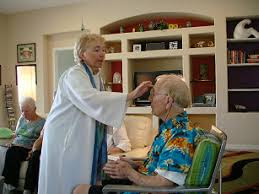
Members of Mary, Mother of Jesus Community pray over Bridget Mary Meehan in preparation for her ordination as bishop.
The article below indicates a welcome shift to "pastoral co-responsibility" It also is a reminder that women, half of the church's membership are excluded from priestly ministry and full equality in the church. It is time for the Vatican to address the issue of justice for all including women in the church.The people on the margins have moved to the mainstream and reflect Christ's example of a discipleship of equals.They are taking pastoral co-responsibility in empowered, prophetic communities in a number of ways including calling women forth to serve their faith communities as deacons, priests and bishops. This is the charism, the gift that the Roman Catholic Womenpriests' movement brings to our beloved church. Yes, Pope Benedict, the church needs a change of mentality and Catholics are moving forward to live this renewed vision now. Amen to ARCC's article!
Bridget Mary Meehan, rcwp
ARCC spot LIGHT(analysis of Church issues offered by the ARCC Publications Committee, R. Schutzius, ed.)
Benedict XVI: Church Needs Change of Mentality
ROME, MAY 28, 2009 (Zenit.org).- "Lay people are not merely the clergy's collaborators, but rather share in the responsibility of the Church's ministry", says Benedict XVI. The Pope called on the laity to become more aware of their role when he inaugurated an ecclesial conference for the Diocese of Rome on "Church Membership and Pastoral Co-responsibility". "There should be a renewed becoming aware of our being Church and of the pastoral co-responsibility that, in the name of Christ, all of us are called to carry out," the Holy Father said.
The Pope, in one sense, is absolutely correct on this one! He recognizes, as we all do, that serious changes are needed in the Church, and even points in the right direction suggesting that we all are co-responsible for the Catholic Christian Community, the Church. The Pontiff acknowledged that this requires a "change of mentality," especially regarding lay people, shifting from "considering themselves collaborators of the clergy to recognizing themselves truly as 'co-responsible' for the being and action of the Church, favoring the consolidation of a mature and committed laity". "There is still a tendency to unilaterally identify the Church with the hierarchy, forgetting the common responsibility, the common mission" of all the baptized.
But the "devil is in the detail" (perhaps literally). "Up to what point is the pastoral responsibility of everyone, especially the laity, recognized and encouraged?" he asks. We must ask in return, what co-responsible member of a community has no say in choosing its leadership, or how the resources of the community are spent, or can tolerate secrecy, lack of accountability, and no participation in decisions of the community?
ARCC suggests that Pope Benedict must first change his own mentality about the Church. He means well, but his understanding of co-responsibility is just not real. He seeks to change our Church mentality back to the pre- Vatican II model when we had responsibilities but no rights. We call that a monarchy, not a community. His words remain sounding gongs and tinkling cymbals until he changes first.
ARCC is a co-sponsor of THE AMERICAN CATHOLIC COUNCIL (ACC) Please consider joining this effort to bring about much-needed organizational restructuring in the Church
Feel free to distribute this article without change. Thank you for support of ARCC..
Send comments to rschutz1@prodigy.net or 1-877-700-ARCC (2722).
If you move the slider on the viewer to Minute 26 you will come to the start of the section on women priests. This program was filmed in Dublin earlier this month when we celebrated Mass with the Women's Ordination and Married Priests Community. Bridget Mary Meehan
For more resources/videos/articles/information about Roman Catholic Womenpriests, visit www.romancatholicwomenpriests.org
Read our book Women Find A Way-- edited by Elsie McGrath and Bridget Mary Meehan Stories of the call of womenpriests to serve the people of God. www.virtualbookworm.com also available on amazon.com Email: Bridget Mary Meehan at sofiabmm@aol.com
Aisha Taylor, (left to right) outgoing director of Women's Ordination Conference (WOC) Bridget Mary Meehan RCWP, Erin Hanna (incoming executive director of WOC) Laura Singer, president of the Women's Ordination Conference voice the gratitude of the movement for Aisha's leadership Aisha Taylor and Erin Hanna Aisha Taylor Bernie Byrne presenting card and gift from NOVA On Thur. June 25, 2009, supporters of the Women's Ordination Conference gathered to pay tribute to Aisha Taylor outgoing Executive Director of the Women's Ordination Conference. Fr. Roy Bourgeois, MM, threatened with excommunication for his public support of women's ordination in Washington DC gave a powerful talk addressing the importance of solidarity with the women's ordination movement. He recalled that he became involved when he attended the ordination of Janice Sevre-Duszynska in Lexington, Kentucky. This prophetic action on his part resulted in the treat of excommunication by the Vatican. The Maryknoll Order stood by Roy as their brother and a member of their community whom they continue to support.
Andrea Johnson and Bridget Mary Meehan from Roman Catholic Womenpriests attended this gala event that paid tribute to Aisha Taylor's many accomplishments during her five year tenure a WOC. Erin Hanna led the tributes and will continue the essential mission of the Women's Ordination Conference.
I feel hopeful that young women like Aisha, Erin and Laura are leading the way to the full equality of women in the Roman Catholic Church. May justice for women in the church become a reality in our lifetime!
Kathy Reddig is a Roman Catholic Womanpriest who serves a Catholic Community in Minnesota. She gave permission to share the homily she preached on Corpus Christi Sunday, June 14, 2009.
Homily—Corpus Christi
June 14, 2009
Over the years, since the time of Jesus, when he first made the Passover Meal something new by proclaiming the profound words, “This is my body, this is my blood, the whole notion of the Body and Blood of Jesus—or Corpus Christi—which actually means, “the Body of Christ, has made quite an evolution.Even from the time when I was a child learning about these mysteries—a span of 50 years, I have seen the changes.When I was preparing to make my first, (and we always added then) “holy” communion—it was all about reverence, worship and awe.There were special protocols if ever a host was dropped—everything stopped and it was as if everyone was holding their collective breath until Father retrieved a white cloth and picked Jesus up so that no one would step on him—something we would never have wanted to do!
Jesus, in the form of bread and wine was so sacred then that there were special things everyone had to remember about even how to receive this gift that was originally intended as a way for our God in Jesus to be closer to us.In those days, as many of you recall, we didn’t even receive the wine—the most precious blood was simply too precious for us to receive. And we received the host, the most precious body on our tongues as we weren’t worthy to touch it and we were never to chew it.This puts a great deal of stress on a young child like myself who was also very reverent and would never think of desecrating the host in any way.
Today things have changed. With Vatican II, we were encouraged by John XXIII to open some windows, let some fresh air in—think again about the original intention of this special gift.Jesus took common elements—the stuff of the Passover Meal—
flat bread—matzos—remembering the time of their forebears’ fleeing captivity in Egypt—no time to put leaven in the flour—wine, the common drink.Within the course of this religious ritual, Jesus did something new.He said, never again will you need to offer atonement/blood offerings to our God.I will become the sacrificial lamb who takes upon himself all the sufferings—all the evil that humans are capable of—I will become at last the offering that “cleanses your consciences”—makes you a whole and worthy gift to our loving God.My whole life has been to show you the way—this is my body—you are my body for the world.This is my blood—you are now that blood—that life-force, and without you, I have no heart, no voice, no eyes, no ears to engage the world.I came that you might know how much our loving God holds each one of you close—in the palm of God’s hand—carries you close under her heart as a mother soon-to-be carries her precious young.
Today, as a result of Vatican II, I see there being much more emphasis on the body of Christ, which is all of us, than on the body of Christ which is represented by the bread and wine on the table that we will soon together make sign and symbol of Jesus present among us.
Another aspect of those pre-Vatican II times, as I described earlier was the over-emphasis on worshipping the body and blood of Jesus in the form of bread and wine.It spawned practices of Eucharistic devotion and perpetual adoration—practices the Church is trying desperately today to reinstate, which will further keep Jesus away—untouchable as in earlier times.
The word “transubstantiation” –a word we second graders in the 50’s could barely pronounce and even less understood, was the talk of the day whenever the Eucharist was mentioned.The doctrine, as most of you know, states that one must believe that the bread and wine, with the words of consecration, have become “flesh” and “blood” even though they still appear to be bread and wine—taste like bread and wine.
The question perhaps to ask is—can the bread and wine—looking like bread and wine, tasting like bread and wine, still be Jesus-with-us?How about this? When we eat the bread and drink the wine, sign and symbol of Jesus-with-us, it becomes, actually, flesh and blood in our bodies. Again, I believe this is an instance of us taking Jesus’ words too literally and spending undo time and energy trying to get our heads around something that is not intelligible. I believe what Jesus intended is that he would remain with us, a part of us, body and blood, by incorporating all that he taught us and making it literally, a part of us. That’s what we mean when we say we are now Jesus’ body for our world. Hopefully, we become a bit more transformed into the body and blood of Jesus each day.People should be able to see Jesus in our actions.
Jesus’ task on this earth was to show us the way—he said, you will do greater things than I.He wasn’t going to be the one staying around—that would be our task.He knew we would need to feel his presence and thus he gave us the Eucharist—as a way to remember him, as a way to receive the strength needed to be his body in our world.
You might have wondered why we all say the words of institution unlike in the traditional Church. Many inclusive communities have been doing this for several years now and it is reflective of taking ownership for Jesus present-among-us.
We all together say the words that in effect make it so and it is again a mystery we can only see around the edges—dimly, as through a glass, to use Paul’s words. If we can grasp the fact that our God has loved us from all time, and that is proven by the sending of Jesus to be one with us, we have gotten the core message.Then, because Jesus couldn’t remain with us in physical form, he left us a way—a sacrament that when we share it, we become cognizant of his presence with us in a special way. We live in our respective worlds—in our own life situations and we are Jesus’ body and blood for the world, if we so choose.
For me, if it is a choice between reverencing Jesus’ body in the host and in the cup or reverencing Jesus’ body in our world and its people, my choice is clear—the world and its people.
So, am I saying that the sacrament of the altar is not important to me? No, on the contrary—it continues to be a very important ritual and a starting place for me. Jesus’ gift to each of us—his body, his blood, his loving, his dying, his rising—all instill within me a great sense of responsibility because if I believe he is here present, then I am called to make his gift my own—and not onlymy own, but a gift I am obligated to share with my world.
Earlier, I spoke about Vatican II bringing fresh air into the Church.In this homily, I have spent the most of my time trying to help us see the importance of putting the stress in the right place.As a child, I had a great reverence for the Eucharist—I went to Catholic schools and on special days when there was 40 hours devotion—the Eucharist was displayed outside the tabernacle.
I thought it so wonderful to go into the Cathedral on my lunch break and worship Jesus there. Those were the thoughts of a child.As an adult, I believe Jesus meant so much more than that.
I remember God’s words to the 1st Testament people—I don’t want your offerings of bullocks and lambs—we might add—I don’t need you to worship me in the bread and the wine, but in the flesh and blood of my people. There was a time when we worried about dropping the host and desecrating it on the floor—I believe Jesus is more concerned about the desecration that happens when we fail to recognize him in the sufferings and needs of others. Our God simply wants us to have clean hearts that show our love by the way we live our lives.
So my friends, I invite us to have great reverence for the Eucharistic
meal—something we make our own each time we celebrate together, each time we say the words that make Jesus present here in our lives in a special way.We remember Jesus’ words to us—where two or three are gathered in my name—I am there. We become a family when we share this meal—we become vulnerable to each other as we eat together and we promise as a community, with Jesus’ help to continue to share his life among us. That is why anyone who wants to be part of our celebration and partake of the meal is welcome here, because Jesus has 1st welcomed us. Partaking of the bread and wine as sign and symbol of Jesus with us only makes sense if we then go out and share the gift of Jesus’ love with all we meet. Worshipping or reverencing Jesus in the bread and wine only makes sense if we likewise reverence him in each person who comes into our lives.
Mary, Mother of Jesus Catholic Community Celebrates Eucharist in Sarasota, Fl. Sheila Carey performs a liturgical dance during Lenten season.
Pope Benedict declared a Jubilee Year of the priest from June 19, 2009 to June 19, 2010. During this year of the priest, Roman Catholic Womenpriests are offering the church the gift of a renewed priestly ministry in a community of equals in grassroots communities where we serve God's people NOW. We are birthing the renewal of the Roman Catholic priesthood in our time as an inclusive partnerhsip within the community of faith.
Roman Catholic Womenpriests are working for justice for women in the church and for a total transformation of patriarchal structures to reflect the Spirit's presence in all the baptized as disciples and equals. As the Women's Ordination Statement below states:
"When women are full and equal partners in every aspect of the Catholic Church, only then, will the Roman Catholic Church be associated with accountability, transparency and justice rather than hierarchy, exclusion, and scandal."
Now is the time for Catholics who love our ancient tradition-- which includes a twelve hundred year history of women serving as deacons, priests and bishops-- to live Jesus' vision of Gospel equality. Let us promote an inclusive, renewed priestly ministry in a renewed Catholic Church where justice is a reality and all are welcome at the table. Bridget Mary Meehan, rcwp June 19, 2009
FOR IMMEDIATE RELEASE: June 18, 2009
MEDIA CONTACT: Clarissa Mendez, office: +1 (202) 675-1006
Women's Ordination Conference Statement On Vatican's Year of the Priest
On March 16, 2009, Pope Benedict XVI announced a Jubilee Year of the Priest beginning tomorrow, June 19, 2009, coinciding with the 150th anniversary of the death of the Cure d'Ars, St. Jean Vianney. The year-long commemoration is intended to strengthen and reinvigorate the male, clerical priesthood. The year is expected to close on June 19, 2010, with a "World Meeting of Priests" in St. Peter's Square. The following is a statement from Erin Saiz Hanna, incoming Executive Director of the Women's Ordination Conference (WOC), effective July 1, 2009. Erin Saiz Hanna currently serves as Assistant Director.
WASHINGTON, DC- "While the Holy See prepares for a year-long focus on the priesthood and struggles to reinvigorate a damaged institution, Women's Ordination Conference calls for a celebration of the priesthood of the baptized. Second Vatican Council documents state that all the baptized share in the "priestly, prophetic and kingly office of Christ" (Lumen Gentium 31). All people receive gifts of the Holy Spirit and all are called to use these gifts in service to the needs of our world. Instead of emphasizing the separation between the hierarchy and the people of God, WOC calls on the Vatican to return the church we love back to the example of Jesus, where all are invited and included.
In Pope Benedict's letter to clergy, he states that the example and teachings of St. Jean Vianney should serve as a 'significant point of reference' for today's clergy and quotes the saint's teaching, 'Without the Sacrament of Holy Orders, we would not have the Lord. Who put Him there in that tabernacle? The priest.... After God, the priest is everything!' In fear of their escalating loss of credibility and influence, this dangerous mentality can only be described as the hierarchy's desperate attempt to latch onto outdated doctrine used to oppress the people of whom they should be focused on serving.
Simply declaring this 'the year of the priest' cannot and will not rebuild credibility. From sex abuse scandals, to threats of excommunication, to denying that condoms are effective in reducing the spread of HIV/AIDS, ordained men have obliterated their moral credibility with the people of God.
Since 1975, the Women's Ordination Conference has worked for women's full inclusion in the church, especially as priests, deacons and bishops, and for inclusive, participatory church structures where all Catholics take part in decision-making within the Church. We celebrate the countless women and men who make a positive difference in our churches and communities every day. Right now in every diocese, lay ecclesial ministers are working for justice and responding to the spiritual needs in our communities. There are over 31,000 lay ministers in the U.S.A., surpassing the 29,000 diocesan priests in the country. It is important to note that 80 percent of these ministers are women.
Though the Vatican may call on us to praise our priests this year, we will not turn back the clock on our vision for a discipleship of equals. When women are full and equal partners in every aspect of the Catholic Church, only then, will the Roman Catholic Church be associated with accountability, transparency and justice rather than hierarchy, exclusion, and scandal. Until then, we will continue to raise our collective voices and organize actions that will bring our church closer to the gospel values of Jesus."
This was a joyful day of new beginnings in our Church of the Good Shepherd: An Inclusive Catholic Community. During our regular Mass in the late afternoon of June 13th, 2009 two young people were Baptized and four ,including the two newly baptized, received their first Holy Communion. They were welcomed warmly to new life in Christ and to our Community with a rousing A-men ! ( Hear this as sung by Sidney Poitier in Lilies of the Field-but with even greater gusto and warmth). The girls Maria, 15, Marcella ,7, Marina,13 and Josefina, 11 completed a preparation process of several months and deeply understood the steps they were taking in following Jesus. Lucy Conley, our Master's student from Adelaide, Australia and Lauretta Rasmussen, a resident of our Joshua House, and Kathy McGhan, a volunteer, assisted me in preparing the group. The parents who initially asked for the Sacraments for their children also participated in some parts of the preparation process and the whole community was supportive and involved. The families, traditionally Roman Catholic, one Hispanic and one Italian, had been denied Sacraments in the institutional Church due to marriage situations and had responded by delaying the Sacraments for their children, and one by non-participation in the Church since before her children were born. You can understand the joy of these parents at finding a church home to include them within the renewed Church. The picture of the larger group standing outside of the Church are some of the community members and God-parents who stayed to celebrate with the families. After the Celebration we had a festive community meal, and in the last picture we see Carl, Jasper and Nate having seconds at the food table. Carl and Nate also live at our Joshua House, a Guest Residence for formerly homeless men and women making the transition to permanent housing. Carl is our head Usher and Nate is our Lector. Mr. Harry Gary ,standing next to me in the large picture is our Church Elder. Our gathering hymn ,led by Hank who also is our Community Music leader and Artist, was "Let The River Flow" and its words were so true today. "Let the poor man say I am rich again..let the blind man say "I can see again-Oh,oh, let the river flow". The families and the whole church of the poor and non-poor together was blessed by the waters of Baptism and the faith of the children on this beautiful day. Judy Lee+, Priest of the Poor in Fort Myers, Florida
Roman Catholic Womenpriests: Bridget Mary celebrates liturgy with members of Brothers and Sisters in Christ (BASIC/Women's Ordination) and LEAVEN(Married Priests) Communities in Dublin, Ireland on June 6, 2009
On my trip to Ireland, I met with some of the members of the women's ordination and married priests communities in Ireland. We shared a liturgy and on three occasions had an opportunity to dialogue on issues of women's ordination and the Roman Catholic Womenpriests movement.
These communities warmly welcomed me and shared their efforts at renewing the Roman Catholic Church in Ireland. It is my hope that courageous women will step forth and join our movement to gift the church with a renewed priestly ministry in a community of equals.
Time for Catholics to build a new Church By John Cooney Monday June 08 2009 "THE first Irish-born woman bishop since the fifth century has called on ordinary Catholics to work to transform the power structures of Church and State. Bishop Bridget Mary Meehan said that old hierarchical structures needed to be broken down to prevent scandals, such as those revealed in the Ryan report, from ever happening again. The female bishop was born in Rathdowney, Co Laois, but later emigrated to the United States with her parents..." http://www.independent.ie/national-news/time-for-catholics-to-build-a-new-church-1765359.html
According to an Irish Government panel, thousands of children were sexually and physically abused by priests and nuns in Ireland from 1934-1990. According to the report rape and sexual assault were prevalent in boys institutions... "A climate of fear; created by pervasive, excessive and arbitrary punishment, permeated most of the institutions and all those run for boys." The commission found that girls also were subject to horrific physical abuse as well as emotional abuse. In some schools "a high level of ritualized beating was routine." One of my Irish cousins received harsh treatment at an institution for girls, and has left the Catholic church as a result of its cruelty. Another relative left Ireland years ago and never returned. I was stunned at the cruel treatment of young pregnant women portrayed in the movie, "Magdalene Laundries". But apparently, it was just the tip of the iceberg. In the past families did not know where to go to find help to stop the violence. The church and state at that time in Ireland were in collusion. They controlled everything. This report blamed the Vatican stating that the hierarchy failed to protect children out of fear of scandal.None of the abuser names was made public because of a prior arrangement. The Christian Brothers who ran the majority of residential homes for boys in Ireland, sued the commission in 2004 to keep the names from being publicized. The victims groups were outraged at this omission and called it a whitewash. I was born in Ireland and attended St. John of God School in Rathdowney, County Laois. When I was in first class, Sister would raise the ruler and pow, right across the hand if I gave a wrong answer. No wonder I was a nervous wreck! My 84 year-old Dad, who grew up in the 30's, often told stories of brutal beatings of boys in his school in Ballyroan. Dad said "if you missed a catechism question, you got a box on the ears." I wonder how many Irish people have similar horrible memories. My guess is, sad to say, this was the standard operating procedure in all Irish schools during that time. This panel's report is a indictment of the Roman Catholic Church and the Irish government. The institutional church put its reputation and fear of scandal ahead of pastoral care of children and truth-telling about its failures. Jesus, who gathered the children in his arms, would weep! What can we do to correct this tragedy? Pray and unite in working for real change. Pray for healing for all survivors of clerical abuse, especially the Irish people who have endured so much humiliation and degrading treatment at the hands of those who were called to serve them. But what is needed now is people-power. We need to join hands and hearts to work together for a reformed, renewed church. In Ireland and elsewhere, law enforcement and elected officials must put their responsibility to the people first, not their deference to any religious institution including the Catholic church. We the people must make it happen. In my view, Catholics in Ireland and around the world need to work together to transform the power structure and mindset that puts the church's reputation and fear of scandal over its responsibility to God's children. We need to take steps to change the up-down, pyramid model to a more circular model -- a community of equals- each with different gifts, all working to build up the Body of Christ. We are companions on the journey, partners in ministry, and we need to build together a more accountable, caring, pastoral church. We can join with other reform-minded Catholics to support one another in this endeavor. One way is to form intentional Eucharistic communities, another suggestion is to support the Survivors Network(SNAP) for those abused by priests. http://ncronline.org/news/faith-parish/intentional-communities-find-way In addtion, we need to reclaim the church's earlier tradition of married priests and women priests. For twelve hundred years, women were ordained in the Catholic church. The good news is that in grassroots communities Roman Catholic Womenpriests have already begun to work with others to shape these kinds of Christ-centered, Spirit-empowered communities. www.romancatholicwomenpriests.org May St. Brigit of Kildare, St. Patrick and all the holy women and men of Ireland intercede for all victims of abuse especially the people of Ireland as they go forward into a new day of justice and healing. Bridge Mary Meehan The sexual abuse crisis is a worldwide one, and has devastated the Catholic church in the United States. According to the U.S. Conference of Catholic Bishops, 5000 priest have been credibly accused of sexual abuse of minors. 12, 000 Americans have reported sexual abuse by priests. The lawsuits have cost the church over 1 billion and several U.S. dioceses have filed for bankruptcy. (Source: Washington Post, Mary Jordan, "Pupils Abused For Decades in Irish Schools", May 21, 2009.


+%282%29.JPG)


