Translate

Monday, December 23, 2013

"Our Story Living Love in Wisdom's Embrace", "As If a Birth Was Happening" Newly Ordained Priest Mary Sue Barnett and Deacons Betty Smith and Denise Davis Celebrate Inclusive Catholic Liturgy in Louisville, Kentucky,

Articles about Liturgy by Deacon Denise Davis, ARCWP and Deacon Betty Smith, ARCWP
I must admit that I began the day of December 21st a bit melancholy - the eve of my daughter’s 21st birthday, I couldn’t help but admit that my beautiful baby girl was no longer mine alone. As birthdays sometimes do, that day was simply telling me it was time to finally admit  that, surely, as the lovely adult she has grown into, she belongs to the world. So, I turned my energy and efforts to the liturgy we were holding that night - the first that would bring the priestly ministries of Mary Sue Barnett to the world, ministries accompanied by the new ARCWP deacons, Betty Smith and I. And oh, what a liturgy that was!

We began as we so often do with a simple statement about an aspect of our practice, and then a contemplative invitation. That night’s statement emphasized our awareness of the Christian call to our universal priesthood, one, we told them, we would honor through three means. First,  when the words of consecration were spoken, community members - not the ordained present - would raise the plates and cups in the center of our celebration. Second, all present would raise their own hands and speak those words always reserved for the male clergy alone. Third, all would also act as ministers, distributing the bread and wine to each other, to everyone present. We told them we do those things for one simple reason: through our universal priesthood we are called to become transformational people. Together, we transform the bread and wine. Together we are called to be transformed by the bread and wine. Together, we bring that transformational power to the world, where it is so desperately needed. Our contemplative meditation was a simple one ending with this simple reminder - that, in being in our celebration that night, they were “nowhere, but now here,” their breaths intermingling into one beautiful symbol of unity.

A most sublime and sweet soprano voice then broke the silence with the familiar words, “Oh, come all ye faithful…” Within seconds, our community joined in, filling our beautiful space with song. Sitting in two concentric circles, we faced each other, all visible to the other. Two simple music stands were placed opposite each other, within the outer rim of the circle so that all were truly included. Within the circle’s middle stood three tables on which our bread and wine were resting. Two candles, standing amidst pine greens, alone, functioned as decoration. Surely, within that holy, precious space, nothing else was needed. As the song finished, Mary Sue began the liturgy with these words….

“In the name of the One who births all that is, and of Jesus - love’s Incarnation, and of the Holy Spirit, our Liberator…”

communicating so powerfully that we are a people who seek our Living God, the One who lies beyond any single specific image or name, the One who is forever surprising us. And so, we continued. A blend of male and female voices spoke the prayers and read throughout our liturgy that included a reading from Sirach and another from St. Teresa of Avila’s The Interior Castle. And, maybe, for the first time ever, everyone present heard the Magnificat spoken as Gospel in a woman’s voice. The opening of Mary Sue’s homily touched us all. After reminding us of her recent experience in CPE at a nearby trauma hospital she said this…..

“I have been present to individuals and families who cry out loud for a miracle.
The cries are filled with passion and seem to reverberate into the vastness of the night skies.
To be human and to cry out in grief is to know what it is like to be little. It is a contingency experience. "I am suffering. I am afraid. I want a miracle!”
She went on to remind us that on this Christmas Eve, “Wisdom  will be waiting.
You are Her beloved,” Mary Sue reminded us, “and She desires to be in dialogue with you.
And in this darkest day of the year, let us imagine what it would be like to join one another on Wisdom's path to traverse the diverse rooms and the lands for those who suffer:
----in hospital rooms
----in inner city violence
----in shelters
-----on the streets
-----in psychiatric wards
-----in halfway houses
----in brothels
----in isolation
-----in the bleakness of depression.”
Her closing words told us why it is so imperative that we listen:
“This is Wisdom Incarnate. This is the Christ breaking into the mystery of today's winter solstice, who is taking up residence in a beloved city, who grows tall like a cedar, who fills out with glorious blossoms the weeping cherry tree and who gives forth to all her sacred fragrance. Let us participate fully in the human cries for miracles and let us compose our own songs of liberation and healing where the sounds of Wisdom reverberate from Zion forever!” Silence then filled us all as those words of such deep insight and compassion resonated through us.

And then, after communion, that sweet soprano sang, this time alone,  the first verse of the beloved hymn, Silent Night. When she paused, Betty’s voice became audible, speaking words that Mary might have said that first night after all others had fallen asleep. “Joseph,” she began, “Joseph, are you awake?”  As her gentle voice continued, I couldn’t help but become aware of our own place within that sanctuary. Now past sunset, I could see through the windows, streetlights just then blinking on. Faint sounds of traffic in the distance reminded me that the world was still moving, but in that space, there within that circle, well, I was experiencing so much of what Betty was revealing of Mary’s experience.

While Mary was asking Jesus how she was to give Him, God’s miracle to her, what He needed, I was wondering what I could give to those with me as I accept this ministry, one I consider God’s miracle to me. Oh, I know my intentions are good, but I strongly suspect that, as an “ordained minister,” it is not I who will always be the one to give and guide. More than likely, it will be these people with whom I share a universal call to priesthood who will be giving and teaching me so much. Like Mary, I am humbled to be in such a place. Like Mary, I know, I have only love, really, to give.

As Betty’s voice faded, and our soprano - Betty’s granddaughter Sabrina actually - began again, we all realized that it was time for our liturgy to end. Mary Sue offered our communion closing prayer, and then our concluding rite began, culminating with a mutual blessing. With energy and enthusiasm, we sang our closing song, “Joy to the World.” And, then, of course, it was time to depart. Oh, how warmly people received our work. More than one told me how much they appreciated the sense of inclusion, the ability to truly participate throughout the liturgy, the fact that even a young boy could give his own mother the bread. A long-time community member hugged me warmly, telling me that our albs were “icing on her Christmas cake,” inspiring her because, in her eyes, those simple garments were symbols of the fiats the three of us had made. In claiming our ordination, she explained, we were saying yes to God in spite of opposition, in spite of what others might say. And so, in seeing those symbols, she is inspired to speak her own personal yes to God as well regardless of whatever opposition or dismay she may need to face as she claims her own role within our kin-dom.

As I sat in my car that night, alone, ready to drive home, I thought again of my daughter’s birth so many years ago. On December 21, 1992, I had spent that night anticipating her new life, hoping that all would go well with her delivery and then, of course, through all the years that followed. Well, here I was, 21 long years later, aware that another birth had just occurred, so sweetly timed with hers. Oh my….. what a mystery in which we live. I can only say….

“My soul proclaims your greatness, O God,
and my spirit rejoices in you, my Savior.
For you have looked with favor upon your lowly servant….”


AS if a "Birth Was Happening" by Deacon Betty Smith, ARCWP
Our whole process of getting ready was as if a "Birth" was happening.  Mary Sue, Denise and I met several times for long sessions of planning, exchanging, and preparing during a "gestation" time.   We were "fertile" with ideas and blessings during the preparations.  Our white albs would be worn in the "birthing place" as a symbol of our commitment to our ministry, (as drs. and nurses do in hospitals).  We felt "stirrings" of happiness and, yes, gleefulness, as we thought out each word and place-to-be in our church.  As Mary Sue retreated to a place of quiet, Denise and I set up the room, moving heavy chairs in two circles so all could "be in the event", pulling and placing tables for the nativity event, "laboring" as we prepared to "deliver" our Liturgy.    As friends and families began to arrive, they were greeted by all three of us.  Rosie was busy with so many behind-the-scene actions: bringing in greens for the tables,, getting the vessels ready for communion, laying out information about our future liturgies.  I had spent time with my granddaughter, Sabrina Wellendorff, going over the music and timing of the "onset" of our piece together.  As Denise invited all of us to "breathe" and "be", our parenting began.  Mary Sue, Denise and I were too humbled by what took place during the readings of the Words, Communion, sweet music,  and birthing celebration to do any more than look at each other in solidarity and sisterhood and smile.
Birthing with Mother Sophia was as powerful for me as when I gave birth to my four children.  God knows how powerful that is. 
Merry and happy holy days,
Betty


Pope Francis to Curia - An End to the Role of "Inspector and Inquisitor"-- Now that would be a great gift to the Church!

http://concernedcatholicsmt.org/pope-to-curia-an-end-to-the-role-of-inspector-and-inquisitor/


"Incompetence and lack of communication, of course, have been two of the biggest criticisms of the Roman Curia in recent years – criticisms that were aired in the cardinals’ meetings that took place ahead of last spring’s conclave.
Second, the pope emphasized that the Roman Curia is at the service of the church – the whole church and every local Catholic community, not just the pope. When this attitude of service is lacking, he said, “the Curia structure grows into a heavy bureaucratic customs office, an inspector and inquisitor that no longer allows the action of the Holy Spirit and the development of the people of God.”
Bridget Mary's Response:
Amen, Pope Francis! Let's hope these words of our Pope will lead to the lifting of the automatic excommunication  of Roman Catholic Women Priests who love our church and are serving the people of God in inclusive Catholic communities in the United States, Latin America, Canada, Africa, and Europe. 
There is a long list of Catholics who  have been condemned by the hierarchy for following their consciences.  Let us pray that the Vatican Curia will follow Pope Francis's attitude and display a more open, Christ-like attitude to those who dissent from church teaching.  Let us pray that 2014 will be a new beginning for the Catholic Church, that it will become a home where everybody is welcome and where unity and diversity is celebrated! Bridget Mary Meehan, ARCWP www.arcwp.org, sofiabmm@aol.com

Sunday, December 22, 2013

Mary Sue Barnett, ARCWP, "First Liturgy/Mass as Roman Catholic Woman Priest with Christ Sophia Inclusive Catholic Community, Louisville, KY.

Mary Sue Barnett, ARCWP newly ordained Priest presided at first liturgy as a priest
with Christ Sophia Community in Louisville, KY

Christ Sophia Community, Deacon Denise Davis, ARCWP on far left

Deacon Betty Smith, ARCWP shares reflection on "Baby Jesus" from Jesus Christ Superstar, see reflection printed below. 


Deacon Betty Smith, ARCWP, serves Christ Sophia Inclusive Catholic Community in Louisville, KY.

Christ Sophia Inclusive Catholic Liturgy Celebration on Dec. 21st, 2013 in Louisville, KY.

Photos courtesy of Rosemarie Smead, ARCWP, co-pastor at
Christ Sophia Inclusive Catholic Community.
For more information about worship and location in Louisville, contact Rosemarie Smead: 
shanti.rosemarie@gmail.com,

Reflection on Baby Jesus from "Jesus Christ Superstar"

Joseph, are you sleeping?  Joseph, I'm afraid.
Joseph, can I live up to the choice that God has made?
Jesus, can You tell me, here upon my knee,
What kind of mother will I be?

What can I give to You, You, made from miracles,
That God has given me to keep?
I can't give much to you, You, made from miracles,
But I can hold you as you sleep.

What can you learn from me, You, made from miracles,
When I've so much to learn from You?
What can a girl like me offer to a miracle,
Who taught me miracles come true?

Tell me how to guide You....tell me what to say...
Tell me how to show You how to show the World the way....
How to please the angels, watching from above,
When all I have to give You is my love.

But if it's love You need...You made from miracles,
Then take my hand and hold it tight.
And I will give You love, sweet little miracle..
Oh, what a miracle that God has given us tonight.
__._,_.___

"She Whose Name is Love: The Woman Who Anoints Jesus" (Luke 7:36-50) by Barbara J. Billey, Candidate, ARCWP


         "When I last visited Aunt Gerry she was moved into assisted living and in a wheelchair. Her husband, Glynn had been in the hospital for several months due to declining health and advancing dementia. The possibility of them ever living together had ended.  
         
When I brought Gerry to Glynn’s bedside at the hospital, she leaned in, touched his face and tenderly called his name. Curled up on his side like a child, Glynn was a shadow of his former self. With some effort, Gerry stood up and kissed him repeatedly. He didn’t respond to any of her affections.

We prayed together and anointed Glynn. I formed a cross on his forehead and hands and Gerry did the same. Glynn eventually opened his eyes, but he still didn’t recognize us. These few moments of awakened presence seemed enough for her.

Later, I praised Gerry’s devotion to Glynn all these difficult months. Her reply “I care to.”

I care to. Luke’s gospel is about a woman whose longing to be near Jesus compels her to break a social convention by interrupting a dinner at Simon, the Pharisee’s house. She is nameless and does not speak, but the outpouring of her emotions and actions conveys so much. The woman lavishly anoints Jesus with unabashed sensuality.

They care to. We see Jesus and the woman engaging in a true partnership, a discipleship of equals. Each anoints, but not in the same way. How?

The woman gives herself without restraint and receives from Jesus forgiveness and peace. She is free to love and is saved. Jesus openly receives the woman’s suffering and is given the gift of her heart. Their remarkable vulnerability and witnessing of one another demonstrates a condition of soul that is spacious and inclusive.

The anointing challenges accepted Jewish social practices and roles that are not of God. Neither judges the other. Thus, something new can enter. Compassionate love flows within and between them. This is a mutual mystical relationship that has a purpose.

The woman reveals Jesus as the prophet who Simon no longer sees. This woman anoints him for his mission to free the oppressed, to bring justice and to liberate love. Her capacity to see Jesus as he truly is makes her a prophet in her own right. Through love, both are revealed in their true identity as God within, as both within God. No wonder there is weeping.

When we gather as an inclusive faith community, the presence of Wisdom Sophia as compassionate love is with us, too, in Christ Sophia. The exchange of love between us and Christ Sophia through Word and Eucharist flows as the fragrant ointment from the alabaster jar. Our love pours out and love returns to us. We are better prepared for our journey of liberating God’s love by being the presence of Christ Sophia in the world.

We care to. In the days ahead, how might we anoint others through our Eucharistic presence? Enliven them for their purpose. Will we reach out to those most in need, often the people closest to home or those we exclude? Will we let others be this presence for us?

“Tears come. She
in her softness, tenderness,
infinite love. She
who is firm, who lasts.” 1.

Jesus asks Simon, “Do you see her?” The gospel leaves us without a reply.

We see her now.
She is Gerry.
She is each woman we have called by name tonight.

She is the one who is firm, who lasts.
She is love.
She is us.
 “We are in miracles now. We are in miraculous Presence.” 

1. Excerpt from “Encounter,” a poem by Rev. Dr. Michele Birch-Conery, ARCWP Priest, Sept 23, 2013.

Barbara J. Billey, Nov 1, 2013


"Mary With Us Now: Annunciation/Visitation/Magnificat" (Luke 1:26-56) by Barbara Billey, ARCWP Candidate


While on retreat two summers ago I came upon a garden with a small, white porcelain statue of Mary holding a dove close to her breasts. An image familiar to many of us, Mary was portrayed as holy, pure and submissive. She was nothing like me.

I felt compelled to draw Mary. My sketch came easily, except I couldn’t capture the simple curved-line of her downcast eyes. After several attempts, I was led to draw her eyes wide-open looking directly at me.

When I returned to this image the next morning I heard “Get me out of this statue!” Here was an invitation to reconsider Mary. Who was Mary? Who is she for us now?

Mary of Galilee was a first century woman – young, poor, unwed and pregnant. We can speculate Mary was a devout Jew with dark features whose education was probably limited to learning Hebrew Scriptures. Given the culture of her times, Mary may have been subjected to violence and poverty, which would have shaped her daily life. Like other women, she probably had few resources to change a society dominated by oppressive political and religious leaders.

In this climate of unrest, Mary gives her life completely to God. Despite her fears, she consciously chooses to be an instrument in God’s plan. I imagine Mary does not consult anyone – not the high priest, the local rabbi, her father or even Joseph. She is utterly attentive to her inner promptings and follows this wisdom. Spirit-Sophia, present from the beginning of time, fills Mary with a new creation, the long awaited Messiah.

Pregnant and alone, Mary travels a long, hot, dusty road to be with her cousin, Elizabeth. Mary as an unwed mother and Elizabeth barren well into her aging, they both knew the stark alienation of being shunned by people in their village. Their reunion is a homecoming filled with acceptance.

Mary and Elizabeth, two women of faith, co-creators in God’s unfolding plan for transformation, witness one another and share their wisdom. The life within Elizabeth’s womb leaps for joy in response to Mary’s Jesus-Sophia presence. This ordinary sacramental encounter ushers in Mary’s song of liberation, the Magnificat, a prayer first spoken by Hannah as found in the Old Testament.

“My soul magnifies the Divine.” Mary praises God’s liberating action in her life, celebrates her goodness. She also reverses the conventional wisdom of her Jewish tradition. Only the wealthy and those in good health are believed to be blessed by God. Instead, Mary proclaims God is in the lives of those who are exploited, on the margins of society. She offers hope for her people, for us.

Mighty and merciful, Mary, as non-violent prophet, shines light on places of barrenness. She proclaims there is no place in God’s plan for domination and destruction through violence and poverty. Her son, Jesus will live and die for this vision of freedom.

Who is Mary for us now? Her life is a testimony of God with us in our struggle. She invites us to bring new life wherever God is exiled – when any person is silenced, violated, or excluded because of gender, race, or sexual orientation; when our earth is destroyed because of greed.

Mary, we hear a song of liberation in us. Like you, we listen prayerfully to the promptings of Spirit-Sophia guiding us to use our gifts for positive change. We sunder the legacy of religious shame along with the charge that we are “too much” or “not enough.” Then, in our homes, workplaces and churches, we speak out, act against, and pray in solidarity with those who are cast aside and oppressed.

Alive in the goodness of our bodies and with hearts aflame for justice, we refuse to be oppressed. We are creative, faithful and joyful in our quest, not driven by fear or compulsive overdoing. We celebrate Eucharist and sustain one another in prayer, love and justice-making within our inclusive faith-community.

Across the world and in our communities we are making a difference. Girls three to 16 sue the government of Kenya for failing to protect them from men who believe rape cures their HIV Aids. Aboriginal women in Canada protest rape of their land and murder of their sisters. Roman Catholic Womenpriests end rape of the soul, break an unjust canon law preventing their sacred right to be priests.

All these efforts and ours form a fatal crack in the rigid structures of unjust systems. Barrenness gives way to fecundity.

Mary was never in a statue. She is flesh, blood, and bone, one who knows our joys and sorrows. With eyes wide-open, we see Mary as she truly is – prophet, sister and friend with us now. An apostle for justice, a contemplative in action, Mary is strong, resilient and liberates. She is womb of compassionate love where Divine Mystery leaps and is birthed into being. God is within her and in us.


Barbara J. Billey, ARCWP Candidate Nov 29, 2013

"Everything is holy now"

http://www.youtube.com/watch?v=KiypaURysz4

"Torn Bread-Communion in a Woman's Hands" by Kaya Oakes

http://killingthebuddha.com/mag/confession/torn-bread


"When I took the bread from the female priest, I wondered about the ontological difference. What difference did it make that her hands were female? That the breath she used to push out the sacred words was female? That her female soul had brought God into being in the yeast and wheat? Did she look into my eyes and see a Catholic woman who hears Catholic women suffering because women don’t hand them transformed bread? ...It is not about the gender of the person who performs the act: it’s about the act. It’s about the recipient. It’s the gift. It’s the food. Whatever church we walk into, whoever says the words that make it shift, we hold out our hands, and we are given bread."

Mary Mother of Jesus Inclusive Catholic Community Celebrates 4th Sunday of Advent with Married Priest/ Co-Presiders Lee and Carol Ann Breyer, reclaiming the church's 1200 year earliest tradition

Lee and Carol Ann Breyer, married priest couple, co-presided at 4th Sunday of Advent

Lee and Carol Ann Breyer
Sally Brochu
Mindy Lou Simmons, music minister
from left to right, Don, Lee, Carol Ann, Bridget Mary
Bob and Pat MacMillian- Presentation of the Gifts
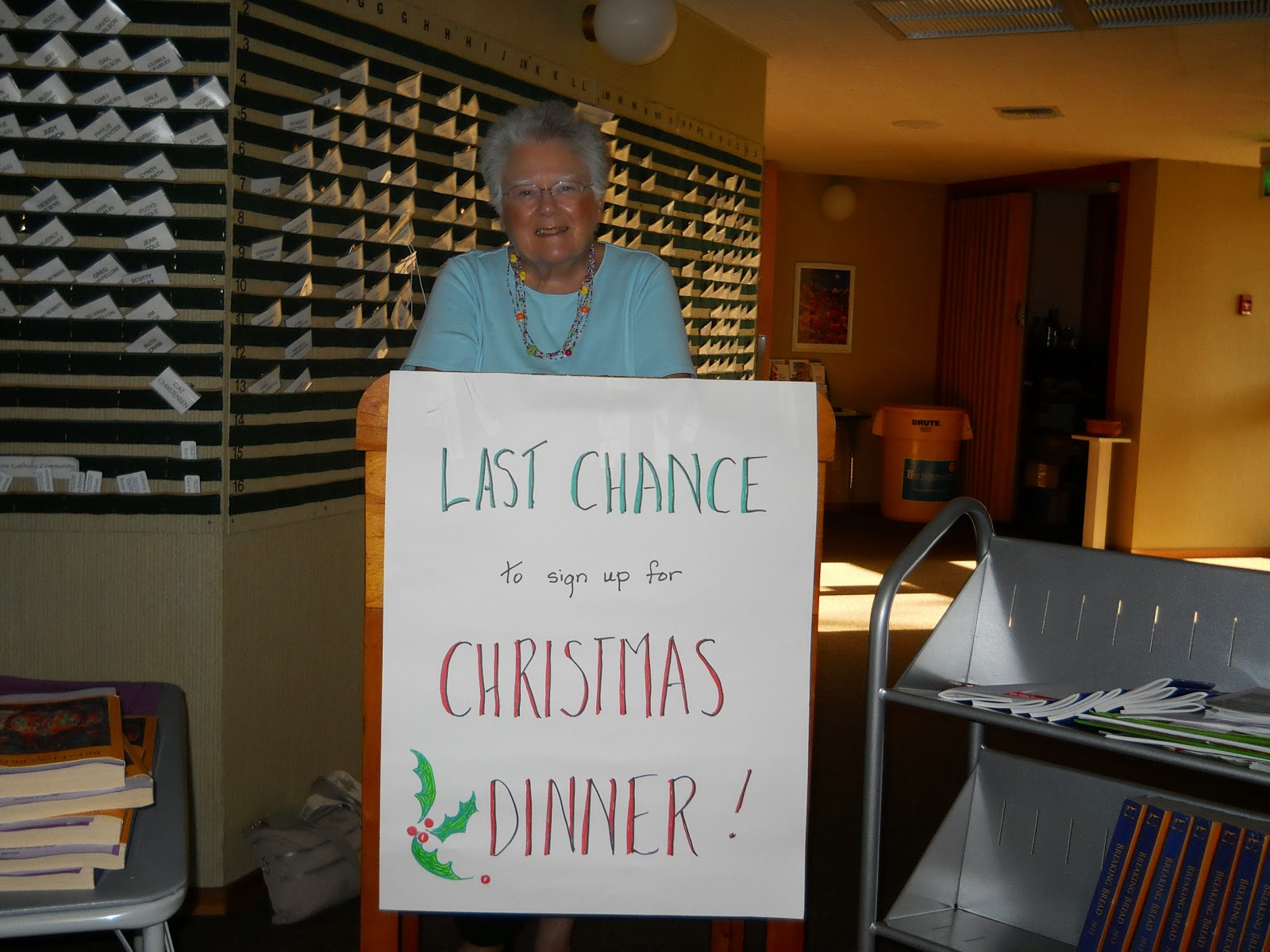
Janet Blakeley, coordinator of Christmas dinner.

In this liturgy the community celebrated the O antiphons, an ancient rite that expresses our living in anticipation of Christ's coming.  We prayed each O Antiphon including:
"O Wisdom, flowing from the mouth of the Most High, reach far and wide, distinguishing things sweetly and mightily. Come teach us the way of prudence."
Mary Mother of Jesus Inclusive Catholic Community is reclaiming the ancient tradition of married priests and women priests which was the church's practice for approximately 1200 years! We are blessed with co-presiders from the community in liturgical leadership, which was an early church tradition. See Romans 16
 For many Catholics, it is about time! Bridget Mary Meehan, arcwp, www.arcwp.org, www.marymotherofjesus.org


Saturday, December 21, 2013

Association of Roman Catholic Women Priests Will Ordain 4 Women on Jan. 18th at 2 PM in Sarasota, Florida


THE ASSOCIATION OF
ROMAN CATHOLIC WOMEN PRIESTS
JOYFULLY INVITES YOU TO
THE LITURGY OF ORDINATION

TO THE PRIESTHOOD
Maureen McGill
Marina Teresa Sanchez Mejia
TO THE DIACONATE
Mary Bergan Blanchard
Rita Lucey

ORDAINING  BISHOP
Bridget Mary Meehan

Saturday
January 18, 2014
2:00 PM
St. Andrew United Church of Christ
6908 Beneva Road
Sarasota, Florida 34238


Dinner to follow at Oriental Buffet

Feliz Navidad from Olga Lucia Alvarez, ARCWP, in Colombia, South America

http://evangelizadorasdelosapostoles.wordpress.com/2013/12/21/adviento-sigue-manifestandose-cada-eucaristia-permiso-gracias-perdon-olga-lucia-alvarez-benjumea-arcwp/
__._,_.___

Friday, December 20, 2013

"God is with us" by Rev. Beverly Bingle, Pastor of Holy Spirit Catholic Community


Today’s readings tell us that Advent is about “God-with-us”—about
recognizing God in human history, about acknowledging the fact that
God is present in us today.

To King Ahaz, “God-with-us” is bad news. He’s in peril, politically
and militarily, so his advisors tell him to form an alliance with
pagan Assyria. The prophet Isaiah tries to get Ahaz to turn to God
instead. Ahaz won’t listen. He’s already made up his mind. He won’t
ask Yahweh for a sign because he knows he has already cast his lot
with Assyria, not with Yahweh. Ahaz has turned his back on God, so he
understands that Emmanuel—God with us—the active presence of God here
and now, is very bad news for him. So Isaiah gives Ahaz a sign: one
of his wives will bear a child who will lead the people in the ways of
Yahweh, who will shepherd the people wisely.

We know that, when Matthew crafted his infancy narrative, he cited
this piece of the Hebrew scriptures as a foreshadowing of Jesus’
birth. Matthew shows Joseph behaving like his ancestor Ahaz, with a
decision to make; but unlike Ahaz, Joseph listens to God’s messenger.

From time to time we reach a point where we must make decisions that
are life-defining. How do we make those decisions?

Paul tells us that he has decided to follow Jesus, and he describes
himself as the servant of Jesus Christ. He devotes all of his energy
to that servanthood. He gives his life away. It’s life-defining.
We define ourselves by how we spend our lives. We can live as
prisoners of our habits and desires and addictions—entertainment,
houses, clothes, stuff. We can live as lovers of self, as lovers of
power. Or we can live as followers of the Way. The choices we make
define us.

It’s easy for me to see the results of life-defining choices that
other people have made. Over at Claver House Tuesday Yo-Yo—that’s her
street name—came in ranting and raving. Monday she had been pleasant
and smiling, but she was off her meds. I’m told she was a very bright
in high school, an A student. Then she made some bad choices, and her
life fell apart. Those choices define her life now, and it will be
very hard for her to change.

And then there’s Matt—he spent four years in prison, an angry young
man who also made bad choices. For him the story changed—he decided
to change. He got out of prison and worked his way to the point that
he’ll graduate from UT next spring. He decided to do without the
immediate gratification from his life of crime. He decided to be
responsible and worked to get his children together and raise them.
He breakfasts at Claver House, then heads off to class.

It’s not just one choice. We’re works in progress. We’re faced with
many choices along the way, and each of them forms us in a good or bad
way.

The coming of Emmanuel shines a light on us, on who we are, on who we
are becoming. It shows us what we put our faith in, which signs we
choose to believe in. It is up to us whether or not Emmanuel’s coming
is good news for us.

Now, three days before Christmas, we are invited to take stock, to
look once more at the choices we’ve made and the choices that are
ahead of us. Are we open to the signs of God’s presence among us? Are
we living as servants of God? If we can say “Yes,” Emmanuel is indeed
good news for us.

--
Holy Spirit Catholic Community
Mass at 2086 Brookdale (Interfaith Chapel):
Saturdays at 4:30 p.m.
Sundays at 9 a.m.
Mass at 3535 Executive Parkway (Unity of Toledo)
Sundays at 5:30 p.m.
www.holyspirittoledo.org

Rev. Bev Bingle, Pastor
419-727-1774

Thursday, December 19, 2013

Cardinal Burke dropped from key Vatican agency


 UNITED STATES
John Thavis
"Pope Francis’ plan to reform the Roman Curia is primarily a two-pronged approach: changing the bureaucratic structures and changing the members of Vatican agencies.
Today we saw yet another sign that the new pope wants people in synch with his more pastoral vision of the church, and in particular with his views on what makes a good bishop.
U.S. Cardinal Raymond Burke has been dropped from the Congregation for Bishops, an office that wields tremendous influence in shaping the world’s hierarchy. Burke has been a kind of folk hero to conservative Catholics, in particular for his statements criticizing Catholic politicians who support legal abortion. Moreover, he has said that bishops who refuse to withhold Communion from such politicians are weakening the faith.
It was significant that the new American named today to the Congregation for Bishops, Cardinal Donald Wuerl of Washington, has publicly defended his decision not to deny Communion in such situations."

Tuesday, December 17, 2013

"Our God Is With You Sister Megan Rice Facing a Possible Thirty-Year Sentence for Anti-Nuclear Activism at 83"

http://judyabl.wordpress.com/2013/12/18/our-god-is-with-you-sister-megan-rice-facing-a-possible-thirty-year-sentence-for-anti-nuclear-activism-at-83/


Here is the prelude to the Article on Sister Megan Rice in Al Jazeera America, 12/16/13-An Open Letter to Sister Megan Rice
Dear Sister Megan, 
Your life of courage and conviction moves us and convicts us. Thank you for your Plowshares Now action with your friends.  You took “extreme” and courageous action and face living out your days in jail where you bear the light in the darkness of our penal system. Your caring for your fellow inmates is life-giving to them. Your anti nuclear actions are life-giving to all of us. You are right that most our young people do not understand the cause of justice and peace interconnected and the meaning of what you did. All we can do is promise you, and God, that we will work to remedy this. We will teach them about you and others who have risked their lives for peace and justice.  We instruct our youth to “study war no more”. You are the light on our path. The least we can do is walk in it toward peace and bring our young people along with us.
Image
It is for them and for their future that we will “study war no more”
Image
Image
In our church the story is a little different,our young people do know about you and your activism and about earlier Plowshares actions as well. Our co-Pastor, Judy Beaumont also a Plowshares activist, She was imprisoned for several months for her part in Plowshares Nein. How blessed they are to have a living example of peace activism in their Roman Catholic Woman priest. She too worked on prison reform from within the walls of prisons in Rhode Island and Connecticut. When you attended our priest sister, Diane Dougherty’s, priestly ordination in Georgia you were brave to do so. But that is who you are a woman of courage who is not afraid of speaking the truth to power no matter where that power lies. It is beautiful that you mention her ordination and the existence of Roman Catholic Women Priests in the interview we are sharing below.
Dearest sister Sister Megan, thank you for your peace and anti-nuclear activism and for your public stance recognizing women priests as in the present as well as the future of the church. Thank you for your witness, thank you for your love. We love you and want you to know that we appreciate what you are doing. We still pray for a merciful sentence and we know that your witness will remain strong whether or not you are in prison. If they keep you in, they’d better watch out for reform will be on the way!
Much love and peace,
Rev. Dr. Judy Lee, ARCWP
Rev. Judy Beaumont, ARCWP
Co-Pastors of The Good Shepherd Inclusive Catholic Community
Fort Myers, Florida,
Here now is the beautifully written  article in Al Jazeera America by Lisa DeBode

Sending a Nun to Prison to Die

By Lisa De Bode, Al Jazeera America
16 December 13
83-year-old Sister Megan Rice continues her anti-nuclear activism in jail, pleads for a Catholic Church ‘of the streets’
ister Megan Rice presses the palm of her hand against the glass in greeting, her blue eyes welcoming her visitor in a cell opposite hers. Lamps illuminate her oval face framed by cropped hair like a white halo. Her uniform – a green-striped jumpsuit, sneakers and a gray blanket that covers her slender shoulders – is not the norm for a Roman Catholic nun, but she sees her presence in Georgia’s Irwin County Detention Center as answering her Christian calling.
The 83-year-old Rice has chosen to spend the final chapter of her life behind bars.
She faces a possible 30-year prison sentence on charges of interfering with national security and damaging federal property, resulting from an act of civil disobedience she committed in July last year.
Exhausted after hiking through the woods adjacent to the Y-12 National Security Complex in Oak Ridge, Tenn., that once provided the enriched uranium for the Hiroshima bomb, Rice, along with Michael Walli and Gregory Boertje-Obed splashed blood against the walls, put up banners and beat hammers “into plowshares” – a biblical reference to Isaiah 2:4, “They shall beat swords into plowshares and their spears into pruning hooks.”
Breaking into a sensitive nuclear facility to stage a protest, the three activists were prepared for the worst. “We were very aware that we could have died,” Rice said.
They were not killed but found themselves incarcerated. Now she spends her days answering letters from supporters and educating other detainees about the dangers of nuclear weapons – and the connections she draws between militarism and the poverty she believes has landed so many young women behind bars. Rice accuses the U.S. government of denying citizens such basic rights such as medical care and access to education because it invests so many billions of dollars in military equipment.
“Every day is a day to talk about it,” she told Al Jazeera, raising her voice a bit to be heard through the glass wall that separates her from the outside world. “It’s not time lost by any means.”
Citing backgrounds of poverty from towns “where there are hardly any other options,” she blames a capitalist economy for not investing more in social services available to the underclass and effortlessly connects nuclear weapons to the “prison-industrial complex.” They’re not bad people, she says of her fellow inmates, but were unfortunate enough to be born into a society that gave them few choices.
“They know that they are the human fallout and the victims of the profiteering by the elite and top leaders of the corporations that are contracted to make the nuclear weapons. It’s (the money) denied to human services that should be the priority of any government,” she said.
She coughs slightly, her nose running from the cold inside the jail. Every morning, she stands in line to receive her daily dose of antihistamines, but others receive pills for conditions far worse than what she has to endure, she said. “So many should not be here,” she sighed, edging closer to the glass wall in which a talking hole was partly blocked.
“I don’t see them as perpetrators but as the victims. People are being warehoused in detention centers all over the country.”
Walli, a 64-year-old Vietnam veteran, also spends long hours talking to inmates, veterans from Iraq with post-traumatic stress disorder, whom he said should be getting proper treatment. “We try to do missionary work here,” he said. “We’re trying to instill the idea that human life is sacred.”
Mushrooms clouds in Nevada
Unlike most of her fellow inmates, Rice was born to an affluent family, on Manhattan’s Upper West Side, whose next-door neighbor was a physicist secretly involved in the Manhattan Project, which created the world’s first nuclear weapons. Her passion for social justice came early. She followed her parents to meetings of the Catholic Workers Movement with Dorothy Day, the social-justice activist currently on course for beatification. Her mother wrote her doctoral thesis at Columbia University on the Catholic view of slavery, and her father helped serve the city’s poor as an obstetrician. “I just happened to have very conscientious parents,” she said.
At 18, she joined the Society of the Holy Child Jesus and started teaching science to girls in rural Nigeria in 1962. During summer holidays, she visited her sister’s home in upstate New York, where she would ride a horse in her habit, looking “different, not a typical nun,” said her niece, who was named after her and is now 52. Wherever Rice went, she inspired people to follow her example, such that six to eight letters reach her cell every day. “I just get this feeling that the action she did with Michael and Greg is a culmination of her life,” her niece said.
As malaria and typhoid began to take their toll, Rice permanently returned to the U.S. in 2003 and took up a position with the Nevada Desert Experience, a nonprofit organization advocating against nuclear warfare at a former test site. Ghastly visions of giant mushroom-shaped clouds became tourist attractions from hotel rooftops in Las Vegas, near which about 1,000 nuclear weapons were detonated since the 1950s.
Rice’s uncle, a former Marine who watched Nagasaki being leveled, befriended a Jesuit bishop whose mother and sister were incinerated in Japan during a Mass. They were among the estimated 60,000 people immediately killed by the blast. He devoted the rest of his life to nuclear disarmament.
“That’s how close I’ve been in touch with the reality,” Rice said.
She was pleased to report that, nearly 70 years later, Japanese media reported on her arrest and lauded her action.
Hypocrisy in disarmament?
Rice and her friends were arrested for acts of civil disobedience they devoted to global nuclear disarmament at various stages of their lives. She feels a special responsibility to draw attention to the U.S nuclear arsenal, she said.
The logic of the Nuclear Non-Proliferation Treaty under which Iran is currently being held accountable, for example, requires that the existing nuclear-armed states take steps toward disarmament. Yet in 2008, for example, almost two decades after the end of the Cold War, the U.S. was spending at least $52 billion a year on nuclear weapons, according to the Carnegie Endowment for International Peace. And only 10 percent of that spending is devoted to disarmament.
“It’s extremely hypocritical to demand disarmament (from Iran),” Rice said, recalling an anecdote involving former Iranian President Mahmoud Ahmadinejad, who reportedly honored the activist trio during a dinner in New York City last year, where he held a photo of them close to his heart. “It showed that he honored the effort to call the U.S. to its legal obligations.”
The activists decided to stage a protest to draw attention to the U.S. nuclear arsenal. Defunct cameras and fences couldn’t prevent the three elderly people from damaging what some call the country’s Fort Knox of uranium, raising questions about how they might restrain professional thieves with less idealistic intentions. Some members of Congress even thanked Rice and her accomplices for bringing the Y-12 facility’s security problems to the nation’s attention – the latest in a series of nuclear security breaches in recent years.
The U.S. nuclear weapons program has become the backwater of military services. In 2010 the Pentagon concluded that“the massive nuclear arsenal we inherited from the Cold War era of bipolar military confrontation is poorly suited to address the challenges posed by suicidal terrorists and unfriendly regimes seeking nuclear weapons.”
Paul Carroll, program director at the Ploughshares Fund, a foundation that supports the elimination of nuclear weapons, said, “Sitting in a missile silo in the middle of the country, waiting for the day when the Soviets (attack) is a throwback. So they have moral problems. They’re rusty.”
Paul Magno, a fellow plowshares activist and loyal friend of Rice’s, said a generational disconnect pushed the nuclear issue into relative obscurity in recent years. A guest lecturer at a University of Tennessee sociology class, he said it’s become increasingly hard to impress his student audience with the gravity of nuclear warfare.
“For decades there was duck and cover and you would climb under your desk at school,” he said. “Kids today never had that moment. They don’t have any idea about nuclear winter.”
Occupy Church
Rice may see her actions as inspired by her faith, but she has had little support from within the Church establishment. Retired Bishop Thomas Gumbleton, a renowned peace activist, laments the Church’s tepid stance on Rice’s detention and nuclear weapons. Citing official doctrine that explicitly condemns the use of weapons of mass destruction as “a crime against God and man himself,” he calls on colleagues to take up her cause as an exemplar of someone who stood up for what is right.
“They’re supposed to be leaders on something like this. There hasn’t been any kind of statement from Catholic bishops on what Megan has done,” he said. To be frank, Gumbleton added, “in the official church, I have to say most people don’t even know about her. And that’s really sad.”
Rice doesn’t expect much from the establishment – not even from the new pope, whose recent pronouncements have raised many eyebrows. She isn’t interested in institutions but swears instead by a grass-roots church. “The church is where the people are,” she said. The church matters only “on a local level.” She is skeptical of Pope Francis but feels encouraged by his choice of a less extravagant lifestyle than those of his predecessors, who she said had been living like “princes in their palaces.”
Her order, the Society of the Holy Child Jesus, offered the lone voice of support from within the Catholic establishment.
“While we do not condone criminal activity, we would like to point out that Sister Megan has dedicated her life to ending nuclear proliferation. With the Catholic Church, she believes nuclear weapons are incompatible with the peace so desperately needed throughout the world and therefore cannot be justified,” Mary Ann Buckley wrote in a statement emailed to Al Jazeera.
Pope Francis certainly seems inclined to rebrand the Church as an institution that fights for social justice and is not afraid of protesting. “I prefer a church which is bruised, hurting and dirty because it has been out on the streets rather than a church which is unhealthy from being confined,” Francis wrote in the mission statement for his papacy issued last month. That’s a message that has resonated with many young people in different parts of the world who have taken to the streets to protest austerity and vast economic inequalities.
“American Christians have been far too polite, too quiet and too accommodating of both the injustice and the blasphemous use of Jesus’ name in committing atrocities in our nation and our world,” wrote a group styling itself Protest Chaplains in a manifesto that coincided with the Occupy movement of which they formed a part. “That’s why we want to protest with all those who, like us, know in the deepest places of our souls that another world is indeed possible.”
Rice met with Occupy activists discussing nuclear issues in New York City, “when it began in September.” She described their work as “religion doing what it’s meant to be doing.”
“The church is where the people are,” she said. “It is the people.”
A similar message has been echoed in Barcelona, where street activists known as Indignados took their cues from Sister Theresa Forcades, a Roman Catholic nun and activist who believes the current economic policy consensus among governments of industrialized nations perpetuates inequality. And like Rice, Forcades has been skeptical of Francis’ pronouncements, arguing that the new pope should be judged by his attention to women’s rights, which so far has been lacking.
Still, Rice is confidence that “it will come,” referring to the ordination of women. Last year she attended the unofficial ordination – not recognized by the Vatican – of Diane Dougherty in Atlanta. “They are preparing the way and are receiving great acceptance from lay Catholics.”
Lessons from prison
Her supporters say Rice’s life exemplifies the social activism needed to revive the church’s appeal among young people. Still, she’s reluctant to be cast as a hero. Her heroes, she said, are ordinary people who act “according to our conscience.”
As she awaits sentencing on Jan. 28 - facing a possible maximum term of 30 years – she borrowed phrases from Dr. Martin Luther King in a letter she sent to Al Jazeera. In it she reflected on her life, which may very well end in prison.
“On some positions, cowardice asks the question, ‘Is it safe?’ Expediency asks the question, ‘Is it politic?’ And vanity comes along and asks, ‘Is it popular?’ But conscience asks the question, ‘Is it right?’” she wrote.
“And there comes a time when one must take a position that is neither safe nor politic nor popular, but one must do it because conscience tells one it is right.”
At a court hearing in May, she told the public prosecutor her only guilt is that she waited 70 years to break into the facility “to be able to speak what I knew in my conscience.” Seven months later she said, “This is a very positive experience. It’s getting better and better.”
She remains uncomfortable being in the spotlight, looking to deflect attention to others. She settles on her fellow inmates in this prison, the ones she is helping prepare for a life outside prison bars – a life to which she herself might not return.
With them in mind, she smiled, noting simply, “I’m not alone in being misjudged.”
We thank God for you, Sister Megan!!