Translate

Thursday, May 7, 2015

"Is Pope Really Serious About Fair Pay?"/Huffington Post /Catholic Women Priests in Inclusive, Empowered, Communities-living Gospel equality now

http://www.huffingtonpost.com/soraya-chemaly/if-the-pope-is-really-serious-about-fair-pay_b_7225128.html=
The shining lights in this situation are American activist nuns and Catholic women priests, who run their own churches. There are now more than 100 ordained women priests in the United States. That and the fact that the Church hierarchy really doesn't represent most Catholics in terms of practical day to day life. Barring altar girls, however, is more than just vestigial sexism, it's obstructionist and grounded in misogynistic ideas.

A Church genuinely committed to addressing the needs of the marginalized wouldstartwith the ordination of women, not end here, centuries from now. The problem for the Church isn't girls who stay, it's the girls they turn away, each of whom realizes she is, for no legitimate moral or ethical reason, not respected as an equal, regardless of what the Pope says. As long as girls have to fight to be recognized in their own churches the Pope's protestations ring hollow. In the meantime, every altar girl this Church turns away is a gift to the rest of the world. Those girls, and the people who support them, are the ones who will eventually close the pay gap.
Portions of this essay have been published in Whatever Works: Feminists of Faith Speak
Trista Hendren
 (Editor), Pat Daly (Editor), Amina Wadud (Foreword)

Wednesday, May 6, 2015

German Catholic Church Won't Fire Gays or Divorced and Remarried Who Work for Church

By Reuters    

  • By Tom Heneghan, Religion Editor
    PARIS, May 6 (Reuters) - Germany's Roman Catholic Church, an influential voice for reforms prompted by Pope Francis, has decided lay Catholic employees who divorce and remarry or form gay civil unions should no longer automatically lose their jobs.
    Catholic bishops have voted to adjust Church labour law "to the multiple changes in legal practice, legislation and society" so employee lifestyles should not affect their status in the country's many Catholic schools, hospitals and social services.
    The change came as the worldwide Catholic Church de bates loosening its traditional rejection of remarriage after a divorce and of gay sex, reforms for which German bishops and theologians have become prominent spokesmen.
    "The new rule opens the way for decisions that do justice to the situations people live in," Alois Glueck, head of the lay Central Committee of German Catholics, said after the decision on new labour guidelines was announced on Tuesday.
    Over two-thirds of Germany's 27 dioceses voted for the change, a Church spokesman said, indicating some opposition.
    There is no worldwide Catholic policy on lay employees. German law allows churches to have their own labour rules that can override national guidelines.
    But German courts have begun limiting the scope of Church labour laws and public opinion reacts badly when a Catholic hospital's head doctor is fired for remarrying or a teacher is sacked after her lesbian union is discovered.
    Munich Cardinal Reinhard Marx, head of the bishops conference and a senior adviser to Pope Francis, has been a leading proponent of making the two-millennia-old Church more open to modern lifestyles that its doctrine officially rejects.
    A worldwide synod of bishops at the Vatican last October was split on how flexible the Church should be in welcoming openly gay or divorced and remarried Catholics. A follow-up synod is due this October, with its result in doubt as debate continues.
    Cologne Cardinal Rainer Woelki, the Francis-style pastor the pope appointed to Germany's richest diocese, said the labour law did not negate official Church teaching that marriage is indissoluble, but brought it into line with actual practice.
    "People who divorce and remarry are rarely fired," he told the KNA news agency. "The point is to limit the consequences of remarriage or a same-sex union to the most serious cases (that would) compromise the Church's integrity and credibility."
    Passages in the new version of Church labour law say that publicly advocating abortion or race hate, or officially quitting the Church, would be a "grave breach of loyalty" that could lead to an employee being fired. (Reporting by Tom Heneghan; Editing by Mark Heinrich)


    Read more: http://www.dailymail.co.uk/wires/reuters/article-3070147/German-Catholic-Church-opens-labour-law-divorced-gays.html#ixzz3ZMn4JIOG 
    Follow us: @MailOnline on Twitter | DailyMail on Facebook
  • Bridget Mary's Response
    The German bishops are leading the way toward a more just church! Hope other bishops follow their example! Bridget Mary Meehan, ARCWP, www.arcwp.org
     arcwp.org

    "Olga Lucia, the priestess", Article by Javier DarĂ­o Restrepo, Director of Vida Nueva Colombia


    "Facing this woman, so vital and enthusiastic than no one would say she has been alive 70 years, and nowadays surrounded by scandal for being a priestess, Bishop Gerardo Valencia would not be outraged.
    Olga Lucia has evoked the memory of her teacher in answering my first question, the type of question you ask just to break the ice:
    - What do I call you, Olga Lucia, Reverend Mother, Priestess? What do I call you?
    - The people in the community call me by my name, including the children. Those who do not know me say Reverend, or Mother. This I learned from a friend who cared for you very much: Gerardo Valencia Cano.
    Olga Lucia Alvarez, first woman priest in Colombia, South America

    Indeed, the Bishop of Buenaventura, who died in a plane crash, would assume the fact of Olga Lucia’s ordination by Bishop Bridget Mary in early 2010 with the same bold spirit with which he agreed to serve as support for the priests in Golconda, a group which surprised and exasperated the hierarchy with their groundbreaking political and social proposals in the early 70s. Olga Lucia was his pupil in the Union of Secular Missions that he founded. It was the spiritual home of the young saleswoman from Tejicondor when she decided to take her life in a radically different direction. Later she became the secretary in an office she remembers as liberation theology, a place that saw the first flow of the early concerns about this form of thought within the Church. This is why, after an intense apostolic activity, when she first heard of the existence of the global network of Catholic priestesses, who already had ordained 230 women, she felt she had found what she had always sought.
    "Was it necessary to institute female priesthood in the Catholic Church?" I ask, echoing the views of those sectors who reject priestesses as unnecessary and contrary to ecclesiastical discipline and tradition:
    -the Institution of female priesthood has always been in the Catholic Church. The fact that the Church does not want to recognize it institutionally is something else. In Jesus' ministry there was no lack of women, they helped him with their own financial resources (Luke 8: 1-3). They tried to have Paul appear as a misogynist, but this is not true, as he is the one who mentions women most and he recognizes the ministerial work they did in the service, growth and strengthening of the Kingdom of God.
    During the Vatican II years a doctor in theology, Miss Munch, submitted a formal request to be ordained a priest before the ecclesiastical authorities in Rome. While no answer was ever provided, she put the issue on the agenda of what could be discussed. Maybe that is one of the facts in the history of the global network of priestesses with which Olga Lucia made contact in 2008 through the internet.
    But her access to the priesthood through the Global Network of priestesses had its own process.
    As she recalls, she had to prove her apostolic experience and her religious and theological training, the consent of her family, references from people who knew her, her criminal record and medical certificates concerning her physical and mental health. Among all these certifications she had to include the history of her passage through the Anglican Church and her adventures with the missionaries of Monsignor Valencia Cano.
    Now she celebrates the Eucharist in the many places that invite her, surrounded by people who know her and who believe in her pastoral practice, but she cannot avoid being followed by some who exhibit curiosity, amazement and, in some cases, hostility. She is living the loneliness and the resistance of all pioneers.
    Those who comment on Olga Lucia tend to think that it is not yet time for priestesses and that their presence on an altar is traumatic, breaks the mold and seems to violate a long tradition, is that true?
    - It is not people who do not accept the figure of female priesthood. It is the institutional church.
    - One hears it said through the grapevine that "female priesthood has been a failure, and that the churches have not grown," commenting on the experience in other churches. The priesthood is about service, in and for the Kingdom of God, in the proclamation of the Good News, and not to grow churches. "
    - My experience in the ministry is and has been totally different and very enriching. It is the community that asks for my services and my accompaniment, both spiritual and pastoral.
    I see her as someone who inaugurates the future and who pays the price for doing it too early."
    Translated from Spanish by Silvia Brandon-Perez

    Homily: This I Command You, Love One Another, Sixth Sunday of Easter, by Judy Lee, RCWP

    https://judyabl.wordpress.com/2015/05/06/this-i-command-you-love-one-anothersixth-sunday-of-easter-5102015/

    The Worst: A Sermon About Baltimore, Eunuchs, Evangelical Conferences and How Irritating The Holy Spirit Can Be May 4, 2015 by Nadia Bolz Weber

    'Catholicism Undervalues Women"/New York Times/ Agree, Women Priests Are Creating Renewed Communities Now to Offer New Inclusive Model

    http://www.nytimes.com/2015/05/06/opinion/frank-bruni-catholicism-undervalues-women.html?emc=eta1&_r=0

    "But the church’s refusal to follow some other Christian denominations and ordain women undermines any progress toward equality that it trumpets or tries. Sexism is embedded in its structure, its flow chart."

    Ordination of Women Priests in Cleveland, Association of Roman Catholic Women Priests
    We are here and serving the Roman Catholic Church now.
     
    Continue reading the main story

    Bridget Mary's Response: I agree with Frank Bruni. The good news is that there are 200 women in the international Roman Catholic Women Priests Movement. 
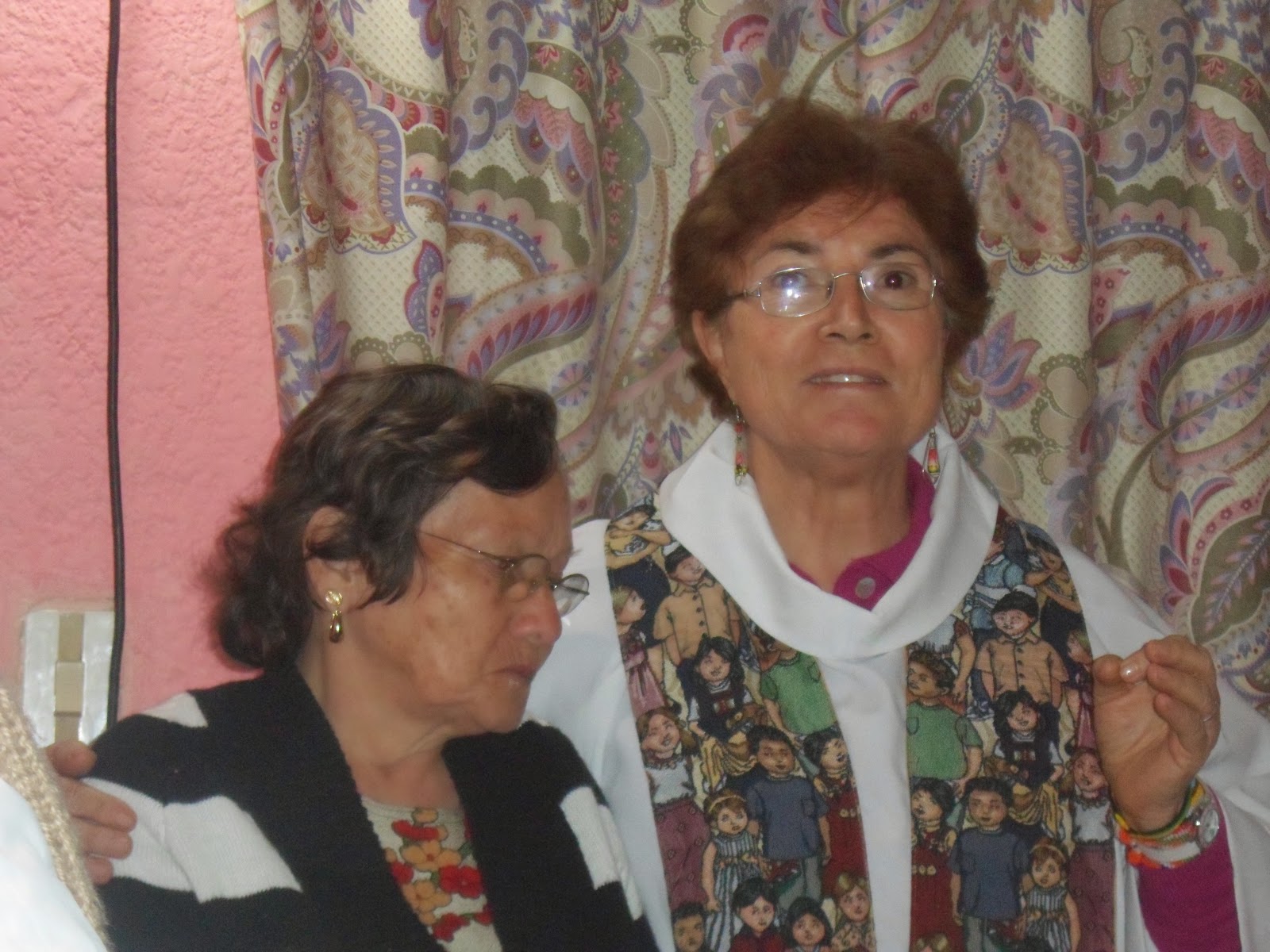
    Olga Lucia Alvarez, ARCWP, Martha Sota, ARCWP in Colombia, Latin America

    We serve inclusive Catholic communities in over 35 states in the United States, in Latin America, Europe, Canada, and Africa. Roman Catholic Women Priests believe that women and men are created equal by God and can equally represent Christ in ministry.

    Mary Mother of Jesus Inclusive Catholic Community, Sarasota, Florida
    has Roman Catholic Women Priests, deacons, and married priests

    Catholics who believe that our church is a spiritual home for everyone, not just those who keep the rules of the church worship in these communities of equals. We are living the church of our dreams now. It is my hope that Pope Francis moves the Vatican from the policy of exclusion to the affirmation of women as priests, deacons and bishops in a church for all that is a renewed model in a community of equals.! Bridget Mary Meehan, ARCWP, sofiabmm@aol.com
    www.arcwp.org, www.marymotherofjesus.org


    Tuesday, May 5, 2015

    "You Can Be Happy" by Bridget Mary Meehan, ARCWP

    There was a wonderful article in the Tuesday Health Section of the Sarasota Herald Tribune today that gave some medical research on choosing happness!
    It is not related to how much money we have or where we live. 
    Dr, Anit Sood reports in "The Mayo Clinic Handbook for Happiness" that we can cultivate practices that lead us to experience happiness. I agree. 
    Here are some of the take home lessons and some of my personal favorites!
    Back row, Zondra, Hank, Bridget Mary, Sean, Nancy, Danny and Katie
    family vacation in 2014

    Our minds are hard wired for doom and gloom. So I say, turn off the TV and electronics. Facebook will survive your absence! Don't watch cable news shows all day long
    1. Start a Gratitude Journal: Make a list of 5 things you are grateful for each day,
     five people you love, 5 activities you enjoy! Spend time with your family, friends, loved ones.
    Bridget Mary with brother Patrick

    2. Re-program your thoughts-- focus on love, joy, goodness, kindness, healing forgiveness 
    3. Practice kindness to others, do a good deed for a stranger, smile, call a friend
    4. Breathe, pray, meditate, be still, go into the depths of your soul.
    5. Lighten up - Relax, laugh, dance, sing, exercise, paint, listen to music, do something fun!
    Bridget Mary Meehan, ARCWP
    www.arcwp.org

    Monday, May 4, 2015

    Matthew Fox, in Eckhart, A Warrior Mystic for Our Times, Provides Innovative, Alternative Approach to Education

    Many educators and visionaries including Matthew Fox and the Dali Lama believe that education is in crisis worlwide. Politicans and critics have called for more courses in math, science and additional testing. In his new book on Eckhart, Dr. Fox outlines an innovative, alternative  approach that has been tried in  some public school systems in the United States and Latin America with contemporary youth.  
    Here are my notes on the values and fundamentals of his innovative approach to a more holistic approach that integrates body, mind and spirit. 
    Values in Designing an Alternative Education System
    A)     Move away from patriarchy, control and domination into creativity, joy and mutuality
    B)      Incorporate Body, and Feminist philosophy and compassion
    C)      Cosmological worldview. Our lineage is 13.8 billion years long, What does this mean for our theology, spirituality, ministry etc?
    D)     Begin with awe- What is awesome about being a teacher, doctor, priest?
    Ten Fundamentals for Educational Alternatives-Moving from Knowledge Factories to Wisdom Schools:
    1.       Cosmology/Ecology- Our universe is our home. What does it mean? How do we respond to ecological challenges?
    2.       Contemplative- Learn to BE! Get into – body and find silence.
    3.       Chaos and Darkness- There is great potential in chaos- birthing and creativity include chaos.
    4.       Creativity- Truth comes from inside us.  Dancing, painting, singing, writing poetry help us to get in touch with wisdom inside of us.
    5.       Compassion: We all possess compassion and this includes our quest for gender justice, eco justice, racial justice, political and economic justice
    6.       Community- rights of groups in balance with rights of individuals in order for communities to flourish
    7.       Critical thinking- ability to do critical thinking needs to be integrated with intuitive and mystical, right and left brain
    8.       Chakra and Character Development How we develop our imperfect selves, ethics and morality?
    9.       Courage-How do we develop courage, move beyond fear and become empowered?
    10.    Ceremony and Celebration- Ritual is essential in the life of community To re-create community we must develop rituals that appeal to body, mind and spirit.
    (Matthew Fox, Meister Eckhart, A Mystic Warrior for our Times)

    __._,_.___

    Sunday, May 3, 2015

    Liturgy in Celebration of Women Spirit Rising, Albany, New York, with Deacon Kathie Ryan and ARCWP and Priest Mary Theresa Streck, ARCWP

    Liturgy in Celebration of WomenSpirit Rising


    Receiving the stole:  A representative from the assembly prays the following prayer as the presiders are vested in stoles.
    _______ and _______, we your community call you forth and we bless you as you lead us in our liturgy today.

    Welcome and Theme


    Presider 1: Welcome to our inclusive catholic community. We celebrate with joy the indwelling of our God among us. Our liturgical style is highly inclusive and you are invited to participate in the words of consecration. We are happy you are here with us today. All are welcome to share in our simple Eucharistic meal around this friendship table. Let us begin by greeting one another with a sign of peace.

    Presider 2: Our theme today is WomenSpirit Rising and we celebrate the women prophets, mystics and rebels who understood the message of Jesus and followed faithfully in his footsteps. We stand on their shoulders as we faithfully live the Gospel.
    Presider 1:  Let us pray: O Holy One, you bi
    rthed us and continue to nurture us.  We are your children and we are united with all of your children, those with us now and those who have gone before us. We are grateful for all of the strong women who continue to encourage and inspire us to live as prophets and mystics in our time.


    Please join in singing our opening song:  # 65 I Am the One Within You
    words: Janet Carol Ryan
    Music: Karen Drucker

    I am the infinite presence
    I am the one in all
    I am the truth in beauty
    The answer to Spirits call

    I am the one within you
    (ever present, ever new)
    I am the one you seek
    (whispering softly in your ear)
    Within your heart there is a doorway
    (step through the light)
    The arms of love awaits you
    With these golden wings take flight…


    LITURGY OF THE WORD

    First Reading: More Than a Father by Mechtilde of Magdeburg

    More Than A Father
    The name of Father I have always known
    This God who creates and holds,
    This God who calls and welcomes,
    This God who rules and loves,
    This God whom I once feared and fought.

    But Father is not enough to contain the coming God of my being.
    As I grow, God grows,
    Deep in my being I know a God who is more,
    More than Father,
    I now know my God as mother.

    I have been held in her embrace
     I have played at her knee
    I have found a home in her heart
    I have laid my head on her breast

    I have touched the lines on her face
    I have looked into her eyes
    And I have known
    A God who is Mother. 

    Mother God,
    Father God,
    Keep me in your embrace.

    These are the inspired words of Mechtilde of Magdeburg

    Second Reading: A Reading from The Ways of the Mystic: Seven Paths to God
    By Joan Borysenko

    A mystic sees beyond the illusion of separateness into the intricate web of life in which all things are expressions of a single Whole. You can call this web God, the Tao, the Great Spirit, the Infinite Mystery, Mother or Father, but it can be known only as love.

    How can words convey the depth and sweetness of unconditional love, the soul’s joy in coming home to God, the stunning revelation that despite all your errors you are forgiven? How to describe the realization that your every thought and deed is known, and the bliss of being shown that your soul is pure, not because you are perfect, but because you are willing to acknowledge your imperfections? How is it possible that you can think about anything and know instantly, at an infinite number of levels, its very essence? How to convey the perception that everything is interconnected, crafted of an intelligent light that forms a seamless matrix from which all matter springs?

    These are the inspired words of Joan Borysenko, mystic and healer

    Alleluia (sung)

    Gospel: This is the Gospel of Jesus written by his disciple, John (Jn 17 !8:23

    (Jesus, looked up to heaven and said,) “ As you have sent me into the world, so I have sent them into the world; I consecrate myself now for their sakes, that they may be made holy in truth. I don't pray for them alone. I pray also for those who will believe in me through their message, that all may be one, as you, Abba, are in me and I in you; I pray that they may be one in us, so that the world may believe that you sent me. I have given them the glory you gave me that they may be one, as we are one – I in them, you and me – that they may be made perfect in unity.
    These are the inspired words of John, disciple of Jesus

    Shared Homily

    Statement of Faith

    Presider 2: Please stand and proclaim our statement of faith:

    All: We believe in one God, a divine mystery
    beyond all definition and rational understanding,
    the heart of all that has ever existed,
    that exists now, or that ever will exist.

    We believe in Jesus, messenger of God's Word,
    bringer of God's healing, heart of God's compassion,
    bright star in the firmament of God's
    prophets, mystics, and saints.

    We believe that We are called to follow Jesus
    as a vehicle of God's love,
    a source of God's wisdom and truth,
    and an instrument of God's peace in the world.

    We believe that God's kin-dom is here and now,
    stretched out all around us for those
    with eyes to see it, hearts to receive it,
    and hands to make it happen.


    LITURGY OF THE EUCHARIST


    Presider 1: As we prepare for the sacred meal, we lay our stoles upon the table as a sign that just as Jesus is anointed so is each of us.  And, we bring to this table our blessings, cares, and concerns.

    (Please feel free to voice your concerns beginning with the words, “I bring to the table…”)
    Presider 1:  We pray for these and all unspoken concerns. Amen.

    Presider 2:  O Holy One, you have been called by many names by many people in the centuries of our planet’s life. Yet, no name truly defines you or describes you.  We celebrate you as the marvelous, loving energy of life who caused us and our world to be. We celebrate you as the Source of light and life and love, and we celebrate your presence and all-ways care.

    Presider 1: Please (gather around our friendship table and) join in praying the Eucharistic prayer together: WomanSpirit Rising written by Jay Murnane.

    O Holy One, You are both Mother and Father to us human beings. You give us life, and we live and breathe with your own Spirit.

    You create us female and male; You call us good, and ask us to live as equal partners. You share the earth with us, and ask only that we compliment your ongoing activity of creation.

    Among all our blessed ancestors, we celebrate the women who gently and firmly broke through the death-structures of their times with unique vision and compassion: Sarah, Deborah, Judith, Miriam, Ruth, Esther, Anna, Miriam of Nazareth, Julian, Hildegard, and so many more.

    United with them, with WomenSpirit rising, with our vast universe, with our Mother-Planet and her people everywhere, with one another and You, Loving God, our spirits dance and sing this song of praise:

    Holy, Holy, Holy by Karen Drucker


    We are holy, holy, holy
    We are holy, holy, holy
    We are holy, holy, holy
    We are whole...


    Spirit divine,  Come to me
    Feeling love, Healing me 


    Open my heart, Allow me to see
    Beauty & love Lives in me 


    You are holy, holy, holy

    We give grateful thanks for all your faithful servants, opening for all of us a path to life. We thank you for all the women who risked everything they had so that all of us could live in a better, brighter world.

    We thank you for your child and our brother, Jesus. He showed us so simply, so tenderly, how the world is in our hands.  He knew that we would be afraid; he showed us how to be free of the blindness and paralysis of fear.

    He had nothing in this world but your love, companions on the journey, and his very self. Together, that was more than enough, and that remains our clarity in the midst of confusion: the miracle of healing, new hope, nurturance, nourishment, liberation and life.

    On the night before he faced his own death and for the sake of living fully, Jesus sat at the Seder supper with his companions and friends.  He reminded them of all that he taught them, and to fix that memory clearly within them, be bent down and washed their feet.

    When he returned to his place at the table, he lifted the Passover bread, spoke the blessing, broke the bread and offered it to them saying:

    Take and eat; this is my very self.
    (pause)

    He then raised high the cup of blessing, spoke the grace, and offered them the wine saying:

    Take and drink of the covenant made new again through my life,
    for you and for everyone,
    for liberation from every oppression.
    Whenever you do this, Re-member me!
    (pause)

    Loving God, we have felt deeply the barrenness of our lives and of our community. Yet, we have always been pregnant with your creative Word and your life-giving Spirit.

    We have looked for others to save us and to save our world. Yet, we are called, and consecrated and sent into the world to establish justice and show the blessed fulfillment that comes with simplicity and the giving of ourselves in love.  

    We will look at our world with open eyes, and make compassion our truest vision.  We will live in the belief that blindness, death and illusion have no final dominion.

    We will make new our commitment to the harmony of the original vision of creation. We have held our sisters captive in so many ways and will no longer stand in the way of the development of any living creature, be that a person, a gathering of persons, or the earth herself.

    We will live justly, love tenderly, and walk this earth with integrity.  We will bind and blind and burden no longer.  We will deliberately lay down our various weapons, and use our gifts only for life.

    We will open up wide all that has been closed about us, and our small circles. Like Jesus, in all openness, we will be filled with your own Spirit and renew the face of the earth.

    For it is through learning to live as he lived,
    And why he lived,
    And for whom he lived,
    That we awaken to your Spirit within,
    Moving us to worship you truly,
    Life-giving God,
    At this time and all time and in all ways.
    And we say yes to You!

    Presider 2: Let us sing together the prayer of Jesus:
    Words: Miriam Therese Winter, Music: Pamela Parker

    "Our Mother who is within us,
    We celebrate your many names.
    Your wisdom come; your will be done,
    unfolding from the depths within us.
    Oh, Each day you give us all that we need.
    You remind us of our limits and we let go.
    You support us in our power, and we act with courage.
    For you are the dwelling place within us,
    the empowerment around us,
    and the celebration among us,
    now and forever, now and forever, now and forever,
    now and forever. Blessed be!"

    (Presiders lift bread and wine)

    Presider 1: This is Jesus, Bread of Life.  How blessed are we who are called to the table.

    All:  What we have heard with our ears, we will live with our lives; as we share communion, we will become communion, both Love’s nourishment and Love’s challenge.

    Communion Song:  # 65 I Am the One Within You
    words: Janet Carol Ryan
    Music: Karen Drucker

    I am the infinite presence
    I am the one in all
    I am the truth in beauty
    The answer to Spirits call

    I am the one within you
    (ever present, ever new)
    I am the one you seek
    (whispering softly in your ear)
    Within your heart there is a doorway
    (step through the light)
    The arms of love awaits you
    With these golden wings take flight…


    BLESSING
    Presider 2: Let us pray:
    May we continue to be the face of God to each other and may our name be a blessing in our time!  Amen.

    Presider 1: Please join in singing our Closing Song: #63 Woman’s Spirit
    words and music: Marvella McPartland & Lynn Fugua
    sung by: Karen Drucker

    Woman’s Spirit is beauty
    Woman’s Spirit runs deep
    Woman loves with compassion
    Our perfection is complete…

    Woman’s Spirit is graceful
    Woman’s Spirit is wise
    Woman’s Spirit is moving
    Bringing love into our lives...

    Woman’s Spirit is passion
    Woman’s Spirit is birth
    Woman’s power unfolding
    To honor life on earth.



    "Catholic Women Priests Fight for Inclusion-For All" by Mark Di Ionna/Star Ledger

    http://www.nj.com/news/index.ssf/2015/05/catholic_women_priests_fight_for_inclusion_--_for.html

    ..."Schessler's communion was 68 year ago at Our Lady of the Valley Church in Orange. What followed was a life of religious service with the Dominican Sisters of Caldwell. She taught school, directed religious education and then immersed herself in helping children in the inner cities.
    But she -- like the other women ordained last weekend and their sister priests around the world -- had a growing dissatisfaction with the "lack of inclusivity" and "ego domination" of the male hierarchy.
    "I was tired of people telling God how to be God," she said.
    Two years ago, at age 73, she made the decision to seek priesthood and said "the freedom that came with that decision is the freest I've ever felt in my life."
    Inclusivity is a word the Roman Catholic Women Priests (RCWP) organization is built upon. The movement began in Germany in 2002 with seven women who were ordained on the Danube River by an Argentine Catholic bishop who cut his ties to Rome and began a church he believed would be more progressive.
    Those women chose ex-communication by Rome, which, simply put, is like leaving a club you were never allowed to join...."

    St. Gobnait of Ballyvourney: Lessons in Power from a Powerful Woman, by Jeannette Mulherin, " Holy Women in the Early Celtic Tradition"


    Artist, Patricia Banker
    Purpose
    This paper explores the ways in which 21st-century women could benefit from the example of St. Gobnait, a powerful woman whose use of power was beneficial to the religious community she founded, the wider community she served, and to St. Gobnait herself.    
      Introduction
    In an article titled, Eight Ways of Looking at Power, author Stacy Schiff asks the question, “Women and power: Is there a more incendiary combination of words in the English language? Drinking and driving? Teenagers and sex?”  To which she provides the following response, “A woman can never be too rich or too thin, but until very, very recently, she could be too powerful, for which–if she wasn’t smart enough to camouflage herself–she paid the price.”[1]
    As history attests, powerful women were rarely tolerated for long. The Apostle to the apostles, Mary Magdalen was labeled a prostitute, Joan of Arc was burned at the stake, countless women of the Victorian era were deemed “hysterical” in societal efforts to diminish and silence them.     
    In the long history of female powerlessness, St. Gobnait of Ballyvourney is a notable exception. What little is known of St. Gobnait’s life indicates she was a powerful woman who wielded power in multiple forms.  She demonstrated personal power when as a young woman she set out to forge her own destiny in a strange land. As a leader she exercised the power to organize, unify, and guide her community. In her role as protector, she asserted her power in self-defense, providing a vulnerable village with a 7th-century version of homeland security.[2]    
    In the following pages, I will examine St. Gobnait’s use of power, attempting to extract lessons about power for today’s women, lessons hidden in the story of a powerful woman.    
    St. Gobnait’s Power
    It requires intelligence, maturity, and wisdom to identify and apply the form of power most likely to produce a favorable outcome. Evidence suggests that St. Gobnait was aware of the varied forms of power available to her, and chose among them with a keen eye toward attaining specific objectives.
    An analysis of her life’s story indicates that St. Gobnait relied primarily on three categories of power: personal power, an individual’s inner strength or power to persist toward a goal; the power of leadership, that of a leader capable of organizing and inspiring those around her; and the power of force, the threat or use of violent force, in defense against certain destruction.                                        


    Women have been taught that, for us, 
    the earth is flat, 
    and that if we venture out, 
    we will fall off the edge.-
    Andrea Dworkin, writer, and feminist

    Personal Power

    In the beginning of St. Gobnait’s story, we see a young woman who possesses an immense amount of personal power. In one version of Gobnait’s early history, she leaves the pirate ship she’d been traveling on with her father at the urging of an angel and journeys alone in a strange land. In an alternate version, she is said to have crossed the sea to escape a danger to her welfare.[3]  Could St. Gobnait’s demonstration of personal power inspire today’s woman to travel alone, move to a new city, or even discover an unexplored part her hometown? How many opportunities for growth do women miss because they chose not to access the personal power that saw St. Gobnait through the difficulties, anxiety, and fear inherent in striking out alone into the unknown?
                St. Gobnait’s journey began with a vision. She was to find the spot where nine white deer were grazing, and there found a monastery. Initially, she came upon three white deer, and further along, she spotted six white deer. She did not stop at these places. Almost good enough wasn’t good enough for St. Gobnait. She continued in her quest until the nine white deer finally appeared.[4]
    In contrast, how many women of today give up or give in before their visions become reality? The justifications are many, and include the religiously inspired idea that women are selfish if they pursue their goals, and should be satisfied merely to support the goals of others, largely the goals of men.  St. Gobnait models a different set of values. She brooks no distractions, and tenaciously seeks that place in the world that is rightfully hers.
                                        The Power of Leadership
    Some leaders are born women. –Geraldine Ferraro, attorney, politician, and vice presidential candidate
      St. Gobnait set to work establishing a self-sufficient community, one that required physical labor, a base of knowledge and technical skill that allowed the women to maintain livestock, produce food and crafts, and practice beekeeping.  The community of women did not seek male know-how or labor to provide for them, and yet, they produced such abundance they were able to share the fruits of their labor with the larger community.[5]   
    Traditional religious teaching would have women believe that self-sufficiency is unfeminine and unimportant, as if a truly Christian woman wouldn’t bother with the man’s world of work, particularly work with a monetary compensation attached to it. And yet, St. Gobnait demonstrated otherwise. Could the women have prospered under male leadership? Likely, they would have been relegated to more ‘feminine” work, excluded from opportunities to perform the “masculine” work of community organizing and decision-making.  
    The Power of Force
    Above all, be the heroine of your life, not the victim." Nora Ephron,
    writer, director, and journalist
    St. Gobnait is easily her era’s version of Wonder Woman.  When the community was threatened with armed assault, she repeatedly trained her weapons (swarming bees and an agate bowl) on the enemy until they were defeated, ensuring the continued peace and prosperity of the monastery and surrounding village.  Surely, there were men living in the area and yet, it was the superior power and strength of a woman, St. Gobnait who was relied upon to ensure the security of the land.[6]  
                An essential aspect of St. Gobnait’s choice to use force is that she used it only in self-defense, but use it, she did.  When a woman is imprisoned for using deadly force against an attacker, jailed for defending herself against a violent spouse, or convicted of adultery when raped, society’s message to women is that they must submit to men, whatever the consequences. It is St. Gobnait who says otherwise,  demonstrating a woman’s right to defend herself.


    Power used in the service of self-defense takes many forms. Would a woman like St. Gobnait tolerate those experiences so common in the lives of today’s women? How would she handle being interrupted when speaking? Belittling comments passed off as humor? Receiving a lower salary than her male counterparts? We do not have such details of her life. However, we can safely assume that a woman, who single-handedly defeats an armed enemy force, would likely protect herself and the women around her with equal fierceness, whatever the source or substance of the threat.

    Conclusion

    It is not often that a story from a distant era with so little detail could yield enlightened and practical guidance for the current age. St. Gobnait provides a model for women and men of the responsible and beneficial use of power in the service of humankind.

    The society founded, nurtured, and protected by St. Gobnait was one in which the gifts of women were leveraged, ensuring each woman the opportunity for productive work, membership in a self-sufficient and peaceful community, and the opportunity to contribute to the larger world. St. Gobnait’s wise and judicious use of power made this possible.

    What can today’s women learn from St. Gobnait about power? Perhaps her most important lesson is that power matters. Power should not be denied women, nor should women avoid the opportunity to wield power for their personal benefit or the benefit of society as a whole.

    Power used to persevere toward a goal (personal power), to organize and inspire others toward a goal (leadership) and to defend those targeted by violence and injustice (the power of force), belong in the hands of those who would use such power wisely. St. Gobnait tells us that some of those people are women.


    [1] Stacy Schiff Eight Ways of Looking at Power http://www.oprah.com/money/8-Ways-of-Looking-at-Power-Women-and-Power


    [2] Oliver, Regina Madonna & Meehan, Bridget Mary, Praying with Celtic Holy Women. (Liguori/Triumph Publishing, Liguori, Missouri 2003)


    [3] Ibid.(73-75)


    [4] Ibid.(73-74)


    [5] Ibid.(75)


    [6] Ibid. (75)

    (Paper submitted for Global Ministries University Course on Holy Women in the Early Celtic Tradition by Dr. Bridget Mary Meehan)