Living Gospel Inclusivity and Empowerment Now- https://bridgetmarys.blogspot.com/2025/10/rev-dr-bridget-mary-meehan-arcwp-chat.html
Friday, April 29, 2016
Thursday, April 28, 2016
Homily at Holy Spirit Catholic Community, Easter 6, May 1, 2016 by Beverly Bingle RCWP
That story about the debate over circumcision
that we hear in the Acts of the Apostles
was written sometime in the mid-90s,
and it's a different from the story
from what Paul wrote to the Galatians about 40 years earlier.
Fr. Raymond Brown says that decision
to allow non-Jews to become Christians without circumcision
guaranteed that Christianity
would eventually become separate from Judaism.
So, from the very beginning we were ecclesia semper reformanda
—a church always re-forming, always changing,
always searching for ways to tell the story of faith
to the next generation.
In the early 400s St. Augustine of Hippo wrote about it.
In the 1960s Fr. Hans Küng wrote about it.
Now, because of technology,
we get almost immediate reporting of the ongoing debate
about what we need to do to be Christian.
How do we think about the wisdom and the glory of God?
How do we spread the good news that Jesus taught,
that good news that the reign of God is at hand?
How do we express the inexpressible?
Just like they did, we use symbols and metaphors
and create meaningful narratives.
Just like they did,
we try to live what we believe.
___________________________________________
It's like today's passage from Revelation, for example,
with all those visionary twelves:
twelve angels at twelve gates
with twelve names inscribed on them,
and twelve courses of stone in the foundation,
with twelve names of apostles inscribed on them.
Those twelves meant more than twelve to the early Christians.
Twelve to them meant complete:
all the people of God, everyone,
all included in God's house,
all that is.
And Revelation tells us that the city doesn't have a temple
because all the people live in God.
They don't need sun and moon
because the presence of God—God's “glory”—
is in them and lights up the world.
___________________________________________
Another effort of early Christians to tell the good news in narratives
shows up in today's gospel,
a continuation from last week
of Jesus' “last will and testament,”
created by the evangelist.
The story is true, but it's not, as Marcus Borg would put it,
something that really happened.
And the message is not written for the disciples.
They're not around any more.
It's for future generations,
communicating in story
Jesus' important messages:
first, that the Spirit will be with them to help them remember
that Jesus lives not only with God but also with them;
and second, that love, and the peace that love brings,
are central to Jesus' legacy.
___________________________________________
How do we see the joy and the dedication,
the care and the compassion,
the love for one another,
that Jesus learned from his Jewish tradition,
and called on his followers to practice,
in the midst of foreign occupation, oppression, and hardship?
His own experience had to have taught it to him,
had to have brought him the peace
that comes from helping others.
___________________________________________
Brain scientists looking at mob mentality found
that people who can think about their own moral standards
are more likely to be able to resist
getting caught up in a vicious cycle of violence.
They also tell us that generosity, kindness, and caring
release oxytocin, the hormone that brings feelings of warmth,
euphoria, and connection to others
and causes them to give more generously
and to feel more empathy.
It's the exact opposite of the vicious cycle of violence:
people on an “oxytocin high” can jump-start a virtuous circle,
where one person’s generous behavior triggers another’s.
So one person does a good deed for another,
and it inspires people who see it
to behave with compassion later, toward different people.
Maybe you've seen those TV ads for Liberty Mutual,
where one person's small action helps someone
and is seen by a third,
who goes on to do a good deed for someone else.
That really happens.
Brain scientists have shown how altruism spreads
from person to person to person to person,
how one person's goodness
can influence dozens or even hundreds of people,
some of whom he or she does not know and has not met.
___________________________________________
It's been 2000 years since Jesus called us to love one another,
2000 years since he said God's reign is at hand,
that he said we would have peace.
Where is this peace in our world?
In Michigan, 16-year-old Hunter Gandee
found peace in the world last week
when he carried his disabled nine-year-old brother 110½ miles
to inspire people to embrace people with disabilities.
In Tennessee, Jacob Weiss and Joy Teal found peace—
and spread it, too—
when they asked the people they invited to their wedding
to skip the presents and donate instead
to a fund that gives micro-grants to local nonprofits.
In last Wednesday's talk on Luke's gospel,
Fr. Jim Bacik shared a story about UT students
coming back from their service project in Haiti
to tell about the happiness they had seen
among people who lived in garbage dumps—
people whose faith taught them to live
with love for one another.
In Toledo, Julie is a coupon queen,
but she doesn't keep her bargains for herself and her family.
On the first of every month she delivers peace to the world
in the form of hundreds of dollars worth
of food and household goods
to local efforts to help the needy among us.
Down at Claver House, a local firefighter
finds peace in the world every Tuesday
when he brings a package of cookies
to thank George for his service in the Navy.
___________________________________________
There was great joy in the early Christian community.
It brought them peace, and it was noticed, and it spread.
They went about doing good, like Jesus had shown them,
and they were remarkable for the way they loved one another.
Their world was at peace.
___________________________________________
We experience that same joy, that same peace,
in this community dedicated to the Holy Spirit,
in each of the ways we reach out as individuals
and as a community together in our social concerns ministry.
As theologian Elizabeth Johnson says,
it's the Holy Spirit,
nothing less than God's own loving self,
present and active in the world,
bringing new life to all peoples
and the whole of creation.
It's truly the Holy Spirit in us.
--
Holy Spirit Catholic Community
Saturdays at 4:30 p.m./Sundays at 5:30 p.m.
at 3925 West Central Avenue (Washington Church)
www.holyspirittoledo.org
that we hear in the Acts of the Apostles
was written sometime in the mid-90s,
and it's a different from the story
from what Paul wrote to the Galatians about 40 years earlier.
Fr. Raymond Brown says that decision
to allow non-Jews to become Christians without circumcision
guaranteed that Christianity
would eventually become separate from Judaism.
So, from the very beginning we were ecclesia semper reformanda
—a church always re-forming, always changing,
always searching for ways to tell the story of faith
to the next generation.
In the early 400s St. Augustine of Hippo wrote about it.
In the 1960s Fr. Hans Küng wrote about it.
Now, because of technology,
we get almost immediate reporting of the ongoing debate
about what we need to do to be Christian.
How do we think about the wisdom and the glory of God?
How do we spread the good news that Jesus taught,
that good news that the reign of God is at hand?
How do we express the inexpressible?
Just like they did, we use symbols and metaphors
and create meaningful narratives.
Just like they did,
we try to live what we believe.
___________________________________________
It's like today's passage from Revelation, for example,
with all those visionary twelves:
twelve angels at twelve gates
with twelve names inscribed on them,
and twelve courses of stone in the foundation,
with twelve names of apostles inscribed on them.
Those twelves meant more than twelve to the early Christians.
Twelve to them meant complete:
all the people of God, everyone,
all included in God's house,
all that is.
And Revelation tells us that the city doesn't have a temple
because all the people live in God.
They don't need sun and moon
because the presence of God—God's “glory”—
is in them and lights up the world.
___________________________________________
Another effort of early Christians to tell the good news in narratives
shows up in today's gospel,
a continuation from last week
of Jesus' “last will and testament,”
created by the evangelist.
The story is true, but it's not, as Marcus Borg would put it,
something that really happened.
And the message is not written for the disciples.
They're not around any more.
It's for future generations,
communicating in story
Jesus' important messages:
first, that the Spirit will be with them to help them remember
that Jesus lives not only with God but also with them;
and second, that love, and the peace that love brings,
are central to Jesus' legacy.
___________________________________________
How do we see the joy and the dedication,
the care and the compassion,
the love for one another,
that Jesus learned from his Jewish tradition,
and called on his followers to practice,
in the midst of foreign occupation, oppression, and hardship?
His own experience had to have taught it to him,
had to have brought him the peace
that comes from helping others.
___________________________________________
Brain scientists looking at mob mentality found
that people who can think about their own moral standards
are more likely to be able to resist
getting caught up in a vicious cycle of violence.
They also tell us that generosity, kindness, and caring
release oxytocin, the hormone that brings feelings of warmth,
euphoria, and connection to others
and causes them to give more generously
and to feel more empathy.
It's the exact opposite of the vicious cycle of violence:
people on an “oxytocin high” can jump-start a virtuous circle,
where one person’s generous behavior triggers another’s.
So one person does a good deed for another,
and it inspires people who see it
to behave with compassion later, toward different people.
Maybe you've seen those TV ads for Liberty Mutual,
where one person's small action helps someone
and is seen by a third,
who goes on to do a good deed for someone else.
That really happens.
Brain scientists have shown how altruism spreads
from person to person to person to person,
how one person's goodness
can influence dozens or even hundreds of people,
some of whom he or she does not know and has not met.
___________________________________________
It's been 2000 years since Jesus called us to love one another,
2000 years since he said God's reign is at hand,
that he said we would have peace.
Where is this peace in our world?
In Michigan, 16-year-old Hunter Gandee
found peace in the world last week
when he carried his disabled nine-year-old brother 110½ miles
to inspire people to embrace people with disabilities.
In Tennessee, Jacob Weiss and Joy Teal found peace—
and spread it, too—
when they asked the people they invited to their wedding
to skip the presents and donate instead
to a fund that gives micro-grants to local nonprofits.
In last Wednesday's talk on Luke's gospel,
Fr. Jim Bacik shared a story about UT students
coming back from their service project in Haiti
to tell about the happiness they had seen
among people who lived in garbage dumps—
people whose faith taught them to live
with love for one another.
In Toledo, Julie is a coupon queen,
but she doesn't keep her bargains for herself and her family.
On the first of every month she delivers peace to the world
in the form of hundreds of dollars worth
of food and household goods
to local efforts to help the needy among us.
Down at Claver House, a local firefighter
finds peace in the world every Tuesday
when he brings a package of cookies
to thank George for his service in the Navy.
___________________________________________
There was great joy in the early Christian community.
It brought them peace, and it was noticed, and it spread.
They went about doing good, like Jesus had shown them,
and they were remarkable for the way they loved one another.
Their world was at peace.
___________________________________________
We experience that same joy, that same peace,
in this community dedicated to the Holy Spirit,
in each of the ways we reach out as individuals
and as a community together in our social concerns ministry.
As theologian Elizabeth Johnson says,
it's the Holy Spirit,
nothing less than God's own loving self,
present and active in the world,
bringing new life to all peoples
and the whole of creation.
It's truly the Holy Spirit in us.
--
Holy Spirit Catholic Community
Saturdays at 4:30 p.m./Sundays at 5:30 p.m.
at 3925 West Central Avenue (Washington Church)
www.holyspirittoledo.org
Mary Mother of Jesus Inclusive Catholic Community Liturgy," The Joy of Love", Imogene & Michael Rigdon Presiding Linda Lee Miska, Music Minister, April 23, 2016
 |
| Imogene and Michael Rigdon, Co-Presiders |
Welcome!
Gathering Song: #304 Gather the People, 4 , 8
All: In the name of God our creator, and of Jesus our brother, and of the Holy Spirit our wisdom. Amen.
Presider: God is with you. All: And also with you.
Opening Prayer. All: Let us pray. O God, make our hearts places of peace and our minds harbors of tranquility. Sow in our souls true love for you and for one another. And root deeply within us friendship and unity, and concord with reverence. So may we give peace to each other sincerely and receive it beautifully. Amen
General Absolution by Community. All, with hand extended in prayer: O God of all mercy, through his life Jesus revealed that nothing can separate us from your love. May God give us pardon and peace, and may we forgive each other our failures to care for one another and for our earth, in the name of Abba God, and of our brother Jesus, and of Spirit Sophia. Amen
Two readings from James Carroll’s The New Morality of Pope Francis.
Gospel Acclamation: #931 Celtic Alleluia
A reading from the Gospel of John.
Response. All: Glory & praise to Jesus the Christ!
All (sing): Celtic Alleluia

The Joy of Love by Imogene Rigdon
Profession of Faith. All: We believe in God, the creator of all, whose divinity infuses life with the sacred. We believe in Jesus the Christ who leads us to the fullness of humanity. Through Christ we become new people, lifted to the fullness of life. We believe in the Holy Spirit, the breath of God on earth, who keeps the Christ vision present and infuses energy into weary spirits. We believe in God who is life. Amen to courage, to hope, to the spirit of truth, to wholeness, to the partnership and equality of women and men in God’s plan. We believe in justice and peace for all. We surely believe in all this!
Community Petitions. Presider: Always mindful of God’s love and care for us, we bring the needs of the people to our loving God. Response: God of love, hear our prayer.
Presider: Energize us in our works for justice, equality, and peace. We pray this with Jesus our brother.
All: Amen
Collection and Procession of Gifts to the table.
All Sing: #361 Seed Scattered and Sown, 1&3

Eucharistic Prayer. We invite all to gather around the table for our community meal.
All Sing: We are holy holy holy (x3) We are whole. You are holy… I am holy… We are holy…
All: As we do in this place what you did in an upstairs room, send down your Spirit Sophia on us and on these gifts of bread and wine that they may become for us your body, healing, forgiving, and making us whole. And that we may become for you, your body, loving and caring in the world until your kindom comes. Amen.

We remember Jesus. All, with hand extended in blessing): On the night before he died, while at supper with his friends, Jesus took bread, said the blessing, broke the bread and gave it to them saying, “Take this, all of you, and eat. This is my body which will be broken for you.” (Pause) In the same way, Jesus took a cup of wine. He said the blessing, gave the cup to his friends and said, “Take this all of you and drink. This is the cup of my life-blood. Do this in memory of me.”
All: Remember, gracious God, your Church throughout the world. Make us open to receive all believers. In union with all people, may we strive to create a world where suffering is diminished, and where all people can live in health and wholeness.
Thru Christ, with Christ, in Christ, in union with the Holy Spirit, all glory is yours, gracious God. Amen (sing)

Prayer of Jesus (Sing “Our Father and Mother”)
Group Sign of Peace: #532 Let there be peace on earth. Presider: Let us offer one another a sign of peace.
Presider: This is Jesus who liberates, heals and transforms us and our world. All are invited to partake of this banquet of love. All:We are the Body of Christ.
All Sing: Holy gifts for holy people; come, you hungry, and believe. Come and take Christ’s body offered, come and be what you receive. (Repeat x2)
Communion: Instrumental music (Linda)
Prayer of Thanksgiving (Didache, Instruction, 100CE)
Men: For the thanksgiving, give thanks this way: First, for the cup: We thank you, Abba God, for the sacred vine of David your son, whose meaning you made clear to us through our brother Jesus, yours ever be the splendor.
Women: And for the bread fragment: We thank you, Abba God, for the life and wisdom whose meaning you made clear to us through Jesus, yours ever be the splendor.
All: As this fragment was scattered high on hills, but by gathering was united into one, so let your people from earth’s ends be united into your single reign, for yours are splendor and might through Jesus Christ down the ages.
Prayers of Thanksgiving. Introductions. Announcements.
All Sing hand extended in blessing: You are the face of God, I hold you in my heart, You are a part of me, You are the face of God. You are the face of God, I hold you in my heart, You are my family, You are the face of God.
Presider: Go in the peace of Christ, may our loving service to all continue! All: Thanks be to God. Alleluia!
Closing song: #440 Though the Mountains May Fall, 1&3 Anointing of those in need


Our Differences Are Blessings
"
 |
Audre
Lorde
|
| Visit Gratefulness.org |
Pope Francis, Ireland and Option for the Poor and Marginalized
Pope
Francis has regularly underlined how Christ’s vision privileged those who are
materially disadvantaged, marginalised and excluded, and has called on Catholics
to establish a more equitable world. The gap between rich and poor has continued
to rise exponentially since the abrupt end to the Celtic Tiger and one wonders
when the social documents of Vatican II might be reignited to combat the massive
disparity between the haves and the have-nots. Gerard McCann quotes the words of
Martin Luther King, which have a huge significance for today’s world: “We must
rapidly begin to shift from a thing-oriented society to a person-oriented
society. When machines and computers, profit motives and property rights, are
considered more important than people, the giant triplets of racism, extreme
materialism, and militarism are incapable of being conquered.”
People
inspired by the spirit of Vatican II were to the forefront in the struggle for
human rights in places like South and Central America, often (as in the case of
Archbishop Romero in El Salvador) paying for their convictions with their lives.
In Ireland, the Jesuit priest Peter McVerry and Sister Stanislaus Kennedy of
Focus Ireland are two well-known and respected advocates for the homeless, while
Brother Kevin Crowley runs the Capuchin Day Centre on Merchants Quay, where
hundreds of people come daily to avail of the meals that are supplied there for
those who have fallen on hard times. These three spiritual witnesses are in
harmony with the spirit of Vatican II.
http://www.irishtimes.com/culture/books/review-ireland-and-vatican-ii-essays-theological-pastoral-and-educational-1.2627949
http://ncronline.org/blogs/ncr-today/report-pope-considering-global-peace-topic-next-synod-bishops
http://ncronline.org/blogs/ncr-today/report-pope-considering-global-peace-topic-next-synod-bishops
Wednesday, April 27, 2016
The Upper Room Community's Liturgical Celebration for Earth Day and Passover
The Upper Room Inclusive Catholic Community
Albany, NY

On Sunday, April 24,
Kim Panaro and Jim Marsh, newly ordained priests, led our liturgical
celebration at the Upper Room. The
liturgy encompassed the themes of Earth Day and Passover.

Along with the
bread and wine, the friendship table was set with a number of foods eaten
during the ritual Seder (Jesus, an observant Jew, would have celebrated the
Seder yearly with his family and friends).

Beth, our
Jewish companion on the journey, explained the meaning of each food item on the
plate:
• Matzoh: Three
unleavened matzohs are a reminder of the haste with which the Israelites fled
Egypt, leaving no time for dough to rise.

• Maror: bitter herbs, usually horseradish or romaine lettuce, symbolize the bitterness of slavery.
• Charoses: a mixture of apples, nuts, wine, and cinnamon,are a reminder of the mortar used by the Jews in the construction of buildings as slaves.
• Beitzah: a roasted egg, is a symbol of life and the perpetuation of existence.

From our Eucharistic table we go into our week to live the Gospel. On Tuesday, April
25, many members of the Upper Room Community gathered to serve lunch at the St.
John’s St. Ann’s welcome table.
 |
| Judy, Jim, Lynn and Marge |
 |
| Chris, Dave and Mary Theresa |
 |
| Deven, Maryann and Joan |
 |
| Margaret and Mary Kay |
 |
| Servers listening to instructions from Cookie before guests arrive! |
Homily by Olga Lucia Alvarez Benjumea ARCWP in Colombia, South America
https://evangelizadorasdelosapostoles.wordpress.com/2016/04/24/cuantos-discipulos-eran-cuantos-apostoles-eran-juan-1331-34-35-olga-lucia-alvarez-benjumea-arcwp/

UNA HOMILÍA DIALOGADA
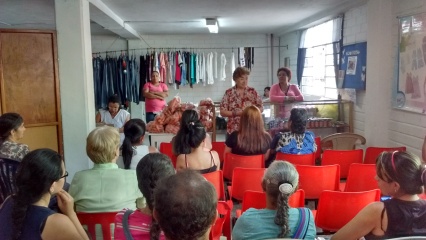
Todos los Viernes en la Fundación Bordado a Mano, nos reunimos con varias mujeres recién salidas de la cárcel, o con sus familiares, hacemos una breve oración y nos preparamos para disponernos a escuchar el Evangelio del Domingo, en la celebración que hagamos en alguna de la Casa-Iglesia.
Viernes Abril 22/16 reflexionando con las pos-penadas el texto del Domingo Juan 13:31-33-35
Quien me quiere decir que es una homilía? Nadie, se atreve?A ver Consuelo, que se te ocurre? “No, le quería devolver la pregunta, porque yo no se”.
Entonces, preguntemos de otra manera. Saben que es un sermón? Margot responde: “Hay varios sermones, el que dice el Padre en la misa, y el que dice la mamá en la casa cuando regaña”. Liliana comenta: “El Padre también regaña, en la misa”.
Quien hace la “homilía” en la misa? Marta dice: “Ahora, voy entendiendo. A pues, el Padre”. Muy bien, Marta, has dado en el clavo.
Les gustan las “homilías” o esos sermones, que hemos escuchado? María Elena, no vacila en responder: “A mi no me gustan, porque él Padre, el solo habla, se pregunta y se responde, él solito”.
Mercedes, quiere intervenir: “Es como si nos estuviera diciendo: “Yo hablo y ustedes, se callan y me escuchan”. Amparo, agrega: “Es que él tiene la Palabra de Dios y por eso fue Padre y fue ordenado”.
No estas equivocada Amparo, eso es lo que nos enseñaron y hemos escuchado. Pero, aquí en confianza, qué tal nos parece esa norma, será correcta, será justa? Tiene que ser así? Ligia, dice: “Yo no creo. Eso tendría que ser más ameno, donde con entusiasmo se nos explicaran las cosas de la religión, pero no regañadas y ni tan con tanta revoltura, por lo alto que nadie entiende”. Muy bien, Ligia, creo que lo que has dicho es la definición más correcta. Muchas gracias.
Entonces? Creo que todos comentarios a modo de breve introducción, que hemos hecho nos van ayudar para hacer nuestra homilía. Les parece?
Amparo, nos ha leído el texto de Juan 13: 31-33-34-35. Qué nos ha llamado la atención de este texto?
“Me llama la atención con el cariño con que Jesús trata y le habla a sus discípulos”interviene de nuevo Ligia. “Me gusta ese pedazo, en que dice que “cuando salió” refiriéndose a Judas. Jesús dice: que el Hijo el hombre y Dios ha sido glorificado”. Nos comenta Margarita.
Que maravilla! Lo que han dicho! Este texto tiene mucha tela para cortar. Perdón, Sandra, que querías decir? “Tengo la curiosidad, cuántos discípulos estaban con Jesús?”. En ese momento, según el evangelista San Juan, se suponen que eran los 12. Pero, se sospecha que habían más. No dudo que a Jesús le gustaba la sazón de las hermanas de Lázaro…(risas, con picardía femenina).
Saturia: “Tengo otra pregunta. Entonces es lo mismo “discípulos” que “apóstoles”? Buena pregunta Saturia. Quien nos puede aclarar esto? Qué dices, Margarita, ya que tienes la mano levantada. “A mi me enseñaron, en la escuela que discípulo, es el que está aprendiendo” Así es, Margarita, no hay nada que agregar. Jesús, en este pasaje les estaba enseñando a amarse los unos a los otros, y les dice “en eso conocerán que son mis discípulos, en el amor que se tengan unos a otros” Juan 13:35.
Cruz Elena, nuestra directora del grupo, pregunta: “Entonces, quienes eran los apóstoles, y cuántos eran?” Uy! Cruz Elena, qué pregunta! Cómo les parece, no eran solo 12, habian muchos más. No lo digo, yo. Lo pueden leer en Lucas 10:1.9. De todas maneras la palabra “Apóstol” les cuento, significa ser enviado. Si mal no recordamos, a María de Magdala, Jesús la envió, a ella, a llevar el mensaje de su Resurrección a sus discipulos y apostoles. Mensaje muy importante, que si no fuera por ello:Vana seria nuestra fe.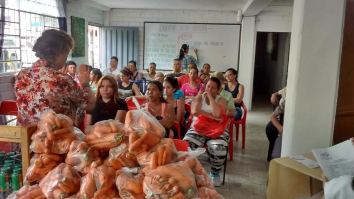
Beatriz que está allá, atrás, que nos quieres compartir o decir? “Por qué solo se habla de hombres? y no aparecen a las mujeres ya que allí no se mencionan?” Gracias, Beatriz por tu pregunta.
Se pueden considerar dos motivos y convertirlos en pregunta: 1) quién escribió la Biblia?, y 2) quién hizo más tarde la traducción de esos textos que estaban en griego, arameo y hebreo, para que llegaran hasta nosotros en el español? A mi comentario Liliana dice: “O sea que esos textos, han sido traducidos y vueltos a traducir y muy fácilmente manipulados, o cambiados? Mejor dicho, la Palabra de Dios, nos ha llegado, pero,bien reciclada”.
Gracias, Liliana. Por hoy dejamos acá, y vamos a seguir estudiando y reflexionando los textos de cada Domingo.
Agradezcamos a la Divinidad su Presencia en medio de nosotros/as en nuestra nueva sede, de manera especial hoy Día de la Madre Tierra, y nos disponemos a recibir la Ayuda Alimentaria, así como dice Cruz Elena, esto solo, no es solución a nuestros problemas, pero si es una puerta que nos abre a la Solidaridad, Apoyo y Amor mutuo entre todas/os.
Nos veremos para la celebración en la Casa-Iglesia de Consuelo y el próximo Viernes nuevamente aqui.
*Presbitera católica romana.
Tuesday, April 26, 2016
Pope Francis: On Clericalism and the Holy Faithful People of God//National Catholic Reporter
"It
is good for us to remember that the Church is not an elite of priests, of
consecrated people, of bishops -- but that everyone forms the Holy Faithful
People of God," states Francis.

The
pontiff then says that he cannot reflect on the role of laypeople in the church
"ignoring one of the greatest deformations that Latin America must confront, and
to which I ask you to give special attention: clericalism."
"This
attitude not only cancels out the personality of Christians, but tends to
diminish and undervalue the baptismal grace that the Holy Spirit has placed in
the heart of our people," states Francis.
"Clericalism
brings about a homogenization of the layperson, treating as 'mandatory' limits
to his or her diverse initiatives and efforts, and I would dare to say, the
audacity necessary to bring the Good News of the Gospel to all places of social
and overall political activity," he continues.
"Clericalism,
far from giving impulse to diverse contributions and proposals, turns off,
little by little, the prophetic fire from which the entire Church is called to
give testimony in the heart of its peoples," says Francis. "Clericalism forgets
that the visibility and the sacramentality of the Church belongs to all the
people of God and not only an elect or illuminated few."
Francis: Spirit works in laypeople, 'is not property of the hierarchy'
Homily by Ann Harrington ARCWP for Liturgy "Celebrating the Cosmic Christ" at Free Spirit Inclusive Catholic Community in North Carolina 4/24/16
 |
| Ann Harrington, ARCWP pressiding at Liturgy Celebrating the Cosmic Christ Photos by Mark Harrington |
Opening song: O Magnum Mysterium
https://youtu.be/nn5ken3RJBo
Psalm: Everyday God
https://youtu.be/2_3MSBJIq5o
Communion Hymn: We Are the Body of
Christ https://youtu.be/9Vj_VYbbn_c Stop
at 2:48
Recessional: The rest of "We Are
the Body of Christ
What follows are some ideas from Richard Rohr and Ilia Delio, both
Franciscans, both I believe, are Prophets and Wisdom teachers. I will post the links I used on our fb page
if you are interested in furthering your understanding of the Cosmic Christ..
The Big Bang occurred over 13 billion years ago. As God revealed God self in the material
evolution of life, the Christ was present.
And this revelation has been ongoing since the beginning. On the first
day, God says, "Let there be light".
The Cosmic Christ is the light that fills all things since the beginning
of time and invites us into this realm of reality. God is love--the love that loves to
love. God created the world because God
longs to share that love with one who could respond to God in grace and
glory. I learned in Bev Bingle's homily
this week that glory means "manifestation of God's presence". A
favorite quote of mine is from the second century St. Irenaeus. He said, "The glory of God is a person
fully alive". Jesus is this man
fully alive. Ilia says he was like a Big
Bang, for in Jesus, God consciousness breaks forth. Jesus had an immediate awareness of God in
his life that breaks through the Jewish tradition. His mission was to take what is fragmented in
life make it whole whether it means challenging the Jewish Law or turning over
the tables in the Temple. Whatever is
opposed to more unity and love must be challenged. Jesus ushers in a New Integral
Wholeness. So, Jesus can be called a Whole
Maker, a healer. We his followers share
in this mission.

The early church recognized that Jesus was the "Christ". But this understanding was lost. Our
religion is carrying a lot of baggage.
Our God concept is for many, of medieval origin. A God out there somewhere. The legacy of the Greek philosophers is with
us still. Platonic spirituality gives us
the idea that God is up there and we are here and our whole path is to leave
here and go there. This thinking leads us to see earth as a mere way station on
the journey to some other heavenly realm and explains the current ecological
condition we find ourselves in. Our call is to embrace this wise home that has
been given to us, to become conscious that beauty is all round us and life
never stops bursting forth.

In the 14th century with the invention of telescopes people saw something
very different from what they had
believed. The earth was not the center
of the universe but just one planet that revolved around the sun. The church decided not to deal with this. For
what then does Scripture mean? What is
our purpose in creation if humans are not the be all and end of creation? How can we come to any certainty about God
amidst all these changes? Seventeenth
century French philosopher, Rene Descartes decides to take God out of the
cosmos and put God in a self thinking person.
This leads the church to respond with a heavy emphasis on doctrine and
law. God becomes judge, the one who is
"over us". Once you separate
God from the cosmos you don't have God, you have a thought.
Teilhard de Chardin was a Jesuit
paleontologist who spent many years beginning in the 1920's in China looking
for the story of how humans emerged and continue to emerge. He put evolution and the Christ story together. He said evolution is not a theory, it is the
way nature works, it is a process of unfolding life. There seems to be a fundamental law of
attraction going on. Things come
together and form a new entity. A new
complexity forms something else new. It
is because of what was there that something new comes, emerges. de Chardin calls this fundamental attraction,
love. Love is the physical structure of
the universe. This dynamic universe of
energy of love, unites, attracts and gives rise to more being, over and over
again. The whole structure of the
universe is oriented toward more life, more being, more consciousness. The story is still being written. Evolution continues through us. We are the arrows of evolution. Our choices and decisions are fundamental to
how this universe will continue to evolve.
Everything we think, say or do matters.
It may help to come to some
understanding of the immense process that we are part of. The first stars emerge 400 million years
after the Big Bang. If Evolution is a 30
volume encyclopedia, humans show up in the last volume, on the last page, the
last 2 words of the last line. We are
new to the universe, We have been given a crucial role in evolution. For if Christ is as, T. says, the organic
unfolding of divine life that has come to consciousness in the human person,
what does that make us but evolving Christ's?
In the life of Jesus we see what the Big Bang is about, love poured out
for the sake of more life. Evolution is
cruciform, suffering and death all along the way. Resurrection is a new energy field, this is
why the early Church was so dynamic.
They were experiencing something new, New Life, life that will never
end. Life that empowered them to give
their lives for the sake of the Gospel.
We often miss the Risen
Christ. We are so driven by
self-preservation. We are so distracted by noise and busyness and
clutter that we cannot find that "still center" within, the place of
Integral Wholeness where Jesus lived and moved and had his being. It is when we come to know the whole within,
when we meet the Christ within, when we get in touch with what Merton says is
"the pure glory of God in us", when we find ourselves embraced in
love, then we can move outward and
become whole makers, reconcilers, people of mercy and compassion.
Ilia defines a Christian as one who is connected through to the heart
and to the whole of life, attuned to the deeper intelligence of nature and
called forth irresistibly by the
Spirit to creatively express one's gifts in the evolution of self and
world. As we open to change, to grow, to
unite, so too will the world around us, because we are part and parcel of a
larger whole.
Questions for reflection: I think it important to claim our
goodness. All of us are involved in whole
making in some way. I invite you to
share what you do to bring wholeness to yourself and the larger world.
What gives you energy? What
gift/s is the Spirit calling you to creatively express? You might be having a niggle of awareness
that this thing is calling you.
If we stopped using the word Catholic and said "wholemakers",
Free Spirit Inclusive Whole maker's Community, how might that change how we
think about ourselves and what we are doing?
Readings for 4/24/16
First Reading: Hymn of
the Universe by Teilhard de Chardin
...far from light
emerging gradually out of the womb of our darkness, it is the Light, existing
before all else was made which, patiently, surely eliminates our darkness. As for us creatures, of ourselves we are but
emptiness and obscurity. But you, my
God, are the inmost depths, the stability of that eternal milieu, without
duration or space, in which our cosmos emerges gradually into being and grows
gradually to its final completeness, as it loses those boundaries which to our
eyes seem so immense. Everything is
being; everywhere there is being and
nothing but being.
Psalm: Everyday
God by Bernadette Farrell https://youtu.be/2_3MSBJIq5o
Second Reading: Colossians 1 15-16 Inclusive
New Testament
Christ is the image
of the unseen God
and the firstborn of all creation,
for in Christ were
created
all things in heaven and on earth:
everything visible
and invisible,
Thrones, Dominations, Sovereignties,
Powers-
all things were created through Christ and
for Christ.
Gospel: John 1: 1-5
Inclusive New Testament
In the beginning
there was the Word,
the Word was in God's
presence
and the Word was God.
The Word was present
to God
from the beginning.
Through the Word
all things came into
being,
and apart from the
Word
nothing came into
being
that has come into
being.
In the Word was life,
and that life was
humanity's light-
a Light that shines
in the darkness,
a Light that the
darkness has never overtaken.
Sunday, April 24, 2016

Saturday, April 23, 2016
Homily for Ordination of Kim Turcotte ARCWP as a Deacon by Bishop Bridget Mary Meehan on April 23, 2016 in Manchester, New Hampshire

We
rejoice today as we ordain Kim Turcotte a deacon with the Association of Roman
Catholic Women Priests.

In
her own words, Kim shares what her ordination will mean:
“…I
will have the privilege to walk with our local faith community to pray together, discuss relevant
issues in our open homilies just as Jesus taught in the early
church. In our homes or out in a park,
at the coffee shop or in a church, we are able to reach people wherever they
are and on their own terms. All are welcome at the table. Being a mother of a
child with disabilities and myself being one of those excluded from the church
I understand and am called to serve those who are forced to be at the margins.”

The
Gospel of John portrays a close relationship between Mary of Magdala and Jesus.
When the other disciples come and go, Mary stays nearby, weeping, searching for
clues of Jesus whereabouts. Her grief is soul-wrenching. She has listened to his teaching
and experienced his compassionate love. This type of deep friendship suggests a
break with the social conventions of the time. Jesus treats Mary of
Magdala as an equal among the male disciples. In an age where a woman’s word
was suspect, the Risen Christ calls her to be the apostle to the apostles to
proclaim the good news of the Resurrection, the central belief of
Christianity.

In
Romans 16, St. Paul praises Junia and Andronicus, as “outstanding apostles” who
were in Christ before he was. Since Paul, Junia and Andronicus were apostles,
there were more than 12 apostles and Junia was a woman apostle. The
“twelve” was a symbolic number referring to the twelve tribes of Israel.

In
an ancient Coptic Christian Scripture, “Pistis Sophia”, written in the Second
Century, Jesus chooses Mary of Magdala and John to “be on my right and on
my left.” Mary’s prominence is reflected throughout the document. She asks 39
out of 46 questions and participates in providing interpretation of this
document. Peter expresses resentment toward her throughout the work: “My Lord
we shall not be able to endure this woman, for she takes our opportunity and
she has not let any of us speak and takes all the time herself.” Mary objects
to Peter’s efforts to intimidate her and charges that “he hates the female race.” I ask you: two thousand years later, what has
changed?

In
the Gospel of Mary, written early in the Second Century, Jesus warns the
disciples against following a “set of rules and laws not given by him.” Mary
tells the disciples to proclaim the Gospel without fear. She assures them of
the Savior’s presence. In the second part, she shares a vision she has
received. Andrew and Peter react with scorn to her revelations but Levi defends
her: “Peter , thou has ever been of hasty temper. Now I see that thou dost
exercise thyself against the woman like the adversaries. But if the Savior has
made her worthy, who then art thou to reject her?”

Jesus’
encounters with Mary of Magdala and the women in the Gospels indicates that he
treated women as equally beloved, equally chosen and equally holy. Elizabeth
Johnson writes, “He (Jesus) brings salvation through his life and Spirit
restoring women to full personal dignity in the reign of God and inspiring
their liberation from structures of domination and subordination. (Elizabeth Johnson, Consider Jesus: Waves
of Renewal in Christology, New York: Crossroad, 1990, p. 112. )

In
addition, a Pope and early church father also affirmed women as apostles.

Pope
Hippolytus who lived from 170 to 236 AD, addressed the role of women in early
Christianity: “Lest the female apostles doubt the angels, Christ himself came
to them so that the women would be apostles of Christ… Christ showed himself to
the male apostles and said to them…’It is I who appeared to the women and I who
wanted to send them to you as apostles.’” (Brock,
Ann Graham, Mary Magdalene, the First Apostle The Struggle for Authority,
2003 (quotes Hippolytus (DeCantico 24-26, CSCO 264) pp. 43-49)

Gregory of Antioch (d. 593) portrays Jesus as appearing to Mary Magdalene and the other Mary at the tomb and saying to them: “Be the first teachers to the teachers. So that Peter who denied me learns that I can also choose women as apostles.” (Brock, p. 15)

So
let’s be clear, women were apostles-
according to the Risen Christ, St. Paul, Church Fathers and a pope. Therefore,
the church should follow the example of Jesus and treat women as equals in
every area of our church’s life today including decision making and ordination!

Scholars,
like Gary Macy, in The Hidden History of Women's Ordination, present scholarly
evidence of women in Holy Orders during the first twelve hundred years of the
church's history. Women and men were
ordained to a specific service role within the community. One could say that the
fact that women were ordained in our church tradition is the church's best kept
secret, but NO MORE!!


St. Paul taught, "As many of you as were baptized into Christ have clothed
yourselves with Christ. There is no longer Jew or Greek, there no longer
servant or free, there is no longer male and female; for all of you are one in
Christ Jesus" (Galatians 3:28).


Pope John Paul II contradicted the early tradition of women in priestly ministry when he wrote: "The church has no authority whatsoever to confer priestly ordination on women and ...this judgment is to be definitively held by all the Church's faithful."
However, Pope John Paul II did not consult the people of God (including the theologians and the bishops) before issuing this decree.
The church teaches that infallible teaching must reflect the sense of the faithful. Therefore, this teaching is not infallible because it does not reflect the sensus fidelium, the faith of the believing community. In fact, according to recent surveys about 70 percent of Catholics and 80 percent of Catholic theologians support women's ordination, including some of the world's bishops. The church cannot continue to discriminate against women and blame God for it.

Women and men are created in God's
image and both may represent Christ as priests. Women as priests remind us that
women are equal symbols of the holy and that the identity of priests should
reflect the experiences and spiritual authority of women.

From
the first ordination on the Danube of seven women, our international Roman
Catholic Women Priests’ Movement has grown to over 220 in 13 countries, 31 states in the U.S. serving 81 communities. The Spirit is moving and we are growing. Who
says there is a vocation shortage?!

My sisters and
brothers, like Mary of Magdala, the Risen Christ is calling us to be apostles
today. As we live Gospel equality and
partnership in inclusive, vibrant faith communities, our church is being
reformed and renewed! We don’t have to wait for the Vatican to act. Mary of
Magdala did not wait for Peter’s approval. The good news is: justice, like a
river is rising up in the Catholic Church today in New Hampshire as we ordain
Kim Turcotte a deacon!


Subscribe to:
Posts (Atom)
constant love must prevail over judgmentalism.
In our family we have experienced this mercy & compassion.
The Joy of Love began when Joan and John fell in love years ago.
They were both divorced, Joan a devout Catholic and leader of her
parish choir; John an Episcopalian who served on the Catholic
Hospital Board ; a member of the choir.
They applied for annulments and waited and
waited without a response.
Ten years later, they talked to a monastic priest, a mystic,
Joanie said. He looked at them and said, “You are a gift of love
to one another. Talk to your pastor.” And they did.
To their surprise, he supported marriage on one condition:
‘Do not give up any of your parish involvements!”
Together the pastoral solution and moral discernment embodied
in primacy of consciences was made.
They were married on the Manatee River on Thanksgiving weekend.
The issue as Fr. Roy Bourgeois described his experience,
revolves around conscience and really living out in our lives—
all of us, what we believe.
In our journey of faith we are going to come across situations
in which we have to make decisions rooted in our belief in a
loving and; just God.
With the understanding that a Pope and a Church
and each of us can build a merciful and loving Catholic Church.