Living Gospel Inclusivity and Empowerment Now- https://bridgetmarys.blogspot.com/2025/10/rev-dr-bridget-mary-meehan-arcwp-chat.html
Thursday, June 9, 2016
Wednesday, June 8, 2016
Homily for Holy Spirit Catholic Community,11th Sunday OT, by Beverly Bingle, RCWP
Two Saturdays ago
six-year-old Robbie Richardson of Quincy, Massachusetts,
called 911 when his father drove through a red light.
Robbie knows the law.
“Daddy went past a red light,” he told the dispatcher.
“It was in the brand new car, my mummy’s car.”
The 911 dispatcher asked Robbie to put his father on the line.
Robbie's father explained about his right turn on red
and apologized to the dispatcher.
It's a cute story—a six-year-old calling the police on his dad.
It's understandable.
Six-year-olds are very literal.
___________________________________________
It's different for an adult…
like Simon the Pharisee in today's Gospel.
Robbie saw his father go through the red light.
He thought he was seeing his father break the law.
Simon the Pharisee saw a woman with her head uncovered,
touching Jesus.
What did Simon think he was seeing?
Historians say there is clear evidence
that first-century Jewish women covered their heads
not only for prayer
but whenever they were outside of their own home.
For the women it was a matter of morals and a religious duty.
That's the way it was.
And for Pharisees the law was sacred—
the only way for them to please God.
So Simon is seeing the woman's hair,
and for him it's a clear sign of her immorality.
She is a sinner.
And she is touching Jesus.
That breaks another law,
the one that makes a person unclean for touching a sinner.
So it's unquestionably clear to Simon that Jesus is a sinner, too.
That's the law.
And for Simon, the law is the most important thing.
___________________________________________
Those three little verses at the end of today's gospel
help explain what's really going on at that dinner.
Women followed Jesus.
They provided for him.
Other women, as well as men,
experienced healing from Jesus' teaching.
The woman at the well experienced acceptance
when Jesus entered into theological dialogue with her.
She became a disciple.
All around Galilee women and men
experienced freedom and new life
when Jesus accepted them as equals.
He talked with them.
He ate with them.
He showed God's love to them.
___________________________________________
Perhaps the woman in today's Gospel had heard Jesus teaching.
Followed him on the way.
Saw him taking sides with the marginalized.
Listened to him, turned her life around
and, freed from guilt, changed her ways.
That fits the dynamic that Paul describes in the second reading,
that it's not following the law that makes us right with God.
It's our openness to God's gracious presence in our lives.
Once we see, we change—
and the fruit of our faith in God is love.
So Jesus doesn't tell the woman, “I forgive you.”
He tells her, “Your faith has saved you.”
That is, you admitted your wrongs,
you let yourself be open to God's loving forgiveness,
and you are now right with God.
You are justified.
___________________________________________
The same lesson
is at the heart of Jesus' story to Simon about the two debtors:
the response to forgiveness is love.
The woman's extravagant act of devotion is a sign
that her many sins—whatever they may have been—
have already been forgiven.
Free of her past sins, she is full of love,
and she pours it out
on the man who taught her about God's forgiveness.
___________________________________________
Simon's friends, in that same legalistic and judgmental mindset,
still don't understand.
They think Jesus—the prophet who came out of the desert
calling people to “repent and believe the good news”—
is claiming that he is the one forgiving her sins.
But Jesus clearly says that he doesn't forgive sin.
God does.
___________________________________________
These scriptures have deep levels of meaning for us today.
Among other things, they teach us about forgiveness,
that God is the forgiver of sin,
that gratitude for forgiveness spurs us to good works.
They show us that Jesus stood with
the poor, the hungry, sinners, and the marginalized
over the religious and political leaders.
___________________________________________
We know that God has forgiven us.
We celebrated that forgiveness
in our penitential rite and general absolution
at the beginning of today's Mass.
Out of gratitude, we—like that sinful woman—
are filled with love and called to good works.
We are called to follow Jesus' Way,
along with that formerly sinful woman,
along with every sincerely remorseful sinner who ever lived.
As Dr. Elizabeth Vasko puts it,
“To be a Christian
is to take sides with those who are marginalized,
dehumanized, and subject to violence.”
___________________________________________
How do we take sides?
In the next few weeks we will see
two major party Presidential nominating conventions.
We are already seeing the ads—especially the attack ads—
for and against the candidates for President and Congress.
We've been seeing ads
that glorify fracking and promote the use of fossil fuels
for quite a while.
One of the ways we take sides is by exercising faithful citizenship.
We look for the candidates who stand with the poor, the hungry,
the repentant sinners, and the marginalized.
We vote for policies and issues
that reflect the values and principles
of Catholic Social teaching,
all based on the right and dignity of the human person—
every person.
We take into account the preferential option for the poor.
___________________________________________
It's not always an easy choice.
Maybe we wanted a different candidate,
but someone else got nominated.
Maybe we don't think any of the candidates
are as good as we'd like.
But whether we like it or not—neutrality is not an option.
We have to do our homework
and put our X for the candidates and issues
that most closely reflect our deepest values.
We have to be on the side of
the poor, the hungry, and the marginalized.
We have to stand up for them… just like Jesus did.
Amen.
--
Holy Spirit Catholic Community
Saturdays at 4:30 p.m./Sundays at 5:30 p.m.
at 3925 West Central Avenue (Washington Church)
www.holyspirittoledo.org
Rev. Dr. Bev Bingle, Pastor
Mailing address: 3156 Doyle Street, Toledo, OH 43608-2006
419-727-1774
six-year-old Robbie Richardson of Quincy, Massachusetts,
called 911 when his father drove through a red light.
Robbie knows the law.
“Daddy went past a red light,” he told the dispatcher.
“It was in the brand new car, my mummy’s car.”
The 911 dispatcher asked Robbie to put his father on the line.
Robbie's father explained about his right turn on red
and apologized to the dispatcher.
It's a cute story—a six-year-old calling the police on his dad.
It's understandable.
Six-year-olds are very literal.
___________________________________________
It's different for an adult…
like Simon the Pharisee in today's Gospel.
Robbie saw his father go through the red light.
He thought he was seeing his father break the law.
Simon the Pharisee saw a woman with her head uncovered,
touching Jesus.
What did Simon think he was seeing?
Historians say there is clear evidence
that first-century Jewish women covered their heads
not only for prayer
but whenever they were outside of their own home.
For the women it was a matter of morals and a religious duty.
That's the way it was.
And for Pharisees the law was sacred—
the only way for them to please God.
So Simon is seeing the woman's hair,
and for him it's a clear sign of her immorality.
She is a sinner.
And she is touching Jesus.
That breaks another law,
the one that makes a person unclean for touching a sinner.
So it's unquestionably clear to Simon that Jesus is a sinner, too.
That's the law.
And for Simon, the law is the most important thing.
___________________________________________
Those three little verses at the end of today's gospel
help explain what's really going on at that dinner.
Women followed Jesus.
They provided for him.
Other women, as well as men,
experienced healing from Jesus' teaching.
The woman at the well experienced acceptance
when Jesus entered into theological dialogue with her.
She became a disciple.
All around Galilee women and men
experienced freedom and new life
when Jesus accepted them as equals.
He talked with them.
He ate with them.
He showed God's love to them.
___________________________________________
Perhaps the woman in today's Gospel had heard Jesus teaching.
Followed him on the way.
Saw him taking sides with the marginalized.
Listened to him, turned her life around
and, freed from guilt, changed her ways.
That fits the dynamic that Paul describes in the second reading,
that it's not following the law that makes us right with God.
It's our openness to God's gracious presence in our lives.
Once we see, we change—
and the fruit of our faith in God is love.
So Jesus doesn't tell the woman, “I forgive you.”
He tells her, “Your faith has saved you.”
That is, you admitted your wrongs,
you let yourself be open to God's loving forgiveness,
and you are now right with God.
You are justified.
___________________________________________
The same lesson
is at the heart of Jesus' story to Simon about the two debtors:
the response to forgiveness is love.
The woman's extravagant act of devotion is a sign
that her many sins—whatever they may have been—
have already been forgiven.
Free of her past sins, she is full of love,
and she pours it out
on the man who taught her about God's forgiveness.
___________________________________________
Simon's friends, in that same legalistic and judgmental mindset,
still don't understand.
They think Jesus—the prophet who came out of the desert
calling people to “repent and believe the good news”—
is claiming that he is the one forgiving her sins.
But Jesus clearly says that he doesn't forgive sin.
God does.
___________________________________________
These scriptures have deep levels of meaning for us today.
Among other things, they teach us about forgiveness,
that God is the forgiver of sin,
that gratitude for forgiveness spurs us to good works.
They show us that Jesus stood with
the poor, the hungry, sinners, and the marginalized
over the religious and political leaders.
___________________________________________
We know that God has forgiven us.
We celebrated that forgiveness
in our penitential rite and general absolution
at the beginning of today's Mass.
Out of gratitude, we—like that sinful woman—
are filled with love and called to good works.
We are called to follow Jesus' Way,
along with that formerly sinful woman,
along with every sincerely remorseful sinner who ever lived.
As Dr. Elizabeth Vasko puts it,
“To be a Christian
is to take sides with those who are marginalized,
dehumanized, and subject to violence.”
___________________________________________
How do we take sides?
In the next few weeks we will see
two major party Presidential nominating conventions.
We are already seeing the ads—especially the attack ads—
for and against the candidates for President and Congress.
We've been seeing ads
that glorify fracking and promote the use of fossil fuels
for quite a while.
One of the ways we take sides is by exercising faithful citizenship.
We look for the candidates who stand with the poor, the hungry,
the repentant sinners, and the marginalized.
We vote for policies and issues
that reflect the values and principles
of Catholic Social teaching,
all based on the right and dignity of the human person—
every person.
We take into account the preferential option for the poor.
___________________________________________
It's not always an easy choice.
Maybe we wanted a different candidate,
but someone else got nominated.
Maybe we don't think any of the candidates
are as good as we'd like.
But whether we like it or not—neutrality is not an option.
We have to do our homework
and put our X for the candidates and issues
that most closely reflect our deepest values.
We have to be on the side of
the poor, the hungry, and the marginalized.
We have to stand up for them… just like Jesus did.
Amen.
--
Holy Spirit Catholic Community
Saturdays at 4:30 p.m./Sundays at 5:30 p.m.
at 3925 West Central Avenue (Washington Church)
www.holyspirittoledo.org
Rev. Dr. Bev Bingle, Pastor
Mailing address: 3156 Doyle Street, Toledo, OH 43608-2006
419-727-1774
Tuesday, June 7, 2016
Women's Ordination Conference Report on Jubilee for Women Priests in Rome, Press Coverage List of Articles
| |||||||||
 You did it!


|

"Ordination for the Woman on the Floor" by Nancy Rockwell
http://www.patheos.com/blogs/biteintheapple/ordination-for-the-woman-on-the-floor/
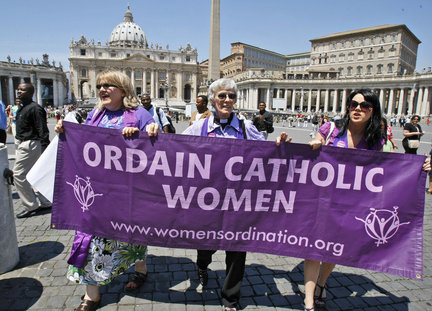 Women in priestly robes. Women in clerical collars. Women in collars opening local meetings with prayers. Women Bishops. Women bestowing sacraments: pronouncing marriage; forgiveness; eucharist; the belovedness of baptism.
Women in priestly robes. Women in clerical collars. Women in collars opening local meetings with prayers. Women Bishops. Women bestowing sacraments: pronouncing marriage; forgiveness; eucharist; the belovedness of baptism.
These images, these experiences, would help to remove the icon of females as subservient, as slaves, as property of husbands and fathers, as never to rise above menial work and not deserving of education. These icons rule vast numbers of women in much of the world.
If the Vatican were to decide that the robes and rituals of sanctification were no longer exclusively for men, it would be a huge symbol of humanity and equality. Because the Roman Church numbers over one billion, the ordination of women by it would cause a seismic shift in the estimation of women everywhere, and could raise billions of women and their children from abject poverty, as many doors to work and worth would open.
The bright light of hope that this might happen has been lit by Pope Francis, who recently agreed to set up a commission to study ordaining women as Deacons in the Catholic Church..."
Image: Ordain Catholic Women, picture from Women’sOrdinationWorldwide.org
Monday, June 6, 2016
Ordination of Woman Priest Lucero Arias Manco ARCWP in Colombia, . JUNIO 4/16. by Olga Lucia Álvarez Benjumea ARCWP
Espero nos acompañes, en esta aventura hermosa, en búsqueda de la equidad e igual en Justicia en medio de nuestro pueblo.
De por sí, ya el nombre del sitio, nos hace pensar en la fresca aurora y salida del astro Sol que nos ilumina y caliente, a medida que va bajando de las montañas, sobre la ciudad de la Eterna Primavera, pregonando la Buena Nueva llena de vida y esperanza para un pueblo acosado y sufrido por el ambiente corrupto de una sociedad y cultura, que sigue pretendiendo, cubrir cada nuevo amanecer.
La Ciudad de Medellin, recibe el calor de la Esencia Divina del Oriente.
Desde muy temprano, fuimos a buscar el bus-público que nos llevaría hasta el sitio indicado, “#060 Bello Oriente”. El sistema del Metro Cable, no operó ese día, así tuvimos una buena experiencia de bus de más de una hora, pasando por diferentes barrios. Sus calles súper estrechas, con mucho cuidado pasa un bus al otro que por milímetros dan la impresión que van a chocar, romper el espejo, etc. etc. Debido a esto mientras hacen sus maniobras ambos conductores, va pasando el tiempo. Es todo en subida, como si fueras en caracol, unas veces puede avanzar, otras muy despacio. La verdad, que estos conductores nada que envidiar a las habilidades de quienes realizan la “Formula 1”. Por la ventanilla, se va viendo como la gente va y viene, todo el tiempo tratando de evitar ser atropellados. Se sube con tensiones, pero a la vez con ilusiones.
En mi juventud, tuve la oportunidad de visitar y conocer estos Barrios por dónde íbamos pasando. Anteriormente eran calles destapadas, y no les digo cuando llueve….ranchos de madera, con tejas sostenidas por piedras o ladrillos, para evitar que el viento las levantara. Hoy, están mejoradas, pero no me imaginaba cómo esto se ha ido extendiendo hacia la cima…
Un niño, afro, fue mi compañero de viaje. Ambos íbamos solos, y él me fue indicando por donde estábamos y el sitio donde me debía bajar. Tuvo la delicadeza de ir hasta donde el chofer y decirle, donde me hacia la parada. Para mí, este niño era un ángel en el camino. Él iba para donde su familia mucho más arriba.
Me bajé, en la sitio llamado “El Paraíso”. Ahí me esperaba Milena, para llevarme a su casa, donde su tía Rocío, me ofreció un rico desayuno! Estábamos en esas, conversando y conociendo a algunas vecinas. Cuando llega Johanny un joven vecino. Rocío aprovecha de pedirle el favor de que vaya a avisar a su marido y sus 3 hijos que vengan a desayunar, que ya está listo. Ellos están más arriba ayudando a construir la casa a un vecino. No habían pasado mucho tiempo, quizás 10 minutos, cuando llega Andrés con los pelos de punta, con su ropa ensangrentada…Qué pasó? Fue la pregunta que nos hicimos. “Acaban de apuñalar a Johanny, en el cuello, y su sangre brota a chorros…”
Rápidamente la Comunidad se mueve, los hijos de Rocío, que desde lejos vieron cuando iba hacia ellos, tenía su mano en el cuello y de pronto se desploma…le recogen llevan en el camión del depósito de materiales, que hay cerca hasta donde la policía y de ahí lo sacan en la ambulancia…Ya nadie quiere saber del desayuno. Qué quien, le avisa a la señora Gloria, la mamá. Qué quien le avisa a Olga su compañera. Es la angustia y los nervios a flor de piel… “Qué, quien fue?” Preguntan los vecinos. “Mejor que no se sepa…porque seguiría la cadena…”dice una vecina.
Se va acercando la hora de regresar a “El Paraíso” para la ordenación de Lucero. Y la tensión en el barrio va subiendo de presión…Hasta que por fin, alguien que se había ido con él en la ambulancia, regresa con alguna noticia…”Esta en el Hospital Santo Domingo, le han cauterizado, de esta,se salvó!”. Pasa un rato…, y ya las ganas de volver a sonreír y buscar el desayuno a todos/as nos ha regresado!
Vamos al salón, para organizar la ceremonia. Luis Eduardo ya está ahí, la mesa esta lista, los asientos también. Él, como Maestro de Ceremonia, ha repartido las lecturas, ha entrenado a los niños que llevan las luces, a la Señora que lleva la Biblia, la mesa de las ofrendas.
Los invitados van llegando, tenemos presencia de las Comunidades Cristianas de Base, de los Grupos de Jesús, el Cedebi, Comunión sin Fronteras, Fundación Bordado a Mano, la Casa Bíblica de Laureles, la Iglesia Anglicana, la Iglesia Vetero Católica,(el Señor Obispo Rodrigo Ospina y Luis Eduardo Valencia) la familia de Lucero, algunas vecinas y nosotras Asociación de Mujeres Presbiteras Católicas Romanas.

La pequeña mesa para el altar está en el centro. Las sillas colocadas en forma de círculo. Qué interesante! Hace mucho tiempo que aprendí de mis hermanos indígenas, el valor del círculo. El círculo es símbolo de la Divinidad. No tiene principio ni fin. El Sol es circular. Dicen ellos que… “desde que el “blanco civilizado” irrespetó el símbolo de la Divinidad para explotar y dominar a la humanidad y a la Madre Tierra, el mundo anda en dificultades. Del símbolo copian la rueda, los anillos, lo utilizan en relojes, en toda clase de motores para acelerar determinada producción violando la Madre Tierra”. Podríamos imaginar un minuto siquiera, que sería del Mundo sin “el invento de la rueda”?
Dada la disposición del sitio y el ambiente creado, el Maestro de Ceremonia (Luis Eduardo) explica, por qué estamos usando el círculo alrededor del altar. El símbolo de la Divinidad, nos coloca a todas/os en posición de iguales, nadie es más importante que el otro/a. Así nos podemos ver todos/as y empezamos, dándonos a conocer, de dónde venimos, quienes somos y qué hacemos. Espacio que aprovechamos para explicar nuestra presencia y la Historia de nuestro Movimiento, a fin de que nadie se sienta llamado/a a engaño u utilizado.
Damos inicio a la celebración, siguiendo el Ritual Romano.

En la postración y el canto de las Letanías, imposible dejar de mirar al niño del lado derecho quien también las estuvo cantando.

Evelio, su marido, toca la guitarra y Sonia su hermana ,canta las Letanías y el símbolo de la Divinidad les acompaña con sus rayos en Divina armonía.

La señora Ana Manco, le impone las manos a su hija.

Evelio, su esposo le impone las manos.

La Comunidad participando conjuntamente en la Consagración Eucarística

Algunos de los participantes en la Ordenación de Lucero Arias Manco.

Lucero Arias con su mamá, Sonia y un hermano y cuñada, (izquierda)su hija y Manuela (adoptada) a la derecha.

Lucero como buena campesina, agradece a la Esencia Divina, con alegría, le haya llamado a su servicio en la Iglesia!
APROVECHAMOS DE DAR LAS GRACIAS A LA ESENCIA DIVINA POR SU PRESENCIA EN MEDIO DE NOSOTROS/AS.
“Salgamos con gozo al mundo a anunciar su Evangelio”!
NOTA: A medida que nos hagan llegar más fotos y el video, les daremos a conocer.
*Prebitera Católica romana.
Sunday, June 5, 2016
Sr. Thea Bowman, FSPA: "What does it mean to be Black and Catholic?", Faith-filled and Joy-filled!
 |
| Sister Thea Bowman FSPA |
Published on Mar 2,
2015
In 1989,
a year before her death from cancer, the U.S. bishops invited Sr Thea Bowman, to
be a key speaker at their conference on Black Catholics. In her prophetic call
for the members of the Church to be "fully-functioning", "holistic", and
"Spirit-filled", Sr. Thea is a pioneer of what would later emerge the
evangelical movement in the Catholic Church.
TRANSCRIPT:
"What does it mean to be black and Catholic? It means that I come to my Church fully functioning. That doesn’t frighten you, dudes, does it? I come to my Church fully functioning. I bring myself, my black self, all that I am, all that I have, all that I hope to become, I bring my whole history, my traditions, my experience, my culture, my African-American song and dance and gesture and movement and teaching and preaching and healing and responsibility as gift to the Church.
I bring a spirituality that our black American bishops told us — they just told us what everybody who knew, knew: that spirituality is contemplative and biblical and holistic, bringing to religion a totality of minds and imagination, of memory, of feeling and passion and emotion and intensity, of faith that is embodied, incarnate praise, a spirituality that knows how to find joy even in the time of sorrow, that steps out on faith, that leans on the Lord, a spirituality that is communal, that tries to walk and talk and work and pray and play together — even with the bishops.
You know, when our bishop is around, we want him to be where we can find him, where we can reach out and touch him, where we can talk to him. Don’t be too busy, y’all.
A spirituality that in the middle of your Mass or in the middle of your sermon just might have to shout out and say, “Amen, Hallelujah, thank you Jesus!” A faith that attempts to be Spirit-filled. The old ladies say that, “If you love the Lord your God with your whole heart, then your whole soul and your whole mind and all your strength, then you praise the Lord with your whole heart and soul and mind and strength and you don’t bring him any feeble service.”
If you get enough fully functioning black Catholics in your diocese, they are going to hold up the priest and they are going to hold up the bishop. We love our bishops, you-all. We love y’all, too. But see, these bishops are our own, ordained for the Church Universal, ordained for the service of God’s people, but they are ours; we raised them, they came from our community and in a unique way they can speak for us and to us.
And that’s what the Church is talking about. Indigenous leadership. The leaders are supposed to look like their folks, ain’t that what the Church says?
To be black and Catholic means to realize that the work of the ordained ministers (priests and bishops) is not a threat to me and I’m no threat to that. The work of the ordained minister, of the professional minister, is to enable the people of God to do the work of the Church. To feed us sacramentally, to enable us to preach and to teach, and I ain’t necessarily talking about preaching in the pulpit.
You know as well as I do that some of the best preaching does not go on in the pulpit, but as a Catholic Christian I have a responsibility to preach and to teach, to worship and to pray. Black folks can’t just come into Church and depend on the preacher and say, “Let Father do it.” And if Father doesn’t do it right, then they walk out and they complain, you know, “That Liturgy didn’t do anything for me.“
The question that we raise is, “What did you do for the Liturgy?” And the Church is calling us to be participatory and to be involved. The Church is calling us to feed and to clothe and to shelter and to teach. Your job is to enable me, to enable God’s people, black people, white people, brown people, all the people, to do the work of the Church in the modern world."
TRANSCRIPT:
"What does it mean to be black and Catholic? It means that I come to my Church fully functioning. That doesn’t frighten you, dudes, does it? I come to my Church fully functioning. I bring myself, my black self, all that I am, all that I have, all that I hope to become, I bring my whole history, my traditions, my experience, my culture, my African-American song and dance and gesture and movement and teaching and preaching and healing and responsibility as gift to the Church.
I bring a spirituality that our black American bishops told us — they just told us what everybody who knew, knew: that spirituality is contemplative and biblical and holistic, bringing to religion a totality of minds and imagination, of memory, of feeling and passion and emotion and intensity, of faith that is embodied, incarnate praise, a spirituality that knows how to find joy even in the time of sorrow, that steps out on faith, that leans on the Lord, a spirituality that is communal, that tries to walk and talk and work and pray and play together — even with the bishops.
You know, when our bishop is around, we want him to be where we can find him, where we can reach out and touch him, where we can talk to him. Don’t be too busy, y’all.
A spirituality that in the middle of your Mass or in the middle of your sermon just might have to shout out and say, “Amen, Hallelujah, thank you Jesus!” A faith that attempts to be Spirit-filled. The old ladies say that, “If you love the Lord your God with your whole heart, then your whole soul and your whole mind and all your strength, then you praise the Lord with your whole heart and soul and mind and strength and you don’t bring him any feeble service.”
If you get enough fully functioning black Catholics in your diocese, they are going to hold up the priest and they are going to hold up the bishop. We love our bishops, you-all. We love y’all, too. But see, these bishops are our own, ordained for the Church Universal, ordained for the service of God’s people, but they are ours; we raised them, they came from our community and in a unique way they can speak for us and to us.
And that’s what the Church is talking about. Indigenous leadership. The leaders are supposed to look like their folks, ain’t that what the Church says?
To be black and Catholic means to realize that the work of the ordained ministers (priests and bishops) is not a threat to me and I’m no threat to that. The work of the ordained minister, of the professional minister, is to enable the people of God to do the work of the Church. To feed us sacramentally, to enable us to preach and to teach, and I ain’t necessarily talking about preaching in the pulpit.
You know as well as I do that some of the best preaching does not go on in the pulpit, but as a Catholic Christian I have a responsibility to preach and to teach, to worship and to pray. Black folks can’t just come into Church and depend on the preacher and say, “Let Father do it.” And if Father doesn’t do it right, then they walk out and they complain, you know, “That Liturgy didn’t do anything for me.“
The question that we raise is, “What did you do for the Liturgy?” And the Church is calling us to be participatory and to be involved. The Church is calling us to feed and to clothe and to shelter and to teach. Your job is to enable me, to enable God’s people, black people, white people, brown people, all the people, to do the work of the Church in the modern world."
Upper Room Community of Albany, NY - Liturgy for the Tenth Sunday of the Year - Remembers Muslim Neighbors
Upper Room Community, Albany, NY
Presiders: Jim Marsh, ARCWP and Helen
Blanchette
Receiving the Stole: Helen and Jim, we your community call you forth and bless you as you lead us in liturgy today.


Welcome


Welcome
We
are celebrating the Tenth Sunday of the year this weekend—also called Ordinary Time, since the Sundays are
numbered (from the Latin ordinalis).
It’s that period of the year outside the great seasons of Advent,
Christmas, Lent and Easter. Even though
it may feel ordinary, that is we are not feasting or fasting, it can be an
extraordinary time for us as we are mindful of our call to bring about God’s
kin-dom.

Let
us be mindful that our Muslim sisters and brothers begin their holiest month of
the year called Ramadan this evening. Do
we have anything in common? Will their
rigorous fasting and prayers be “sacramental” to/for us? Just some thoughts as we prepare to celebrate
this weekend. A ‘Blessed Ramadan’ to all
our Muslim neighbors!

Opening Prayer
May we all be open to
God acting in our lives to change and conform our minds and hearts to God’s
dream (vision) for the world. May we grow to be change-makers alongside one
another where the value of each life is placed at the center of our families,
communities, and nation. May we be
gracious and courageous in our living and loving ….. may it be so, AMEN.

First
Reading: 1
Kings 17:8-10, 17-24

Second Reading:
Salaam
and Greetings of Peace:
“If
you wish to draw near to God, you must seek God in the hearts of others. You
should speak well of all, whether present or absent. If you seek to be a light
to guide others, then, like the sun, you must show the same face to all. To
bring joy to a single heart is better than to build many shrines for worship …
The true person of God sits in the midst of their community, and rises up and eats and
sleeps and buys and sells, and gives and takes in the bazaars, and marries and
has social interactions with others, and yet is never for one moment forgetful
of God.” ― Abu Sa`id Abul-Khayr, a SUFI Mystic

Gospel: Like 7:11-16
Homily starter for June 5, 2016 – by Jim
Marsh, ARCWP
Today’s
first and the third reading sound very similar: both involve a widow and a dead
child that is brought back to life, one by Elijah and the other by Jesus. Certainly even in our day of modern medicine
and powerful drugs, children do die and mothers do weep.
Luke’s
Gospel does not seem to concern itself with the return of Jesus; instead it
emphasizes the day-to-day concerns in their world. Luke wants his readers to know Jesus is God’s
anointed one, who is making the kin-dom [“God’s
vision for a new reality”] happen.
Through Jesus, God was and is restoring the original blessing(s) of
creation.
Luke
calls us, his readers today, to identify with the Teacher, who is caring and
tender toward all he meets: the poor, the lowly, the outcast. In other words, be compassionate and merciful,
justice-seekers and peacemakers!
Jesus
saw the weeping mother. He went to her. He comforted her. Then he handed the
child back to her. Jesus breathed life
into a very broken situation, perhaps took away fear and says it’s time to
begin again. His deep sensitivity provides a glimpse of what the Gracious
Mystery we name God is like. God is not
some abstract being in a place called heaven, separate from creation. “God is love,” the love-energy expressing
self in, through, and with the entire cosmos.
The
Sufi mystic Abu Sa’id is very straightforward when he says “If you wish to draw
near to God, you must seek God in the heart of others …. To bring joy to a
single heart is better than to build many shrines for worship.” This reminds me of the prophet Hosea’s words:
“It is love that I desire, not sacrifice; and knowledge of God rather than
holocausts” as well as Paul’s words to the Corinthians “Clearly you are a
letter of Christ, … a letter not written with ink, but with the Spirit of the
living God; not on tablets of stone, but on tablets of flesh in the heart.”
Ramadan
is special to Muslims as a holy period dedicated to fasting, self-purification
and spiritual attainment. They believe
that the gates of heaven are open and the gates of hell are closed for the
entire month and that God will have mercy and absolve them of their sins if
they engage in sincere worship.
St.
Augustine said in the fourth century, “the church consists in the state of
communion of the whole world.” When you
and I are connected in right relationship to each other, there is love; and
where there is love, there is God. God
is found in all of us, whether in a church, temple or mosque. We all breathe the same air and drink the
same water: there are no Jewish, Christian or Muslim versions of these
universal elements. Creation and all
creatures manifest the very presence of the divine.
In
the recent words of Pope Francis, “Prayer is not a magic wand….” and so my
friends, how are you and I being called to act …. this day, this week, this
month? Remember, Jesus is our Teacher,
and he said, “anyone who has faith in me, will do the works that I do—and even
greater works too.”
When
was the last time you raised a child from the dead? Your thoughts …….


photos by Dennis McDonald and Mary Theresa Streck
Subscribe to:
Posts (Atom)