Translate

Monday, April 17, 2017

Spiritual Spa Cruise

BOOK NOW AND SAVE  


Sunday, April 16, 2017

On Maundy Thursday, Pope Washes 12 Prisoners' Feet, Including Women and Muslim Man, Sojourners

https://sojo.net/articles/maundy-thursday-pope-washes-12-prisoners-feet-including-women-and-muslim-man
The Vatican said the 12 included three women and a Muslim man who has decided to convert to Catholicism and is due to be baptized in June.

Easter Homily by Richard Vosko

https://richardsvosko.wordpress.com/author/richardsvosko/

Article on Resurrection in our Church by Olga Lucia Álvarez Benjumea

https://evangelizadorasdelosapostoles.wordpress.com/2017/04/16/arcwp-resucito-es-nuestro-anuncio-desde-la-iglesia-olga-lucia-alvarez-benjumea/

O Great Love,... in our World Arise!/ Song by Jan Novotka

O Great Love - YouTube


https://www.youtube.com/watch?v=erojwyuCPGw


Easter Hymn for Earth by Jan Phillips

photo by Mary Theresa Streck

Easter Hymn for Earth
Jan Phillips 2017
Hallelujah! They have risen! 
Snowdrop, crocus, bearded iris. 
Exult and throw your happy arms upward! 
The trillium carpet the forest floor.
The tulips, triumphant in rainbow rows,
rise up singing "our cups overflow."
The creatures dress in their feast-day finest,

the loons and penguins in black tie and tux.
Hallelujah ushers forth from lips and beaks
as quacks, warbles, howls and hoots
fill the forests and fields with hymns of joy.

Let the Earth be glad and the sky shower praise
for the riot of color in her cloak of glory:

Purple Martin, Scarlet Tanager,
Red-winged Blackbird, Yellow-bellied Flycatcher,
Great Blue Heron, Snowy Egret,
Ruby-crowned Kinglet, Indigo Bunting.

It is right to give thanks and to pray for the endangered,
relatives among us but not for long:

Bengal Tiger, Blue Whale, Leatherback Sea Turtle,
Asian Elephant, Javan Rhinoceros, Mountain Gorilla,
Snow Leopard, Red Wolf, California Condor.

It is fitting that we mourn our relations now extinct-
though the list is long, let us name a few:

Chinese River Dolphin, Japanese Sea Lion, 
Caribbean Monk Seal, Cascade Mountain Wolf, Sardinian Lynx, 
Bali Tiger, Mexican Grizzly, Eastern Cougar, Black Rhinoceros, 
Koala Lemur, Barbary Lion, Laughing Owl.

For all that dies and rises, we bend our knee.

As creatures of the Cosmos, progeny of the Universe,
we give thanks and rejoice for the Flame within us.
With the bald eagles and hairy frogfish,
with the furry kittens and spiny hedgehogs,
with the runny-nosed bison and red-nosed reindeer
we stand in awe as Earth spins, tides change,
hearts beat, eyes see, hands comfort.

We who believe in Life give Life.
In adoration, we sing, we bow,
we weep tears of joy and anguish.

This feast marks the life of a prophet 
who said, we're told, more than once,
"What you see me do, you can do, and more."
That is what this praise is for.

What rises today and every dawn
are these words that remind us:
There is nothing in the world we cannot do.

Let us rise, let us pray, let us sing.
Let us take this suffering world into our arms
and rock and rock and rock.

Hallelujah!  


Happy Easter from the Upper Room - Albany, NY


Debra Trees and members of the Association of Roman Catholic Women Priests led the Easter Vigil Liturgy. Deb Trees provided the homily starter below. The community read the Story of Salvation History (below) adapted by Jay Murnane (1945-2004) who continues to inspire this community with inclusive liturgies written 20-30 year ago. 


Homily Starter by   Debra Trees

Every Easter season, we see the perennial renewal of life around us; at least if we are in a wonderful place on Earth like the great Northeast.  Trees that are bare begin to bud anew. Bulbs from last year begin to peak green through the dark soil. Birds bop around, making nests, tweeting their hearts out. Eggs and lilies and baskets are some of our symbols for Easter, and just remind us again of new life.


But the surprise of Easter, are the words “He is risen!”  Never, in our wildest dreams as human beings, would we ever think that this was a possibility. In one instant of recognition, when Mary heard her name as only Jesus could say it, we are given the witness of all time, “Rabboni.”
Here, in your beautiful life, a gift from our Creator, each of you is invited by this witness to hear your own name spoken, with pure knowing and intimate love.
How will you respond? 

Through this Lent and Easter season, What did you hear?  What will you do anew? What will it cost you?


The first Reading is the Story of Salvation History
 (adapted from the books of the Hebrew Scriptures by Jay Murnane)

In the beginning, there was only chaos and a void. God breathed life into it and said, "Let there be light." And there was light: sun and moon and stars in the heavens. There emerged vast bodies of water filled with live creatures. Then, birds flying across the breadth of the skies, and on the earth, reptiles and animals of every kind, color and shape. And all had a purpose. God saw what had come to be, and God found it very good.

God then said: "Let us make human beings in the divine image; women and men together to take care of all of this, and one another! When this was done, God viewed the whole of creation, and loved it, for it was very, very good.

But human beings did not take care of creation and each other. Human beings corrupted the good-ness of what God had made. Rain fell, a torrential, purifying rain, covering the earth and washing away all the corruption to which people had given birth. Only Noah, his family, and living creatures from every species on earth floated above the flood in an ark made of wood.


After forty days, the rain subsided, so that the water was no longer a flood, and the ark came to rest on high, dry ground. The people and the animals looked up into the sky and saw something beautiful. God said: "That is my rainbow, the sign of my presence with you and my love for you. It will forever be the sign of my relationship with you, and your responsibility to take care of creation, and each other."

From these survivors of the flood, creation was begun all over again. Many, many years went by and there were many gatherings of people all over the face of the earth. One of these was the people, Israel, and among all of God's precious people, the Jews were very precious. During a time of famine, the Jews were invited by the Egyptians, their neighbors, to share their land and their food. But some centuries after this hospitality, a cruel leader in Egypt forgot the old relationship and made the Jews into slaves.
They lived this way for a long time, until Moses came among them and risked his safety and security to convince the Jews that God loved them and wanted them to be free. So, they left Egypt, filled with the Spirit of God, led by Moses and Miriam through the desert in search of a new home where they could be free again.

During this difficult journey, they were often disillusioned and resentful, and they complained bitterly. Moses asked God for help, and God offered the ten commandments, so that the people might know the simplest possible way to love God and their fellow human beings. And from these survivors of oppression, Israel began all over again.

But the people forgot the simple way of God and were not always faithful, and at times they were as oppressive to each other and to strangers as the Egyptians had been to them. They paid lip service to God, but their hearts were very far from God, and therefore, from justice and compassion. People of wisdom came from among them to remind them of the rainbow of their journey to freedom, and of their promise to God about caring for creation and each other. These were the prophets, and like Moses, they risked everything to convince the people to come home to freedom and responsibility, compassion and justice, faithfulness and integrity.


The prophet Isaiah said: "God is displeased with your prayers and your liturgies because the hands you lift in prayer are covered with blood. God wants prayer from the heart. God wants justice for the oppressed. God wants food for the hungry. God wants true peace!"

The prophet Amos said: "Some of you have grabbed power and made your own people no better than slaves. You have stripped people of their dignity as God's children, buying and selling them as if they were groceries or sandals. Greed is your god and selfishness, your liturgy!"

The prophet Micah said: "My people, you struggle blindly to know what God wants, and you act as if you remember nothing from your history, as if you know nothing. From the beginning of time, there has been one message from God. What God wants is this, ONLY this: That we live justly, that we love tenderly, that we walk with integrity in God's presence!

These are the inspired words of our prophets.


Homily for Holy Spirit Catholic Community for Easter by Beverly Bingle RCWP

Advances in scientific understanding
say that some experiences
that were once labeled “pathological”
are “normal,
among them religious ecstatic trance experiences.
Because of the work of cognitive neuroscientists
we now know
that our brains have many different levels of consciousness.
So far they’ve detected 35 of them.
Dr. Felicitas Goodman ‘s research shows that four elements
of ecstatic trance experiences exist in all cultures,
especially cultures where death is understood
as a process over time
rather than a point in time.
All four elements appear in our New Testament accounts
of people who saw Jesus alive after the crucifixion,
and it’s easy to recognize the parallels
between the resurrection gospels
and Dr. Goodman’s description.
First, she says, the visionary is usually frightened by the vision…
as it’s told in the resurrection appearances
in the gospels of Mark, Matthew, and Luke.
Second, the visionary doesn’t recognize who it is who’s appearing
or what it is that’s being seen…
as in the gospels of Mark, Luke, and John.
Third, the vision communicates calm assurance
followed by self-identification...
like the angel in Matthew’s gospel
telling Mary Magdalene not to be afraid.
Finally, the visionary receives some useful information,
like an answer, an insight, or a commission…
like Mary being told that Jesus has been raised
and given the commission to go tell the disciples about it.
________________________________________
These ecstatic trance experiences can happen when we pray.
They are are common to grieving people,
especially when they visit burial sites.
Other cross-cultural psychiatric research shows that,
when death is seen as a process, a journey, or a transition,
survivors keep relating to the departed for many years,
most commonly within the first ten years after the loss.
This science can help us understand today’s Gospel
and the other resurrection reports.
Mary Magdalene and the other Mary
report what fits the scientific description
of an ecstatic trance experience.
The other Gospels, the Acts of the Apostles,
and the letters of Paul relate the same kind of experiences.
________________________________________
What about us?
In our culture we tend to think of death as a point in time,
not as a process,
so we’re less likely to be open
to the reality of post-death experiences.
At the same time,
we’ve all heard a bereaved widow
saying she felt her husband’s presence at certain times.
“It’s like he’s still with me,” she’ll say.
Maybe it’s a dream,
where the deceased person gives you a message.
I had one of those.
Maybe you’re praying, and you zone out,
and when you come back to your everyday consciousness,
you feel assured that it’s going to be okay.
I’ve had those, too.
Science now tells us that these are normal human experiences.
Our evolving brains
have developed multiple levels of consciousness.
As Professor John Pilch puts it,
good science can help us to understand and appreciate
the marvelous gifts to human beings from our Creator God.
________________________________________
There’s not much reason to doubt
that Jesus’ disciples experienced his presence with them
after the crucifixion.
By the time the scriptures were written down,
the lived reality of Jesus’ resurrection
had found expressions in multiple levels of consciousness
of those witnesses and their communities.
As we know from trying to tell someone else
about our own spiritual insights and experiences,
the words don’t come easily.
The experience often defies description.
But our understanding grows
as we live with that experience
and embrace its meaning.
We believe, and we begin to act on our belief.
We carry Christ into the world, wherever we go.
Our families bask in the bright light
of our care and concern for them.
Our friends call on us for help
because they know how we are.
The poor find us with them,
providing for their urgent needs
and working to change the systems
that keep them from thriving.
________________________________________
In John’s Gospel Mary of Magdala looks at the empty tomb
and laments, “We don’t know where they’ve put him.”
She will soon find out.
I know exactly where to find him,
where that unique expression of the Divine Presence lives:
in you!
In your heart, in your values, in your prayers,
in your reaching out, in all you do and all you are.
Yes, Christ has died.
But Christ is risen!
And Christ comes again!
Alleluia!

Public Domain
-- 
Holy Spirit Catholic Community
Saturdays at 4:30 p.m./Sundays at 5:30 p.m.
Holy Thursday, April 13, 5:30 p.m. Mass of the Lord's Supper
Easter Mass of the Resurrection, Saturday, April 15, 5:30 p.m.
at 3925 West Central Avenue
Toledo, OH 43606
(Washington Church)

www.holyspirittoledo.org

Rev. Dr. Bev Bingle, Pastor
Mailing address: 3156 Doyle Street, Toledo, OH 43608-2006

An Interview with Silvia Perez-Brandon ARCWP on Spanish Language Television

http://www.telemundoareadelabahia.com/noticias/local/Mujer-hispana-es-ordenada-sacerdote-en-Berkeley_TLMD---Area-de-la-Bahia-419490113.html

A Reflection on Contemporary Beatitudes adapted from writing by Rev. Becky Withington of Pilgrim Congregational Church, Seattle, WA (Questions by Rev. Dr. Barbara Billey, Priest ARCWP)


Michele Birch Conery ARCWP with Gerry Moody

In front Tish Rawles ARCWP and Michele Birch Conery ARCWP


Blessed are the marginalized, for they are welcome in the culture of the Sacred.

How am I welcoming? Period of silence ...

Blessed are those who care for the earth, for they promote a healthy, dynamic ecosystem that cares for us all.

How am I caring for the earth? Period of silence ...

Blessed are the bold, for they see the culture of the Sacred manifest before their eyes.

How am I being bold? Period of silence ...

Blessed are the empathetic, for they heal the brokenness of our world and bring beauty.

How am I being empathetic? Period of silence ...

Blessed are the inclusive, for they see with eyes of love.

How am I being inclusive? Period of silence ...

Blessed are those with integrity, for their hearts, minds, words and actions are one.

How am I living with integrity? Period of silence ...
Blessed are those who commit themselves to peace, for they disarm violence and oppression.

How am I committed to peace? Period of silence ...

Blessed are those who organize, struggle and sacrifice for freedom and equality, for they bend the moral arc of the universe towards justice.

How am I promoting justice? Period of silence ...

Blessed are we in our difference - ethnicity, age, ability, and orientation, for we make our Creator visible.

How am I embracing difference? Period of silence ...


Refuse to Fall Down - clarissa pinkola estés
Refuse to fall down.
If you cannot refuse to fall down,
refuse to stay down.
If you cannot refuse to stay down
lift your heart toward heaven
and like a hungry beggar,
ask that it be filled,
and it will be filled.
You may be pushed down.
You may be kept from rising.
But no one can keep you
from lifting your heart
toward heaven —
only you.
It is in the midst of misery
that so much becomes clear.
The one who says nothing good
came of this,
is not yet listening.

-->

Saturday, April 15, 2017

Easter Vigil Liturgy with Women Priests in Kentucky

Left to right Debra Myers, ARCWP, Tish Rawles, ARCWP, Paula Hoeffer RCWP and Rosemare Smead ARCWP, not in photo


Homily for Easter Vigil, 2017 at St. Bridget's Community by Mary Eileen Collingwood ARCWP


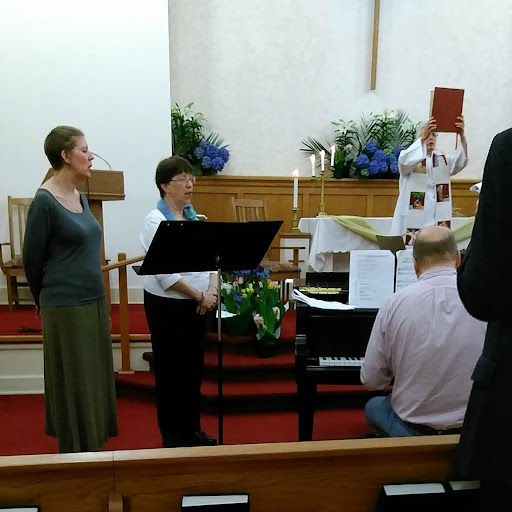
Music ministers Kate and Ann Klonowski with Dave Debic, and Mary Eileen processing with Gospel Book

Mary Eileen blessing the Easter water for the Assembly gathered.


Homily for Easter Vigil, 2017
In the 1998 movie, You’ve Got Mail, Tom Hanks plays an ambitious book store owner who opens one of his stores in a New York City neighborhood. Meanwhile, Meg Ryan plays the local children’s bookshop owner who goes out of business because of the big box competition that lured her sales across the street.  At one point in the film, Hanks’ interest in this woman moves him to pay her a visit.  He finds Ryan in her apartment nursing a bad cold. Charming his way in with a bouquet of daisies, they begin a conversation that develops into an interesting exchange with Hanks claiming, “It wasn’t personal.”  Ryan retorts with, “What does that mean anyway? …whatever else anything is, it ought to begin by being personal.”
Our Lenten journey as members of the Community of St. Bridget started out with a personal plan.  It was suggested that we read the weekly reflections in Sr. Joan Chittister’s booklet, The Prophet in You, that follow the Gospel readings from the first week of Lent through the Resurrection on Easter, seven weeks total.  During that journey of reflection, Sr. Joan challenged us to meditate on how we can grow, heal others by our physical and spiritual touch, find a venue that would fruitfully direct our passion, discover a new vision, love deeply to the point of tears, improve the life of others so that Jesus’ face becomes clearer, and find a way to live faithfully in a hostile world. Yes, this was our personal beginning…  It left some of us feeling like the reflections before us were more like the big box behemoth in the movie that moved in across the street, and they were sucking the life out of the little we thought we had.  Yep! This assignment was a lot of work.
Leaving that aside, tonight I want to share with you a very intimate thread that weaves through the history of Christianity. Columnist Sr. Joan Roccasalvo, C.S.J. piqued my memory with her writing on this theme.   
In the Old Testament are poor people of every sort: the vulnerable, the marginalized, and socio-economically depressed, those of lowly status without earthly power, a group of people referred to in Hebrew as the anawim.  This expression is used frequently in the Bible, especially in the Psalms, and is the basis for Jesus’ belief that the poor are those blessed among us.  The anawim are a people who lovingly surrender to Holy Mystery, remaining faithful and waiting for the Holy One to fill their emptiness.
Mary of Nazareth belonged to the anawim.  Her life of fidelity and free acceptance in allowing the Spirit to work in her came to voice in the Magnificat, where she acknowledged that the Almighty had done great things for her in her lowliness.  Mary is the star among the anawim about whom Jesus later speaks in the Sermon on the Mount, “Blessed are the poor.” In a letter to the Philippians, Jesus is said to have “emptied himself,” freely choosing to give up wealth of any kind, and become poor in many earthly ways, even to the point of feeling spiritually abandoned.  Jesus and his Mother embraced their station in life knowing the embrace of the Divine in their doing so.
Our Old Testament readings tonight are messages that look toward the future, much like the anawim looked ahead and believed they would be eventually and eternally satisfied.
As we reflect on the readings offered at this Easter Vigil, religious writer Rita Ferrone sheds light that provides some clarity.  Our faith is in the creation story, showing the power of the Holy One to give life and to create a new world, always poised to act again in our liturgy.
In our Exodus reading, the events at the Red Sea underscore the Christian conviction that true freedom comes by passing through the water.
Isaiah offers us a compelling invitation to come to the water and partake of a feast.  These passages sing to us of the loving and generous promises of the Sacred Presence that holds us together.  They awaken hope and expectation not only for the sacred moments we celebrate, but for the life into which these moments welcome us. 
The passage from the Book of Baruch uses the title “Divine Wisdom” as a figure of Christ, who we now believe is among us on Earth and converses with us. 
These readings are from the past, but they tell us more than how the Divine acted a long time ago. They illuminate what that Divine Presence is still doing and will continue to do for us.  They speak of origins and destiny together.  Much like what our liturgy celebrates for us today.
In the New Testament reading tonight, St. Paul’s letter to the Romans lays out very clearly that if we follow Jesus through death, through hardships, through uncertainties and fear, we will rise with Jesus and live a new life forever.
And the best part, the Gospel story of Mary Magdalene who is charged with being the first evangelist -- the first apostle among them all -- was sent to tell the disciples that Jesus had risen.  This is indeed a saving event not only for humankind as a whole, but specifically for all women.
Tonight, there is very real reason to celebrate!  As we gather together, we are the anawim spirit.  This Community has gathered and includes those who are frustrated over the lack of vision and inclusivity in our church, who are indignant over the lack of transparency and equality in her leadership, are disappointed in the restoration of ancient prayers that do not reflect the understandings of an enlightened people, and those who are excluded from a traditional faith community because their lifestyles and those they love are not recognized as part of the Creator’s plan for life.  Women are major players in the anawim of today.  In addition to all the social and religious oppression we continually face in our world, we have endured the exclusion from lawful ordination in the Roman Catholic Church based on culturally conditioned and long documented discrimination.  Ann and I are now leading the prayer of our sacred liturgies, and there are other women tonight, spanning five continents across the planet, who are doing the same.  The anawim spirit has been resurrected once again among us and is coming to light in the face of bias, prejudice, and injustice.  The lowly have once again come into the Light!
Tonight, we are the anawim -- living examples of new hope entering our world and our church. 
My friends, we began with a personal journey that was before us, and, as was stated in the words of the shop girl character in You’ve Got Mail, “Whatever else anything is, it ought to begin by being personal.”  But our journey is more than personal, isn’t it?  We are a community, and, as such, we enjoy the harvest of our faith together -- our own personal resurrection and our communal resurrection in Christ.  We are truly an Easter People!  May you know and experience the effects of this sacred event as your joy and resurrected hope is shared with all you encounter. 
Happy Easter!


-->

-->