Translate

Friday, May 19, 2017

Decrease in Number of Priests Statistics/ Bishop Gumbleton Calls for Ordination of Married Men and Women

  1. https://www.churchmilitant.com/news/article/new-vatican-report-shows-global-decline-in-priests
a look at the statistics that tell of a decreasing number of priests worldwide except for Africa. 

2. And a bishop’s response from Retired Detroit MI: Bishop Thomas Gumbleton:
"I read just the other day that the Archdiocese of Chicago, with over two million Catholic people, has less than 800 priests right now. Within a decade, it will be down to less than 400 — 300 and some priests for over two million people. How can we serve the church adequately with the Eucharist and with the other sacraments if we fail to find a way to bring more ordained ministers into our church? I’m sure all of you would say easily and quickly, “I can think of ways. Ordain married men. Ordain women.” We could have all the ministers we need and quickly."
 Quote received from John Chuchman [mailto:poetman@colicom.com]

"Not a Novelty The Eastern Orthodox Case for Deaconesses" By Carrie Frederick Frost

https://www.commonwealmagazine.org/not-novelty

I think there's a very important difference between the Orthodox faithful and Catholic faithful. The RC Church in the US alone has lost 33 million Catholics. Why?  Certainly some of that exodus has to do with the sex abuse scandal, sexism (no female priests) and the marginalization of the LGBTQ community.The most recent respectable poll (BANRA) shows that 80 per cent of Catholics favor the ordination of women. We call that the voice of the Spirit, the Sensus Fidelium moving through the people of God. It's been consistently disregarded by the Vatican hierarchy. Janice Sevre Duszynska ARCWP, Program Coordinator, Media

 "I watched with interest in August 2016 when Pope Francis made good on his promise to convene a commission to study the female diaconate. I was especially attentive to this development because I am a supporter of the renewal of the order of deaconesses in my own church—the Orthodox Church. Later last year I was astonished when one of the self-governing churches of the Orthodox world, Alexandria, decided to revive the female diaconate in Africa and proceeded to consecrate five women as deaconesses this past February. These moves by the Synod of Alexandria surprised those of us in the United States working on this issue—we did not know the female diaconate was even under consideration by the African church. Rarely does anything happen this fast in the Orthodox world.
That we were unaware of support for the female diaconate in Africa is evidence of two Orthodox realities. First, our church is fragmented: we do not yet have established international mechanisms for theologians and historians, or even hierarchs, to communicate with one another. Second, the autocephalous Orthodox churches throughout the world are self-governing, which means that any one of them could decide to revive the female diaconate tomorrow and ordain a deaconess the next day.
As my Catholic sisters and brothers await the report from Pope Francis’s commission, we in the Orthodox Church are waiting to learn more about the ministry of the new deaconesses in Africa. The Synod of Alexandria has not yet published an official description of their duties, but it has informally suggested that these women will assist with missionary work, such as catechism and baptism, as well as conducting services in mission parishes that have no regular priest. We are also waiting to see if another Orthodox church will follow in Alexandria’s footsteps, and to find out what the female diaconate will look like in other parts of the world.

We know at least one thing already: it will not be a novelty. There is ample evidence of a female diaconate through the twelfth century in the Orthodox Church—a fact of great importance in a tradition that zealously values precedent. From the third century on, there are several extant texts that include or mention ordination rites for deaconesses. From these texts, we know that deaconesses were ordained at the altar during the Divine Liturgy, that they received the Eucharist with the other ordained orders and had an orarion (deacon’s stole) placed over their necks, and that their bishop laid hands on them.
There are also ample records of women who were deaconesses in the Christian East, starting with Paul’s esteemed benefactor Saint Phoebe in the middle of the first century. (Though the term Saint Paul uses to describe her is somewhat ambiguous, the Orthodox Church has long presented Phoebe as a deaconess in its prayers, hymns, and iconography, which often shows her holding a diaconal censor.) We still have detailed records of some of these women: Saint Olympias, the friend and confidant of Saint John Chrysostom; Saint Nonna, the mother of Saint Gregory the Theologian; Saint Irene of Chrysovalantou, an abbess of the ninth century. At the height of the Byzantine Empire, one could find deaconesses in many places, including Jerusalem, Constantinople, and Thessalonica.The precise historical roles and responsibilities of deaconesses are less clear. The language of a surviving eighth-century ordination rite is broad: “Bestow the grace of your Holy Spirit also upon this your servant who desires to offer herself to you and fill her with the grace of the diaconate just as you gave the grace of your diaconate to Phoebe whom you called to the work of ministry.” Deaconesses were said to serve their bishops by being available for “many things,” as noted in the third-century Christian treatise, the Didascalia apostolorum. Surviving lists of their duties include: assisting with female baptism; administrative work, such as management of church properties; processing and chanting during liturgy; and many ministries to other women, such as catechetical instruction, spiritual advising, charitable care of widows, ministry to the ill, and bearing the Eucharist to the homebound. The job description of deaconesses changed according to time and place, adapting to new needs. But then, so did the job descriptions of deacons, priests, and bishops.
As Catholics await the report from Francis’s commission, the Orthodox Church waits to learn about the ministry of deaconesses in Africa
The big question about the female diaconate in the Christian East is why it diminished so rapidly in the late Byzantine era. Was it monastic influence? During this period, liturgical rites that included rubrics for deaconesses were replaced with rites from male monasteries that lacked such rubrics. Was it geopolitical forces? ..."

"When the Clergy are 1 %" , Questions from a Ewe

http://questionsfromaewe.blogspot.com/2017/05/when-clergy-are-1.html?utm_source=feedburner&utm_medium=email&utm_campaign=Feed%3A+QuestionsFromAEwe+%28Questions+from+a+Ewe%29

A re-appreciation of Julian of Norwich's ‘gospel of love’ Veronica Mary Rolf May 11, 2017

https://www.americamagazine.org/faith/2017/05/11/re-appreciation-julian-norwichs-gospel-love

"During the past century, the explosion of interest in the Shewings (or Revelations) of Julian of Norwich has been astounding. Why is this? I think because Julian’s Shewings are, above all, a gospel of love. They bear witness that we are created in love, redeemed by love and enclosed within love. And because we have been loved in God’s mind “from without beginning,” as Julian puts it, so “in this love our life is everlasting.” Julian understood that love was the meaning of all Christ’s revelations.
Julian of Norwich lived in the 14th century during the Hundred Years War between England and France. She was probably a merchant-class wife and mother before she became enclosed as an anchorite in her 50s. She survived five cycles of the plague that eventually killed half the population of Europe, and she witnessed first-hand the brutalities of the peasant revolt in Norwich. In 1373, at the age of 30, Julian became deathly ill and experienced visions of Christ’s suffering on the cross. She also heard Christ speak directly to her, interiorly."
Thomas Merton called Julian “one of the most wonderful of all Christian voices” and “the greatest English theologian.”

We Celebrate Our Voices

https://vimeo.com/217308713

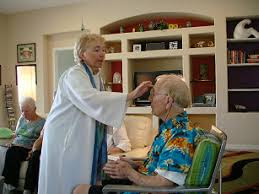
Anointing of Katy Zatsick by Elena Garcia ARCWP and Mary Mother of Jesus Inclusive Catholic Community before hip surgery on June 21, 2017

Left to right, Pat MacMillan, Elena Garcia ARCWP, Bob MacMillan, Russ Banner and Katy Zatsick ARCWP
(Elena presided at Rite as part of preparation program/unit work for one of the ARCWP units. The entire community prayed - 30 people. This photo was taken after the prayer to demonstrate the communal nature of the Rite. )

Presider: All are invited to gather around Katy as we invoke God’s grace and blessing on her and her surgical team. 

ALL:  Glory be to you Source of all being, Eternal word and Holy Spirit Sofia, as it was in the beginning is now and will be forever. Amen

Presider: Loving Mother and Father God, from our mother’s womb you pronounced our names and you have soothed us saying, “Do not worry about tomorrow”. 

Voice 1: We thank you that you pour out your Spirit upon us within each day.
Voice 2: We thank you that your loving blessings are sufficient for us within each moment that we live. 

ALL: We pray for our beloved sister Katy that she will know your peace in her heart as she waits to undergo hip surgery in June. We ask for a peace that surpasses all understanding and guards her heart and mind. A peace offered by Jesus every minute of every day.

Voice 3: May she rest into your promises and lean back into your love for her with total confidence in your loving providence. Remove from her heart all painful anxiety.  

Voice 4: Holy Spirit guide the hands and hearts of the nurses and surgeons who will work with Katy, giving her hope, relieving her pain and bringing restoration.

ALLWe believe with a most lively and unlimited confidence that we are safe in the arms of your Divine Providence when we are most vulnerable.

Presider:  Katy, the same spirit that moved in Jesus dwells in you and fills you with love and peace beyond all imagination.  All of your loved ones in this community and the communion of saints join us in prayer. In their name and in the name of God we now anoint you for your journey.
(anoint Katy’s forehead and hands)

ALL: Katy, you are embraced by the Holy One and by all who are praying for you.  May you feel the power of divine love healing, comforting and strengthening you. In the name of God our Creator, Jesus our Brother and Holy Spirit Wisdom. Amen.

Presider: Let us pray as Jesus taught us. 
ALLOur Father and Mother…

Chant

Psalm 139: sung by Kathryn Christian

https://www.youtube.com/watch?v=l1Z8j576HLU&sns=em
"for you have formed in my mother's womb my days are safely secure..."


Thursday, May 18, 2017

Mother's Day Vigil / Vigilia Por El Día De Las Madres by Silvia Brandon Perez ARCWP

Bilingual format: formato bilingüe

English
As all of you should know, Mother's Day in the US was an antiwar protest, represented by Julia Ward Howe's poem, which begins appropriately with: Arise, all women who have hearts, whether your baptism be that of water or of tears! Say firmly: “We will not have great questions decided by irrelevant agencies, our husbands shall not come to us, reeking with carnage, for caresses and applause." 

Spanish
 Como todos deben saber, el día de las madres en los EE.UU. fue una protesta en contra de la guerra, representado por el poema de Julia Ward Howe, que comienza de forma muy apropiada con la siguiente estrofa: Álcense, todas las mujeres que tienen corazones, ¡ya sea que su bautismo sea del agua o de las lágrimas! Digan con firmeza: "No permitiremos que las preguntas importantes sean decididas por agencias irrelevantes, y nuestros maridos no vendrán a nosotros, con la peste de la matanza y la carnicería, para que les demos caricias y aplausos."

English
It has become, as so many things in our grubby capitalist society, another "shopping" holiday, rather than the holy day it was meant to be. We express our love for those who gave us life by presents, and merchants get richer but we don't change a thing in our society or in the world at large by celebrating this merchants' well-orchestrated carnival. 

Spanish
Como tantas cosas en nuestra asquerosa sociedad capitalista, esta fecha se ha convertido en otra fiesta de mercadería, en lugar de día sagrado que debió ser. Expresamos nuestro amor por las que nos dieron la vida mediante la compra de regalos, y los mercaderes se enriquecen pero no cambiamos nada en nuestra sociedad o en el mundo en general al celebrar este carnaval tan bien instrumentado por los mercaderes.

English
The Mother's Day vigil at West County Detention Center was wonderfully different; we supported the many mothers who are imprisoned there and in other immigrant prisons throughout the country. We had testimony from a woman whose husband is imprisoned and who needs housing and money for bail; her husband, who is very ill, has been detained for 2 years because he cannot afford to make bail. This is a violation of the reason for bail in the first place, and of the 9th Circuit's holding (for California, at least), in RODRIGUEZ v. ROBBINS, 804 F.3d 1060 (2015), which held that immigrants who were expected to be detained for at least six months had to have bond hearings (mandatory) and those bond hearings were required to be held again in six months if the immigrant could not make bond. 

Spanish
 La vigilia del día de las madres en el centro de detenciones de West County fue muy diferente, de forma maravillosa; apoyamos a las muchas madres que están presas en ese centro y en muchos otros centros de detenciones a lo largo del país. Oímos el testimonio de una mujer cuyo esposo está preso y que necesita alojamiento y dinero para pagar la fianza; su esposo, que está muy enfermo, ha estado encarcelado por los últimos dos años porque no ha podigo pagar la fianza. Esta es una violación del concepto de fianza como tal, y de la decisión del Circuito 9 (para California, al menos) en el caso de RODRIGUEZ v. ROBBINS, 804 F.3d 1060 (2015), que expresa que los inmigrants que se piensa estarán detenidos al menos seis meses tienen que tener (como cosa obligatoria) audiencias para determinar una fianza, y que incluso si no pudieran pagarla, tienen que tener nuevas audiencias cada seis meses.

English
Our vigil was heartwarming and similar to the monthly vigils we have celebrated on the 1st Saturday of every month for at least five years at the WCDC. We met, talked, sang, and shared testimony. Here is a video taken by Michael Kerr (actually, there are seven videos) of the event; it is the second Sunday vigil, and will be repeated on the second Sunday of each month for those who cannot attend our Saturday vigils because of the Sabbath.

Spanish
 Nuestra vigilia fue acogedora y similar a las vigilias mensuales que hemos celebrado el primer sábado de cada mes durante cinco años en el centro de detenciones de West County. Nos reunimos, hablamos, cantamos y compartimos testimonios. Aquí les comparto un video tomado por Michael Kerr (en realidad, hay siete videos) del evento; es la segunda vigilia celebrada el domingo, y se repetirá en el segundo domingo de cada mes para los que no pueden asistir debido al sabbat a nuestras vigilias los sábados.

English
He also took great photos which I hope to add to an album and share with his permission.  This event was very well attended including many children, which is very appropriate for a Mother's Day event!  

Spanish
También tomó fotos excelentes que pienso añadir a un álbum y compartirlo, con su permiso. Este evento tuvo muy biena asistencia y tuvo muchos niños, ¡lo que es muy apropiado en particular en el día de las madres!

Make yours a traditional** Mother's Day this Sunday! STAND UP for the Bay Area's separated families and protest immoral American immigration policies! Join K...


My Encounter with Cookie, the Broken Body of Christ, in Sarasota Today

Cookie in Sarasota, Florida

Today, Cookie, not her real name, shared with me that she was recently hospitalized with seizures, and an unidentified man said he was working on getting her into an Assisted Living facility. I sure hope this will happen soon.  I was deeply touched by her witness to Jesus' love embracing her in her pain. She is the broken body of Christ in our midst, and our call is to help her. She needs more than a hug and McDonald's food that I can give her. Bridget Mary Meehan, sofiabmm@aol.com


"Is it Freedom?" by Sara Thomsen

https://www.youtube.com/watch?v=bqXSl1AIimY&feature=youtu.be

Wednesday, May 17, 2017

Krista Tippett- "Becoming Wise: An Inquiry into the Mystery and Art of Living"

https://www.youtube.com/watch?v=o5S7b4Y9Ugw&feature=youtu.be

People's Catholic Seminary, A Journey to Spiritual Transformation

https://evangelizadorasdelosapostoles.wordpress.com/2017/05/16/seminario-catolico-de-la-gente-pcs-un-viaje-a-la-transformacion-espiritual/ (Spanish translation)


A Journey to Spiritual Transformation

Vision

People's Catholic Seminary, a seminary without walls, offers programs to inspire and educate individuals and groups who embrace a vision of church that is inclusive, liberating, empowering and equal.

Matthew Fox, one of the great visionaries of our times, proposes that contemporary seminaries move from knowledge factories to wisdom schools. PCS offers pathways to theological and ministerial competencies in a renewed priestly ministry that nurtures our baptismal call to live holy lives as midwives of grace in mystical, prophetic, and sacramental communities of equals.

Mission

People’s Catholic Seminary provides educational programs that appeal to mainstream Catholics and to those on the margins. Our programs foster an expanded worldview of our liberating God of compassion present in all and working for justice for all through systemic change. As co-creators and companions on a journey, we share the wisdom of God in our sacred texts, theologies, sacred practices, sacramental celebrations, and lived experiences. 


Overview of Programs

Spiritual Development

People’s Catholic Seminary provides a broad range of on-line learning experiences and spirituality programs that are open to adult participants regardless of previous educational background. We recognize that women’s roles in the world religions are undergoing dramatic shifts and changes that have been inspired by a transformative consciousness of gender equality and justice.

Spiritual Development Programs

SDP101: The Healing Power of Prayer

Certificate Programs for Ministry

People’s Catholic Seminary offers certificate programs for candidates on the journey to ordination and for supporters and community members. The certificate programs provide a comprehensive overview to theology, scripture, women studies and sacramental ministry. These programs are designed for the candidate preparing for ordination who needs basic knowledge in contemporary theology to begin a pathway to ministry.

Certificate Programs

Certificate Program I – Introduction to Pastoral Ministry
101. Introduction to Contemporary Theology
201. Jesus of Nazareth – Christ of the Cosmos
202. Rediscovering Jesus in a Companionship of Empowerment
302. Spiritual Encounters with Women Mystics for the 21st Century
303. Praying with Women in the Hebrew Scriptures
304. Praying with Women of the Gospel
305. Praying with Women in Ministry in the Early Church
401. History of the Sacraments

Certificate Program II – Sacramental Theology and Ritual
501. Eucharist
601. Baptism and Confirmation
701. Marriage, Sexuality, Just Love
801. Compassion and Reconciliation
901. Anointing of the Sick: Healing and Wholeness

Cost

The average cost is $10 per session. Programs run from 6-12 sessions. The sessions are mostly on-line through Blogger.

Instructors

All instructors are highly qualified in their field, hold a master’s degree or doctorate in theology, ministry, spirituality or pastoral ministry, and adhere to the vision and mission of the organization.


Founders and Administrators

Dr. Bridget Mary Meehan, ARCWP and Dr. Mary Theresa Streck, ARCWP are founding members of the People’s Catholic Seminary. Please send inquiries about the People’s Catholic Seminary to peoplescatholicseminary@gmail.com.


-->