
Living Gospel Inclusivity and Empowerment Now- https://bridgetmarys.blogspot.com/2025/10/rev-dr-bridget-mary-meehan-arcwp-chat.html
Thursday, June 22, 2017
Call 1-888-738-3058 Now to Protect MEDICAID, Message from Sister Simone Campbell,NETWORK
MESSAGE FROM SISTER SIMONE CAMPBELL IN NETWORK
Senate Republicans have finally released their healthcare bill to the public, and it confirms what we already knew: this cruel bill would cause massive harm to our families and must be rejected.
Senate leadership is rushing the bill (which they are now calling the Better Care Reconciliation Act) to a vote by June 30 and get it one step closer to President Trump's desk. To be clear: this is the American Health Care Act (AHCA) but worse. Today, and the next few days, are our last best chance to stop this immoral bill.
We need you to call your Senators at 1-888-738-3058 NOW to oppose the GOP health plan and protect Medicaid.
Call twice to reach both Senators.
After the House passed the AHCA in May, you told your Senators that the AHCA was beyond repair, and many of them promised to craft a better bill. Instead, they made the cruel cuts to Medicaid even deeper, kept most of the harmful aspects of the House bill and changed the name. This bill endangers over 70 million children, disabled people, seniors in nursing homes, and hardworking individuals and families who rely on Medicaid for healthcare.
Lives are on the line, and your calls can make the difference. We need to let Senators (in Republican and Democratic offices!) know that people of faith support healthcare and are against this bill.
Call your Senators at 1-888-738-3058 NOW.
Call twice to reach both Senators...and keep calling until we stop this bill!
When you call, here’s what you might say:
“Hi, my name is [NAME] and I am a constituent from [CITY/TOWN]. As a person of faith, I’m calling to oppose the Better Care Reconciliation Act. I oppose any efforts to cut or cap Medicaid, and no one should lose coverage as a result of any healthcare replacement. Please protect the human dignity of the millions of Americans who would lose coverage and oppose the Better Care Reconciliation Act.”*
*Also add your personal story!
Millions of lives are on the line. Please call your Senators (call twice!) at 1-888-738-3058 to stop this bill.
Then, when you’re done, forward this email to all your friends so they can make their calls as well. If you know anyone in Alaska, Arizona, Iowa, Louisiana, Maine, Nevada, Ohio, Pennsylvania, Tennessee, or West Virginia forward this email to them -- it is ESPECIALLY important that they make their calls!
 In solidarity,
Sr. Simone Campbell, SSS
Executive Director
P.S. Share your belief that healthcare is a right on social media! Share these graphics on Facebook and Twitter with NETWORK's call to action.
Senate Republicans have finally released their healthcare bill to the public, and it confirms what we already knew: this cruel bill would cause massive harm to our families and must be rejected.
Senate leadership is rushing the bill (which they are now calling the Better Care Reconciliation Act) to a vote by June 30 and get it one step closer to President Trump's desk. To be clear: this is the American Health Care Act (AHCA) but worse. Today, and the next few days, are our last best chance to stop this immoral bill.
We need you to call your Senators at 1-888-738-3058 NOW to oppose the GOP health plan and protect Medicaid.
Call twice to reach both Senators.
After the House passed the AHCA in May, you told your Senators that the AHCA was beyond repair, and many of them promised to craft a better bill. Instead, they made the cruel cuts to Medicaid even deeper, kept most of the harmful aspects of the House bill and changed the name. This bill endangers over 70 million children, disabled people, seniors in nursing homes, and hardworking individuals and families who rely on Medicaid for healthcare.
Lives are on the line, and your calls can make the difference. We need to let Senators (in Republican and Democratic offices!) know that people of faith support healthcare and are against this bill.
Call your Senators at 1-888-738-3058 NOW.
Call twice to reach both Senators...and keep calling until we stop this bill!
When you call, here’s what you might say:
“Hi, my name is [NAME] and I am a constituent from [CITY/TOWN]. As a person of faith, I’m calling to oppose the Better Care Reconciliation Act. I oppose any efforts to cut or cap Medicaid, and no one should lose coverage as a result of any healthcare replacement. Please protect the human dignity of the millions of Americans who would lose coverage and oppose the Better Care Reconciliation Act.”*
*Also add your personal story!
Millions of lives are on the line. Please call your Senators (call twice!) at 1-888-738-3058 to stop this bill.
Then, when you’re done, forward this email to all your friends so they can make their calls as well. If you know anyone in Alaska, Arizona, Iowa, Louisiana, Maine, Nevada, Ohio, Pennsylvania, Tennessee, or West Virginia forward this email to them -- it is ESPECIALLY important that they make their calls!
In solidarity,Sr. Simone Campbell, SSS
Executive Director
P.S. Share your belief that healthcare is a right on social media! Share these graphics on Facebook and Twitter with NETWORK's call to action.
Wednesday, June 21, 2017
"When Priests Display Misogyny, They Subvert the Persona Christi" by Rebecca Bratten Weiss
http://www.patheos.com/blogs/suspendedinherjar/2017/06/priests-display-misogyny-subvert-persona-christi/
"One of the most compelling elements, for me, in the Gospel accounts of the life of Jesus, is the way he interacted with women. At a time when women were relegated to the margins of society, easily discarded, punished for the wrongdoings of men, Jesus did the radical thing, and treated women like human persons. I’d like to point out here that the etymology of “radical” is “radix” or “root” – and Jesus’ radicality in treating women like persons has to do with roots and origins, going back to the original unity of men and women, the original equality, immortal souls hungering for their creator. When he meets the Samaritan woman at the well, his emphasis is less on the number of men she has been with, and more on the thirst she has for the living water that will never run dry. Perhaps when we thirst, we try to slake our desires with those earthly goods and pleasures that never quite suffice? Men and women both, we do this.
Women were drawn to Jesus, healed by him, traveled with him. Women stayed by his side when Judas had betrayed him, Peter denied him, and all the other of the Twelve but John run away. Women prepared him for burial, and it was to a woman that the resurrected Christ first was made manifest.
And this is why it is so contrary to the persona of Christ, when priests exhibit misogyny. Oh, no doubt they can find select precedents among church fathers, saints, and theologians, but none of these groups are guaranteed to be infallible, and when their words run counter to the example of Christ, they carry no authority beyond that which can be evaluated in relation to reason and evidence.
Exhibit A in this regard: the blog of the self-styled “Fr. Z”, who here deplores the devotion to Divine Mercy because it is, apparently, feminine.
I would not actually recommend that you peruse this piece, if you wish to avoid a near occasion of sin...."
We are called to be Mystics in Action Everyday!
Carl Jung says that it is to the mystics that we owe what is best in humanity and that mystics bring creativity to religion itself. The Prophet who struggles for justice has been called “the mystic in action. We are called to be mystics in action everyday!


Tell your member of Congress: Catholics oppose discrimination
 |
Conservative members of Congress have reintroduced HR 644/S 301, a bill that would impede access to critical health services for many in our society and allow several entities to usurp the consciences and health rights of individual employees, patients and service beneficiaries. If passed, this bill will imperil access to reproductive healthcare for millions of women. We can’t let the Catholic hierarchy impose one narrow set of religious beliefs on everyone else, nor be allowed to enact one religious viewpoint into public law.
Tell your member of Congress to oppose HR 644/ S 301.
Sen. Clarence William Nelson
District: FLS01
Phone:(202) 224-5274
Fax:(202) 228-2183
Sen. Marco A. Rubio
District: FLS02
Phone:(202) 224-3041
Fax:(202) 228-0285
Rep. Vernon G. Buchanan

District: FL16
Phone:(202) 225-5015
Fax:(202) 226-0828
Tuesday, June 20, 2017
Thoughts of a RC Woman Parish Priest: In Response to Pope Francis’ Praise of Parish Priests by Judy Lee RCWP
https://judyabl.blog/2017/06/20/thoughts-of-a-rc-woman-parish-priest-in-response-to-pope-francis-praise-of-parish-priests/


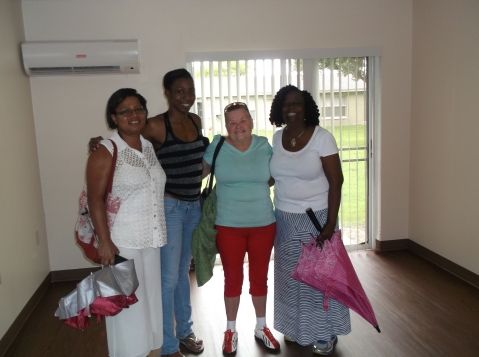
Today, June 20,2017 Pope Francis gave an inspiring speech praising parish priests in various parts of Italy who entered into the dark corners of society and reached out with the hands of Christ by keeping the poor and marginalized primary in their service.
Rev. Dr. Bridget Mary Meehan of the Association of Roman Catholic Women Priests responded in her blog that she hoped the Pope would also end the darkness of the church by including women priests in his consideration for Holy Orders. I would like to illustrate the ministry of three RC woman priests,members of Roman Catholic Women Priests, Eastern Region who attempt the kind of service the Pope desires of priests. Even as illness causes a curtailing of services of the Good Shepherd Inclusive Catholic Community in Fort Myers, Pastors Judy Lee and Judy Beaumont and Marina Teresa Sanchez Mejia press on as parish priests among the poor and homeless and marginalized. We present here some of the recent activities of two RC women Priests and then ,for reference, the articles on Pope Francis’ Speech and Rev. Dr. Meehan’s Response.
Rev. Dr. Bridget Mary Meehan of the Association of Roman Catholic Women Priests responded in her blog that she hoped the Pope would also end the darkness of the church by including women priests in his consideration for Holy Orders. I would like to illustrate the ministry of three RC woman priests,members of Roman Catholic Women Priests, Eastern Region who attempt the kind of service the Pope desires of priests. Even as illness causes a curtailing of services of the Good Shepherd Inclusive Catholic Community in Fort Myers, Pastors Judy Lee and Judy Beaumont and Marina Teresa Sanchez Mejia press on as parish priests among the poor and homeless and marginalized. We present here some of the recent activities of two RC women Priests and then ,for reference, the articles on Pope Francis’ Speech and Rev. Dr. Meehan’s Response.
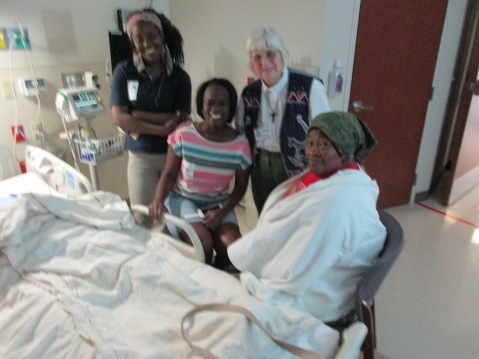
Here (above) we minister to and with a church member and her family as she deals with hospitalization for advanced cancer and critical corollary problems. Linda has been in the hospital for almost 40 days now and her Health Plan, for those on Disability, is inadequate for discharge planning. Also she has so many Doctors who do not coordinate with each other that she is hardly seen as a whole person and her cancer treatment has fallen by the wayside while the family needs much assistance in negotiating the medical and hospital systems that are critical to her life. Pastor Judy Lee is working with the oldest children and the husband to help them get the best care for her and she is also challenging the systems directly herself. She has helped them apply to two Cancer Foundations for help with daily living expenses so they do not become homeless as their Mom receives treatment. She has anointed Linda with the family present and participating twice and prays with the family as often as she can. This is a family that is falling between all of the cracks and suffering with a lack of real safety net for the poor in America and in this area. Pastoral work with Linda and this extended family of over 20 people includes many helpers from the congregation. This large and close family keeps vigil in the hospital almost daily.
Below Judy Alves is with one of the little nieces who visit the hospital and Judy Alves, a Lawyer, is also the mentor for Linda’s 15 year old twins. She takes them to tutoring, and enriching educational opportunities and monitors school progress while their Mom is so ill.

Below Judy Alves is with one of the little nieces who visit the hospital and Judy Alves, a Lawyer, is also the mentor for Linda’s 15 year old twins. She takes them to tutoring, and enriching educational opportunities and monitors school progress while their Mom is so ill.
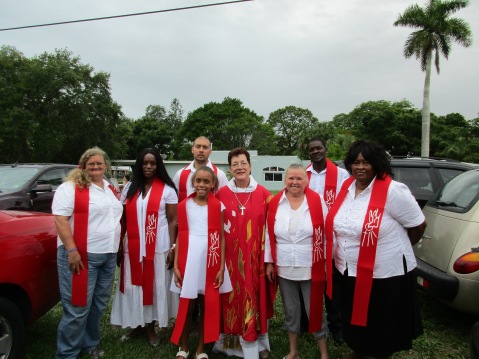
Here (below) are some members of the Core leadership Group with the three Pastors serving this community after a recent Mass. We must be fed in order to feed the sheep.
Another pastoral activity is helping to prevent homelessness with supporting formerly homeless people in housing and helping them to find new housing when needed. Brenda (left) is seeking housing for her family of two and four pets. Mr. Gary is continually thankful for his apartment in housing for the physically disabled, and Patricia is delighted with her housing in Senior Housing.
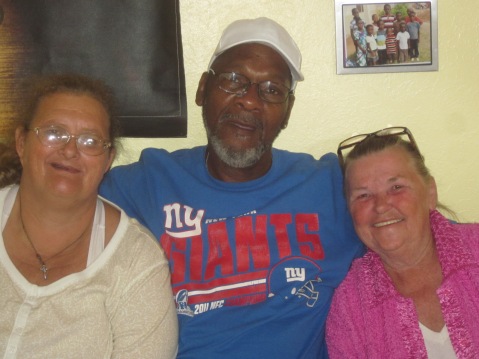
Below Patricia shows her home to our parishioners . Patricia lived in the woods for almost two years before meeting our Pastors and then living behind our church for seven months. She remains a member of our community and was confirmed in 2016 along with Brenda and two members of Linda’s family, her eldest son, Quayschaun and her mother, Mrs. Jolinda Harmon.
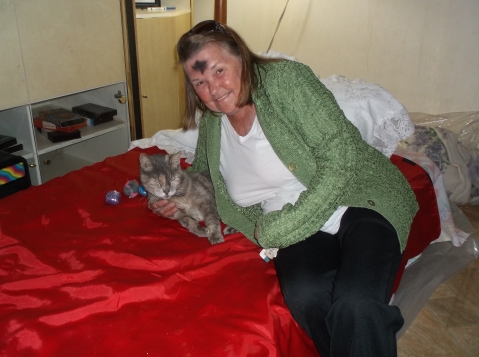
Two months ago Patricia lost her beloved cat Sarah who died suddenly. Sarah was her companion in the woods and in her church and Senior Housing. (above Pat and Sarah relax in their room behind the church). Pat was truly bereaved at Sarah’s loss and we shared her grief. Last week Pastor Judy Beaumont and I brought her a little kitten that completed her home and family again. Assisting homeless animals often brings joy to our people as well.
Our church members were so happy to participate in the ordination of R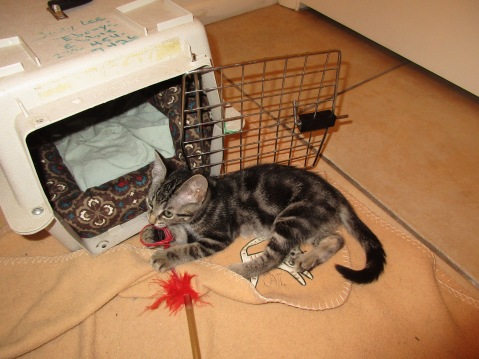 ev. Maria Elena Sierra Sanchez at our church, welcoming a new Pastor who would serve the poor and outcast in Colombia, South America.
ev. Maria Elena Sierra Sanchez at our church, welcoming a new Pastor who would serve the poor and outcast in Colombia, South America.
Pope Francis, will you welcome your new women Roman Catholic Priests of the Poor as well?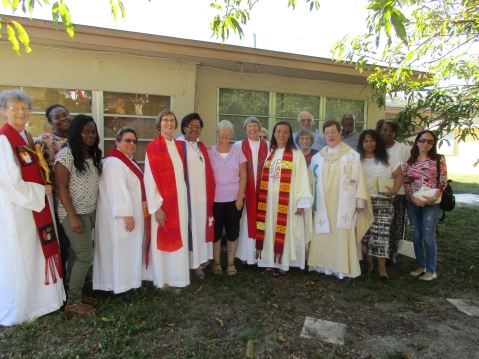
From Radio Vaticana:
Pope Francis pays tribute to “Italy’s parish priest”
Pope Francis pays tribute to Father Primo Mazzolari in Bozzolo, near Cremona – ANSA
Pope Francis pays tribute to Father Primo Mazzolari in Bozzolo, near Cremona – ANSA
Pope Francis pays tribute to “Italy’s parish priest”
Pope Francis pays tribute to Father Primo Mazzolari in Bozzolo, near Cremona – ANSA
Pope Francis pays tribute to Father Primo Mazzolari in Bozzolo, near Cremona – ANSA
20/06/2017 12:58SHARE:
(Vatican Radio) Pope Francis on Tuesday made a pilgrimage to northern Italy to honor two 20th-century parish priests whose commitment to the poor and powerless challenged many faithful – inside and outside the Vatican – to step outside their comfort zones.
The Pope flew by helicopter to Bozzolo, near Cremona in the region of Lombardy, to pray at the tomb of Don Primo Mazzolari, parish priest of a small town, a scholar who wrote about St. Francis and Blessed John Henry Newman, he opposed the Mussolini regime and emphasized the importance of the poor. Sanctioned for a time by diocesan authorities, Father Mazzolari was a friend of Pope John XXIII and praised by the future Pope Paul VI. He died in 1959.
The Pope then travelled to Barbiana, near Florence to pay tribute to Don Lorenzo Milani, a wealthy convert to Catholicism who founded a parish school to educate the poor and workers.
In Bozzolo, Francis stood in silent prayer before the simple tomb of Mazzolari, and then delivered a long tribute to the priest whom he described as “Italy’s parish priest.”
The Pope quoted Mazzolari’s writings about the need for the Church to accompany its flock and recalled his exhortation that a priest’s job isn’t to demand perfection from the faithful, but to encourage them to do their best.
Quoting Mazzolari’s own words he said: “Let us have good sense! We don’t to massacre the backs of these poor people.”
He said the legacy of priests like Don Mazzolari is a bright one that challenges us to leave our comfort zones.
“Don Mazzolari tried to change the world without regrets for the past; he was not one who hung on to the Church of the past, but tried to change the Church through love and unconditional dedication” he said.
Pope Francis warned against those men of the Church who “do not want to soil their hands” and who “observe the world through a window”; he warned against those who engage in what he called “separatist activism” where one runs Catholic institutions like banks or businesses; and he spoke out against the temptation for spiritualism which dehumanizes and is devoted only to the apostolate.
Don Mazzolari, the Pope said, conceived the Church going forth into world in the firm belief that that is the only way to reach out to those who do not come to Church any more.
“He was rightly described as ‘the parish priest of those who are far’ because he always loved those on the peripheries and to them dedicated his mission.
Pope Francis concluded his speech with an exhortation to all priests to “listen to the world”, to “step into the dark areas without fear because it is amongst the people that God’s mercy is incarnate.”
He urged them to live in poverty and said that the credibility of the Gospel message is in the simplicity and poverty of the Church and he reminded them always to treasure the lesson of Don Mazzolari.
(Vatican Radio) Pope Francis on Tuesday made a pilgrimage to northern Italy to honor two 20th-century parish priests whose commitment to the poor and powerless challenged many faithful – inside and outside the Vatican – to step outside their comfort zones.
The Pope flew by helicopter to Bozzolo, near Cremona in the region of Lombardy, to pray at the tomb of Don Primo Mazzolari, parish priest of a small town, a scholar who wrote about St. Francis and Blessed John Henry Newman, he opposed the Mussolini regime and emphasized the importance of the poor. Sanctioned for a time by diocesan authorities, Father Mazzolari was a friend of Pope John XXIII and praised by the future Pope Paul VI. He died in 1959.
The Pope then travelled to Barbiana, near Florence to pay tribute to Don Lorenzo Milani, a wealthy convert to Catholicism who founded a parish school to educate the poor and workers.
In Bozzolo, Francis stood in silent prayer before the simple tomb of Mazzolari, and then delivered a long tribute to the priest whom he described as “Italy’s parish priest.”
The Pope quoted Mazzolari’s writings about the need for the Church to accompany its flock and recalled his exhortation that a priest’s job isn’t to demand perfection from the faithful, but to encourage them to do their best.
Quoting Mazzolari’s own words he said: “Let us have good sense! We don’t to massacre the backs of these poor people.”
He said the legacy of priests like Don Mazzolari is a bright one that challenges us to leave our comfort zones.
“Don Mazzolari tried to change the world without regrets for the past; he was not one who hung on to the Church of the past, but tried to change the Church through love and unconditional dedication” he said.
Pope Francis warned against those men of the Church who “do not want to soil their hands” and who “observe the world through a window”; he warned against those who engage in what he called “separatist activism” where one runs Catholic institutions like banks or businesses; and he spoke out against the temptation for spiritualism which dehumanizes and is devoted only to the apostolate.
Don Mazzolari, the Pope said, conceived the Church going forth into world in the firm belief that that is the only way to reach out to those who do not come to Church any more.
“He was rightly described as ‘the parish priest of those who are far’ because he always loved those on the peripheries and to them dedicated his mission.
Pope Francis concluded his speech with an exhortation to all priests to “listen to the world”, to “step into the dark areas without fear because it is amongst the people that God’s mercy is incarnate.”
He urged them to live in poverty and said that the credibility of the Gospel message is in the simplicity and poverty of the Church and he reminded them always to treasure the lesson of Don Mazzolari.
Bridget Mary’s Response:
As a movement for inclusiveness within the Roman Catholic Church, we are on the peripheries, serving the rejected, marginalized Body of Christ. When will Pope Francis leave his comfort zone and embrace a church for everyone including women called to Holy Orders? Bridget Mary Meehan ARCWP, www.arcwp.org
As a movement for inclusiveness within the Roman Catholic Church, we are on the peripheries, serving the rejected, marginalized Body of Christ. When will Pope Francis leave his comfort zone and embrace a church for everyone including women called to Holy Orders? Bridget Mary Meehan ARCWP, www.arcwp.org
"A Spiritual Retreat Can Rearrange Your Mind" by Cindy Lamothe, Sarasota Herald Tribune
http://www.heraldtribune.com/news/20170620/spiritual-retreat-can-rearrange-your-mind
"I wanted to go somewhere so I could figure out how to stop having all of these negative experiences,” she said. Not long after, she packed her bags and boarded a plane to gather with over 200 people on a week-long spiritual retreat in the heart of Ireland.
While there, Kozlowski learned to meditate and listen to herself, experiencing moments of awe and transcendence. She loved the feeling of deep calm and inner peace the group meditations gave her, and attended the retreat three more times.
“It brings awareness to what goes on inside of your subconscious mind,” she explained. “Every single time that I would leave, I would have a better understanding and more acceptance of myself.”
As interest in mindfulness meditation, adult coloring and other calming techniques grows, more people are turning to spiritual retreats as a way to unplug and reset. In the last few years, revenue for “wellness tourism,” which includes meditation and other spiritual retreats, increased by 14 percent, from $494.1 billion in 2013 to $563.2 billion in 2015, a growth rate more than twice as fast as overall tourism expenditures, according to the Global Wellness Institute.
In a recent study in the journal Religion, Brain & Behavior, scientists from The Marcus Institute of Integrative Health at Thomas Jefferson University discovered that changes take place in the brains of retreat participants. The findings, although preliminary, suggest that engaging in a spiritual retreat can have a short-term impact on the brain’s “feel good” dopamine and serotonin function — two neurotransmitters associated with positive emotions..."
NBC News: "Meet the Man Who Wants NYC Catholic Churches to Offer Sanctuary to Immigrants
http://www.nbcnews.com/news/latino/meet-man-who-wants-nyc-catholic-churches-offer-sanctuary-immigrants-n773021
Across the country, churches and congregations have rallied to offer support to undocumented immigrants facing deportation. Now one activist in Manhattan is pushing the powerful Archdiocese of New York to do more to help immigrants.
Felix Cepeda, 36, wants the Roman Catholic Church to open at least one of its shuttered churches and provide sanctuary to undocumented immigrants – a step that would be as bold as it could be potentially risky.
Pope Francis 'Tribute to Italy's Parish Priest", Link to "Two Faces of Francis"
http://en.radiovaticana.va/news/2017/06/20/pope_francis_pays_tribute_to_italys_parish_priest/1320180
Bridget Mary's Response: As a movement for inclusiveness within the Roman Catholic Church, we are on the peripheries, serving the rejected, marginalized Body of Christ. When will Pope Francis leave his comfort zone and embrace a church for everyone including women called to Holy Orders? Bridget Mary Meehan ARCWP, www.arcwp.org
"Don Mazzolari, the Pope said, conceived the Church going forth into world in the firm belief that that is the only way to reach out to those who do not come to Church any more.“He was rightly described as ‘the parish priest of those who are far’ because he always loved those on the peripheries and to them dedicated his mission.Pope Francis concluded his speech with an exhortation to all priests to “listen to the world”, to “step into the dark areas without fear because it is amongst the people that God’s mercy is incarnate.”
http://religionnews.com/2017/06/19/nice-guy-or-tough-guy-the-two-faces-of-pope-francis/
Bridget Mary's Response: As a movement for inclusiveness within the Roman Catholic Church, we are on the peripheries, serving the rejected, marginalized Body of Christ. When will Pope Francis leave his comfort zone and embrace a church for everyone including women called to Holy Orders? Bridget Mary Meehan ARCWP, www.arcwp.org
"Don Mazzolari, the Pope said, conceived the Church going forth into world in the firm belief that that is the only way to reach out to those who do not come to Church any more.“He was rightly described as ‘the parish priest of those who are far’ because he always loved those on the peripheries and to them dedicated his mission.Pope Francis concluded his speech with an exhortation to all priests to “listen to the world”, to “step into the dark areas without fear because it is amongst the people that God’s mercy is incarnate.”
http://religionnews.com/2017/06/19/nice-guy-or-tough-guy-the-two-faces-of-pope-francis/
Olga Lucia Alvarez Benjumea ARCWP: My Experience of Priesthood, Seven Years After Ordination in Colombia, South America
 |
| Olga Lucia Alvarex Benjumea ARCWP, Colombia, South America |
May I share my experience as a woman priest in my 7th year of ordination?
Thank you! With your permission I'll tell you.
When I was ordained my close friends questioned me from head to foot:
"Why did you become a priest ? To be like the priests? "Dressed like them?" "Celebrating just like them?" "We need priests, yes, but different from them." "Very easy, to be a priest, they only seek” power, and to be revered", "Everything very comfortable, they just expect that people come to the temple". "Why does the Church reject you?"
My answers: I became a priest to make the Gospel known, breaking the walls and the distance between the altar and the faithful, following the example of the pioneers of the Gospel: Mary, the mother of Jesus, who runs carrying him in her womb to share him with his cousin, crossing dangerous territories; and Mary of Magdala, who also hurries to deliver the announcement, as Jesus mandated her to bring it to his friends in Galilee. Although the boys did not believe her very much. It seems that same thing happens today. Isn't it?
The alb I use is a Guajira manta. I put on my adornments and earrings and even a little perfume.
We have no temples. We go wherever they call us, request a service, look for and support.
I go there walking, by bus, by Metro. Or by Transmilenio (Bogota). I do not have bodyguards.
Sacramental blessings and graces: we receive them free of charge from God, and free of charge we share them.
The Church does not reject us. The Church are you, are all of us. No, we have not left the Church. No one can erase, snatch away or remove my Baptism. In the Ecclesiastical Hierarchy there is a norm written by men, it is Canon 1024, which says: "Only baptized men can be ordained." It is a law, quite strange. We are asking that it be abolished, and for this to happen we hope to count on your support. The issue is more one of culture and society than a religious matter, that is why it concerns all of you with more reason.
I believe, the Gospel has a feminine face.
There is another Canon very interesting and not so negative, but it does not apply, can 1026 says: "It is necessary that whoever is going to be ordained enjoys the necessary freedom; It is strictly forbidden to compel anyone in any way and for any reason to receive the orders as well as to remove from their reception one who is canonically suitable. "
Up to here my brothers and sisters. Another day we continue ...
* Catholic Woman Priest
Monday, June 19, 2017
People's Catholic Seminary and Christian Mystics

People’s Catholic Seminary (PCS), a seminary without walls, offers programs in theology and spirituality for groups and individuals.
Program facilitators accompany groups and individuals throughout the programs.
Currently PCS is
offering a 12 week program on the Christian Mystics. This program explores the
life of six mystics using text from Bridget Mary Meehan’s book, Praying with Visionary Women, along with
supplemental materials from YouTube and Blogger, an on-line vehicle for sharing
information. Through the use of Blogger, participants post responses to
assignments. Other participants are able to read the posts and respond to them.
This cohort model is a great learning opportunity for those who like to work
and interact in groups.
Courtney Allen is
currently enrolled in the mystic’s program. Her response (below) to an
assignment on Catherine of Siena is a very good example of the quality of work
submitted by the program participants.
About Courtney Allen

Courtney Allen is an Italian-American
Catholic with a deep and abiding love for the faith, and for the ways it can
grow through the gifts of inclusive visionaries. As a former academic
medievalist, she has a special place in her heart for women mystics and is delighted
to explore their modern-day relevance with the ARCWP. Courtney currently
resides in Southern California and enjoys a career in the museum field, while
she discerns God's call regarding how she can be of most useful service.
Catherine of Siena
by Courtney Allen
The
treatment of body as sacred space is prehistoric. In Greek thought, the
concept for development of mind, body, and spirit toward virtue was termed
“arete.” Arete meant striving for the highest good, the most excellent
self, that state of holiness in which one desired to dwell. This process
required an integrated approach, with the improvement of all components depending
on each other and leading one’s quest to the most sacred purpose:
contemplation. Henri Nouwen refers to this intersection of mind, body,
and spirit as “the heart,” the place within ourselves where we can best listen
to God. From ancient to contemporary, mystics have offered testimony on
the sanctity of self-unity.
Much
medieval Christian theology builds upon the foundations of ancient philosophy;
however, attitudes of body positivity did not always make the transition during
this period, and were replaced in some cases with mortification
practices. Catherine of Siena did not ascribe to contemplation through
integration. In fact, she believed the exact opposite – that the body and
spirit are in fundamental conflict, as evidenced in her Treatise of Prayer (18.
Light of reason), in which she states: “the fragility of the body is a cause of
humiliation to the soul.” Today, we may deem Catherine’s separation from
her body as unhealthy, rather than a method of discipline to heighten the spirit.
We might note in her Dialogue (particularly Treatise of Prayer, 19) the
obsession to become “perfect,” as a sign of body dysmorphia. We may ask
why her family would enable such behaviors, or point to them as a cause of her
lack of confidence in her own control or agency. We might ponder how
plague throughout her family changed her relationship to life and death, and
thereby her body. We could simplify Catherine’s piety as self-loathing,
pointing to her Treatise of Divine Providence (7), in which she claims that
“self-love…is the principle and foundation of every evil.”
However,
there is a more telling issue at the center of these discussions, and that is
the aversion to our own discomfort. As people of faith, God asks us to
sit with people who are in pain, including self-inflicted pain or inescapable
pain that lives inside them. Places of discomfort and pain are where God
is most present, and where we are most needed. Naturally, this is not as
comfortable as sitting with someone like Hildegard – someone whom we, through
our contemporary lens, identify with as strong and empowered. Or with
someone like Julian, who encourages us to believe in our goodness by virtue of
being made in God’s image. We can learn from Catherine in a different way.
Catherine’s vulnerability holds up a mirror to our own souls in a way we would
rather not acknowledge. Everyone feels less than worthy of God at some
point, forgetting our belovedness, forgetting that God’s love is not something
we can earn but rather something that is freely given. In those moments,
I would hope to be reminded of my belovedness, not judged for my insecurity.
Furthermore,
women are often judged by their bodies and their relationships to their bodies,
while men are judged solely on their work. Rather than accuse Catherine
of being complicit in her own oppression, without regard to the historical
context, a feminist perspective asks us to focus on Catherine’s strengths and
her offerings to us! We can glimpse this best not through her treatises,
but rather her letters. Of the approximately 385 letters that remain,
possibly the most powerful are her letters to Pope Gregory XI from around
1375-1378, at the end of the Avignon Papacy and approaching the Western
Schism. Catherine holds the Pope responsible for the divided Church,
stating in her first letter to him that “temporal things are failing you from
no other cause than from your neglect of the spiritual.” Catherine
believes that the Church has come to hold earthly wealth too dear, but that Catholics
(including some clergy, though not all) may return by God’s healing. She
encourages the Pope to let go of conflict and forgive with kindness, reminding
him in her second letter that “these sheep…cannot be won back by wrath or
war.” Pope Gregory XI eventually does relocate the Holy See to Rome, but
does not heed Catherine’s pleas; consequently, she declares “you should use
your virtue and power: and if you are not willing to use it, it would be better
for you to resign what you have assumed.” Catherine masterfully walks a fine
and dangerous line, writing directly about her concerns, but in a
conversational tone that indicates she is trying to engage, rather than berate,
the letters’ recipient. Catherine speaks truth with love, and with a long
vision toward unity. She reminds the Pope that action is required for
change: “If you want justice, you can execute it. You can have
peace.” Justice, peace, and unity require conscientious work.
The
same conscientious work is needed in the Church today. While the Church
remains united and rooted in its progressive stances on such critical issues as
charity, pluralism, and the environment, we are in the midst of another sort of
schism. The Church is diversifying and growing globally, and yet the same
system exists that enables organizational, doctrinal, and policy power to be
held by a select few, while large demographics (such as women and LGBTQ folks)
are not recognized as being called by God to the same leadership roles.
This inequality alienates Catholics from our religious home. When we
think about reform in the Church today, what we really mean is radicalism,
returning to our roots: a community of disciples in which individual and
differing voices are heard, represented, celebrated, and loved. Respectful,
kind, and open communication is critical to building unity; however, dialogue
requires a place at the table. A place at the table requires the constant
presence and persistence demonstrated by Catherine. We can use her tools:
initiating brave conversations with a wide range of people, including those in
power; voicing our ideas repeatedly and in written form, especially when they
are not solicited; and building allies for support. We do this out of
love of our faith and the belief that it can and should be more
inclusive. That we can do better. That the body of the Church
should be striving for arete.
Catherine,
you led a life peppered with self-doubt. Yet through your trials, you
surrendered your heart to God. You accepted God’s call to “rise out of
yourself,” from an interior life that at times was tumultuous, in order to
bravely speak truth with love. Guide us to transform our feelings of
brokenness into belief in belovedness, and to share the message of belovedness
with others through service. Remind us to love God in our wholeness, in
our bodies, and in our imperfection. Give us strength, bravery, and
compassion to open difficult dialogues and to advocate for inclusion.
Help us to grow each day in our understanding of the “two things [necessary to
be] blessed: who we are, and who God is.”

For more
information about PCS, contact Bridget Mary and Mary Theresa at peoplescatholicseminary@gmail.com or visit the PCS website at www.pcseminary.blogspot.com.
Individual programs are available on request. Group programs begin again in the
fall.
"I can't get the institutional church out of my system" Tom Smith
(From The Association for the Rights of Catholics in the Church)
| ||
Sunday, June 18, 2017
Upper Room Liturgy - June 18, 2017
Dennis McDonald, ARCWP, and Mary Theresa Streck, ARCWP led the Upper Room Community with the Theme, You are the Body of Christ. Dennis's homily starter follows the first reading by Henri Nouwen.


Opening Prayer: Divine sustenance of life, we gather today around this table to remember a meal long ago, at which bread and wine were used by Jesus to proclaim the call to be life-givers to the world and those around us. As we bless bread and wine today, let us celebrate the gift of ourselves that we present and offer at this liturgy. Let us bless and encourage one another, in our response to the needs of the afflicted, the forgotten, and the oppressed. May we continue to be transformed by the power of the Spirit so that we might be the Living Body of Christ. Amen.


Opening Prayer: Divine sustenance of life, we gather today around this table to remember a meal long ago, at which bread and wine were used by Jesus to proclaim the call to be life-givers to the world and those around us. As we bless bread and wine today, let us celebrate the gift of ourselves that we present and offer at this liturgy. Let us bless and encourage one another, in our response to the needs of the afflicted, the forgotten, and the oppressed. May we continue to be transformed by the power of the Spirit so that we might be the Living Body of Christ. Amen.
A reading
from Can You Drink the Cup? By Henri Nouwen
No one in our
family would ever drink from his or her glass before everyone had been served
and my father had lifted up his glass, looked at each of us, spoke a word of
welcome, and emphasized the uniqueness of the occasion.
Lifting up
the cup is an invitation to affirm and celebrate life together. As we lift up
the cup of life and look each other in the eye, we say: Let’s not be anxious or
afraid. Let’s hold our cup together and greet each other. Let us not hesitate
to acknowledge the reality of our lives and encourage each other to be grateful
for the gifts we have received.
We lift the
cup of life to affirm our life together and celebrate it as a gift from God.
When each of us can hold firm to our cup, with its many sorrows and joys,
claiming it as our unique life, then too, can we lift it up for others to see
and encourage them to lift up their lives as well. Thus, as we lift up our cup
in a fearless gesture, proclaiming that we will support each other in our
common journey, we create community.
Homily Starter by Dennis McDonald, ARCWP:

I loved reading about Nouwen’s
family gatherings and the welcome offered by his Father each time. He was
saying to those present, more than you’re welcome here, but we are blessed to
have you here for this special occasion. It was especially significant that he
looked each person in the eye, pulling them in to the life of the family.
Jesus during the meal shared
with companions, looked, I am sure, at each disciple and pulled them in with
that glance and the words spoken, “this
is my body, this is my blood, do this in memory of me”.
The call of Jesus was that the
disciples then, and we now, become like him, body and blood, our very being to
respond to those in need, those looking for a better way, a way out of darkness,
out of imprisonment, out of the pain of life.
The Body of Christ is transformational, bringing about a new world of
love, acceptance and wholeness. It is
following in the footsteps of Jesus, who transformed the lives of those who
sought him out. He engaged fully as a human, body and blood, in assisting each
person to see that they too were worthy of being fully human and filled with
the divine presence.
Augustine in a homily stated: If,
then, you want to know what the body of Christ is, you must listen to what the
Apostle tells the faithful: “Now you are the body of Christ, and individually
you are members of it.”
If that is so, it is the sacrament of yourselves that is placed on the Lord’s altar, and it is the sacrament of yourselves that you receive.
If that is so, it is the sacrament of yourselves that is placed on the Lord’s altar, and it is the sacrament of yourselves that you receive.
You reply “Amen” to what you
are, and thereby agree that such you are. You hear the words “The body of
Christ” and you reply “Amen.” Be, then, a member of Christ’s body, so that your
“Amen” may accord with the truth.
Our sharing of this common meal,
bread and wine, or in our case, grape juice, signifies coming together as
community, as the Body of Christ, ready to respond to his request, “Do this in
memory of me”. It is recognizing the
sacrament that we are as we bring our body and blood to the table. Will we heed the call, go beyond the sharing
of bread and wine, and once nourished by this community, go out and share the
Good News? The news that the Divine is within each person and in the midst of
daily life, working through us, the Body of Christ to bring hope for the
hopeless, release to prisoners and freedom to the oppressed.

Saturday, June 17, 2017
Mary Mother of Jesus Inclusive Catholic Community Celebrates Liturgy of Corpus Christi Co-Presiders: Pat MacMillan and Bridget Mary Meehan ARCWP, Music Minister: Linda Lee Miska Cantors: Russ Banner and Cheri McDonagh
 |
| Co-Presiders: Pat McMillian and Bridget Mary Meehan ARCWP, right to left |
 |
| Mary Mother of Jesus Inclusive Catholic Community Prays Eucharistic Prayer Around Altar at St. Andrew UCC in Sarasota, Florida |
Introduction and Welcome
Theme: We, the Body of Christ, share the Body of Christ with the Body of Christ.
Gathering Song: Table of Plenty #310, verses 1, 2, 3, 4
Presider: Opening Prayer: O Holy One, you share the depths of your love in the Eucharist. Divine Compassionate Love, be our source of strength as we live our call to be your Body, broken and shared in our world. Be with us always as we live your compassion and justice. We ask this in union with Jesus, our brother and Spirit Sophia, our wisdom. All: Amen.
PENITENTIAL RITE
Presider: O Love of all Ages, may we see your face in all who are demonized and excluded so that the hate will stop.
ALL: May we open our hearts, affirming the fullness of life for all.
Presider: Jesus the Christ, may we see the divine reality in victims, especially in all who suffer violence, and discrimination.
ALL: May we, like Mary, champion the oppressed and protect the abused.
Presider: O Wisdom Sophia, may we see your face in people who are hungry and homeless, anxious and stressed.
ALL: May we, like the saints,, care for those in need.
Presider: God of love we ask our sisters and brothers to forgive our failures to serve them in works of compassion and justice. May we be your hands and feet in the world.
ALL: Amen.
ALL: Glory to God, glory, O praise God alleluia, glory to God, glory, O praise the name of our God, 3x (sung)
Presider: Loving God, we give thanks for your tender compassion always at work in our world. We cry out today for justice for the broken Body of Christ, all who are impoverished and marginalized. May we work for their liberation and do all we can to advance their well-being. ALL: Amen.
LITURGY OF THE WORD
First Reading: Deuteronomy 8:2-3, 1:4b-1:6a
Responsorial Psalm: 147
Response sung: Ubi Carias
“Ubi Caritas, et amo, ubi caritas, deus ibe est.”
Second Reading: 1 Corinthians 10:16-17
Sequence: Panis Angelicus sung by Cheri McDonagh
Gospel Acclamation: ALLELUIA! (sung)
Gospel: John 6:51-58
 |
| Bridget Mary Meehan ARCWP proclaims the Gospel |
A reading according to the Gospel of John:
All: Glory to you, O God.
Reader: The good news of Jesus, the Christ!
ALL: Glory and praise to you, Jesus the Christ!
Homily Starter:
 |
Pat MacMillan shares Homily Starter
Corpus Christi – Body of Christ – Communion – Community
by
Pat MacMillan
When I was a young girl, I didn’t refer to the body of Christ as the Eucharist, I called it Communion. I didn’t receive my First Holy Eucharist, I received my First Holy Communion. Communion, to me, meant taking in God, making God part of me. Through our theological evolution, I now say, I am the body of Christ! We now acknowledge that we are in communion with Christ, we have a spiritual and intimate relationship with HIM.
Are we the only form of the Body of Christ? Look at that sphere hanging from the ceiling, what do you see? I see the image of Earth but I, also, see the body of Christ – broken and shared for us. That Body of Christ is dependent upon this Body of Christ.
As I was reading and preparing this homily starter I came across a passage taken from a sermon preached by Annett Andrews-Lux at Earth Ministry’s 16th Annual Celebration for St. Francis that speaks to this global Body of Christ. She writes of a gift that was given to her. “A parishioner came up to me, talked with me for a bit and then offered me an unexpected gift. The gift was a monk’s begging bowl, which she had brought home from Bangkok years ago. The parishioner talked about the effect it made upon her to see the Buddhist monks moving about the people, holding their bowls out in a simple gesture of request, knowing that the people would provide for their needs. There is a web that connects the monks to their community, a community that seems to innately know the importance of the presence of these spiritual teachers among them, and so they support them with gifts of sustenance. She shared with me how she came to view this begging bowl as a sacred vessel, a sign of God’s providence, a powerful image of a community that is shaped by a deep sense of inter-dependence.”
The earth itself is like a sacred vessel, that God offers to us. The earth holds all of God’s gifts and we are like the beggar receiving all that we need to sustain us. The body of Christ.
The question is do we recognize our inter-dependence, do we see ourselves as spiritual leaders responsible for creating community to preserve our planet.
God created this Universe! He broke it and gave us a piece to share – to create community and communion with Him. Jesus gave us the rule to live by – “love your neighbor as yourself.
Our country and the world at large seem is so deeply divided right now. We are warring over politics, warring for power, warring over religious beliefs. It seems that we cannot share our thoughts and opinions or be who we are for fear of an angry retort or even worse a violent reaction. As a result, we don’t engage, we don’t get to really know each other. There is little authenticity to our relationships. I think of the community surrounding the monks, the community that took care of them and the monks in turn shared their grace with the community.
We need to create connectivity in our community not by preaching but by caring and sharing because we are dependent upon each other. Our planet earth depends on its community of living creatures to take care of it. And the community of living creatures depend on each other. This need for others, this inter-dependence, is deeply rooted and God given.
God also gave us humans a brain that is more powerful than that of any other earthly creature. And HER expectation of us is to use that powerful tool to build bridges.
To survive in a cold and cruel world requires deep relationships. Those relationship do not just happen, they require effort. We have to do more than just reach out to others; we have to share our lives with others as well.
God has entrusted the Body of Christ to the Body of Christ. We need to engage. Get to know people who are different from us.
Recently, I read the book Hillbilly Elegy (which I highly recommend). This book opened my eyes to an America that I heard news clips about but really didn’t understand the depth of the issues. This book describes the life of a boy who grew up in the Rust Belt state of Ohio, his heritage, what life was like for him growing up in a very dysfunctional home, how he overcame the educational, economic and class barriers but is still battling the emotional trauma of his upbringing. This book vividly describes the brokenness of the white working class and its strengths.
Yesterday, I read an article that describes the brokenness of our world. The article was about an immigrant boy from Venezula who was grabbed by plainclothes security during a 2014 demonstration against Mr. Maduro, the man chosen by Hugo Chavez to replace him. The security officer put a gun to this 18 year old, high school student’s head, trenched him in gasoline, wrapped a thin matt around his body and tied it with tape. Then 10 officers began beating him, kicking him with their feet, beating him with a golf club and a fire extinquisher. When they were through they threw him in jail where he was tortured for several months. Upon his release he fled to the US. Human Rights Watch, a non-profit human rights organization had extensively documented his case, so, his lawyer expected a straightforward asylum interview. Instead, he was arrested upon entering the immigration office in Miami and put in a detention facility. In the first 3 months of the Trump administration, ICE agents have arrested 41,000 people, an increase of nearly 40 percent over the same period last year.
It is not enough to admit we need each other. We must commit ourselves to getting beneath the superficial talk and become interested and committed to one another. Truth surfaces when conversations get deep, hearts open-up, lives are shared, and tenderness flows.
To quote Martin Luther King “ Love is the only force capable of transforming an enemy into a friend.” We are all different creations of God but we are all God’s creations. Let’s create communion with God to preserve this Community of God, the Body of Christ.
.
My question for you is: How can we create community and be in communion with God?
|
Dialogue HOMILY
Profession of Faith:
ALL: We believe in God who is creator and nurturer of all. We believe in Jesus, the Christ, who is our love, our hope, and our light. We believe in the Holy Spirit, the breath of Wisdom Sophia, who energizes and guides us to build caring communities and to challenge exploitation and injustices. We believe that God loves us passionately and forgives us everything. We believe that God calls us to be the saving presence of the Holy One in the world . We believe that we are called to love those in need in the most practical ways. We believe that all are one in the Heart of God. We believe in the communion of saints our heavenly friends, who support us on life’s journey. Here we dwell in loving relationships. Here we live our prophetic call of Gospel compassion.
GENERAL INTERCESSIONS
Presider: Aware that God, like a fierce mother bear, who protects her young, is a defender of the oppressed and pursuer of justice, we now bring the needs of the suffering, Body of Christ, before you.
Response: Loving God, you hear our prayer.
Presider: For those who have been rejected and demonized, we pray for acceptance and fullness of life. R.
Presider: For the hungry and homeless, we pray for food and shelter. R.
Presider: For those who experience loneliness, we pray for kind friends. Other intentions
R. Presider O Holy One, we walk in faith that nothing is impossible and we can care for others in need through the power of your Spirit working in us. ALL: Amen
PREPARATION OF THE GIFTS
Presider: Blessed are you, O God, Creator of all. Through your divine providence we have this bread to offer, it will become for us the Bread of Life. ALL: Blessed be God forever.

Presider: Blessed are you, O God, Creator of all. Through your divine providence we have this wine to offer, it will become our spiritual drink.
ALL: Blessed be God forever.
Presider: Divine Presence, we are united in this sacrament by the love of Jesus Christ in communion with all who live as the saving presence of God in our world ALL: Amen.
(At our family meal, we invite you to join us around the table)
Presider: God dwells in you.
ALL: And also works through you.
Presider: Lift up your hearts and love deeply
ALL: We lift them up to God.
Presider: Let us give thanks to the Creator of all. ALL: It is our joy to give God thanks and praise.
EUCHARISTIC PRAYER
Voice 1: Holy One, it is right that we give you thanks and praise at this table of boundless compassion. Your empowering presence is revealed in the friendship meals where Jesus dined with tax collectors, lepers, sinners, and women. All are accepted, loved and forgiven. In joyful thanksgiving for your extravagant affection to all of us, we join with the angels and saints in an unending hymn of praise:
ALL: (sing) We are holy, holy, holy (Music by Karen Drucker)
Profession of Faith:
ALL: We believe in God who is creator and nurturer of all. We believe in Jesus, the Christ, who is our love, our hope, and our light. We believe in the Holy Spirit, the breath of Wisdom Sophia, who energizes and guides us to build caring communities and to challenge exploitation and injustices. We believe that God loves us passionately and forgives us everything. We believe that God calls us to be the saving presence of the Holy One in the world . We believe that we are called to love those in need in the most practical ways. We believe that all are one in the Heart of God. We believe in the communion of saints our heavenly friends, who support us on life’s journey. Here we dwell in loving relationships. Here we live our prophetic call of Gospel compassion.
GENERAL INTERCESSIONS
Presider: Aware that God, like a fierce mother bear, who protects her young, is a defender of the oppressed and pursuer of justice, we now bring the needs of the suffering, Body of Christ, before you.
Response: Loving God, you hear our prayer.
Presider: For those who have been rejected and demonized, we pray for acceptance and fullness of life. R.
Presider: For the hungry and homeless, we pray for food and shelter. R.
Presider: For those who experience loneliness, we pray for kind friends. Other intentions
R. Presider O Holy One, we walk in faith that nothing is impossible and we can care for others in need through the power of your Spirit working in us. ALL: Amen
PREPARATION OF THE GIFTS
Presider: Blessed are you, O God, Creator of all. Through your divine providence we have this bread to offer, it will become for us the Bread of Life. ALL: Blessed be God forever.

Presider: Blessed are you, O God, Creator of all. Through your divine providence we have this wine to offer, it will become our spiritual drink.
ALL: Blessed be God forever.
Presider: Divine Presence, we are united in this sacrament by the love of Jesus Christ in communion with all who live as the saving presence of God in our world ALL: Amen.
(At our family meal, we invite you to join us around the table)
Presider: God dwells in you.
ALL: And also works through you.
Presider: Lift up your hearts and love deeply
ALL: We lift them up to God.
Presider: Let us give thanks to the Creator of all. ALL: It is our joy to give God thanks and praise.
EUCHARISTIC PRAYER
Voice 1: Holy One, it is right that we give you thanks and praise at this table of boundless compassion. Your empowering presence is revealed in the friendship meals where Jesus dined with tax collectors, lepers, sinners, and women. All are accepted, loved and forgiven. In joyful thanksgiving for your extravagant affection to all of us, we join with the angels and saints in an unending hymn of praise:
ALL: (sing) We are holy, holy, holy (Music by Karen Drucker)


Voice 2:: Jesus taught his disciples how to love with a compassionate heart. Healing Spirit, we trust that your love flows through us as we feed the hungry, give drink to the thirsty, clothe the naked, shelter the homeless, visit the sick and imprisoned, and assist the dying.
ALL: As we come together in memory, Jesus we pray that Your Spirit will come upon these gifts of bread and wine and upon us, that we may become the body and blood of
Christ blessed, broken and shared.

(pause as bread is lifted)
ALL: We remember how, on the night before he died, Jesus was at table with those he loved. He took bread and blessed you, God of all creation. He broke the bread shared it with his friends and said, “Take this, all of you and eat. This is my body. Do this in memory of me. “
(pause as wine is lifted)
Presider: Then Jesus took the cup of blessing, spoke the grace, and offered them the wine:
ALL: “Take this all of you and drink. Do this in memory of me.”
MEMORIAL ACCLAMATION
ALL: The Body of Christ is blessed, broken and shared every time we comfort the troubled.
The Body of Christ is blessed, broken and shared every time we counsel the confused.
The Body of Christ is blessed, broken and shared every time we advocate for justice.
Voice 3: Heart of Love, we celebrate this feast in memory of Jesus, our brother, who reminds us that we are the face of God, through whom the Spirit redeems injustice by caring for our sisters and brothers in our world today especially the undocumented and those who are most marginalized in our local areas.
Voice 4: Creator of the Universe, your love flows through all beings to heal our earth. As we work for environmental healing, your sacred energy transforms the cosmic Body of Christ.
Voice 5: Energizing Spirit, we are one with the cloud of witnesses who have lived your works of mercy during their lives. As we serve human needs with generous hearts, we are channels of your tender compassion.
ALL: Through Christ, with Christ and in Christ, All glory and honor is yours, loving God forever and ever.
Great Amen.
We pray with Jesus: Our Father and Mother….
The Sign of Peace
Presider: Jesus, you said to your disciples, “My peace I leave with you; my peace I give to you.” Look on the faith of those gathered here and
All: … grant us your peace. O God, following the example of Jesus and with the strength of the Spirit, help us live in peace and harmony with everyone, everywhere.
Presider: May the peace of God be always with us, as we join hands and sing, Peace is flowing like a river…
Litany for the Breaking of Bread
Presider: Loving God…All: you call us to Spirit-filled service and to live the Gospel of non-violence for peace and justice. We will live justly.
Presider: Loving God…All: you call us to be your presence in the world and to be bearers of forgiveness and understanding, healing and compassion everywhere in your name. We will love tenderly.
Presider: Loving God…All: you call us to speak truth to power. We will walk humbly with you.
Presider: This is Jesus, who liberates, heals, and transforms us and our world. All are invited to partake of this sacred banquet of love. All: We are the Body of Christ.
Communion: Song of the Body of Christ# 324 Verses. 1,2, 3

Prayer of Thanksgiving After Communion
Presider: Holy One, thank you for this holy meal that we have shared. Fuel our hearts with your divine energy that we may share your love with everyone. May we live always as instruments of your faithful love. We ask this in the name of Jesus, the Christ, and the Spirit, the Wisdom. All: Amen.
Community Prayers of Gratitude and Announcements
Final Blessing of Community:
Presider: Liberating Spirit at work within us, we go forth in your abiding presence to live joyously, and work for healing, justice and equality for all your holy people.
All: (with an outstretched arm in blessing)
May the fire of God’s love ignite our hearts in love;
may the passion of God radiate through us;
may the Spirit of truth and justice burn within us forever. Amen.
Presiders: We go forth in peace, love and joy to serve our world.
Closing Song: I am the Bread of Life #343 verses. 1, 2 ,4
|
| Pat McMillan and Bridget Mary Meehan (right to lleft, Pat in blue stole |
Supper at Dutch Valley after liturgy
 |
| Marie, Pat, Janet (left to right) |
 |
| Judy and Bridget Mary (right to left) |
 |
| Bob. Cheri. Kevin (right to left) |
Subscribe to:
Posts (Atom)