
Living Gospel Inclusivity and Empowerment Now- https://bridgetmarys.blogspot.com/2025/10/rev-dr-bridget-mary-meehan-arcwp-chat.html
Friday, July 14, 2017


Pope asked Cardinal Mueller Opinion on Women's Ordination to the Diaconate and Priesthood,
http://www.catholicnews.com/services/englishnews/2017/former-doctrine-chief-denies-false-account-of-papal-meeting.cfm
Former doctrine chief denies false account of papal meeting
7.13.2017 9:20 AM ET
VATICAN CITY (CNS) -- The former head of the Vatican's doctrine office denied reports claiming he was dismissed by Pope Francis due to differences in doctrinal matters.
In a story in the German Catholic newspaper Die Tagespost, journalist Guido Horst said Cardinal Gerhard Muller "could not believe his eyes" upon reading the claims written by Maike Hickson on the online journal OnePeterFive.
"'This is not true; the conversation had been quite different,'" Horst reported that Cardinal Muller said.
OnePeterFive cited a "trustworthy German source" who quoted an eyewitness "who recently sat with Cardinal Muller at lunch in Mainz, Germany" and allegedly heard the cardinal's account of the meeting with Pope Francis.
The article claims the pope asked the cardinal's stance on women's ordination to the diaconate and priesthood, the repeal of celibacy, the exhortation on the family "Amoris Laetitia" and the dismissal of three employees of the Congregation for the Doctrine of the Faith.
It goes on to allege that, following the cardinal's responses, the pope said he would not renew his mandate and left the room "without any farewell or explanation."
Die Tagespost reported that Cardinal Muller said the account of the meeting by the alleged German source "was false."
The claims made in OnePeterFive were reprinted in Italian by journalist Marco Tosatti who received a message denying the claims from Greg Burke, Vatican spokesman.
In the message, shown to Catholic News Service July 13, Burke told Tosatti that the reconstruction of the meeting "is totally false. I ask that you publish what I have written."
Following the announcement that Cardinal Muller's five-year term would not be renewed, two blogs presented the pope's move as a dismissal of the German cardinal.
However, Cardinal Muller told the German daily, Allgemeine Zeitung, that "there were no disagreements between Pope Francis and me" and that there had been no dispute over "Amoris Laetitia," the newspaper reported July 2.
The cardinal also said the pope's decision had been unexpected since such terms were usually renewed, but that he was not bothered by it.
"I do not mind," he said, adding that "everyone has to stop" at some point.
"The five-year term had now expired," he said. The cardinal told the newspaper that Pope Francis wanted, in general, to limit the term of office to five years and he just happened to be the first person to which the new standard applied.
- - -
Follow Arocho on Twitter: @arochoju.
Thursday, July 13, 2017


Rebuilding on a Contemplative Foundation: Contemplation Gives Power to the People by Richard Rohr

"If religious teachers told their parishioners about contemplation, where individuals can experience the mercy of God for themselves, they would not be so dependent upon the clergy. Although this codependency is not engineered maliciously, it does create job security. We all have a hard time doing things that essentially work ourselves out of a job or make ourselves unnecessary. Sin management does hold the flock together, but soon we realize that there is little maturity, or even love, in a flock that is glued together in this way. The passive, passive-dependent, and passive-aggressive nature of the church is rather obvious to many of us who have worked on the inside.
The very emergence of the monks, the early Desert Fathers and Mothers, is an unexpected and surprising third-century movement because there is nothing in Jesus’ teaching to suggest there should be different levels of discipleship in his vision. We are all equally called to follow Jesus, but we created our own caste system; some people were supposed to “get it” and take it seriously, and some were just along for the ride. The very term layperson implies someone who doesn’t know anything. We were left with the professionals and the amateurs. But we were all meant to be professional disciples.
Could meditation or contemplative prayer be the very thing that has the power to both democratize and mature Christianity? Meditation does not require education; it does not need a hierarchy of decision makers; it does not argue about gender issues in leadership or liturgy; nor does it demand licensed officials for sacraments. Meditation does not need preachers and bishops; it does not have moralistic membership requirements. Meditation lives and thrives with dedicated pray-ers who have every chance of becoming healers in their world, each according to his or her gift. And let’s be very honest, Jesus talked a lot more about praying and healing than anything else.
Christians who meditate are self-initiating. Since we no longer have formal rites of passage in our cultures, we need contemplation to change us. Faithfulness to contemplative practice can achieve the same radical inner renewal as sacraments and formal initiation rites. Contemplation addresses the root, the underlying place, where illusion and ego are generated. It touches the unconscious, where most of our wounds and need for healing lie. With meditation or contemplation, I think we have every likelihood of producing actual elders for the next generation, and not just elderly people."
Gateway to Silence:
Build on the positive; build on love.

Reference:
Adapted from Richard Rohr, Dancing Standing Still: Healing the World from a Place of Prayer (Paulist Press: 2014), 55-57, 98.
Tuesday, July 11, 2017
Pope Approves New Path to Sainthood: Heroic Act of Loving Service
https://www.ncronline.org/news/vatican/pope-approves-new-path-sainthood-heroic-act-loving-service
Bridget Mary's Response: My parents, Jack and Bridie Meehan, Sister Regina Madonna Oliver, my family members, religious community, and other friends, who have died, are saints- whether recognized officially by the church or not. I always thought living loving service was at key requirement for sainthood!
Bridget Mary's Response: My parents, Jack and Bridie Meehan, Sister Regina Madonna Oliver, my family members, religious community, and other friends, who have died, are saints- whether recognized officially by the church or not. I always thought living loving service was at key requirement for sainthood!
Annie Watson ARCWP: Homily: Come to me, all you that are weary and are carrying heavy burdens, and I will give you rest.” , July 8, 2017
July 8
homily – Annie Watson


I assume you
all believe worship is important because you are here. You may not be able to
articulate why you think it is important, but you are here nonetheless.
Frederick Maurice, a 19th century English theologian, said,
“Men (and
women) must worship something; if they do not worship an unseen Being who loves
and cares for them, they will worship the works of their own hands; they will
secretly bow down to the things that they see, and hear, and taste, and smell;
these will be their lords and masters, these will be their cruel tyrants.”
People who
engage in worship must benefit from it in some way or they wouldn’t be here.
Actually there are at least three benefits of worship, which I will name: 1)
spiritual rest, 2) spiritual connection, and 3) spiritual support.


I think we
can all agree about #’s 2 and 3. During the week, we might feel disconnected
from God and one another, but when we come to worship we reconnect to God and
one another. We also find support for one’s spiritual journey with fellow
travelers. We instinctively know that coming to worship is a way to find
spiritual connection and spiritual support.
But what
about spiritual rest? Speaking to a bunch of weary peasants, Jesus said, “Come
to me, all you that are weary and are carrying heavy burdens, and I will give you rest.” We may or may not
be as overburdened as first century peasants, and yet we can still get
overwhelmed and weary in life.
Worship may
not be able to provide adequate physical rest for our weary bodies, but it can provide
spiritual rest. This one hour experience gives us something we desperately
need.
Our daughter
in California has three young girls, two of which are toddlers. Her situation
reminds me of the following thank you note from another young mother of three:
“Many thanks for the pack ‘n play/play pen (as we know it). It is being used
every day. From 2 to 3 p.m. I get in it to read, and the children can’t get
near me.”
I suspect
that for many of us, this one hour worship experience is the time we get to
climb into the pack ‘n play/play pen we call church to get a little rest from
an overwhelming world. Although people say there is no rest for the weary, the
worship hour at church IS a place of
“rest for the weary.”
It is the
place and time where and when Jesus’ words become a reality: “Take my yoke upon
you,” he says, “and learn from me; for I am gentle and humble in heart, and you
will find rest for your souls. For my yoke is easy, and my burden is light.”
This is a
great use of irony on the part of Jesus. A yoked animal or slave is not
supposed to have an easy task, but a burdensome task. And in the context in
which this is written, we can assume that Jesus is talking about the burdens of
the religious institution of his place and time. Jesus is talking about rest
for the weary outside of institutional
religion.
So here we
are in the context of a religious institution, and we hear Jesus ask, “Are you
tired? Worn out? Burned out on religion? Then come to me. Get away with me and
you’ll recover your life. I’ll show you how to take a real rest. Walk with me
and work with me—watch how I do it. Learn the unforced rhythms of grace. I
won’t lay anything heavy or ill-fitting on you. Keep company with me and you’ll
learn to live freely and lightly.”
Jesus’ words
were spoken in contrast to the experience of first century Judaism. Because of
its demands for animal sacrifice, an oppressive tithe on the poor, and the
obedience of strict purity laws that no one could follow, Jesus' contemporaries
often found their religion to be as intolerable as a yoke around a slave or an
animal’s neck.
Ironically,
the rabbis of that day argued that the Torah, the first five books of the
Bible, WAS rest for the weary. But it was Jesus who offered a truly
liberating message. He promises in his own person to do what the Torah could
not do: give people rest from their yokes and heavy burdens.
Although we
have produced yet another religious institution, at its best the church of
Jesus Christ has developed the practice of worship with this very purpose in
mind: to give people a sacred rest.
As you consider
this wonderful benefit of worship, let me close with these words:
People come
to worship carrying many burdens. Some worry about a family member serving in
the military. Some face financial struggles that tear at the fabric of family
life. Some sense a lack of fulfillment in their careers. Some fear health
challenges.
Some feel
deeply affected by a distant tragedy. Some face tough personal decisions. Some must
constantly moderate intense conflict at home. Some are overwhelmed with
gratitude, humbled by feelings of love and joy. Some are trying to be as
charitable as possible.
Every
congregation, large and small, is a beautiful tapestry of hope and hurt, a
collage of experience and anticipation, a patchwork quilt of gifts, needs,
fears, and aspirations. People come to worship to connect to God and one
another as well as to feel restored, reminded, remembered, and refreshed.
I hope you
are enjoying your restful time today in the comfort of this sanctuary. Amen.
Nuns Build Chapel on Pipeline's Path; "The Real Wonder Women Are Saving the Earth!"
http://www.wgal.com/article/nuns-build-chapel-on-pipeline-s-path/10270095
These real wonder women are saving the earth, the sanctuary of the Holy One and our common home!
Bridget Mary Meehan, ARCWP, www.arcwp.org
These real wonder women are saving the earth, the sanctuary of the Holy One and our common home!
Bridget Mary Meehan, ARCWP, www.arcwp.org
Monday, July 10, 2017
"What would Teilhard say? Evolve or be annihilated" by Ilia Delio

"In 1953, Pierre Teilhard de Chardin wrote an essay on "The Agony of Our Age: A World That Is Asphyxiating," in which he pointed out that after eons of slow expansion, the human species has entered a phase of compression. Every part of the globe is inhabited by the human species and we are all now confronted by a new reality on this Earth.
The internet and mass media have made the world even smaller by providing instant news every moment of the day. What we see is a wellspring of humanity competing for limited resources and land. This flood of sheer humanity, Teilhard wrote, is seeping through every fissure and drowning the rest of us. We are becoming enervated both intellectually and physically, from lack of solitude and of nature.
We find ourselves in a disagreeable closeness of interaction; a continual friction between individuals who are alien or hostile to one another; a mechanization of persons in the corporate collective mentality of big business; and the increasing insecurity of daily life with constant threats of terrorism and violence invading our waking hours. There are too many us in too little room, Teilhard wrote:
The truth is, it is just like a train in the rush hour - the earth is coming to be a place on which we simply cannot breathe. And this asphyxiation explains the violent methods employed by nations and individuals in their attempt to break loose and to preserve, by isolation, their customs, their language and their country. A useless attempt, moreover, since passengers continue to pile into the railway carriage.Instead of being exasperated by these nuisances from which we all suffer, or waiting vaguely for things to settle down, would we not do better to ask ourselves whether, as a matter of solid experiential fact, there may not possibly be, first, a reassuring explanation of what is going on, and secondly, an acceptable issue to it?
He goes on to say that we are witnessing an explosion in the biosphere that has suddenly been released from the rest of the living mass and is now piling up, to the point of being crushed on the closed surface of the Earth. In order to escape the asphyxiation that threatens us, the remedies proposed are either a drastic restriction of reproduction or a mass migration to another planet. Since the latter is unlikely at this point and the former does not ensure a sustainable future, Teilhard said we must look for the relief without which our zoological phylum cannot now survive, not in a eugenic reduction nor in extraterrestrial expansion of the human mass but in an "escape into time through what lies ahead." The one thing we hold together is the future and we must allow this reality to engage us together.
The fact is, we have not accepted evolution as our story. We treat evolution as a conversational theory or something that belongs to science, as if science is something separate from us and outside our range of experience. Politically, we have fiefdoms and kingdoms; socially, we have tribes and cults. Religiously, we have hierarchy and patriarchy. There is nothing that sustains, supports or nurtures human evolution.
By evolution, I mean simply that change is integral to life, that we are not static or fixed, but, as Teilhard often wrote, we are moving. We are becoming something that is not yet seen or known. To live in evolution is to let go of structures that prevent convergence and deepening of consciousness and assume new structures that are consonant with creativity, inspiration and development.
Evolution requires trust in the process of life itself because, from a faith perspective, there is a power at the heart of life that is divine and lovable. In a sense, we are challenged to lean into life's changing patterns and attend to the new patterns that are emerging in our midst. To live in openness to the future is to live with a sense of creativity and participation, to use our gifts for the sake of the whole by sharing them with others. From a Christian perspective, to live in evolution is to make wholes out of partials, to risk, get involved, challenge the entrenched and fixed by finding new models of practice and beliefs that energize life in God.
There is something about this word evolution that frightens people, as if evolution renders us less human or less special as human. We do not talk in terms of evolution nor do we think in terms of evolution. Our everyday lives are conceived as static and fixed, as if it has always been this way and should always remain this way. But this type of thinking is completely erroneous.
A trip to the Smithsonian Museum of Natural History will help relieve the delusion of a fixed species. In a large exhibit on human origins, the museum set up life-size reproductions of all species that preceded the human species and led up to our emergence. It is sobering to see our predecessors such as Homo neanderthalensis, Homo naledi and Homo australopithecus all sharing similar features and characteristics with us, Homo sapiens.
The truth is, evolution is not a series of radical leaps from one species to another but a gradual emergence of traits, along with genetic mutations and adaptations that result in new genetic identities and traits. The process of evolution reveals nature to be in a constant flux of openness to new forms, new relationships and new processes that not only sustain but optimize life in the face of environmental changes, especially climate change.
Evolution reveals that nature is much more interactive, creative and adaptive than the human species alone can attest. There is a constant urge in nature to transcend toward higher levels of complexity (degrees of relationship) and consciousness. Teilhard thought that evolution is the fundamental process of all aspects of life, leading him to assert that every system, if it is to survive, must now conform itself to evolution.
I am completely amazed how many people resist evolution, even though they buy wholeheartedly into the technological culture. We have our smart phones, iPads, iPods and computers, and with these devices we can access different worlds at the click of a button. Yet we treat technology as if it is something we create simply for our use. Gordon Moore, cofounder of Intel Corporation, predicted in the 1960s that the computer chip would grow exponentially; that is, every two years we would evolve to a new level of computing power - which is exactly what has happened.
But this growth in computing power has changed us significantly. If you were born before 1985, you might remember the phone on the wall with a cord. One could only walk so far with the phone in hand. I remember when the first cellphone went public. It was about a foot long and weighed a few pounds but it was completely novel.
Then came the laptop computer, another unbelievable innovation of human ingenuity, and then the anticipation of holding a palm-sized computer in hand. When I heard about the cellphone-computer back in the early 1980s, I thought it seemed incredible, if not impossible. Would we really be able to talk to someone and then send them a message, too, all with the same device?
Now, some people might say, these devices just make phone calls easier or communication faster. Technology shows us that evolution is a result of where our minds are and what we focus on. Mind and matter are woven together. If I dream of something and I focus my mind on the object of my dream and I create this object and make it real, then I can merge with the object of my dream and what was once a dream is now a reality. This is the human dimension of evolution.
Technology is an extension of biological evolution, indicating that human nature has an infinite capacity to imagine new things. And what we imagine, we find a way to create, and what we create is what we become. Our world is now smaller than ever because we are wired together - and while this affords new growth, it has also bred more competition and consumerism. Our attention spans are limited and diverted by extending our waking selves into our devices. The amount of information we are confronted with each day has exploded into an exhausting level of confused ideas because we do not know how to make sense of the copious information that is flooding our overworked brains. Essentially, we do not know how to think as people in evolution.
The challenge of evolution is essentially stifled by two main systems: religion and education. Religiously we have faith systems confined to old cosmologies and entrenched doctrines. In education, we are still operating on the scientific principles of the German university, where objective knowledge and specialization are not to be confused or mingled with subjective experience or spirituality.
We are educated to think as closed-system specialists, and we are religiously sheltered by medieval dogma. From these two main systems arise all other systems in the world. If we are thinking out of old boxes and praying to old Gods, it is no wonder that evolution frightens us and we resist its forces.
But I do not see this challenge of evolution unilaterally across age groups. Digital natives tend to be entrepreneurial and more creative. The post-millennial "digital native," a term coined by Marc Prensky in 2001, is emerging as the globe's dominant demographic. Digital natives, or those born after 1985, are wired differently from analogues, or those who grew up with wall phones and black-and-white television. Digital natives think like their networks and social media sites; they think in terms of connections and communication rather than across lines of ontological distinctions.
There is a greater sense among the post-millennial generation that things can change, that the world can become a better place and that we must use our gifts to help create this new world. This is evolutionary thinking. Resistance to evolution comes primarily from the older, "analogue" generations who fear being connected, that is, being closer together as different tribes of people, different religions, different cultures, different languages and different worldviews.
Yet, evolution is pressing in the direction of convergence and globalization and the political forces of the world are resisting this change at a high price. Anti-evolutionists want to remain stable, fixed, tribal and nationalistic. They want to avoid convergence, which includes shared space, shared resources, shared policies and shared power. Teilhard warned that we must converge by way of evolution or we will annihilate ourselves.
This is our threshold moment and we need to get on board with evolution. And if we get nothing else straight about our present moment, it should be this: Stability is an illusion. The only real stability is the future. Our moment of evolution requires revolution, and one of the main forces that must make a complete turnaround is religion.
At a U.N.-sponsored conference in 1975, a group of religious leaders drew on Teilhard's ideas of planetization in their statement calling on world religions to come together to harness the spiritual energies of the Earth: "The crises of our time are challenging the world religions to release a new spiritual force transcending religious, cultural and national boundaries into a new consciousness of the oneness of the human community and so putting into effect a spiritual dynamic toward the solutions of world problem."
Not much has changed among world religions in 47 years. Of course, one could name all that has taken place in the Catholic Church since Vatican II, but the fact is we still profess the Nicene Creed composed in the fourth century. Today, the church suffers from internal forces of resistance, as Pope Francis seeks to update the church's presence in the world.
We are all complicit in the present forces of devolution by which we are thinning out our resources and draining our energies to converge. Our refusal to see, our inability to hear the new sounds of a new world arriving, and our refusal to rearrange our comfortable lives are taking their toll. We suffer the sin of fixity and stability. And the price to pay for this sin will be high because the tension of our current political situation is such that, at some point, the rope tautly drawn between big money and corrupt power structures will snap. We will not be able to hide in our glass houses because we will all be gasping for the little air left to breathe.
Thomas Berry summed up the problem of our age in a single sentence: "We will go into the future as a single sacred community or we will all perish in the desert." We are starting to feel the effects of perishing in the desert.
We must consolidate our efforts and come together for that which lies before us, the future, into which we are being fearfully but irresistibly drawn. This is the true test of our faith in the Almighty God who rules heaven and earth, because this God is the future.
URL
[Ilia Delio, a member of the Franciscan Sisters of Washington, D.C., is the Josephine C. Connelly Endowed Chair in Theology at Villanova University. She is the author of 16 books, including Making All Things New: Catholicity, Cosmology and Consciousness (Orbis Books, 2015), and the general editor of the series Catholicity in an Evolving Universe.]
Prayer of Reconciliation and Peace by Rev. Dr. Barbara Billey, Priest ARCWP Heart of Compassion International Faith Community, Windsor, ON, Canada
06 July 2017
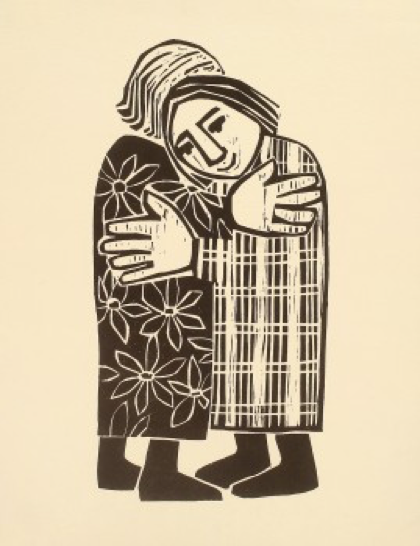 |
| artist Marion Honors, csj |
I invite you
to close your eyes and to feel into your breath, the gentle rise and fall of inhale
and exhale. With each wave upon wave of breath, enter the refugee of welcoming silence
... Feel yourself embraced by the luminous quiet of Mystery, of Holy Presence
... What you need is here ...
Ask
yourself: Is there someone with whom I need to reconcile? A person with whom I
am angry or who has hurt me deeply? Someone who incites my judgment, avoidance,
or exclusion?
If
comfortable, allow the image of this person to surface in your imagination. Notice
thoughts and memories that arise, how these rest as feelings or sensations in
your body ...
Gaze into this
persons' eyes. She/he is sometimes afraid, hurting, angry, joyful, and loving,
a person with hopes and dreams, sorrows and joys. She/he, like you and all of
creation, is filled at the core with Holy Presence.
Bring your
awareness to the space of your heart. Breathe deeply into this space the always
abiding and already healing love of our Holy One ... Breathe out peace and
healing into the heart of the other ...
Repeat this
circle of breathing until you feel a softening in your heart, a release from
separation and alienation from this person. (If this is not possible, surrender
any and all judgment of yourself. You can return to this prayer at another
time.)
Allow the
image of your person to fade.
Take a few
more moments of silence to rest into the freedom of healing and peace ... What
you need is here ...
You might
end this prayer by dancing the dance of releasement, writing a poem and/or listening
to the You Tube "Be Still" by Shaina Noll https://www.youtube.com/watch?v=6VUSESEwMtY.
Often we are
unwilling to surrender our "righteousness" perspective or we refuse
to accept "what is" true in the reality of our life situation,
leading to all kinds of suffering within ourselves and between persons. There
are also persons who have caused us immense pain through abuse. We can forgive
them, too, without engaging in further relationship, thus releasing ourselves
while wishing them healing and all good things.
A helpful
resource is found in a chapter from "The Grace in Aging" by Kathleen
Dowling Singh entitled Forgiveness as
Liberation from Aversions: Freedom from Anger and Judgment.
Another
resources is on You Tube: "Forgiveness in the Service of Justice" by Sr.
Margaret Farley
Subscribe to:
Posts (Atom)