 |
| Kilkee, Irelandd |
Living Gospel Inclusivity and Empowerment Now- https://bridgetmarys.blogspot.com/2025/10/rev-dr-bridget-mary-meehan-arcwp-chat.html
Friday, September 1, 2017
Homily: "A Solid Foundation" by Annie Watson ARCWP
Exodus 1:8-2:10; Matthew 16:13-20 August 27, 2017 Rev. Annie Watson, Assisting Priest, St. Stanislaus Preached at Pilgrim Congregational UCC
I know this isn’t Christmas, but I love a good birth story:
A hospital nurse writes about a non-English speaking couple
who came in ready to deliver. The man kept trying to leave the delivery room,
but the nurse kept insisting he had to stay for moral support. When the baby
emerged, the nurse made the man look at the moment of delivery. Unfortunately,
the next day the nurse discovered that he wasn’t the woman’s husband. He was
her brother.
As a priest and pastor’s spouse, I have heard quite a few
birth stories over the years. All of them are unique. On a personal level I
have never lived through one quite as precarious
as the birth of our first grandson, Lyle, a few weeks ago. The words
“precarious” and “precious” seem to apply equally as he lies in his incubator
in the neo-natal unit.
So far he is doing fairly well. He is gaining weight and
growing, although he is still hooked up to threatening and invasive looking
machines. The sight of him lying there with all those tubes is almost too much
to bear. Almost every family member that has walked into the neo-natal unit to
see him has shed a lot of tears. Life can be extremely fragile.
So can our faith communities. Our faith communities are
precious to us, and yet they are also precarious. The word “precarious” means
something is not securely held or in position, dangerously likely to fall or
collapse, too dependent on chance or luck, with an uncertain future.
Is that too gloomy of a description or does that sound like
many of our faith communities, at least compared to how things were in past
decades? Am I exaggerating when I say that our respective faith communities are
becoming more and more precarious?
One reason this is so is that Christianity as a whole is
diminishing in terms of size and power in the United States. According to
Robert Jones, the author of The End of
White Christian America, both mainline and evangelical expressions of
Euro-American Christianity is in a freefall decline.
Because of that fact alone this congregation—and many others
like it—will likely continue to become more and more precarious in terms of its
future viability. Racial division and strife, of course, plays a role in the
demise of American Christianity, especially in terms of its public witness.
This congregation has done a better job than most in terms
of bringing people together from different walks of life. But sadly this is not
the norm. For a variety of reasons that include differing worship styles and
old-fashioned racism, whites and blacks often have a difficult time worshiping
together.
As my husband wrote this past week on social media, it would
be nice if we could eschew racism for “gracism.” This means we should learn to
look at one another through a different lens—a grace lens rather than a race
lens.
Last Monday many of us gathered outside with special glasses
that enabled us to look at the solar eclipse. We were warned not to look at the
sun, even as the moon was blocking out most of the sun’s rays. If we did we
were in danger of damaging our corneas. Likewise, we do damage to our souls
when we look at one another through the naked eye of racism rather than the
lens of grace.
Somehow we need to reinvent ourselves in light of all the
factors that are creating the demise of our faith communities. We need a rebirthing, and yet a rebirthing on
solid ground, on a firm foundation. To help us along this path, let us look at
two very important biblical stories.
The first one is the beginning of the story of Moses found
in the first chapter of the book of Exodus. I call this the original “Birther”
story. Do you remember the Birther claim about President Obama? The “birthers”
were those, including the current President Donald Trump, who claimed that
Obama was not an American citizen. I offer no comment on that interesting
chapter in American history.
Similarly, I suspect that more than a few Egyptians
questioned the legitimacy of Moses’ citizenship. They certainly didn’t have access
to his birth certificate! You know the background to the story of Moses’ birth.
Although kept in slavery, the Hebrews in Egypt had become a very strong and
numerous ethnic minority and therefore they were a threat to Pharaoh’s administration.
They were doing the jobs “nobody else wanted to do.” Does that sound familiar?
Pharaoh was so threatened by the growing power of the
Hebrews that he ordered the Hebrew midwives to murder all the newborn Hebrew
baby boys so that the population would start to diminish. In defiance of
Pharaoh the midwives allowed the births to continue, telling him that the
Hebrew women were too “vigorous” and that they gave birth even before the
midwives could arrive.
An interesting detail in this story is the reference to the
“birth stool” in verse 16 of the first chapter of Exodus. This word is a little misleading. The Hebrew term
for “birth stool” literally means “two stones.” The Hebrew women gave birth by
standing on two stones—or bricks since the Hebrews were brick makers.
I read that the
Hebrews may have been introduced to the use of these “birth bricks” from the
Egyptians, who believed that the bricks were given magical birthing powers by
their gods. The Hebrew midwives were probably told that if they saw
Hebrew women on the magical birth bricks they should make them get off of the
bricks. Without the aid of the magical birth bricks, Pharaoh believed this
would cause their birth rates to go down. But again, the midwives refused to
comply.
Imagine how history would be different if the midwives had
obeyed Pharaoh. The birth of the Hebrew baby boys and the future of their
nation were very precarious because
the Egyptians were determined to weaken their population and keep them in
slavery. But we know the rest of the story.
One of the boys born secretively to a Hebrew slave woman was
put in a basket and hid in the reeds of the Nile River. The baby was discovered
“accidentally” by Pharaoh’s daughter and raised in Pharaoh’s palace as an
Egyptian Prince. Later, as an adult, Moses would help the Hebrew slaves escape
and secure their future. A boy born on Egyptian birth bricks became the
foundation for the rebirth of the Hebrew nation.
As you reflect on that, let us look briefly at the story of
the birth of the Christian church in Matthew 16. We usually refer to the Day of
Pentecost as the “birthday of the church,” but in truth the church was born on
the solid foundation of what we call “the Petrine Confession.”
A disciple named Simon confesses Jesus as the Christ, the
Son of the Living God and thus becomes Peter, the rock on which the church is
built. Simon is renamed “Petros” or Peter, which is a play on the Greek word
for rock, “petra.” He becomes the rock—or birth bricks—upon which the church is
built, a claim that has special significance in Catholicism where Peter is
considered to be the first Pope.
I am particularly interested in this story of the Petrine
Confession because it addresses the central question of my faith life—and maybe
yours as well: the identity of Jesus of Nazareth. It is here that Jesus asks
his disciples, “Who do people say that I am?” After giving some possible
answers, all of which reflect the importance of the prophets of Israel, Simon
Peter gives the correct answer: Jesus is the long-awaited Messiah (or Christ),
the Son of the Living God, the foundational statement of our faith.
Obviously, the rebirth of Abrahamic or monotheistic religion
through Simon Peter’s confession was just as precarious as the rebirth of the
Hebrew nation through Moses. In one moment Peter is blessed for his
“confession” and the next moment he is chastised for not understanding what he
just said because, according to Jesus, he had set his mind on human things
rather than divine things. Things did not begin well.
The moral of all three stories I have shared this
morning—the birth of my grandson, the rebirth of the Hebrew people through
Moses, and the birth of the church through Simon Peter—is that life and faith
are precarious. The birth of babies, nations, and religions, by their very
nature are precarious. The future is always uncertain, especially when it comes
to the rebirth our faith communities. We are as fragile as a prematurely
delivered baby in a neo-natal unit.
But we all love a good rebirth
story, do we not? You and I have a chance to do just that, to pour the cement
and build a church on a foundation that is even more solid than Egyptian birth
bricks and the fickle faith of Simon Peter. We can begin with a very simple
statement, a rock solid confession, that Jesus is the Christ, the Son of the
Living God. Now we can build.
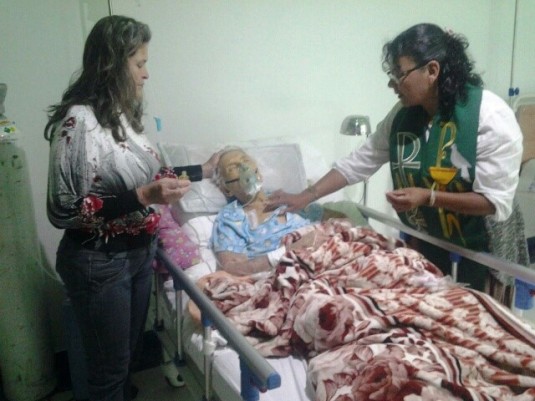
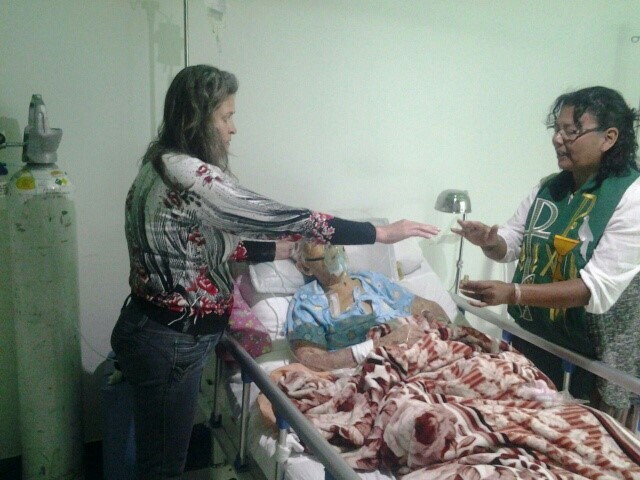
Blanca Cecilia Santana. ARCWP-Colombia. Unción de la Salud
https://evangelizadorasdelosapostoles.wordpress.com/2017/08/31/colombia-popayan-blanca-cecilia-santana-presbitera-arcwp-impone-la-union-de-los-enfermos/
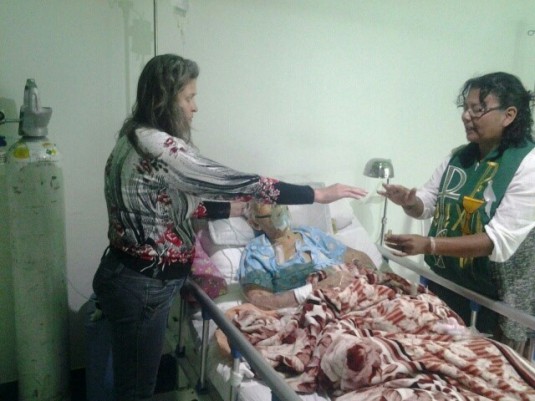

Blessing of the oil with her daughter Mery.
"God, Father-Mother, Divine essence, giver of health and salvation: Send your Spirit to sanctify is oil, so that as your apostles anointed many sick and healed them, so that all who receive faith and repentance this holy anointing; through Jesus Christ, who lives and reigns with you and the Holy Spirit, one God, for ever and ever. "Amen.

I have been called by herdaughter, to attend Mrs. Flor, who at age 86, suffers from a terminal illness.
"Florecita: I lay my hands upon you, in the company of your daughter Mercy, pleading with the Divine Essence our Father-Mother God to sustain you with divine presence, to drive away from you all illness of body and spirit, and grant you that victory of life and peace, which will enable you to serve God now and forever. "Amen.
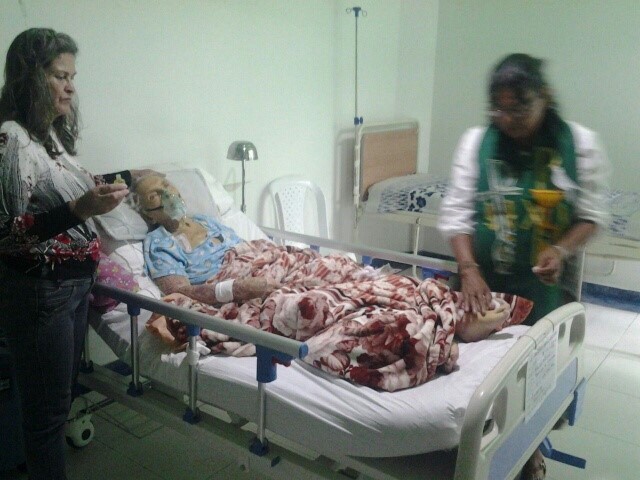
We pray for him to strengthen herself to fight the disease and to redouble the peace.
As a presbyter, it has been an experience and a blessing for me to share with Lady Flor and her daughter Mery this process of transition to the fullness of life, showing the feminine Face of the Divine that welcomes us, embraces and protects us in divine mercy.
* Catholic Priest
Thursday, August 31, 2017
Pope Asks World Leaders to Listen to Earth, My Response: Yes, and Honor Women as Equals in Church and World

Bridget Mary's Response: Amen to Pope Francis' mandate to care for the planet, but the institutional church must also raise its voice to recognize its role in the crisis of the planet in our times. Women and their dependent children are two-thirds of the world's poor. The church's failure to promote responsible birth control, decisions of conscience on artificial birth control and women as priests and spiritual equals is a contributing factor to this ecological crisis. If the church honored women's voices and leadership, it could more effectively listen to the "cry of the Earth and the cry of the poor."Bridget Mary Meehan ARCWP, www.arcwp.org, sofiabmm@aol.com
By
VATICAN CITY (AP) — Pope Francis is urging world leaders to “listen to the cry of the Earth and the cry of the poor” and take measures to protect the environment.
Francis made the appeal Wednesday (Aug. 30) in announcing that he and the spiritual leader of the world’s Orthodox Christians, Patriarch Bartholomew I, would be releasing a joint statement on care for God’s creation on Friday.
In 2015, Francis designated Sept. 1 as the church’s day for prayer for the environment, framing care for the planet as a moral issue.
In his announcement Wednesday, Francis urged everyone to be respectful and responsible toward the environment: “We also appeal to those who have influential roles to listen to the cry of the Earth and the cry of the poor, who suffer the most from ecological imbalance.”
Wednesday, August 30, 2017
Local Texas Charities Aiding in Recovery from Hurricane
|

__._,_.___
| Reply via web post | • | Reply to sender | • | Reply to group | • | Start a New Topic | • | Messages in this topic (1) |

Have you tried the highest rated email app?
With 4.5 stars in iTunes, the Yahoo Mail app is the highest rated email app on the market. What are you waiting for? Now you can access all your inboxes (Gmail, Outlook, AOL and more) in one place. Never delete an email again with 1000GB of free cloud storage.

.
__,_._,___
A Prayer for People of Texas
Thinking of the people of Texas: shared by Mindy Lou Simmons
God of healing and mercy, we come before you with our hearts filled with grief as we see the devastation in Texas.
We pray that your presence would be felt by those who are grieving, who are injured, who have lost their homes and livelihoods.
We pray for wisdom and safety for those who are responding to the people in need and the many challenges left as this disaster continues to unfold.
We pray for the church, that it may be a witness to your compassion and care for all who suffer.
God, you are our refuge and strength, an ever-present help in times of trouble. For this we give you thanks and ask that you hear our prayers for the people of Texas.*
We pray that your presence would be felt by those who are grieving, who are injured, who have lost their homes and livelihoods.
We pray for wisdom and safety for those who are responding to the people in need and the many challenges left as this disaster continues to unfold.
We pray for the church, that it may be a witness to your compassion and care for all who suffer.
God, you are our refuge and strength, an ever-present help in times of trouble. For this we give you thanks and ask that you hear our prayers for the people of Texas.*
We pray specifically for:
- The undocumented men, women and children who may fear getting the help they need in the face of the passage of SB4.
- Those who were already hanging on by a thread financially and now may be missing work and wages that they cannot afford to lose.
- For those who cannot afford the things they need to weather this literal storm.
- For those without family and friends to stay with or who could not to afford to evacuate, that they would find places of rest that are safe and humane.
- For the stories we've heard about the impact on the most marginalized, like the 50 undocumented women and children ICE dropped off at a bus station from a family immigration detention center with no resources and no buses on the way to help them safely evacuate.
- For those without insurance who will have a hard time replacing their losses.
- For the elderly and sick, those who live alone, and those who are already so vulnerable.
- For those in Cancer Alley, and downstream from the oil refineries and the dioxin Superfund site that are underwater and will undoubtedly spread their pollution, affecting people's health and the environment into the future.
- For those who were already homeless and are now facing homelessness.
- For those who are forgotten even from this list or from our minds, but that you know and love deeply. Thank you that you keep watch and are not a God who sleeps nor slumbers!
- The undocumented men, women and children who may fear getting the help they need in the face of the passage of SB4.
- Those who were already hanging on by a thread financially and now may be missing work and wages that they cannot afford to lose.
- For those who cannot afford the things they need to weather this literal storm.
- For those without family and friends to stay with or who could not to afford to evacuate, that they would find places of rest that are safe and humane.
- For the stories we've heard about the impact on the most marginalized, like the 50 undocumented women and children ICE dropped off at a bus station from a family immigration detention center with no resources and no buses on the way to help them safely evacuate.
- For those without insurance who will have a hard time replacing their losses.
- For the elderly and sick, those who live alone, and those who are already so vulnerable.
- For those in Cancer Alley, and downstream from the oil refineries and the dioxin Superfund site that are underwater and will undoubtedly spread their pollution, affecting people's health and the environment into the future.
- For those who were already homeless and are now facing homelessness.
- For those who are forgotten even from this list or from our minds, but that you know and love deeply. Thank you that you keep watch and are not a God who sleeps nor slumbers!
Oh Lord, may we continue to remember and help, even after news of this disaster has left the headlines. May we have eyes to see the help needed, not just for communities that look like our own or belong to our own denominations and the communities they're in, but for all of the people in Texas, especially those already marginalized.
Amen.
*Adopted from a prayer For the People of the Mennonite World Conference for the people of Japan following the earthquake and tsunami of March 11, 2011.
Tuesday, August 29, 2017
Monday, August 28, 2017
ARCWP Priests Visit Ireland: Day 29-31 - Giving thanks and Team Packing Up
Today we are doing paperwork, making phone calls,
starting to pack and organize.
Mary Theresa and Joan will be flying out on Thursday.
August 31st.
I will be in Ireland until September 13th.
Contact me at 703-505-0004 or
email me at sofiabmm@aol.com
for more information about women priests in Ireland.
starting to pack and organize.
Mary Theresa and Joan will be flying out on Thursday.
August 31st.
I will be in Ireland until September 13th.
Contact me at 703-505-0004 or
email me at sofiabmm@aol.com
for more information about women priests in Ireland.
Sunday, August 27, 2017
Homily by Mary Eileen Collingwood ARCWP 21st Sunday in Ordinary Time
Matthew 16: 13-20
The US Congress passed the 19th Amendment to
the Constitution which granted women full and equal voting rights on this very
day in 1920.
As a result of its passage, today we celebrate “Women’s
Equality Day.”
It took women 113 years of struggle, putting their lives
on the line, to get this amendment passed.
Yet their fight is not over. There are limits being placed on women
everywhere where changes needed in childcare policies, reproductive rights,
education and employment, and vocational opportunities remain.
It is clear in our day and age, that women still have a
long way to go in securing their equality among men.
What does this have to do with our Gospel story today?
First off, it’s always good to realize what is happening
on the ground. It’s important to gather
information in order to be properly informed.
It’s important to know about what Jesus actually taught. You know, in the beginning times when things
started to really happen.
We know that Jesus spoke in Aramaic and Hebrew. We know that the original Gospel stories were
written in Aramaic and Hebrew. We know
that the first translation of these stories were in Greek. And, as with all translations, what is meant
in one language, is not always translated properly to another. Instead of being objectively translated,
these stories were most often interpreted
by editors who inserted their understanding of who Jesus was, and what Jesus
said, along with what the faith community at the time believed. Remember, the
understanding of faith was an evolving matter (and is so, even today). Each age
had differing thoughts and insights. As time
continued on, we find that the whole body of work was translated again from the
Greek into Latin. Another era, another
opportunity for interpretation of the text, another mindset for understanding
what they believed. And so, it continued. Many different translations, many centuries
of interpreters that distanced the original language from the current thought.
So, let’s clarify some terms.
In Greek, “Peter” is “Petros” and “rock” is “petra.”
Peter’s Aramaic name was “Kephas” that is also the Aramaic
word for “rock.”
Whatever else it is, “rock” is a word of tremendous
praise, and by no means strange or unusual to Jewish thought. No Jew who knew the Old Testament could ever
use the word without their thoughts turning to God, who alone was the true rock
of their defense and salvation.
Remember. Abraham was the rock (petra) on which the nation and purpose
of God were founded.
The word “church” in Greek is “ekklesia,” which we most
often experience in New Testament translations. However, the word that Jesus
almost certainly used was the Aramaic “quahal” which is the word the Old
Testament used for the congregation of Israel, or, more precisely, the gathering
of the People of God.
When Peter responded to Jesus that he was the Messiah, the
Firstborn of the Living God, Jesus affirmed Peter’s faith by calling Peter the “beginning
of a new Israel,” the new people of God, the new group of religious peers,
equally associated with one another, who believed in what Jesus taught.
Peter was the first person to publicly proclaim his faith in
Jesus. And it certainly was not a coincidence that
the authors of this story have Jesus asking his question of Peter in a place that
housed the legends of the gods of Greece, the temples of the ancient Syrian
worship, and the great Caesarea Philippi temple built to the godhead of Caesar
that projected the might and divinity of Rome.
This location was where all gathered to remember the old ingrained ideas
and practices, and the looming arm of Roman rule. But it also contained the source of new life,
the source of the River Jordan where Jesus was baptized and began his public
ministry.
It is noteworthy that it was not a church in the human
sense that began with Peter. What began
with Peter was the fellowship of all believers in Jesus—who were equally
associated with one another. This new
phase, new journey of faith, was not identified with any church and not limited
to any church, but embraced all who believed in Jesus’ teachings and ministry. On bedrock like this, Jesus said, I will
build my community!
God is the rock, Jesus is the first cornerstone, the force
holding everyone together. All the other believing disciples added their
pebbles of faith upon his, Peter being the first to come forward.
And so, this applies to all Christians-- they are the
living stones built into the fabric of the faith community. The faith community didn’t depend on Peter,
as it depended on Jesus and God. This
new phase of community began with Peter’s declaration of faith. And because Peter declared his faith, Jesus
ensured him that nothing will stand in his way, not even the jaws of death, for
God will be their stronghold against everything.
Jesus also gave to Peter a special responsibility of
opening the door to the kinship of all believers. And so, on Pentecost, Peter did just
that. The story goes that over 3,000
people were welcomed into the fold. He
also opened the door to the Gentile world through welcoming the Gentile centurion,
Cornelius, who through Peter’s witness, was ratified by the Council of
Jerusalem. And by Peter’s example, we,
too, are charged with opening the door of the Kin-dom of God’s world to others
so that they, too, become part of this equal fellowship of believers.
Jesus gave Peter the power to bind and to loose. What does that mean? To loose and to bind were very common Jewish
phrases. They were used especially by
the teachers and Rabbi’s when making decisions. To bind something was to
declare it forbidden; to loose was to declare it allowed. For the Jews, these were regular phrases for
making decision in regard to the law. But Jesus did not follow some of those
laws. He said they did not reflect the
Spirit of the Living God in and among the people. So what Jesus is saying to Peter is: you will be the first guide of this infant
faith community. And in the early
chapters of the Book of Acts, we see that in Jerusalem that is precisely what
Peter did. The privilege of the keys
meant that much like the illusion of Eliakim in our Old Testament reading
today, Peter would be the steward of this community, opening the door for all
to enter into the Kin-dom of God’s presence.
So, to paraphrase this Gospel passage, we can say:
Peter, your name means rock, and your destiny is to be a
rock. You are the first person to
recognize me for who I am, and therefore, you are the first stone in the structure
of the community of those who are mine.
Against that relationship the embattled powers of evil will not prevail
nor hold me captive. And in the days to come, you must be the steward who will
unlock the doors of the Kin-dom so that Jew and Gentile are welcomed in; and
you will guide and direct the work of this infant and growing faith community.
Peter had made the great discovery; and Peter was given
the great privilege and the great responsibility. It is a discovery which everyone of us must
make for ourselves, and, when we have made it, the same privilege and the same
responsibility are laid upon us.
And here is where we get to the part about what Women’s
Equality Day has to do with this Gospel.
We cannot let false interpretations and imperfect
declarations affect the truth of Jesus’ message.
In the Roman Catholic Women Priest movement, we put our
lives on the line in renewing the basic message of Jesus that ‘all are equal in
the eyes of God.’ The hierarchical
structures, oppressive patriarchal language, institutional bureaucracy, and
misogyny have no place in the group of believers who declare their faith in
Jesus, and associate with one another with equal respect inspired by a common
vision.
We stand on the shoulders of women who gave their all in
pursuing the truth of who they were and how they should be treated. And I stand before you as a prophetic witness
in our Church today, proclaiming that Women’s Equality Everyday must set up tent and dwell in the midst of the People of
God as we continue the journey proclaiming the truth of Jesus’ message that all
are equal in the eyes of God, and all are given the privilege of proclaiming
that truth and being Christ for one another.
We all act equally in persona
Christi.
Always remember that Christianity never consists in
knowing about Jesus; it always consists in knowing Jesus. Jesus demands a personal decision. He did not ask only Peter, he asks every
person: “YOU—what do YOU think of me?”
It is our individual answer that will determine our journey forward.
Subscribe to:
Posts (Atom)