Living Gospel Inclusivity and Empowerment Now- https://bridgetmarys.blogspot.com/2025/10/rev-dr-bridget-mary-meehan-arcwp-chat.html
Saturday, December 2, 2017
"How Native American Women Paved the Way for Women's Rights in the U.S" by Kelly Macias
https://m.dailykos.com/stories/2017/11/24/1716629/-A-feminist-primer-How-Native-American-women-paved-the-way-for-women-s-rights-in-the-U-S?detail=emailLL

"Two of the earliest founders of the U.S. women’s movement, Elizabeth Cady Stanton and Matilda Joslyn Gage, saw the egalitarian Native model first-hand while growing up in New York, the land base of the Haudenosaunee—a label denoting the five nations of the Iroquois confederacy: the Mohawk, Oneida, Onondaga, Cayuga, and Seneca—later joined by the Tuscarora. Native women were the agriculturalists of their tribes, and from North to South America they collectively raised corn, beans, and squash. Their responsibility for the survival of the Nation, through the creation of life and the food that sustained life, gave women a position of equality in their society that white women could only dream of.

"Two of the earliest founders of the U.S. women’s movement, Elizabeth Cady Stanton and Matilda Joslyn Gage, saw the egalitarian Native model first-hand while growing up in New York, the land base of the Haudenosaunee—a label denoting the five nations of the Iroquois confederacy: the Mohawk, Oneida, Onondaga, Cayuga, and Seneca—later joined by the Tuscarora. Native women were the agriculturalists of their tribes, and from North to South America they collectively raised corn, beans, and squash. Their responsibility for the survival of the Nation, through the creation of life and the food that sustained life, gave women a position of equality in their society that white women could only dream of.
According to Sally Roesch Wagner, Ph.D., the suffragists were inspired by what they observed and learned about Haudenosaunee women, both politically and socially. While white American women at the time were relegated to taking charge at home, with final decisions always being made by their husbands, their Native American counterparts were not only fully in charge in their families but those families honored matrilineal heritage—which meant that children belonged to their mothers, fully and completely.
Issues of paternal rights were totally foreign to the Native world. Haudenosaunee children were (and are) born into their mother’s clan and follow their mother’s line. When Gage tried to explain the concept of an “illegitimate child” to a Haudenosaunee friend, the woman puzzled, “how can any child not be legitimate? You always know who your mother is.”
The living arrangements were traditionally based on this matrilineal system. A husband came to live with his wife, her parents, her sisters and their husbands and children in their matrilineal family longhouse. Unmarried brothers lived there, too, until they married and moved to their wives’ longhouses. If any of the mothers died or the couple split up, the children continued to live in the mother’s longhouse. “The children also accompanied the mother, whose right to them was recognized as supreme,” Gage wrote [in Woman, Church and State], “if for any cause the Iroquois husband and wife separated.”
But that’s not all. Haudenosaunee women also played a role in the political goings on in their respective nations. From discussions on important issues to selecting a chief, women were active contributors to decisions that impacted the well-being of their communities.
“In the councils of the Iroquois every adult male or female had a voice upon all questions brought before it,” Stanton reported in The National Bulletin in 1891. “The American aborigines were essentially democratic in their government … The women were the great power among the clan.” Stanton went on to describe how clan mothers had the responsibility for nominating a chief, and could remove that chief if he did not make good decisions. “They did not hesitate, when occasion required,” Stanton recalled, “‘to knock off the horns,’ as it was technically called, from the head of a chief and send him back to the ranks of the warriors.”
Apparently, not much has changed among these tribes despite the centuries that have passed. Women still play a critical role in their communities, including having the distinction of nominating and removing a chief if necessary. And in recent years, many women have become chiefs themselves. They have also played a vital part in maintaining their culture, history, and heritage and protecting their right to sovereignty—something the United States government has consistently encroached on for hundreds of years. One fascinating thing that Wagner notes is that feminism and women’s rights is a concept that remains distant to the experience of Haudenosaunee women. She writes, “To the Haudenosaunee, [women’s equality] is simply their way of life. Their egalitarian relationships and their political authority are a reality that—for many non-Native women—is still something to strive for.”
Social movements must start with a vision of an alternative future where people are no longer oppressed. Elizabeth Cady Stanton and Matilda Joslyn Gage saw this future for white women because of the Haudenosaunee women they met. Of course, this led to several different waves of feminism that have continued to create a path forward in society which seeks to ensure that all people are respected and valued, regardless of gender identity. So, the next time you think about feminism and its history, remember to include the contributions of the women of the Mohawk, Oneida, Onondaga, Cayuga, Seneca, and the Tuscarora nations. And remember to honor and thank them for the role they played. Without their way of life and the inspiration they provided, who knows what a feminist movement in this country would have looked like."
"Guadalupe’s Legacy: How a 486-year-old vision of Mary in Mexico continues to influence the church" by Nicole Flores, America Magazine, Outstanding Article
https://www.americamagazine.org/faith/2017/12/01/guadalupes-legacy-how-486-year-old-vision-mary-mexico-continues-influence-church
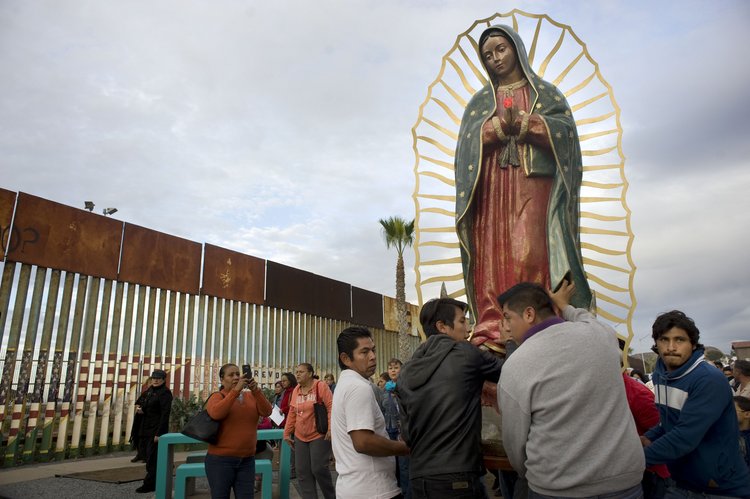
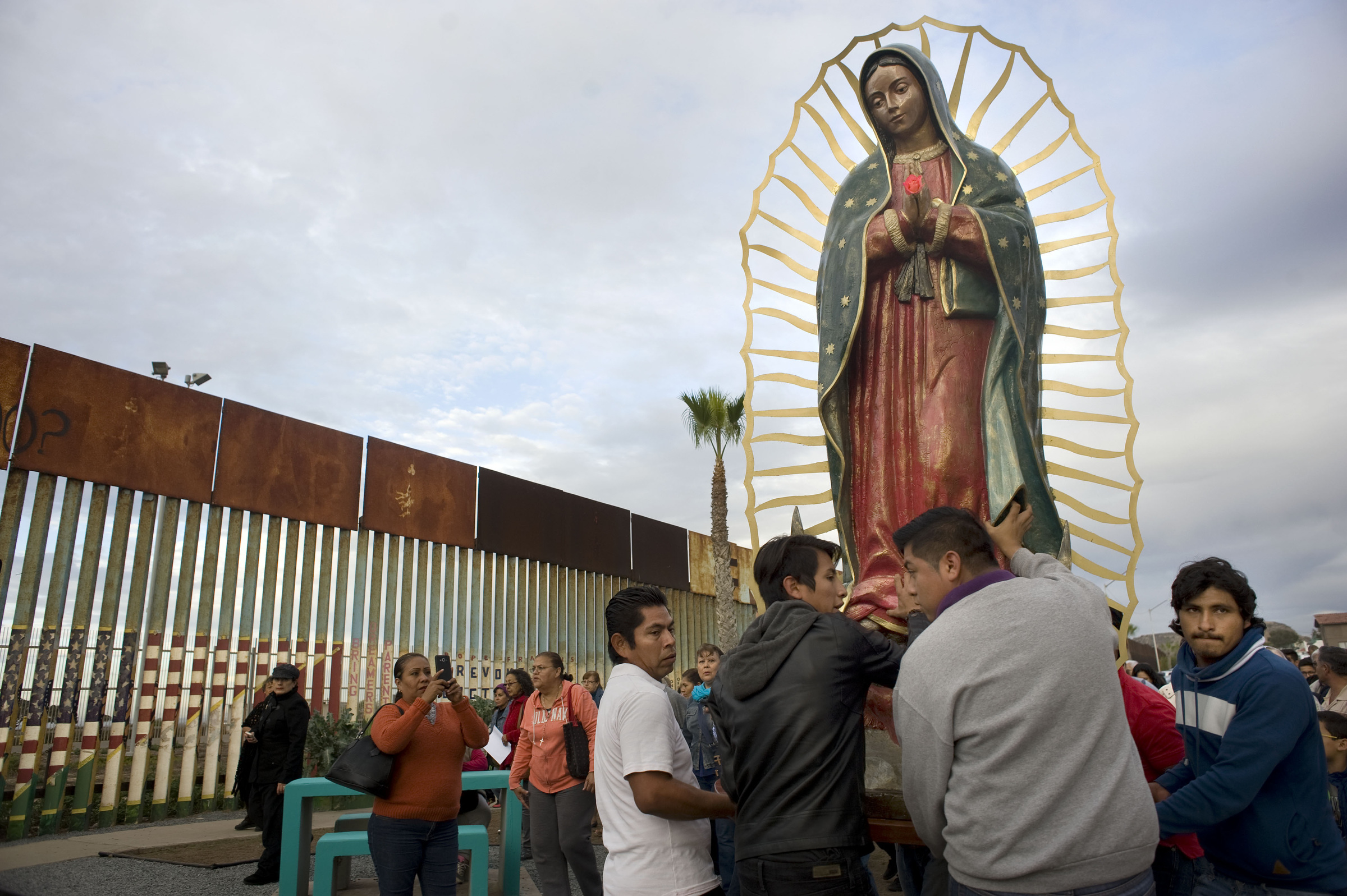
A statue of Our Lady of Guadalupe is unloaded from a truck after a Nov. 19, 2016, in Tijuana, Mexico. (CNS photo/David Maung)
As I was growing up in a Mexican-American family, Guadalupe was everywhere, but most notably in the face of my grandmother, María Guadalupe García Flores. A humble woman without much formal education, her faith guided her as she raised 12 children amid immense poverty in rural Nebraska. My grandmother embodied a distinctly Guadalupan presence: prayerful, patient, joyful and strong. Whether nurturing a child, a friendship or a garden, she knew how to help things grow. In her habits of magnifying the Lord and lifting up the lowly, she emulated Guadalupe by illuminating God’s pervasive beauty and good news to the poor. It was my grandmother’s witness to beauty and justice that led to my own fascination with Guadalupe. Beginning with the presentation I made in seventh grade about my family’s history and continuing in my academic research in theology and ethics, I have longed to know more about my grandmother’s namesake and what her symbol means for the church and the world.
Indeed, the world has taken notice of Our Lady of Guadalupe. Her image can be found everywhere: at gas stations and train stations, at bars and on border fences, on cars and in cathedrals. For Mexican-Americans, especially, life has long been imbued with her presence, and Mexican people inspired by her ethos. Whether one encounters her image at a bus stop, a chapel or a public monument, Guadalupe is inevitably accompanied by disagreements about the meaning of her symbol. Her image has been emblazoned on protest banners for the United Farm Workers and leveraged as a logo for Banamex, the second largest bank in Mexico. Catholic pro-life groups invoke her as a symbol of their cause, her image prominent on rosary beads and protest signs on the National Mall during the annual March for Life.
The range of values and visions mapped onto her image reveal her contested meaning for Catholicism, culture and the common good.
Tweet this
Latin American and feminist theologians, artists, and writers have reimagined the sedate and obedient Virgin as an ordinary woman experiencing the joys and challenges of sexuality, work and motherhood as exemplified by Yolanda López’s “Portrait of the Artist as the Virgin of Guadalupe.” López portrays Guadalupe as a young woman running, a middle-aged woman working at a sewing machine and an elderly woman in a seated position. Each portrait emphasizes the beauty and particularity of ordinary women while using elements of the Guadalupe image to accentuate a particular dimension of Our Lady. The range of values and visions mapped onto her image reveal her contested meaning for Catholicism, culture and the common good.
And what she means matters, as Guadalupe’s symbolism has urgent significance for the future of the church. Latina and Latino Catholics comprise an increasingly large share of Catholics in the United States, representing a majority of millennial generation Catholics (54 percent, according to the U.S. Conference of Catholic Bishops). At the same time, the percentage of Latino and Latina Catholics far exceeds the percentage of Latino deacons, priests and bishops. Culturally competent clergy are needed to serve the U.S. church. These demographic realities raise concerns about the church’s capacity to meet the pastoral needs of the Latino faithful. Understanding the power of Guadalupe can help the larger church understand the Latino Catholic population. And an understanding of Guadalupe must be rooted in an understanding of her history.
A Historic Hill
Devotees believe that Guadalupe first appeared to Juan Diego, an indigenous man, in 1531 on a hill called Tepeyác, which is located on the outskirts of Mexico City. Our Lady admonished Juan Diego to petition the local bishop to build a basilica in her honor in that place. Juan Diego initially demurred, feeling unworthy due to his marginal status in society. Guadalupe persisted, convincing Juan Diego to appear before the bishop.
After several unsuccessful attempts to persuade the bishop to build the basilica, Juan Diego appeared a final time with his tilma (cloak) full of roses from Guadalupe, grown in the frozen December earth. When Juan Diego unfolded his tilma to offer the flowers to the bishop, an exquisite image of Guadalupe, brilliantly colored, appeared embedded in the garment. Her image was remarkable in that it depicted both Spanish and Aztec aesthetic elements, mapping these conflicting identities onto the same canvas.
Overwhelmed by the image, the obstinate bishop finally acquiesced to Guadalupe’s request to build the basilica. Today, St. Juan Diego’s tilma is kept at Basílica de Nuestra Señora de Guadalupe, where it receives millions of visitors each year. In 1999, St. John Paul II declared Guadalupe patroness of the Americas, affirming the theological significance that was first recognized by her Mexican devotees and giving official acknowledgment to her cultural significance that extends beyond Mexico to the entire Western Hemisphere and to the world.
Guadalupe is often interpreted as an image of empowerment for the least powerful members of society.
Tweet this
Although some scholars are skeptical about his existence, Juan Diego remains a popular figure in the Catholic Church. Guadalupe empowered Juan Diego to act within the colonial church by recognizing and honoring his personhood and dignity. Thus, Guadalupe is often interpreted as an image of empowerment for the least powerful members of society. Indeed, La Virgen de Guadalupe plays a vital role in the personal and ecclesial agency of many Latina Catholics in the United States.
On a personal level, Catholics often regard Guadalupe as a source of spiritual comfort. Latinas also interpret her as a source of strength. Her strength is associated with both her ability to endure suffering, as exemplified by witnessing the death of her son, and her ability to act in the face of suffering, as evident in her ability to lift up the lowly Juan Diego by empowering him to serve as her messenger to the bishop. Guadalupe comforts those on the margins of society even as she equips them for action.
On the ecclesial level, Latina Catholic leaders serve the church in myriad and crucial ways, often inspired by Guadalupe’s model of comfort and empowerment. New waves of questions continue to arise about women’s leadership roles in the Catholic Church. The outcome of these discussions will have a profound influence on Latinas and thus on the future of the entire U.S. church. In 2015 Pope Francis called for the development of a “theology of women,” and last year he sparked renewed debates about women’s ordination by inaugurating a study commission on the women’s diaconate.
This commission will affect all Catholic women, but it is of particular significance to women who already serve their parishes, dioceses and the wider church in a diaconal spirit. Taken together, these questions clarify the necessity of sustained reflection on the status of Latinas in the Catholic Church. An understanding of the spirit of Guadalupe within the larger church might help inspire new paths for Latina leadership in the 21st-century church.
Women on the Margins of the Church
For all the grace and empowerment Guadalupe represents, her image is not without complications. In her book, Suffering and Salvation in Ciudad Juárez (Fortress, 2011), Nancy Pineda-Madrid describes the practice of feminicide—the systematic murdering of women because of their gender—on the U.S.-Mexico border. In this city and the surrounding areas, women are raped, tortured, killed and mutilated to mark turf in battles among drug cartels. In this way, women’s bodies are turned into objects in service of an idolatrous and violent power struggle.
The women of Ciudad Juárez have joined forces to resist the systematic killing of women and girls in their city. As Mexican women, one might expect them to look to Guadalupe as a symbol of resistance against violence and assertion of their personhood and human dignity. But their struggle for justice faces challenges from those who blame the problem on the women themselves, claiming that they are at fault for their own rape and murder because of provocative attire, sexual activity or working outside of the home. These assertions undermine the women’s claims of systematic violence perpetuated against them. To make matters worse, the reasoning used to form these arguments too often is rooted in manipulating Guadalupe to become one part of a harmful dyad: the Guadalupe-Malinche binary. La Malinche is said to be the indigenous Aztec woman who was Hernan Cortés’s translator and mistress, assisting him in his conquest of Tenochtítlan. La Malinche is a traitorous figure, one who sells out her own people and assists in their destruction. Moreover, she is said to be a whore, a woman whose sexuality is tainted by immorality and the betrayal of her people.
Guadalupe-Malinche binary bears much in common with the Madonna-whore binary, where honor is associated with sexual purity and shame with sexual immorality.
Tweet this
Whereas Guadalupe is portrayed as a symbol of virginity, purity and obedience, La Malinche is portrayed as a symbol of deceit. Society too often forces women to be labeled as one or the other: A woman is considered to be either pure or impure, with no room for nuance. In this way, the Guadalupe-Malinche binary bears much in common with the Madonna-whore binary, where honor is associated with sexual purity and shame with sexual immorality. This binary particularly presents a difficult tension for the women of Ciudad Juárez, catalyzing the need for symbols that affirm a vision of women’s dignity predicated not on her service of the interests of men but on her reflection of the image of God as revealed in Jesus Christ.
For this reason, Catholic women organizing for justice in Ciudad Juárez turn to spiritual and theological resources beyond Guadalupe to symbolize their struggle against these atrocities. Rather than carrying banners depicting Guadalupe, the women process with pink crosses engraved with the names of the murdered women on the cross bar to represent Jesus Christ’s identification with them in their suffering. They post these pink crosses as public memorials to the women and girls who have been murdered, reorienting the narrative surrounding their deaths from questions of their personal purity to their belonging in Christ. The crosses thus symbolize their dignity, their suffering and their hope for salvation. In this way, we see the real challenges associated with viewing Guadalupe as a symbol of empowerment. Her image can easily be contorted beyond recognition and has often been deployed against women rather than as an affirmation of the inherent dignity of women. Reclaiming the meaning of her symbol is key to understanding its liberating potential in the lives of Latinas.
The struggle of women against feminicide in Ciudad Juárez reveals important and ongoing tensions associated with contests over Guadalupe’s meaning, including her significance for Latinas. And yet, Latina Catholics continue to turn to Guadalupe as a source of comfort, strength, inspiration and empowerment. How do we account for this devotion to Guadalupe?
Identification and Empowerment
In her landmark study Our Lady of Guadalupe: Faith and Empowerment Among Mexican-American Women, published in 1994, Jeanette Rodriguez conducts interviews with young, Catholic, Mexican-American mothers to discover why Guadalupe continues to be such an inspirational figure in their lives. Rodriguez’s study finds that Guadalupe has strong personal significance for these women. The women identify with Guadalupe on both a cultural and a social level. For Latinas, finding images that affirm our dignity, personhood and beauty can be difficult in the church and in broader U.S. Culture. In Guadalupe, these women find a reflection of their own humanity and an affirmation of their inherent worth. According to Catalina, a woman interviewed in Rodriguez’s study: “La virgen morena” the brown virgin, is sent to help Mexican women, “feel comfortable and come to remind us of a love and a spirit that does exist.”
Rather than serving as a symbol of either simply oppression or empowerment, Guadalupe captures the complexities of Latina personal and social identity.
Tweet this
The women also identify with Guadalupe as a mother, one who has a direct experience of the joys and agonies of bearing and raising her son. Ruth, another woman interviewed in the study, says, “I would like to do some things like her...to be a strong person, to believe in God and raise your kids the best you can.” For Ruth, it is important “just to know that she’s a mother.” Reflecting their identity as Mexican-American mothers, these women understand Guadalupe as a figure of stability, support, acceptance, nurture and relationship.
Ms. Rodriguez finds that the women simultaneously view Guadalupe as independent and dependent, meek and strong-willed, assertive and shy. While she notes that these qualities appear to be contradictory, she avers that they represent the ways that Guadalupe serves as a guide for women in understanding our own multifaceted identities. Rather than serving as a symbol of either simply oppression or empowerment, Guadalupe captures the complexities of Latina personal and social identity.
Guadalupe is not an either/or but an already and not yet. For the women in Ms. Rodriguez’s study, Guadalupe reflects an ongoing process of coming into one’s own, of realizing one’s own power and potential even in moments when one feels more reserved or needs to withdraw for reasons of self-care. These facets of Guadalupe’s symbol create space to foster a kind of leadership that is not averse to vulnerability or even reliance on others. In this way, Guadalupe offers a full-spectrum image of women’s identity while creating space for women to bring their selves in holistic entirety into the work of leadership.
Guadalupe and Latina Leadership
These dynamics are also evident among Mexican and Mexican-American women taking leadership roles in their local parishes. In her book Guadalupe in New York (New York University Press, 2010), Alyshia Gálvez offers an ethnographic study of Mexican and Mexican-American leaders of the Comités Guadalupanas, or the Guadalupe committees, located in parishes throughout the Archdiocese of New York. While the comités consist of both male and female parishioners, Gálvez’s study illustrates how women exercise unique authority within these organizations.
Attending Guadalupe meetings at two different parishes that operate under different leadership models, Gálvez observes a central role for women in caring for the Guadalupe statue and organizing events both within the parish and in broader public settings. For example, the comités play a key leadership role in organizing the annual Antorcha Guadalupana, the Guadalupe torch run, which takes every year in the weeks leading up to Guadalupe’s feast day on Dec. 12.
We can see women’s leadership expanding from the parish context, spilling out into the streets and into public space.
Tweet this
As in the Olympic torch relay, a group of pilgrims carries a torch from Guadalupe’s Basilica outside of Mexico City, across the U.S.-Mexico border, eventually arriving at St. Patrick’s Cathedral on 5th Avenue in New York City. The women of the comités play an instrumental role in organizing the torch run and the festivities that mark its conclusion, which serve both as a display of spiritual devotion and as a protest against unjust immigration laws.
In this activity, we can see women’s leadership expanding from the parish context, spilling out into the streets and into public space. The torch run is a public witness to the deep social connections between the United States and Mexico. It is also an illustration of the ways in which Guadalupe inspires women to act in both ecclesiastical and political settings, reconfiguring gender ideologies that fail to honor women as full created in God’s image and for God’s service.
Many U.S. parishes have welcomed images of Guadalupe into their sanctuaries. Others have welcomed her to sit in their pews. But is the church in the United States ready to let Guadalupe lead? If so, the church stands to benefit from the presence of her comfort, strength, nurture, empowerment, beauty and love of justice. As Guadalupe’s presence continues to proliferate across the United States, she calls upon the church to respond to the presence of Latinas in a unique way. She comes offering not only spiritual comfort but also ecclesial empowerment. She comes not only for prayerful devotion but also for public action. She comes not to orient women to men but to orient women to Jesus Christ. On her feast day, La Virgen de Guadalupe gestures toward the future of the American church, one where women are not passive objects in the pews but empowered leaders whose full range of gifts is cherished by the church.
This article also appeared in print, under the headline "Our Lady’s Legacy: How a 486-year-old vision of Mary in Mexico continues to influence the church today," in the December 11, 2017 issue.
Facebook
Twitter
Email
More: WOMEN IN THE CHURCH / WOMEN'S ISSUES / LATINO / HISPANIC
Nichole M. Flores
Nichole M. Flores is an assistant professor of religious studies at the University of Virginia, Charlottesville, Va.
@nicholemflores
As I was growing up in a Mexican-American family, Guadalupe was everywhere, but most notably in the face of my grandmother, María Guadalupe García Flores. A humble woman without much formal education, her faith guided her as she raised 12 children amid immense poverty in rural Nebraska. My grandmother embodied a distinctly Guadalupan presence: prayerful, patient, joyful and strong. Whether nurturing a child, a friendship or a garden, she knew how to help things grow. In her habits of magnifying the Lord and lifting up the lowly, she emulated Guadalupe by illuminating God’s pervasive beauty and good news to the poor. It was my grandmother’s witness to beauty and justice that led to my own fascination with Guadalupe. Beginning with the presentation I made in seventh grade about my family’s history and continuing in my academic research in theology and ethics, I have longed to know more about my grandmother’s namesake and what her symbol means for the church and the world.
Indeed, the world has taken notice of Our Lady of Guadalupe. Her image can be found everywhere: at gas stations and train stations, at bars and on border fences, on cars and in cathedrals. For Mexican-Americans, especially, life has long been imbued with her presence, and Mexican people inspired by her ethos. Whether one encounters her image at a bus stop, a chapel or a public monument, Guadalupe is inevitably accompanied by disagreements about the meaning of her symbol. Her image has been emblazoned on protest banners for the United Farm Workers and leveraged as a logo for Banamex, the second largest bank in Mexico. Catholic pro-life groups invoke her as a symbol of their cause, her image prominent on rosary beads and protest signs on the National Mall during the annual March for Life.
The range of values and visions mapped onto her image reveal her contested meaning for Catholicism, culture and the common good.
Tweet this
Latin American and feminist theologians, artists, and writers have reimagined the sedate and obedient Virgin as an ordinary woman experiencing the joys and challenges of sexuality, work and motherhood as exemplified by Yolanda López’s “Portrait of the Artist as the Virgin of Guadalupe.” López portrays Guadalupe as a young woman running, a middle-aged woman working at a sewing machine and an elderly woman in a seated position. Each portrait emphasizes the beauty and particularity of ordinary women while using elements of the Guadalupe image to accentuate a particular dimension of Our Lady. The range of values and visions mapped onto her image reveal her contested meaning for Catholicism, culture and the common good.
And what she means matters, as Guadalupe’s symbolism has urgent significance for the future of the church. Latina and Latino Catholics comprise an increasingly large share of Catholics in the United States, representing a majority of millennial generation Catholics (54 percent, according to the U.S. Conference of Catholic Bishops). At the same time, the percentage of Latino and Latina Catholics far exceeds the percentage of Latino deacons, priests and bishops. Culturally competent clergy are needed to serve the U.S. church. These demographic realities raise concerns about the church’s capacity to meet the pastoral needs of the Latino faithful. Understanding the power of Guadalupe can help the larger church understand the Latino Catholic population. And an understanding of Guadalupe must be rooted in an understanding of her history.
A Historic Hill
Devotees believe that Guadalupe first appeared to Juan Diego, an indigenous man, in 1531 on a hill called Tepeyác, which is located on the outskirts of Mexico City. Our Lady admonished Juan Diego to petition the local bishop to build a basilica in her honor in that place. Juan Diego initially demurred, feeling unworthy due to his marginal status in society. Guadalupe persisted, convincing Juan Diego to appear before the bishop.
After several unsuccessful attempts to persuade the bishop to build the basilica, Juan Diego appeared a final time with his tilma (cloak) full of roses from Guadalupe, grown in the frozen December earth. When Juan Diego unfolded his tilma to offer the flowers to the bishop, an exquisite image of Guadalupe, brilliantly colored, appeared embedded in the garment. Her image was remarkable in that it depicted both Spanish and Aztec aesthetic elements, mapping these conflicting identities onto the same canvas.
Overwhelmed by the image, the obstinate bishop finally acquiesced to Guadalupe’s request to build the basilica. Today, St. Juan Diego’s tilma is kept at Basílica de Nuestra Señora de Guadalupe, where it receives millions of visitors each year. In 1999, St. John Paul II declared Guadalupe patroness of the Americas, affirming the theological significance that was first recognized by her Mexican devotees and giving official acknowledgment to her cultural significance that extends beyond Mexico to the entire Western Hemisphere and to the world.
Guadalupe is often interpreted as an image of empowerment for the least powerful members of society.
Tweet this
Although some scholars are skeptical about his existence, Juan Diego remains a popular figure in the Catholic Church. Guadalupe empowered Juan Diego to act within the colonial church by recognizing and honoring his personhood and dignity. Thus, Guadalupe is often interpreted as an image of empowerment for the least powerful members of society. Indeed, La Virgen de Guadalupe plays a vital role in the personal and ecclesial agency of many Latina Catholics in the United States.
On a personal level, Catholics often regard Guadalupe as a source of spiritual comfort. Latinas also interpret her as a source of strength. Her strength is associated with both her ability to endure suffering, as exemplified by witnessing the death of her son, and her ability to act in the face of suffering, as evident in her ability to lift up the lowly Juan Diego by empowering him to serve as her messenger to the bishop. Guadalupe comforts those on the margins of society even as she equips them for action.
On the ecclesial level, Latina Catholic leaders serve the church in myriad and crucial ways, often inspired by Guadalupe’s model of comfort and empowerment. New waves of questions continue to arise about women’s leadership roles in the Catholic Church. The outcome of these discussions will have a profound influence on Latinas and thus on the future of the entire U.S. church. In 2015 Pope Francis called for the development of a “theology of women,” and last year he sparked renewed debates about women’s ordination by inaugurating a study commission on the women’s diaconate.
This commission will affect all Catholic women, but it is of particular significance to women who already serve their parishes, dioceses and the wider church in a diaconal spirit. Taken together, these questions clarify the necessity of sustained reflection on the status of Latinas in the Catholic Church. An understanding of the spirit of Guadalupe within the larger church might help inspire new paths for Latina leadership in the 21st-century church.
Women on the Margins of the Church
For all the grace and empowerment Guadalupe represents, her image is not without complications. In her book, Suffering and Salvation in Ciudad Juárez (Fortress, 2011), Nancy Pineda-Madrid describes the practice of feminicide—the systematic murdering of women because of their gender—on the U.S.-Mexico border. In this city and the surrounding areas, women are raped, tortured, killed and mutilated to mark turf in battles among drug cartels. In this way, women’s bodies are turned into objects in service of an idolatrous and violent power struggle.
The women of Ciudad Juárez have joined forces to resist the systematic killing of women and girls in their city. As Mexican women, one might expect them to look to Guadalupe as a symbol of resistance against violence and assertion of their personhood and human dignity. But their struggle for justice faces challenges from those who blame the problem on the women themselves, claiming that they are at fault for their own rape and murder because of provocative attire, sexual activity or working outside of the home. These assertions undermine the women’s claims of systematic violence perpetuated against them. To make matters worse, the reasoning used to form these arguments too often is rooted in manipulating Guadalupe to become one part of a harmful dyad: the Guadalupe-Malinche binary. La Malinche is said to be the indigenous Aztec woman who was Hernan Cortés’s translator and mistress, assisting him in his conquest of Tenochtítlan. La Malinche is a traitorous figure, one who sells out her own people and assists in their destruction. Moreover, she is said to be a whore, a woman whose sexuality is tainted by immorality and the betrayal of her people.
Guadalupe-Malinche binary bears much in common with the Madonna-whore binary, where honor is associated with sexual purity and shame with sexual immorality.
Tweet this
Whereas Guadalupe is portrayed as a symbol of virginity, purity and obedience, La Malinche is portrayed as a symbol of deceit. Society too often forces women to be labeled as one or the other: A woman is considered to be either pure or impure, with no room for nuance. In this way, the Guadalupe-Malinche binary bears much in common with the Madonna-whore binary, where honor is associated with sexual purity and shame with sexual immorality. This binary particularly presents a difficult tension for the women of Ciudad Juárez, catalyzing the need for symbols that affirm a vision of women’s dignity predicated not on her service of the interests of men but on her reflection of the image of God as revealed in Jesus Christ.
For this reason, Catholic women organizing for justice in Ciudad Juárez turn to spiritual and theological resources beyond Guadalupe to symbolize their struggle against these atrocities. Rather than carrying banners depicting Guadalupe, the women process with pink crosses engraved with the names of the murdered women on the cross bar to represent Jesus Christ’s identification with them in their suffering. They post these pink crosses as public memorials to the women and girls who have been murdered, reorienting the narrative surrounding their deaths from questions of their personal purity to their belonging in Christ. The crosses thus symbolize their dignity, their suffering and their hope for salvation. In this way, we see the real challenges associated with viewing Guadalupe as a symbol of empowerment. Her image can easily be contorted beyond recognition and has often been deployed against women rather than as an affirmation of the inherent dignity of women. Reclaiming the meaning of her symbol is key to understanding its liberating potential in the lives of Latinas.
The struggle of women against feminicide in Ciudad Juárez reveals important and ongoing tensions associated with contests over Guadalupe’s meaning, including her significance for Latinas. And yet, Latina Catholics continue to turn to Guadalupe as a source of comfort, strength, inspiration and empowerment. How do we account for this devotion to Guadalupe?
Identification and Empowerment
In her landmark study Our Lady of Guadalupe: Faith and Empowerment Among Mexican-American Women, published in 1994, Jeanette Rodriguez conducts interviews with young, Catholic, Mexican-American mothers to discover why Guadalupe continues to be such an inspirational figure in their lives. Rodriguez’s study finds that Guadalupe has strong personal significance for these women. The women identify with Guadalupe on both a cultural and a social level. For Latinas, finding images that affirm our dignity, personhood and beauty can be difficult in the church and in broader U.S. Culture. In Guadalupe, these women find a reflection of their own humanity and an affirmation of their inherent worth. According to Catalina, a woman interviewed in Rodriguez’s study: “La virgen morena” the brown virgin, is sent to help Mexican women, “feel comfortable and come to remind us of a love and a spirit that does exist.”
Rather than serving as a symbol of either simply oppression or empowerment, Guadalupe captures the complexities of Latina personal and social identity.
Tweet this
The women also identify with Guadalupe as a mother, one who has a direct experience of the joys and agonies of bearing and raising her son. Ruth, another woman interviewed in the study, says, “I would like to do some things like her...to be a strong person, to believe in God and raise your kids the best you can.” For Ruth, it is important “just to know that she’s a mother.” Reflecting their identity as Mexican-American mothers, these women understand Guadalupe as a figure of stability, support, acceptance, nurture and relationship.
Ms. Rodriguez finds that the women simultaneously view Guadalupe as independent and dependent, meek and strong-willed, assertive and shy. While she notes that these qualities appear to be contradictory, she avers that they represent the ways that Guadalupe serves as a guide for women in understanding our own multifaceted identities. Rather than serving as a symbol of either simply oppression or empowerment, Guadalupe captures the complexities of Latina personal and social identity.
Guadalupe is not an either/or but an already and not yet. For the women in Ms. Rodriguez’s study, Guadalupe reflects an ongoing process of coming into one’s own, of realizing one’s own power and potential even in moments when one feels more reserved or needs to withdraw for reasons of self-care. These facets of Guadalupe’s symbol create space to foster a kind of leadership that is not averse to vulnerability or even reliance on others. In this way, Guadalupe offers a full-spectrum image of women’s identity while creating space for women to bring their selves in holistic entirety into the work of leadership.
Guadalupe and Latina Leadership
These dynamics are also evident among Mexican and Mexican-American women taking leadership roles in their local parishes. In her book Guadalupe in New York (New York University Press, 2010), Alyshia Gálvez offers an ethnographic study of Mexican and Mexican-American leaders of the Comités Guadalupanas, or the Guadalupe committees, located in parishes throughout the Archdiocese of New York. While the comités consist of both male and female parishioners, Gálvez’s study illustrates how women exercise unique authority within these organizations.
Attending Guadalupe meetings at two different parishes that operate under different leadership models, Gálvez observes a central role for women in caring for the Guadalupe statue and organizing events both within the parish and in broader public settings. For example, the comités play a key leadership role in organizing the annual Antorcha Guadalupana, the Guadalupe torch run, which takes every year in the weeks leading up to Guadalupe’s feast day on Dec. 12.
We can see women’s leadership expanding from the parish context, spilling out into the streets and into public space.
Tweet this
As in the Olympic torch relay, a group of pilgrims carries a torch from Guadalupe’s Basilica outside of Mexico City, across the U.S.-Mexico border, eventually arriving at St. Patrick’s Cathedral on 5th Avenue in New York City. The women of the comités play an instrumental role in organizing the torch run and the festivities that mark its conclusion, which serve both as a display of spiritual devotion and as a protest against unjust immigration laws.
In this activity, we can see women’s leadership expanding from the parish context, spilling out into the streets and into public space. The torch run is a public witness to the deep social connections between the United States and Mexico. It is also an illustration of the ways in which Guadalupe inspires women to act in both ecclesiastical and political settings, reconfiguring gender ideologies that fail to honor women as full created in God’s image and for God’s service.
Many U.S. parishes have welcomed images of Guadalupe into their sanctuaries. Others have welcomed her to sit in their pews. But is the church in the United States ready to let Guadalupe lead? If so, the church stands to benefit from the presence of her comfort, strength, nurture, empowerment, beauty and love of justice. As Guadalupe’s presence continues to proliferate across the United States, she calls upon the church to respond to the presence of Latinas in a unique way. She comes offering not only spiritual comfort but also ecclesial empowerment. She comes not only for prayerful devotion but also for public action. She comes not to orient women to men but to orient women to Jesus Christ. On her feast day, La Virgen de Guadalupe gestures toward the future of the American church, one where women are not passive objects in the pews but empowered leaders whose full range of gifts is cherished by the church.
This article also appeared in print, under the headline "Our Lady’s Legacy: How a 486-year-old vision of Mary in Mexico continues to influence the church today," in the December 11, 2017 issue.
More: WOMEN IN THE CHURCH / WOMEN'S ISSUES / LATINO / HISPANIC
Nichole M. Flores
Nichole M. Flores is an assistant professor of religious studies at the University of Virginia, Charlottesville, Va.
@nicholemflores
Friday, December 1, 2017
Orthodox Move for Women Deacons is 'Revitalization' not 'Innovation', I Predict Pope Francis Will Approve Women Deacons For Same Traditional Reason
My response:
Don't you love the big smile on Patriarch Theodoros' face!
Don't you love the big smile on Patriarch Theodoros' face!
I predict that it won't be long before the Roman Catholic Church follows the example of the Orthodox, and perhaps, Pope Francis will be smiling too. Millions of Catholics will be cheering!
The Vatican press release will probably use a similar explanation of restoring the female diaconate: '"The reinstitution of the female diaconate does not constitute an innovation, as some would have us believe," the theologians said, "but the revitalization of a once functional, vibrant, and effectual ministry," the theologians said.
There is historical evidence of thousands of women deacons in the East. So women deacons are a return to an ancient Christian tradition.
There is historical evidence of thousands of women deacons in the East. So women deacons are a return to an ancient Christian tradition.
This "revitalization" opens the door for women to serve in liturgical celebrations such as baptisms, and weddings, preaching at Sunday Masses. Millions of Catholics around the world will welcome women deacons and many women are qualified and trained for the diaconate.
Female Deacons will be a first step toward the spiritual equality of women in the Roman Catholic Church. However, until the Vatican approves women priests and bishops in renewed priestly, non-clerical model, we will not have the full equality of women in the church. Bridget Mary Meehan ARCWP, sofiabmm@aol.com www.arcwp.org
National Catholic Reporter
Nov 30, 2017
by James Dearie
https://www.ncronline.org/news/theology/orthodox-move-women-deacons-called-revitalization-not-innovation
This article appears in the Women deacons feature series. View the full series.
Patriarch_of_Alexandria_Theodoros_II crop.jpg

Patriarch of Alexandria Theodoros II (Wikimedia Commons/Greek Ministry of Foreign Affairs)
Orthodox liturgical theologians are voicing support for the decision of Patriarch Theodoros II and the Greek Orthodox Holy Synod of the Patriarchate of Alexandria to reinstate the order of deaconesses.
"We respectfully support the decision of the Patriarchate of Alexandria to restore the female diaconate, thus giving flesh to an idea that has been discussed and studied by pastors and theologians for decades," nine theologians from theology schools and seminaries of the United States and Greece said in a statement dated Oct. 31.
Sign up for our latest Pope Francis news, emailed to you twice a week.
"The reinstitution of the female diaconate does not constitute an innovation, as some would have us believe," the theologians said, "but the revitalization of a once functional, vibrant, and effectual ministry," the theologians said.
Theodoros, pope and patriarch of Alexandria and All Africa, consecrated five women to the diaconate last February in the Democratic Republic of the Congo, primarily to assist in missionary churches.
Modern Orthodox scholarship acknowledges the existence of a female diaconate in the early church, with many tracing it back to a woman named Phoebe mentioned by the Apostle Paul in his letter to the Romans. However, "it really fell out of existence in the late Byzantine period," said Carrie Frederick Frost, an Orthodox theologian who sits on the board of the St. Phoebe Center for the Deaconess, an organization that provides education about and promotes the female diaconate in the Orthodox Church.
"Every now and again there has been one ... but, for the most part, the past few hundred years have not seen deaconesses," Frost told NCR in a Nov. 20 interview.
For several decades, Orthodox patriarchs have discussed the possibility of bringing the order back. A 1988 Pan-Orthodox Consultation at Rhodes, Greece, produced the document "The Place of Women in the Orthodox Church," which stated that the "apostolic order of deaconesses should be revived."
Little had been done to advance the cause until Theodoros' surprise move earlier this year.
Reports indicate, however, that Theodoros did not ordain the women in the traditional manner, with the laying of hands at the altar, but "consecrated" them on the side.
ADVERTISEMENT
Frost says that the ceremony appeared to be a "blending" of the ordination of deacons and the blessing of those entering the subdiaconate, the highest minor order in the Orthodox Church, possibly to deflect pressure from parts of the church that are resistant to the idea of conferring major orders on women.
"There's an allegiance to tradition that sometimes gets lived out as resistance to change," Frost said. Many Orthodox are wary of breaking with tradition, she said, and see the decline in other churches' membership as evidence that the way of the past is the way of the future for the Orthodox Church.
"They see [the female diaconate] as a slippery slope," she said. "It's a fear about capitulating to what is perceived to be the secular world at large, in that doing things differently in the Orthodox Church, even if it were a return to something that was historically the case, like the female diaconate, that that would be a capitulation to secular pressures about modernity and change."
For this reason, the Patriarchate of Alexandria's decision could have a large impact. Orthodox bishops do not answer directly to a pope or head patriarch, and could technically start ordaining women as deacons, but probably will not as long as it appears that such a move would cause conflict. In a church very concerned with precedent, the patriarchate "really gave us an example of a local church ... making that decision internally," said Frost.
Ultimately, she said, the question of female deacons is a question of the needs of the modern church, many of which she believes female deacons could help meet, citing ministry to women as an important example.
Related: Orthodox Church debate over women deacons moves one step closer to reality
"I don't want to pigeonhole them into woman-to-woman ministry, but I think that is something they would give the church that the church does not have right now," Frost said.
She also notes that in the case of the Patriarchate of Alexandria, the women were chosen "to help with missionary work. The church is growing gangbusters in Africa right now; there aren't enough priests, there aren't enough people on the ground ... and they desire to deputize these women to teach, catechize and lead services."
The revitalization of a female order of deacons in the Orthodox Church could influence the work of Pope Francis' commission studying the possibility of female deacons in the Roman Catholic Church, which has traditionally recognized the validity of Orthodox sacraments.
"I'm sure that there's a whole lot of conversation going on in the Holy See right now with regard to Catholic-Orthodox relations on this question," William Ditewig, a theologian, Catholic deacon and former head of the U.S. bishops' Secretariat for the Diaconate, told NCR.
While both churches are considering the possibility of women in the diaconate, the move in the Orthodox Church should not be seen as a step toward women in the priesthood. "There's no movement [in favor of female priestly ordination]," Frost said of the Orthodox Church.
"In the Orthodox Church, the diaconate is a ministry on a different level than that of bishops and [priests]," Orthodox Fr. Steven Tsichlis told NCR. "One can be ordained to the diaconate and remain a deacon for one's entire life; the diaconate should not be seen merely as a step to the priesthood and episcopacy in Orthodoxy — although it sometimes is today."
"It's about the vocation," said Ditewig. The diaconate "is not a lower-case priesthood. This is a vocation in its own right."
[James Dearie is an NCR Bertelsen intern. Contact him at jdearie@ncronline.org.]
IN THIS SERIES
Irish priests call for diaconate pause
SEP 5, 2017
Global Jesuit leader says women's inclusion in church structures 'has not yet arrived'
MAR 9, 2017
Women deacons commission to meet in Rome for first time next week
NOV 19, 2016
Essays boost case for women in diaconate
OCT 26, 2016
FutureChurch honors Canadian archbishop for advancing discussion of women's leadership
SEP 20, 2016
Nov 30, 2017
by James Dearie
https://www.ncronline.org/news/theology/orthodox-move-women-deacons-called-revitalization-not-innovation
This article appears in the Women deacons feature series. View the full series.
Patriarch_of_Alexandria_Theodoros_II crop.jpg
Patriarch of Alexandria Theodoros II (Wikimedia Commons/Greek Ministry of Foreign Affairs)
Orthodox liturgical theologians are voicing support for the decision of Patriarch Theodoros II and the Greek Orthodox Holy Synod of the Patriarchate of Alexandria to reinstate the order of deaconesses.
"We respectfully support the decision of the Patriarchate of Alexandria to restore the female diaconate, thus giving flesh to an idea that has been discussed and studied by pastors and theologians for decades," nine theologians from theology schools and seminaries of the United States and Greece said in a statement dated Oct. 31.
Sign up for our latest Pope Francis news, emailed to you twice a week.
"The reinstitution of the female diaconate does not constitute an innovation, as some would have us believe," the theologians said, "but the revitalization of a once functional, vibrant, and effectual ministry," the theologians said.
Theodoros, pope and patriarch of Alexandria and All Africa, consecrated five women to the diaconate last February in the Democratic Republic of the Congo, primarily to assist in missionary churches.
Modern Orthodox scholarship acknowledges the existence of a female diaconate in the early church, with many tracing it back to a woman named Phoebe mentioned by the Apostle Paul in his letter to the Romans. However, "it really fell out of existence in the late Byzantine period," said Carrie Frederick Frost, an Orthodox theologian who sits on the board of the St. Phoebe Center for the Deaconess, an organization that provides education about and promotes the female diaconate in the Orthodox Church.
"Every now and again there has been one ... but, for the most part, the past few hundred years have not seen deaconesses," Frost told NCR in a Nov. 20 interview.
For several decades, Orthodox patriarchs have discussed the possibility of bringing the order back. A 1988 Pan-Orthodox Consultation at Rhodes, Greece, produced the document "The Place of Women in the Orthodox Church," which stated that the "apostolic order of deaconesses should be revived."
Little had been done to advance the cause until Theodoros' surprise move earlier this year.
Reports indicate, however, that Theodoros did not ordain the women in the traditional manner, with the laying of hands at the altar, but "consecrated" them on the side.
ADVERTISEMENT
Frost says that the ceremony appeared to be a "blending" of the ordination of deacons and the blessing of those entering the subdiaconate, the highest minor order in the Orthodox Church, possibly to deflect pressure from parts of the church that are resistant to the idea of conferring major orders on women.
"There's an allegiance to tradition that sometimes gets lived out as resistance to change," Frost said. Many Orthodox are wary of breaking with tradition, she said, and see the decline in other churches' membership as evidence that the way of the past is the way of the future for the Orthodox Church.
"They see [the female diaconate] as a slippery slope," she said. "It's a fear about capitulating to what is perceived to be the secular world at large, in that doing things differently in the Orthodox Church, even if it were a return to something that was historically the case, like the female diaconate, that that would be a capitulation to secular pressures about modernity and change."
For this reason, the Patriarchate of Alexandria's decision could have a large impact. Orthodox bishops do not answer directly to a pope or head patriarch, and could technically start ordaining women as deacons, but probably will not as long as it appears that such a move would cause conflict. In a church very concerned with precedent, the patriarchate "really gave us an example of a local church ... making that decision internally," said Frost.
Ultimately, she said, the question of female deacons is a question of the needs of the modern church, many of which she believes female deacons could help meet, citing ministry to women as an important example.
Related: Orthodox Church debate over women deacons moves one step closer to reality
"I don't want to pigeonhole them into woman-to-woman ministry, but I think that is something they would give the church that the church does not have right now," Frost said.
She also notes that in the case of the Patriarchate of Alexandria, the women were chosen "to help with missionary work. The church is growing gangbusters in Africa right now; there aren't enough priests, there aren't enough people on the ground ... and they desire to deputize these women to teach, catechize and lead services."
The revitalization of a female order of deacons in the Orthodox Church could influence the work of Pope Francis' commission studying the possibility of female deacons in the Roman Catholic Church, which has traditionally recognized the validity of Orthodox sacraments.
"I'm sure that there's a whole lot of conversation going on in the Holy See right now with regard to Catholic-Orthodox relations on this question," William Ditewig, a theologian, Catholic deacon and former head of the U.S. bishops' Secretariat for the Diaconate, told NCR.
While both churches are considering the possibility of women in the diaconate, the move in the Orthodox Church should not be seen as a step toward women in the priesthood. "There's no movement [in favor of female priestly ordination]," Frost said of the Orthodox Church.
"In the Orthodox Church, the diaconate is a ministry on a different level than that of bishops and [priests]," Orthodox Fr. Steven Tsichlis told NCR. "One can be ordained to the diaconate and remain a deacon for one's entire life; the diaconate should not be seen merely as a step to the priesthood and episcopacy in Orthodoxy — although it sometimes is today."
"It's about the vocation," said Ditewig. The diaconate "is not a lower-case priesthood. This is a vocation in its own right."
[James Dearie is an NCR Bertelsen intern. Contact him at jdearie@ncronline.org.]
IN THIS SERIES
Irish priests call for diaconate pause
SEP 5, 2017
Global Jesuit leader says women's inclusion in church structures 'has not yet arrived'
MAR 9, 2017
Women deacons commission to meet in Rome for first time next week
NOV 19, 2016
Essays boost case for women in diaconate
OCT 26, 2016
FutureChurch honors Canadian archbishop for advancing discussion of women's leadership
SEP 20, 2016
PRESS RELEASE. ARCWP-Colombia SUPPORTS AND DEFENDS THE YOUNG PROTECTORS OF THE HAMBACH FOREST IN GERMANY.

ARCWP-COLOMBIA WE JOIN THE INTERNATIONAL PROTEST THAT IS COMING GESTANDO IN SUPPORT AND DEFENSE TO THE YOUNG PEOPLE OF GERMANY AND BROTHER COUNTRIES, WHICH TODAY ARE IN DANGER YOUR LIFE, TO DEFEND THE HAMBACH MILENARY FORESTS.
WE ASK THE COURT OF JUSTICE, IN THE COURT JUDGE, TO REVERT DEFINITELY THE ORDER THAT HAS BEEN ISSUED TO DEVASTATE THE FORESTS, TERRIFYING AND GENERATING DEATH TO OUR MOTHER EARTH.
WE ARE ALL CHILDREN OF MOTHER EARTH, WE ARE CALLED TO CARE FOR YOU, WE ARE YOUR ADMINISTRATORS, NOT YOUR DOMINATORS:
GENESIS 1:28
"And God blessed them, saying, 'Be fruitful and multiply, fill the earth and take care of it; protect the fish of the sea, the birds of the sky and all the animals that move through the earth. "
THE CREATOR HAS TRUSTED US TO CARE FOR HIS CREATION. DO NOT DEFRAUD, WE THINK OF THE FUTURE OF CHILDREN, GRANDCHILDREN, AND OTHERS TO BE BORN. "What kind of world do we want to leave to those who succeed us, to the children who are growing up?" ( Laudato Si, No. 160).
THE MOTHER EARTH, THE FORESTS, ALSO COUNT ON THEIR RIGHTS, AS WELL AS THE HUMAN BEINGS WE HAVE OURS.

"The World Summits on the environment of recent years did not meet expectations because, for lack of political decision, they did not reach truly significant and effective global environmental agreements" ( Laudato si .166) "why do we want to maintain a power today?" who will be remembered for his inability to intervene when it was urgent and necessary to do so? "( Laudato si 57)
WITH HOPE, THAT OUR PETITION IS TAKEN INTO ACCOUNT, AND MANY MORE ORGANIZATIONS JOIN THIS PROTEST, IN RESISTANCE AND SOLIDARITY!
BLESSINGS,
Blanca Cecilia Santana
Lucero Arias Manco
Marta Aida Soto Bernal
Blanca Azucena Caicedo
Olga Lucia Álvarez Benjumea
Monica Calan
Maria Cristina Paez
Maria Teresa Martinez M
Juan Castro
Teresa Garcia
José Arturo Mora
Magdalena Pachón

Email: apcrsuramerica @ gmail.com
Emerging Church-Rooted and Grounded in Love Richard Rohr Friday, December 1, 2017

Brian McLaren, a longtime friend and speaker at many CAC conferences, has been a leading presence in the Emerging Church movement. Today I share a favorite passage from his recent book, The Great Spiritual Migration:
The only thing that matters is faith expressing itself in love. —Galatians 5:6
Beloved, let us love one another, because love is from God; everyone who loves is born of God and knows God. Whoever does not love does not know God, for God is love. . . . No one has ever seen God; if we love one another, God lives in us, and [God’s] love is perfected in us. —1 John 4:7-8, 12
In light of Scriptures like these, you might think that the primacy of love would be a settled matter in Christian faith. But here we are two thousand years into this religion, and for many beliefs still rule, and love too often waits out in the hallway, hoping to be invited in and taken more seriously. (Even Pope Francis seems to be facing some resistance in this regard among his bishops, who fear that his emphasis on mercy and love violates the tradition.) True, we may have decentered old behavior-correctness codes, but in essence, many of us have merely exchanged them for new belief-correctness codes. We couldn’t handle the call to faith expressing itself in love, so we reverted to beliefs expressing themselves in exclusion instead.
Could it be that now is the time, at long last, for Christians to migrate to the vision shared by its original founder and his original followers? . . . If Christian faith can be redefined in this way, if our prime contribution to humanity can be shifted from teaching correct beliefs to practicing the way of love as Jesus taught, then our whole understanding and experience of the church could be transformed . . . [into] a school of love.
What I believe can and should happen is that tens of thousands of congregations will become what I call “schools” or “studios” of love. . . . What I care about is whether they are teaching people to live a life of love, from the heart, for God, for all people (no exceptions), and for all creation.
If our churches make this migration, if they make the way of love their highest aim, they will experience what Paul prayed for in his Epistle to the Ephesians: their members will be “strengthened in [their] inner being with power through [God’s] Spirit, [so] that Christ may dwell in [their] hearts through faith, as [they] are being rooted and grounded in love” (3:16-17). They will employ every text, prayer, song, poem, work of visual and dramatic art, ritual, rite of passage, and other spiritual resource to help people comprehend “what is the breadth and length and height and depth, and to know the love of Christ that surpasses knowledge, so that [they] may be filled with all the fullness of God” (3:18-19).
Reference:
Brian McLaren, The Great Spiritual Migration: How the World’s Largest Religion Is Seeking a Better Way to Be Christian (Convergent: 2016), 47-48, 54-55.
"Three Prayers to Carry You Through Advent" from Sister Joyce Rupp
 |
| Stained Glass Window in Church in Quilty, Ireland |
simply because we're not looking for it?" (Alice Camille)
Holy One, Essence of True Kindness,
awaken my inner eye to notice how you reveal yourself through thoughtful, loving gestures, to see where and how your kindness is expressed in myself and others. Let me not miss these simple and all too often quickly-shelved revelations. Each day of this Advent season awaken and guide me to your presence through words of care and compassion, messages of hope, easy smiles, opened doors, forgiving hearts and other sources of human kindness. Let me see each gesture as an affirmation of how you dwell among us.
awaken my inner eye to notice how you reveal yourself through thoughtful, loving gestures, to see where and how your kindness is expressed in myself and others. Let me not miss these simple and all too often quickly-shelved revelations. Each day of this Advent season awaken and guide me to your presence through words of care and compassion, messages of hope, easy smiles, opened doors, forgiving hearts and other sources of human kindness. Let me see each gesture as an affirmation of how you dwell among us.
"O Come, O Come Emmanuel, and ransom captive Israel."
(17th century Christian hymn)
Emmanuel, God-with-us, Jesus our Companion,
you have already come as divinity in human disguise. Each of us is called to "come," to draw near to you. It is we who need to be ransomed, to move toward freedom from the armored bias that forms around our fearful hearts. Move us away from a tendency to join the constant hostility infiltrating much of our troubled and alienated society. Help us to out-distance the layers of negative judgment that prevent us from welcoming those whom we see as "the other." Come, yes, come Emmanuel and ransom us, free us from this distress.
you have already come as divinity in human disguise. Each of us is called to "come," to draw near to you. It is we who need to be ransomed, to move toward freedom from the armored bias that forms around our fearful hearts. Move us away from a tendency to join the constant hostility infiltrating much of our troubled and alienated society. Help us to out-distance the layers of negative judgment that prevent us from welcoming those whom we see as "the other." Come, yes, come Emmanuel and ransom us, free us from this distress.
"Inside everyone / is a great shout of joy / waiting to be born."
(David Whyte)
Provider of Joy, Source of Delight, Awakener of Gladness,
a song of jubilant tidings like that of the Bethlehem angels awaits coming to birth within the marrow of my soul. Sadly, this joy often lies hidden in the bad news of the day.This Advent I will allow your transparent joy to fill my voice, to let it course through the hurry and scurry of my activities. I will remember the immense joy associated with your birth and the profound, enduring teachings you gave to our world: love is stronger than death; kindness can overcome divisiveness; divine grace will always be more powerful than harbored hate. I pray with confidence that you will birth your joy within me.
a song of jubilant tidings like that of the Bethlehem angels awaits coming to birth within the marrow of my soul. Sadly, this joy often lies hidden in the bad news of the day.This Advent I will allow your transparent joy to fill my voice, to let it course through the hurry and scurry of my activities. I will remember the immense joy associated with your birth and the profound, enduring teachings you gave to our world: love is stronger than death; kindness can overcome divisiveness; divine grace will always be more powerful than harbored hate. I pray with confidence that you will birth your joy within me.
May this Advent season lead you to a peace-filled, joyful Christmas.
Joyce Rupp


Thursday, November 30, 2017
Master of Pastoral Ministry Degree Information Sheet


Master of Pastoral Ministry Degree
Global Ministries
University (GMU) and People’s Catholic Seminary (PCS) are collaboratively
offering a Master in Pastoral Ministry degree. The degree is granted by GMU and
PCS is providing the course of study. This affordable master’s program is
designed for those who are walking the pathway to ordination, the ordained, and
members of our inclusive communities who seek to continue their education
within an interactive supportive seminary environment. Credit is awarded for
life experience and previous education. Global Ministries University is an
accredited member of the International Association of Distance Learning.
Scholarship Funds are available through the Lucile Murray Durkin Scholarship Fund for Women Discerning Priestly Ordination. An application form can be found at:
http://www.womensordination.org/programs/scholarship/
Scholarship Funds are available through the Lucile Murray Durkin Scholarship Fund for Women Discerning Priestly Ordination. An application form can be found at:
http://www.womensordination.org/programs/scholarship/
For more information
about the degree, please contact Bridget Mary Meehan and Mary Theresa Streck
at peoplescatholicseminary@gmail.com.
Information Sheet
1.
Apply directly to Global Ministries University (GMU)
for admission to Master of Pastoral Ministry. Application can be found on the
GMU website: http://www.globalministriesuniversity.org/application.html
2.
Payment plan is determined by length of program. All
payment arrangements are made through GMU.
3.
Once admitted to GMU, students are directed to
People’s Catholic Seminary (PCS) to design a program of study and to determine
credit for prior learning and life experience. The GMU policy for prior
learning and life experience is printed below.
4.
Global Ministries University is an accredited member
of the International Association of Distance Learning. Please read GMU’s
accreditation statement at: http://www.globalministriesuniversity.org/aboutgmu/accreditation.html
GMU Policy for Prior
Learning and Life Experience Credit
Traditionally, college credits
are earned in formal classrooms within the academic semester. However, Global
Ministries University believes that extra-institutional learning and life
experiences can also be valid for college credit and therefore awards credit
for relevant work duties, volunteer work, non-credit courses, seminars, and
workshops. This feature could significantly reduce the amount of time it will
take you to earn your Master of Pastoral Ministry Degree.
The assessment form that is included in the orientation information serves as a guideline to assist student in the submission of prior learning and/or life experience that may be eligible for credit toward degree program.
The student's completed assessment form is submitted to PCS Dean for evaluation and determination of how many credits will be awarded for prior learning and life experience.
Credits Required: A total number of 36 credits is needed for
completion of the Master of Pastoral Ministry degree. Students must earn 18 credits through Global Ministries University.
Prior Learning and Life Experience Allowance: A maximum of 18
credits may be awarded for prior learning and life experience.
Prior Learning Experience: A maximum of 18
credits may be awarded for prior learning experience.
Prior Life Experience - A maximum of 9
credits may be awarded for life experience.
Study Process
Student will complete and submit
an assessment form, which includes prior learning and life experience, and PCS
Dean will award credits as appropriate. Once credits are awarded, PCS and
student develop a learning contract that includes the number of credits, a
list of courses needed and length of time to complete the Master of Pastoral
Ministry Degree. Students may choose up to 3 years to complete the program.
Wednesday, November 29, 2017
"Emerging Church A Change of Consciousness "Drawing from the Depths of the Great Ocean of Love", People's Catholic Seminary Offers New Degree Program in Partnership with Global Ministries University

I have learned to prize holy ignorance more highly than religious certainty and to seek companions who have arrived at the same place. We are a motley crew, distinguished not only by our inability to explain ourselves to those who are more certain of their beliefs than we are but in many cases by our distance from the centers of our faith communities as well. Like campers who have bonded over cook fires far from home, we remain grateful for the provisions that we have brought with us from those cupboards, but we also find them more delicious when we share them with one another under the stars. —Barbara Brown Taylor [1]
What is happening in Emerging Christianity is far bigger than any mere structural or organizational re-arrangement. It is a revolutionary change in Christian consciousness itself. It is a change of mind and of heart that has been a long time in coming and now seems to be a new work of the Holy Spirit. Only such a sea-change of consciousness—drawing from the depths of the Great Ocean of Love—will bear fruits that will last.
The change that changes everything is the movement away from dualistic thinking toward non-dual consciousness. We know that if we settle for our old patterns of dualistic thought, this emerging phenomenon will be just one more of the many reformations in Christianity that have characterized our entire history. The movement will quickly and surely subdivide into liberal or conservative, Catholic or Protestant, intellectual or emotional, gay or straight, liturgical or Pentecostal, feminist or patriarchal, activist or contemplative—like all of the other dualisms—instead of the wonderful holism of Jesus, a fully contemplative way of being active and involved in our suffering world.
Emerging Christianity is both longing for and moving toward a way of following Jesus that has much more to do with lifestyle than with belief. We do not want to solidify into an institution focused on certain words and the writing of documents. We want to remain, if at all possible, focused on orthopraxy (right practice), compassionate action flowing from non-dual consciousness.
We are grateful and content to let our historic churches and denominations take care of the substructures and the superstructures of Christianity. Some are gifted and called to that, but most are not. Our churches have trained us, grounded us, and sent us on this radical mission. We will keep one happy foot in our Mother churches, but we have something else that we must do and other places that we must also stand. We have no time to walk away from anything. We want to walk toward and alongside.
Gateway to Silence:
Rooted and growing in Love
References:
[1] Barbara Brown Taylor, Leaving Church: A Memoir of Faith (HarperOne: 2012), 224.
Adapted from Richard Rohr, “Emerging Christianity: A Non-Dual Vision,” Radical Grace, vol. 23, no. 1 (Center for Action and Contemplation: 2010), 3.
Posted in Daily Meditations | Also tagged Barbara Brown Taylor, Christianity, contemplative action, emerging church, nondual thought
My Response: People's Catholic Seminary (PCS) offers courses for the profound shift of living the mystical, prophetic and sacramental depths of the Great Ocean of Love. In partnership with Global Ministries University, we are now offering a Master of Pastoral Ministry Degree to equip future leaders with contemporary theology and spirituality to support contemplation in action. www.pcseminary.org
Bridget Mary Meehan ARCWP, www.arcwp.org
"Great Injustice Calls For Great Action" Contact Your Senators to Vote NO on Republican Tax Bill, Bible Reminds Us of Our Duty to Protect the Poor and Vulnerable , #2000Verses
https://sojo.net/articles/great-injustice-calls-great-action
By Jim Wallis, Barbara Williams-Skinner 11-28-2017
This week, the U.S. Senate is set to vote on the Republican tax bill, following the House vote on a similar bill earlier this month. The proposed plan in the Senate is very complicated, and it is being rushed through the political process with little time to consider it or draw public attention to it. But this milestone bill will determine social outcomes for many years to come. Its passage will create a complete shift in the social safety net as we have known it, and it will signal a change that government will no longer care for the needs of the poor — the criteria that the biblical prophets demand of all those who rule.
The treatment of the poor and vulnerable is lifted up in the Bible more than 2,000 times. And it is these people, the ones our Scriptures call us to protect and serve, who will be most hurt by the results of this very consequential tax legislation. An analysis released Monday by the nonpartisan Congressional Budget Office finds that Americans earning more than $100,000 per year would receive substantial tax cuts while the poorest Americans would be worse off. Indeed, the analysis indicates that more than 50 percent of the tax cuts would go to the wealthiest.
Take Action: Flood Senators' Offices with Bible Verses to Stop the Tax Bill
The moral case against the Republican tax bill is becoming alarmingly clear — which explains the fast pace. GOP lawmakers want to get the bill through before their constituencies have time to examine its dire consequences. But people of faith are standing up, making moral and theological arguments, more than political ones, against these tax bills.
Here is what this tax bill will do if it is passed.
Our nation’s debt will be exploded by the results of these proposed tax cuts, which will add $1.5 trillion (that’s trillion) to the federal deficit.
This deficit buster is being done to make enormous tax cuts that overwhelmingly benefit corporations and the wealthiest people in the nation, i.e., your lawmakers’ funders.
Lawmakers will ultimately pay for these budget deficits by cutting programs of care, assistance, food, housing, education, health, and opportunity for lower-income people, families, and children in America.
This is the moral logic of the tax bill about to be voted on by the Senate in a matter of days: Blow a hole in the deficit, in order to give huge for tax cuts to the rich, that will ultimately be paid for by the poor — literally on the backs of their children and their future. That is a shameful hypocrisy, callous and immoral, an offense to the God who hears the cry of the poor, and a call to action for those who worship that God.[The tax bill's] passage will create a complete shift in the social safety net as we have known it ...
Countless people and leaders in our many faith communities have called, written, and met with their political representatives about these issues of fiscal morality, health care coverage, tax policy, and the biblical priority of the poor for many years now, and especially over this last year.
We have written statements, done press conferences, had meetings and rallies, delivered sermons, and prayed for the most at risk among us. Yet, despite our continual pleading for the poor, the momentum for this nation-changing tax bill continues — driven by politics, partisan pressure, and the relentless demands of the wealthiest political donors in America.
So now we are calling upon one another, as people of faith, to take the next step: nonviolent faith-based civil disobedience to call attention to the great injustice about to occur.
Let us raise the moral conscience of the nation by forcing legislators who could still block this immoral tax bill to see us — to see those they would hurt the most by their actions. According to Pew Research, 91 percent of Congress members profess to be Christian; we will remind them what the Bible says about justice for the poor. We will do so by reading our Scriptures that call us to protect and defend the poor, and by publicly praying for the most vulnerable — in the halls of Congress here in Washington, D.C., and in our senators’ offices around the country. We will read our Bibles and pray for the poor until our lawmakers either change their minds and votes, or arrest and take us to jail. And we hope that God will speak to us all. We will try to answer the words of Micah the prophet who tells us, “What does the Lord require of you, but to do justice, love mercy, and walk humbly with your God.”
To participate in these actions—this week—is requiring all of us to set aside other things—but that is exactly what the Congress is doing to pass this horrendous tax bill. Will you join us in action? Here’s a list of different ways to get involved, from storming our senators' social media accounts with #2000verses to taking the message directly to their local offices. Learn how you can join in.
Association of Irish Priests Call for Full Equality of Women and Men in a New Model of Ministry, Women Priests in inclusive Communities Provide Living Examples Now
https://www.ncronline.org/news/people/irish-priests-told-reform-takes-working-bishops-parishioners?utm_source=NOV_29_KELLY_ACP&utm_campaign=cc_112917&utm_medium=email
My Response: We met with Fr. Mark Patrick Hederman when we were in Ireland in August. This article points to the issue of the role of women and their full equality in the church. The full equality of women must include women in a renewed priestly ministry that is inclusive and empowered in the community of the baptized. Our model of a renewed priestly ministry is non-clerical. Our inclusive Catholic communities are living examples of what the Association of Catholic Priests )ACP) in Ireland is calling for "a redesigning of ministry in the church, in order to incorporate the gifts, wisdom and expertise of the entire faith community, male and female."
Bridget Mary Meehan ARCWP, www.arcwp.org

Article by Michael Kelly/NCR
My Response: We met with Fr. Mark Patrick Hederman when we were in Ireland in August. This article points to the issue of the role of women and their full equality in the church. The full equality of women must include women in a renewed priestly ministry that is inclusive and empowered in the community of the baptized. Our model of a renewed priestly ministry is non-clerical. Our inclusive Catholic communities are living examples of what the Association of Catholic Priests )ACP) in Ireland is calling for "a redesigning of ministry in the church, in order to incorporate the gifts, wisdom and expertise of the entire faith community, male and female."

Article by Michael Kelly/NCR
DUBLIN — Priests who are campaigning for liberal reforms within the church need to work harder to bring parishioners on board and quit arguing with bishops, according to one of Ireland's more progressive religious voices.
Fr. Mark Patrick Hederman, a prominent author and former abbot of Benedictine Glenstal Abbey, urged a Nov. 7 gathering of priests to become part of what he described as Pope Francis' "velvet revolution" to change the church.
He also told the Association of Catholic Priests (ACP), which represents about a quarter of Ireland's priests, that if they want to achieve reforms, they have to work with bishops rather than just criticizing them.
"If the ACP is trying to change things and to galvanize the bishops of this country into positive action, then even the most junior politician and unseasoned diplomat would tell them that they are going about it in the wrong way.
"Battering the beleaguered bishops is neither going to spur them into effective action nor is it going to hasten reconciliation," Hederman told the meeting of the priests in Athlone, County Westmeath.
The Association of Catholic Priests is calling for reforms within the church, including what it describes as "a redesigning of ministry in the church, in order to incorporate the gifts, wisdom and expertise of the entire faith community, male and female."
The organization has been particularly critical of members of the Irish hierarchy in the wake of a number of prominent Irish priests being disciplined by the Vatican's Congregation for the Doctrine of the Faith over accusations of teaching things that are contrary to the church.
Though the priests in question — including Redemptorist Fr. Tony Flannery — were disciplined before the 2013 election of Francis, the new papacy has not heralded a resolution to their situation.
Referring to the hierarchy, Hederman said, "If we want to get anything done in the Catholic Church in this country, we have to get them on our side."
He urged the priests to engage lay Catholics in an effective way, ahead of next year's expected papal visit to Ireland. Francis is expected to visit Ireland in August 2018 as part of the Vatican-sponsored World Meeting of Families to be held in Dublin.
"If it is true that Pope Francis is trying to effect a velvet revolution in the worldwide church, and if this revolution is to be carried out through the various synods which the bishops and priests are asked to convoke in every diocese, whereby the voices of all the faithful in the church can be heard, we cannot do without you. We need your help," Hederman said.
"If such initiatives, to consult with, and galvanize, the laity, are to be proliferated here in Ireland, this cannot happen without your enthusiastic commitment and support.
"In such an overall endeavor, the only possible logjams are where the priests fail to collect the data and the bishops fail to bring these to the attention of the pope. You alone can prevent either hijack, if prevention is possible," Hederman said.
The charism of the pope, he said, is to discern where the Holy Spirit is calling the church. "How can he [the pope] make that discernment unless as many voices as possible are heard and the substance of those utterances are brought back to him?" Hederman asked.
"As Pope Francis will be visiting Ireland next year, it is imperative that this work be completed, and you as priests are best placed to convoke your congregations and listen to them. Whence you can be the carriers of our messages to the bishops in the first place, and then to the pope, so that a renewed and more inclusive church may grace us all in this country for the rest of this century."
The Benedictine monk — who is among Ireland's best-known spiritual writers and retreat-givers — described his plan as "a new and daring exercise in infallibility: where the sensus fidelium [sense, or instinct of the faithful], that underutilized source of truth in the church, is activated and the Holy Spirit chooses from the multitude the one who will allow God's voice to be heard; and where the recognition of that voice, and the verification of its authenticity, belongs to the particular charism of the pope."
Meanwhile, the priests' association welcomed plans by Ireland's most-senior bishops to meet the organization to hear their concerns. Last week, the association received word from the Irish bishops' conference secretariat that Primate of All Ireland Archbishop Eamon Martin and Primate of Ireland Archbishop Diarmuid Martin had offered to meet the clerics early in January.
Redemptorist Fr. Gerry O'Connor, a member of the leadership team of the priests' association, said the offer to meet was a positive sign.
However, O'Connor also rejected Hederman's criticism of the association, saying members felt that the former abbot had "misread the ACP at several levels."
He said that Hederman "confused comments from individuals with comments from the ACP about bishops, and came across as someone who had not done his homework."
In a book earlier this year, Hederman, 72, provoked controversy when he said what he described as the church's "stifling teachings on sex" need to be dramatically modernized.
He also said that the church needs to address its subjugation of women and to open a discussion on sex, celibacy and ethics.
"Now that we have legislated for gay marriage and accepted the fact that sexuality does happen for reasons other than procreation; now that we also recognize that some of the most heinous sexual crimes have been perpetrated within the 'sanctity' of marriage; it is surely time to take a more comprehensive approach to the ethics of sexual behavior," he wrote in the book The Opal and the Pearl. The book takes its title from a letter from James Joyce to Nora Barnacle in 1909.
Hederman said in the book that Catholics who wish to remain "conservative and old-fashioned," should avoid being sectarian and supportive of values and lifestyles that have been rejected by the majority of 21st-century families.
"Otherwise we are categorized as out-of-date leftovers from a previous era," he wrote.
[Michael Kelly writes from Dublin.]
Subscribe to:
Posts (Atom)