Living Gospel Inclusivity and Empowerment Now- https://bridgetmarys.blogspot.com/2025/10/rev-dr-bridget-mary-meehan-arcwp-chat.html
Saturday, April 28, 2018


"A Calling" - A Film about Women's Equality in the Catholic Church
For more information about the film and to book a viewing in your location visit:
http://www.acalling.
Thursday, April 26, 2018
"Junia, Phoebe, and Prisca in early Christian Rome" by Michael Peppard
https://international.la-croix.com/news/household-names/7433

"Paul’s letter to the Romans is arguably the most significant theological text in Christian history. The longest and most fully developed exposition of Paul’s thought, it examines among other things the nature of God, the origin of sin, the means of salvation, the relationship between Jews and Gentiles, and matters of ethics and ritual.
Many Christians have read it, in one form or another. But few readers focus on the end of the letter, where Paul greets almost thirty people in the nascent assemblies of Roman Christians. After all, it seems mostly like an ordinary exchange of pleasantries and commendations.
But pay closer attention to whom Paul addresses and a surprise emerges: the status of women in the early church in Rome. Specifically, three women: Junia, Phoebe, and Prisca.
They are not household names. They are not mentioned from pulpits on Sunday morning. But they were undeniably important to Paul—and to the Christian assemblies in Rome and Corinth, where they were authoritative leaders.
If you’ve never heard of Junia, you can be forgiven; very little is known about her. Yet what we do know is remarkable. Paul greets “Andronicus and Junia” in Rome as “my relatives and fellow prisoners,” who are “prominent among the apostles” and were “in Christ before me” (Rom 16:7).
The plain sense of the text suggests that this pair is probably a couple, biologically related to Paul in some way, converts to discipleship in Christ prior to Paul — making them exceedingly early Christians indeed — and also distinguished or outstanding among the “apostles.”
In its etymological and everyday use, the Greek word apostolos meant one “sent out” or “dispatched” for a purpose. It was even used in such a way by Paul, about the messenger Epaphroditus (Phil 2:25).
But outside the context of travel and delivery, the term usually denoted a person who had been sent out by Christ himself. This is why Mary Magdalene in Christian tradition came to be called the apostola apostolorum, the “apostle to the apostles.”
As the first witness to the resurrected Jesus, she was dispatched by him with a message to the rest of his apostles. The very reason that Paul struggled to defend his own authority as an apostle was that he had not met or been commissioned by Jesus on earth, but only through a visionary experience of him as resurrected (e.g., 2 Cor 12:1-12).
Why would so few of us know of a woman called “apostle” in first-century Rome? Junia was a victim of the Bible’s manuscript tradition, in which she was erased from existence by her transition to a man named “Junias.”
That saga of textual transmission has been expertly charted by Eldon Jay Epp in his book, Junia: The First Woman Apostle. Epp is among the leading scholars of textual criticism, which is the practice of discerning the when, how, and why of manuscript transmissions and edits.
The Pontifical Biblical Commission defines it in positive terms as the first step of historical-critical method: “Basing itself on the testimony of the oldest and best..."
You may access this article below.

"Paul’s letter to the Romans is arguably the most significant theological text in Christian history. The longest and most fully developed exposition of Paul’s thought, it examines among other things the nature of God, the origin of sin, the means of salvation, the relationship between Jews and Gentiles, and matters of ethics and ritual.
Many Christians have read it, in one form or another. But few readers focus on the end of the letter, where Paul greets almost thirty people in the nascent assemblies of Roman Christians. After all, it seems mostly like an ordinary exchange of pleasantries and commendations.
But pay closer attention to whom Paul addresses and a surprise emerges: the status of women in the early church in Rome. Specifically, three women: Junia, Phoebe, and Prisca.
They are not household names. They are not mentioned from pulpits on Sunday morning. But they were undeniably important to Paul—and to the Christian assemblies in Rome and Corinth, where they were authoritative leaders.
If you’ve never heard of Junia, you can be forgiven; very little is known about her. Yet what we do know is remarkable. Paul greets “Andronicus and Junia” in Rome as “my relatives and fellow prisoners,” who are “prominent among the apostles” and were “in Christ before me” (Rom 16:7).
The plain sense of the text suggests that this pair is probably a couple, biologically related to Paul in some way, converts to discipleship in Christ prior to Paul — making them exceedingly early Christians indeed — and also distinguished or outstanding among the “apostles.”
In its etymological and everyday use, the Greek word apostolos meant one “sent out” or “dispatched” for a purpose. It was even used in such a way by Paul, about the messenger Epaphroditus (Phil 2:25).
But outside the context of travel and delivery, the term usually denoted a person who had been sent out by Christ himself. This is why Mary Magdalene in Christian tradition came to be called the apostola apostolorum, the “apostle to the apostles.”
As the first witness to the resurrected Jesus, she was dispatched by him with a message to the rest of his apostles. The very reason that Paul struggled to defend his own authority as an apostle was that he had not met or been commissioned by Jesus on earth, but only through a visionary experience of him as resurrected (e.g., 2 Cor 12:1-12).
Why would so few of us know of a woman called “apostle” in first-century Rome? Junia was a victim of the Bible’s manuscript tradition, in which she was erased from existence by her transition to a man named “Junias.”
That saga of textual transmission has been expertly charted by Eldon Jay Epp in his book, Junia: The First Woman Apostle. Epp is among the leading scholars of textual criticism, which is the practice of discerning the when, how, and why of manuscript transmissions and edits.
The Pontifical Biblical Commission defines it in positive terms as the first step of historical-critical method: “Basing itself on the testimony of the oldest and best..."
You may access this article below.
Psalm 142: Psalms for Praying by Nan Merrill

Psalm 142
I call to You from the depths of my being,
with a loud voice, I cry out to You!
I pour forth my fears before You,
I confess the doubts that I feel within.
When I am weary and my heart faint,
You are my rock!
In the paths where I walk,
You are my rock!
In the paths where I walk,
is it not you who knocks at the gate of my heart?
And are you not the voice of mercy,
comforting me in times of trouble?
Yes, Your presence washes over me,
like the ocean lapping the shore.
I call to you, O my Beloved;
For you are my refuge,
And are you not the voice of mercy,
comforting me in times of trouble?
Yes, Your presence washes over me,
like the ocean lapping the shore.
I call to you, O my Beloved;
For you are my refuge,
in my understanding.
Come to me in the Silence,
Drop pearls of wisdom into my heart.
Forgive me for every unkind word and thought;
Release me from the prison a fear
Come to me in the Silence,
Drop pearls of wisdom into my heart.
Forgive me for every unkind word and thought;
Release me from the prison a fear
that I might rejoice and offer thanksgiving!
Transform my weaknesses into new life,
That I may be a gift of your love to all I meet.
Transform my weaknesses into new life,
That I may be a gift of your love to all I meet.
Amen.
"Women Who Roar"-Kathryn Shea, CEO of Florida Center for Early Childhood, Honored as One of Inspirational, Impactful Business Leaders in Sarasota, Florida today


| "I believe we are all leaders, we just have to reach inside ourselves and be brave enough to accept the challenge." Kathryn Shea ARCWP  |
| Kathryn Shea ARCWP, CEO of Florida Center is honored at luncheon today |
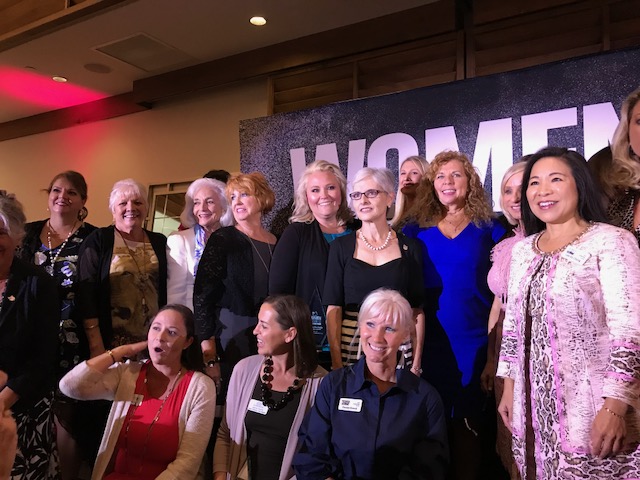 |
| Kathryn is second from left in back row |
 |
| Kathryn Shea, second from left on back row with other winners of leadership Award at Luncheon in Sarasota today |
 |
| Kathryn Shea ARCWP with son Seth, husband Stephen |
 |
| From left to right: Seth, Bridget Mary Meehan, Lee Breyer, Kathryn Shea |
Wednesday, April 25, 2018
"Feminist Theologian Elizabeth Johnson Retires from Teaching, not Theology"
https://www.ncronline.org/news/people/feminist-theologian-elizabeth-johnson-retires-teaching-not-theology
"In both my own university and across the nation, I see very fine younger theologians," she said. "This is my deep conviction: doing theology in the church is the work of the Holy Spirit. "
"In both my own university and across the nation, I see very fine younger theologians," she said. "This is my deep conviction: doing theology in the church is the work of the Holy Spirit. "
Tuesday, April 24, 2018
Pope Francis May Fly into Knock to Begin Visit to Ireland, Happy Memories of my Mother, Bridie Meehan, blessing us with Holy Water from Knock, "Gentle Mother" sung by Nathan Carter
https://www.irishmirror.ie/news/pope-francis-knock-mayo-ireland-12417747
My Response: I love to spend time with pilgrims at Knock Shrine in County Mayo, Ireland. It is a "thin place" where I feel the spiritual presence of Mary and the precious saints I dearly loved, like my Mom, Bridie, who took us to Knock on all visits to Ireland. In 1956, we emigrated to the United States but we were fortunate to be able to return twice as a family when I was a teenager. In 1964 and 1966, we visited our relatives and toured around Ireland .We never left our homeland without holy water from Knock and turf from the bog. At one time, I had several gallons of water from Knock in our family home. I still have a bottle of Knock water in my Florida home.
One of my happy memories is of my mother blessing us on our major trips with holy water. When we got a new car, it was blessed too. Mom kept the holy water fonts at our doors filled with holy water too!
In 2014, I visited Knock with 12 friends on Celtic pilgrimage. We prayed together in a circle near the apparition site. Even though many do not attend church regularly anymore in Ireland people of all ages including the young still go to Croak Patrick and pilgrimage sites like Knock, and St Brigid wells in Liscannor, Kildare and Faughart.
Bridget Mary Meehan #womenpriestsnow, www.arcwp.org
https://www.youtube.com/watch?v=o72r1-rtOtc

 |
| Bridie Meehan, my dear Mother died in 1998. |
My Response: I love to spend time with pilgrims at Knock Shrine in County Mayo, Ireland. It is a "thin place" where I feel the spiritual presence of Mary and the precious saints I dearly loved, like my Mom, Bridie, who took us to Knock on all visits to Ireland. In 1956, we emigrated to the United States but we were fortunate to be able to return twice as a family when I was a teenager. In 1964 and 1966, we visited our relatives and toured around Ireland .We never left our homeland without holy water from Knock and turf from the bog. At one time, I had several gallons of water from Knock in our family home. I still have a bottle of Knock water in my Florida home.
One of my happy memories is of my mother blessing us on our major trips with holy water. When we got a new car, it was blessed too. Mom kept the holy water fonts at our doors filled with holy water too!
In 2014, I visited Knock with 12 friends on Celtic pilgrimage. We prayed together in a circle near the apparition site. Even though many do not attend church regularly anymore in Ireland people of all ages including the young still go to Croak Patrick and pilgrimage sites like Knock, and St Brigid wells in Liscannor, Kildare and Faughart.
Bridget Mary Meehan #womenpriestsnow, www.arcwp.org

"Gone Astray" by John Chuchman, My Response
I agree with John that at the heart of all ministry, (ordained and non-ordained) is spiritual transformation. Our Association of Roman Catholic Women Priests Constitution states: "All of life is sacrament, a sign of God’s presence that reflects our holiness as co-creators in the community of life. Through conscious awareness and committed activism, we work for a more just, peaceful and egalitarian church and world where all beings thrive together. As members of the Community of the Baptized, we are aware that the entire church celebrates sacraments. We preside at sacramental liturgies in inclusive, empowered, egalitarian communities where all are welcome to experience God’s extravagant love. "
Bridget Mary Meehan ARCWP, www.arcwp.org
 |
| Upper Room Inclusive Community Celebrates Liturgy Around Table in Albany. New York |
"Gone Astray"
In the Early Church,
the primary role of leaders/ministers
was Community formation, nurturing, and growth.
Table liturgies
were held in homes, etc.
with the host/hostess
generally in charge of the meal/celebration.
There was no necessary link/mandate
between community leadership
and conducting the home liturgies.
Today,
the primary role
of Ordained Clergy
seems centered on
Officiating at the table liturgies,
removed from the homes of the faithful
into official buildings,
with little, if any,
time or energy or interest
in forming, nurturing, or growing
Community.
Instead of helping to transform people,
Church ministry is focused on transforming bread.
Something wrong with this picture?
My Website: www.sacredtorch.com/
My Blog: https://sacredtorch.blogspot.com/
Richard Rohr: "Reclaiming Women's Wisdom", Praying with Women of the Bible by Bridget Mary Meehan ARCWP
My Response: I agree with Richard Rohr that it is important to reclaim women-wisdom, courage and leadership in the Bible. This is the reason I wrote a book that offers scholarship, passages from scripture, and prayer experiences in Praying with Women of the Bible. https://www.amazon.com/Praying-Women-Bible-Bridget-Meehan/dp/097937670X


Reclaiming Women's Wisdom
Tuesday, April 24, 2018"While there is great value in the archetypes of feminine and masculine principles—which, regardless of our gender, we might all embody—it’s important to acknowledge the inequality within the church and culture at large. For example, in the United States, women make 83% of what men earn; the wage gap is even higher for women of color. [1] I can only nod in agreement with criticism of the Roman Catholic Church for its disregard of women as leaders.Thankfully, there are many people working toward a more inclusive and just society and religion. Womanist theology is helping to restore a feminine view of God and Scripture, honoring the voices and experiences of black women. It applies Alice Walker’s concept of “womanist” to theology, a field that has long been dominated by men. [2] Delores Williams writes:What then is a womanist? Her origins are in the black folk expression “You acting womanish,” meaning, according to Walker, “wanting to know more and in greater depth than is good for one—outrageous audacious, courageous and willful behavior.” A womanist is also “responsible, in charge, serious.” She can walk to Canada and take others with her [a reference to Harriet Tubman]. She loves, she is committed, she is a universalist. . . . Walker insists that a womanist is also “committed to survival and wholeness of entire people, male and female.” [3]Other theologians are reclaiming the importance of women in the Bible. Though the Bible was written primarily by men during patriarchal periods, there are plenty of examples of women in positions of wisdom or authority: Deborah, Esther, Ruth and Naomi, Judith, Rahab, Anna, Priscilla, the several women who accompany and support Jesus, and of course Mary, the mother of Jesus.And then there’s Mary Magdalene. My colleague, CAC core faculty member Cynthia Bourgeault, suggests that a careful study of this woman who first saw the Risen Christ can help us “cut through two millennia of doctrine and dogma to Jesus’ teaching. We find here relational health, an astonishing vision of love as a transformational path, and profoundly empowering models of women and men working together in spiritual leadership roles. To reclaim Mary Magdalene is to reclaim Christianity. Without her, our understanding of what Jesus really taught is incomplete. In fact, it is significantly distorted.” [4]
"There Is No Room for Discrimination in the Church": by Gregory Delgado del Rio

Gregorio Delgado del Río
Culturally speaking, the struggle for women's equality has no turning back. It is unstoppable, democratic and just.
( Gregorio Delgado del Río ) .- In the Opening Speech of the last Plenary Assembly of the EEC , Cardinal Blázquez has finally recognized what was an open secret: "... we have suffered a serious shortage of vocations for the presbyteral ministry ". He added: "If several decades ago the abundance was extraordinary, currently the scarcity is also extraordinary."
The fact is undoubted. "The consequences - he continued emphasizing - of this long and hard famine are in sight: decrease of the number of priests and average of age increasingly high". The problem is there. It is also there - if it is not addressed in an integral way - "the temptation to cover the lack of vocations with improvised solutions and risky shortcuts".
1. Realities sometimes ignored
The fact of the current shortage of priests is undoubted. It can be done, even, extensive to other parts of the Church in the world. Moreover, such a vocational shortage will soon be a full reality in the whole Church. What to do? How to respond to the challenge it poses?
The integral response also involves addressing without fear all those closely related issues: obligatory celibacy , rehabilitation in the ministry of married priests who request it, ending once and for all the unpresentable existing clericalism , proceeding to the recognition and evaluation of the woman in the Church (to put an end to so much discrimination), including her admission to sacramental ordination, to seriously promote the ecumenical movement, valorization of sexuality.
Culturally speaking, the struggle for women's equality has no turning back , it is unstoppable, it is democratic and just. Each day will be more intense and extensively carried out. The Church can turn a deaf ear to this reality (it has already done so against all odds) but, in sin, it will lead to penance. You will not be able to justify or obtain any receptivity before so much discrimination in your environment. It will lose credibility to jets. If he continues to persist in his idea, he will continue to provoke the abandonment (at least) of half of humanity. Moreover, he will commit the grave sin of ignoring current culture and civilization. Where, then, is the option in favor of the inculturation of the faith? (EG, 68-70).

As a sign of one of his most heartfelt concerns, John XXIII left us the Pacem in terris (11.04.1965). In it he already preached equality among all humans: "Today, on the contrary, the conviction that all men are, by natural dignity, equal to each other has spread and consolidated everywhere. Therefore, racial discrimination no longer finds any justification, at least in terms of reason and doctrine. This has an extraordinary importance to achieve a human coexistence informed by the principles that we have remembered "(n.44). Why did the Council not fully endorse this criterion? Why, in the Council, was it prohibited to speak of celibacy and the female priesthood?
It is not strange, therefore, that very significant voices were raised to draw attention to a reality that was then undeniable. It was enough with a minimum of sensitivity for the interpretation of the signs of the times. In full discussion of the scheme on the charisms in the Church, Cardinal Suenens, Primate of Belgium and one of the four moderators of the Council, sent this accusing cry to the council fathers: "Where is half of humanity here?". The situation of women in the Church already seemed, ecclesially and culturally, unsustainable for longer. The priesthood of the woman was, however, a taboo subject. The same as the subject of celibacy. The Council ended and everything went on in the same terms. Was not a revaluation of women in the Church possible in the future? Was not the priesthood of the woman viable?
2. The impulse of the University of Tübingen
In view of the restorative orientation that drove the reform of canon law, the direction of the "Tübinger Theologische Quartalschrift" edits, under the direction of the exegete Herbert Haag and Walter Kasper (today cardinal), a special issue dedicated to women in the Church and in society. The center of this position is constituted by an article by the canonist Heumann and the famous sixteen theses by Hans Küng, which the "New York Times Magazine" (23.05.1976) entitled: 'Feminism, a new Reformation' .
Undoubtedly, the most controversial was the fifteenth thesis:
" There are no serious theological reasons against the presbyterate of women . The exclusively male constitution of the college of the Twelve must be understood in light of the sociocultural situation of that time. The reasons that tradition adduces for the exclusion of women (sin entered the world through women, women were created in the second place, women have not been created in the image of God, women are not members of full right of the Church, the taboo of menstruation) can not refer to Jesus and are testimony to a basic theological defamation of women. In view of the leading roles of women in the primitive Church (Phoebe, Prisca) and in view of the totally transformed place that women occupy in economy, science, culture, the State and society, it should not take longer the admission of the woman to the presbyterate. Jesus and the first Church were ahead of their time in what pertained to the valuation of women; On the contrary, in this matter, the current Catholic Church is far behind its time, as well as with other Christian Churches ".

Although this impulse of the prestigious German magazine would be short-circuited, it was there and lies, to a great extent, the central point of all subsequent reflection to this day. Here lies the solution and the way out of the quagmire in which the Church herself would get immediately. And he would do it (how, no!), As in other cases, through a maximalist interpretation of the ordinary magisterium of the Pope (Henry Tincq). This is, authoritatively and giving the inopportune slamming .
3. The veto to the female priesthood
As usual in other cases, the official Church reacted negatively through a Declaration (October 15, 1976), of the Congregation for the Doctrine of the Faith, commissioned by Paul VI: "... the Church, by fidelity to example of her Lord, she does not consider herself authorized to admit women to priestly ordination ".
Nobody can wonder that the English Cardinal Basil Hume, in the framework of the Synod on the laity in 1987, participated in the Synodal Aula, the next dream, told us Henri Tincq, journalist of 'Le Monde'. The illustrious cardinal called the Nunciature in London and heard in response: "The Nuncia is not. He has gone to read the homily at Mass . " Faced with this, the cardinal reflects: "I learned that in my Church the two highest functions - the representation of the pope and the commentary on the Gospel - were carried out by a woman". A dream, twenty years after the Council, full of disappointment in the face of reality: Nothing had changed or seemed to change.
Later, John Paul II (22.05.1994), through the Charter Sacerdotalis ordinatio , declared that "the Church does not have in any way the faculty of conferring the priestly ordination on women, and that this opinion must be considered as definitive by all. the faithful of the Church. " Asked Cardinal Ratzinger, Prefect of the Congregation for the Doctrine of the Faith, if the previous doctrine of John Paul II "is to be understood as pertaining to the deposit of faith," he answered (28.10.1995) affirmatively.
And it clarifies: "This doctrine demands a definitive assent , since, based on the Word of God written and constantly conserved and applied in the Tradition of the Church from the beginning, it has been infallibly proposed by the ordinary and universal Magisterium (see Lumen gentium , 25.2). Therefore, in the present circumstances, the Supreme Pontiff, in exercising his ministry of confirming his brothers in the faith (cf Lk 22,32), has proposed the same doctrine with a formal declaration, explicitly affirming what always, in all parties and all the faithful must be maintained, insofar as it pertains to the deposit of faith ". We have the end of the conflict!
4. The impulse of Pope Francis
Pope Francis has already shown a very different orientation . At the same time, it has been very prudent. He has created a Commission to study the role of deaconesses in the first centuries. He has promoted significant appointments. For example, the last one: three women consultants from the CDF . He has whipped up the pernicious clericalism. But none of this means - at least for now - the admission of the woman to the priesthood.
I believe that the change will not happen without serious resistance, conflicts and problems. The risk of division will become clear. They will have to act very broad doses of patience . The woman will not conform and will tend to see the diaconate as a step forward but insufficient. The socio-cultural argument will have more weight every day. And, in the end, it will be necessary to confront openly the infallible character attributed to the current doctrine.
Thus, in a rarefied ecclesial environment, the Cardinal of Vienna, Christoph Schönborn, particularly close to Francisco, in recent Declarations, has clearly indicated that "... there is room to maneuver, also a necessary potential to change" . And he makes a coherent proposal: "The one of ordination [of women] is an issue that can clearly only be clarified by a Council. A single Pope can not decide on her. It is too big a question to decide on from the desk of a Pope. " Proposal that, in March of this same year, the Pontifical Commission for Latin America, derived to a universal Synod .
I find it hard to believe that these last two impulses were given without prior knowledge of Pope Francis. A new confrontation between different positions (deposit of the faith) is in sight. However, it is necessary to take a step forward and in a positive way. There is no room for discrimination in the Church. Will the trap be broken?

Subscribe to:
Posts (Atom)