|
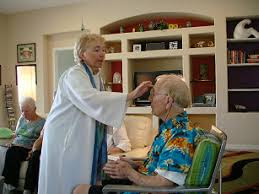
| Karen and Tasha |
About this liturgy:
My name is Karen Kerrigan. I was ordained a Roman Catholic Priest in The
Association of Roman Catholic Women Priests in November of 2018. I am a very fortunate member of St. Peter’s
Episcopal Church in Detroit, Michigan.
This community has a more than 100 year old commitment to serving their
surrounding citizens. In more recent
decades, they have paid close attention to growing injustices, as the divide
between the poor and rich in our city increased. Parishioners are leaders in education,
practical hands on service and works of social justice and activism. I began going to St. Peter’s in November
2017. The outwardly focused spirit has grown on me ever since. This church is officially an Episcopal Church
and Part of the Episcopal Diocese of Michigan.
However, the congregation comes from many different denominations as
well as nones (those who have not
affiliation). It appears the main
attraction, to this church, is the strong commitment to the poor, the
marginalized and the social justice works.
We have a full time pastor. I am
occasionally asked to lead and co-lead liturgies. The following liturgy was written for this
community for the weekend in between Christmas and New Year’s 2018.
-->
Theme: “Divinity has clothed Herself in
Human Skin” (Mary L. Coloe)
The Gift of Embodiment
A Christmas Season Liturgy stemming from John’s Prologue.
Greeting:
Officiant: Good Morning and welcome to our liturgy on The Gift of Embodiment. My
name is Karen Kerrigan and I am a priest in The Association of Roman Catholic
Women Priests. Thank you for this
opportunity to celebrate with you today.
Today we will
use a reading from Proverbs and The Prologue of John’s Gospel to find an
expansive exploration of “The Word becoming Flesh” and to reflect on the
meaning of our own gift of embodiment.
Before we
begin, in the tradition of this community we will take a few moments of silence
before we begin.
Opening Prayer:
Officiant: What an astounding idea that, according to today’s
Gospel, God said, your embodied experience and my embodied experience is… good!
(pause) To help us be more fully present to the idea of the Incarnation, and
the gift of embodiment, I wish to share this meditation. (pause) So, please at this time, take a
moment to find yourself to be comfortable, in the way you are seated. (pause)
If you wish, I invite you to close your eyes (pause)
Please
take some deep breaths and slowly exhale. (pause)
Feel
your feet on the floor.
Feel
your bottom pressing on the seat of your pew. (pause)
Feel
your back against the back rest. (pause)
Imagine
your backbone as a string of pearls, (pause)
Imagine
your tail bone points down, to the depths of mother earth.(pause)
Slowly,
move your attention up your backbone. (pause)
Going
further still, move your attention to the right and left to feel your
shoulders.(pause)
Feel
your beautiful face (pause)
Feel
the top of your backbone, as that string of pearls, is extending up your neck. (pause)
Feel
the crown of your head, as your pearls reach up to the portal of the heavens.(pause)
Now,
take a few more deep breaths and when you are ready, ever so gently, open your
eyes. (pause) Amen
Opening Song: For our opening
song, Please join in singing; “Celebrate A New Day Dawning” The
lyrics of this song follow the tune of Ode to Joy!
Officiant: Let us Pray, (pause) Blessed be Our Beloved Holy One and Living God.
People: Glory to God
Forever.
Opening Prayer: Our Beloved God, We
come together rejoicing, as we celebrate that your Divinity, has clothed
herself in human skin. For we remember
that you chose to, enflesh yourself in our human finitude. You incarnated your Glory and made it
accessible to our human experience. (pause) We ask that you help us to shift
our focus, of where the enfleshment of Christ/Sophia can be found, from a
manger so long ago, to the fullness of your presence, in our community today,
through The Gift of The Holy Spirit. (pause) Amen (pause)
Is there anyone who brought a prayer, poem or reading to share with us
today? (pause)
Healing Service:
Officiant: There
is one other theme that we need to focus on for today’s liturgy. We come together today just before the
New Year starts. And looking back on 2018, although I am grateful that I was
ordained this year, there were many difficult times for our world, our society,
our communities, myself, and for many of you as well. Perhaps, you, like me, experienced difficulties
and hurts in this old year. Because of
that, I can’t think of a better time to have our healing circle, than on this
threshold of the New Year. (pause) Now, I invite everyone, who wants to, to
gather in a circle around the altar for our healing practice. (pause for people
to gather) Please take a moment to
introduce yourself to the person on your left and your right. (pause)
Before, we start anointing each other,
I invite you to take a moment to remember a difficult episode, that happened in
your life during 2018. I wish to pause
now, to give you time to remember the hurt and ask God for healing, in your own
way. (pause)
Now, I ask you to minister to,
anoint and bless the person next to you, as she or he is setting out on their
New Year’s Journey. You may want to say
something like;
“Dear , I pray that
God will heal you of any hurts from the old year and give you, deep healing and
deep blessings as we enter the new year. (pass the anointing jars)
(After everyone has been anointed) Amen. Please return to your seats. (pause)
Officiant: Let
us have the first reading from Proverbs.
First Reading:
Proverbs 8: 22 -36
Reader:
(say) A Reading from The Book of Proverbs
“Rejoice,
for Our Adonai gave birth to me; Sophia/Wisdom, at the beginning,
before the first acts of creation. I have been there, from everlasting, in the
beginning,
before the world began. Before the deep seas, I was brought forth,
before there were fountains or springs of
water; before the mountains erupted up
into place, before the hills, I was born
– before
God created the earth or its fields, or even the first clods of dirt.
I
was there, when Adonai created the heavens, and set the horizon just above the
ocean,
setting the clouds in the sky, and establishing
the springs of the deep, giving the seas their boundaries and setting their
limits at the shoreline.
When the foundation of the earth was laid
out, I was the skilled artisan, standing right next to Adonai!
And, I was God’s delight day after day,
rejoicing at being in God’s Presence continually, rejoicing in the whole world
and delighting in humankind. (pause)
“And
so, my daughters and sons, hear me well: happy are you when you keep my ways!
Dwell in my house and take my instruction
seriously and grow wise; don’t neglect my lessons. Happy are you who listen to me, and keep watch
at my door, waiting at my gates.
For you who find me, find life, and earn
the favor of Adonai…(pause)
Reader:
(say) Hear what The Spirit is saying to the churches!
All: Thanks
be to God.
Alleluia: (Play brief
instrumental “Gloria in excelsis deo”)
Gospel Reader: (Go and get the Book of The Gospels and bring it to the podium)
(say) Please stand. (pause)
“Gloria in excelsis deo” (pause) A Reading from The Gospel of John (pause)
In The Beginning, there was the Word, The Word
was in God’s presence, and the Word was God.
The Word was present to God from the
beginning. Through the Word all things
came into being, and apart from the Word nothing came into being, that has come
into being.
In the Word was life, and that life
was humanity’s light— a Light that shines in the darkness, a Light that the
darkness has never overtaken. (pause)
Then came one named John, sent as an
envoy from God, who came as a witness, to testify about the Light, so that
through his testimony everyone might believe. He himself wasn’t the Light; he only came to
testify about the Light—the true Light that illumines all humankind. (pause)
The Word was coming into the world—
was in the world—and though the world was crafted through the Word, the world
didn’t recognize it. Though the Word came to its own realm, the Word’s own
people didn’t accept it. Yet any who did
accept the Word, who believed in that Name, were empowered to become children
of God— (pause)
Children born not of natural descent, nor urge
of flesh nor human will—but born of God! (pause) And the Word became flesh and
stayed for a little while among us; we saw the Word’s glory—the favor and
position a parent gives a child—filled with grace, filled with truth. (pause)
John testified by proclaiming, “This
is the one I was talking about when I said, ‘The one who comes after me ranks
ahead of me, for this One existed before I did.’ ” Of this One’s fullness we’ve all had a
share—gift on top of gift. For while the gift of the Law was given through
Moses, the Gift—and the Truth—came through Jesus Christ. No one has ever seen God; except only, The
Birthed and Begotten, ever at Abba’s side, who has revealed God to us.
Reader: “Gloria
in excelsis deo” (pause) The
Gospel of Our Beloved Lord Jesus Christ.
All: Praise to You Jesus
Christ. Amen.
Officiant: Please
be seated.
Today we can say, “Gloria in excelsis deo because Divinity has clothed
herself in human skin. And since, we are talking about human skin, we might as
well talk about, one of the things that we humans are good at, which is, we are
good story tellers. For sure, the gospel
writers were good story tellers. For instance, on Christmas Eve we heard Luke’s
infancy story about Jesus being birthed in the manger. This Lucan version has
Jesus coming, to a specific place; Bethlehem and a specific time which was
during the Reign of Caesar Augustus.
But, today, as our Christmas celebration
continues, we hear from The Gospel of John.
This Gospel writer starts his story, by pushing back the story of Jesus
all the way to… “the beginning” (pause) way, way back before Sarah &
Abraham, still further before Eve and Adam and even in our modern understanding
of The Universe, John seems to be pointing us towards even before…The Big Bang,
was this Word, that would become… one of us.
The Gospel Writer of John seems
to be writing a New Genesis. He wants his readers to make several; shifts in
consciousness. Could it be that we, in our time, need to make several shifts in
consciousness as well?
You
may know that all of our Canonical Gospels; Matthew, Mark, Luke and John were
written in the aftermath of the destruction of the temple and the fall of
Jerusalem to the Romans in 70 AD. The
Gospel of John is the last of the four and was written to a mostly Jewish
Community, at the end of the first century.
And I think we may find parallels, with the Gospel, for our own times on
the brink of 2019.
You see by the end of the first century, the persons who did not follow
Jesus and were still Jewish, would replace The Tabernacle, as the place they
would find God’s Glory, with The Torah, in what would become known as
Rabbinical Judaism.
Therefore, John’s Community was facing another huge loss as they were no
longer welcome to worship in their synagogues. Furthermore, in a departure from the
Rabbinical Jews, they would replace The Tabernacle and The Temple with The
Person of Jesus. Yet still, they had
another problem, for just like they no longer had the physical Temple so they
no longer had the physical presence of Jesus either!
Here is where I am relating it to our times. We live in a time of major change both in our
understanding of our society and country as well as our Christian
understandings. For the community of
John, in today’s reading, a new Genesis is being written. This writer will move his readers from their
Temple, from their synagogues and even from the physical Jesus and onto finding
the fullness of Divine Presence in their gathered community itself with The
Power of the Holy Spirit as the new house where God’s Glory is found.
How about us? We are living 19
centuries after John’s New Genesis was written.
We are witnessing and facing multiple events of un-love in our society,
in our world and perhaps many of us have experienced these un-loves in our own
personal lives. We as a community have
taken many actions. We show up, we cross
boundaries, we share what we have, we speak up and we face the consequences of
those who do not want the changes we seek.
However, as much as we are doing, I think more and more of us are
recognizing that, many of the very scaffolds and institutions of our lives are
collapsing. Does it seem as if humanity
is at a serious crisis that involves our very identity? Are we, with our many
actions, like this Gospel of John writer?
John invites more than one shift
in consciousness for his audience. It
seems that they had to find the new seat of God’s Glory, in themselves; collectively
and individually through the power of The Holy Spirit. Once more, in the tradition of John, they
knew themselves not to be a closed community, or in our terms; an insulated
silo, like some other Jewish Communities of their time chose to become. Their
Community, would be a Community that would be outwardly focused. They would not
gate or wall themselves in. Instead they would extend their table and keep
their doors open. St. Peter’s Community
demonstrates how to do this. I am
encouraging us to continue to become more fully aware, that when we do these
many good works and actions, and we support each other in doing so, we too are
writing a New Genesis and honoring the House of God’s Glory present and active
amongst and through us.
After I close, we will take a few moments of silence and then I invite
your responses. But before I close my
sharing, I am asking you to try on, a new chant in the tradition of our
Activist Community. I will call out,
“Tell me what God’s Glory Looks like?” And I invite you to call back, as you
point at yourself and gesture to the entire gathered group, please say; “This
is what God’s Glory Looks like!” (pause) After we get that going, I wish to use
other senses besides just vision and looks.
I will ask you to, “Tell me what God’s Glory Sounds like and even acts
like?” And I invite you to respond
accordingly. Ready?
Leader: So,
“Tell me what God’s Glory looks like?”
All:
(pointing to self and gesturing to the group) “This is what God’s Glory Looks
like?”
(Repeat)
Leader:
“Tell me what God’s Glory sounds like?”
All: “This
is What God’s Glory sounds like.”
Leader:
“Tell me what God’s Glory acts like?
All: “This
is what God’s Glory acts like.
Leader:
“Gloria in excelsis deo”
All: “Gloria
in excelsis deo”
Amen
(pause and invite people to respond
to the Gospel and homily)
Statement
of Faith;
Officiant: For this Feast of
The Incarnation, I have combined; Our Statement of Faith with our prayers of
the faithful. As we read and respond to these, I invite you to practice making
the shift from finding God’s Glory exclusively in the person of Jesus to
finding it now in us, the Community of Jesus, empowered with God’s Spirit. Would you please stand and join our
proclamation of faith found in your program. I am asking for a reader to be the
Leader. The rest of us will read the “All” statements.
(1) We, like
our brother; Jesus, are incarnated from Our Beloved God
and returning to God. Therefore we
recognize our interconnection
with all other humans, all other
creatures and the rest of creation.
All 1: We Remember and
believe, Our Beloved Creator is saying; “It is good!”
(2) We are called to be whole-makers, and
empowering companions of everyone.
All 2: We Remember and
believe, Our Beloved Creator is saying; “We are good!”
(3) We have learned
from Jesus ministry of restoring dis-membered bodies to wholeness and
well-being.
All 3: We Remember and
believe, Our Beloved Creator is saying; “They are good!”
(4) We pray for more appreciation for our own
loving sexual energy and recognize that this power dwells in others who may
identify and orient it differently than we do.
All 4: We Remember and
believe, that God created human generativity in love and for love, and says;
“Doing this is good!”
(5) What we do here is always incomplete until, All
have the opportunity to thrive with joy.
We pray for deeper conviction that we are sent to help provide others
and ourselves opportunities to thrive, with joy.
All 5: We Remember and believe, that God created All,
saying; “All are good!”
Officiant: Amen
(pause) Are there any prayers that you wish to
share with the community?
(After, it appears the pray-ers have
completed what they wish to share)
Officiant: We
entrust these and all prayers we hold in our hearts to Our Beloved God!
(pause) All:
“Gloria in excelsis deo!” Amen
Offertory Song: (pause) Would someone please
pass the offertory plate? (pause)
For Our
Offertory Song let us sing; “Do you hear what I hear?”
LITURGY OF
THE EUCHARIST
Officiant: At this time, I
invite those who wish to join us around the altar bringing your program.
(pause) I want this celebration of Eucharist to be inclusive as possible. Therefore, I am asking if 1 of you would pray
some of the parts. I have numbered, The
ALL statements. Please read the All statement together after my co-leaders or
myself has prayed.(pause)
Officiant: As we prepare for the sacred meal, I invite
each of us, to take an embodied moment and place our hands on Our Table. As you
place your hands, silently, re-member yourself to deeper inner awareness that
Our Table is connected to Jesus’ Table. Therefore, as we shift to Our Table we
are connected with all those who gather around Tables throughout the
world.
Officiant: Also, Our Table
re-members us to how deeply connected, we are to our ancestors who sat around
so many tables. In the silence of your
heart, take a moment to also acknowledge, as long as there are those whose
basic hungers are unmet, Our Table is incomplete. (pause)
1: You, Our Beloved God,
have taught us that,
to be human is,
to be a guest house, for
all.
Officiant: Every morning, teach us to,
welcome the day and others
as a new arrival
All 2: We desire to be embodied with,
Your conscious love every day.
Officiant: Our Gracious God,
you the Loving, Embodier of all life,
re-membering and restoring all that denies, betrays and abandons that which you
deemed as whole and good. Your Joyous Spirit encompasses and envelops all that
exists, we implore that your healing power be upon us all. So, we pray for
today.
1: You,
like a baker woman were kneading our way with healing and providing the leaven
of caring companions sustaining the journey of your holy people.
Officiant: We now join with all of creation
singing of Our Holy Wholeness!
All 4. (Chorus)
We are holy, holy,
holy
We are holy, holy,
holy
We are holy, holy,
holy
We are whole...
(Repeat)
(Verse) Spirit divine, Come to us
Feeling love,
Healing us
Open our hearts,
Allow us to see
Beauty & love,
Lives in us.
For we are (Chorus)
(song by Karen Drucker)
Officiant: We bring you these
gifts with our desire to be more conscious of our own whole-making power. (pause)
Officiant: I invite you to
extend your hands over the bread and wine and say the words in our program
together.
All (While Extending
Hands):
Come, Sweet Spirit of God upon our gifts of bread and wine.
Transform them with your generative power and energy,
to heal, empower and nourish us in our
time of need.
Officiant: Our Beloved Spirit,
you came to us fully enfleshed and embodied in Jesus. Jesus even, came down the birth canal and
become one of us. As an adult, he was
moved to heal those who were sick and broken.
He shared stories with and challenged his listeners to expand their care
for themselves, each other and the earth.
Officiant: As you, Our Beloved
Jesus, worked to re-member us to wholeness, you were met with resistance, by
those who benefitted from the dis-memberment of others felt threatened. They were so alarmed that their domination
strategies were in jeopardy, that they began to seek to destroy your body.
1: Nevertheless, you
continued embodying your path of conscious love. We now, want to remember how you gathered
your closest friends around your table.
(Officiant: Hold the paten or
plate with the bread upon it)
Officiant: I invite you to
pray the words of consecration together.
All: Just like a mother
at a Seder meal, you took bread and broke it,
Saying; This is my body, given for you, Eat it in my
memory.
Officiant: (Holding up the
bread and turning to the right and left, placing it back on the table)
All : ( while the bread
& wine is being held up, everyone bows)
Officiant: (Hold
up the cup)
Then after supper was ended, you took
the cup,
Saying: This cup of liberation is my
blood, given for you.
And together…
All (saying over the cup)
“Take this all of you and drink from it;
This is the cup of my life-blood,
The new and everlasting covenant.
I pour it out for you and for all.
Do this in memory of me.”
Officiant: (Hold up the cup a
little higher and turning to the right and left, placing it back on the table)
All: (everyone bows as
the cup is elevated)
Officiant : (looking around at
everyone) Let us continue companioning
one another with the power of this sacred remembering.
1: Trusting, in Our
Beloved’s Steadfastness, in womb-like love, we are empowered to continue
companioning each other, as we ourselves know healing.
Officiant: Now, we celebrate your presence with
us now,
in this bread and cup and in each
other.
(Before
reading, invite people to intentionally place their right hand on the person to
their right and their left hand on the person to their left)
Officiant : I invite you at
this moment, to place your right hand on the shoulder of the person to the
right of you. Although, you need to hold
your worship aid, I invite you, to have the intention of placing your left hand
on the shoulder of the person to the left of you! Together…
All (saying with
hand on someone’s shoulder):
My dear companions of empowerment, we need
each other! Therefore, we now call upon Our Sweet Spirit of God, to hover over
our companionship. Come, Holy Spirit into
our inner being so we can be fully empowered to come out at the world with;
compassion, love and healing for whoever we touch. (Please place your hands back where they were
before)
Officiant: Our Beloved Jesus,
in this bread we break and in this cup we share, let us recall that you intend
all of life and creation to continue thriving and evolving.
1: So grant, that we
may live, more fully in our humanity, in union with all peoples, living and
dead, empower us to create a world where people are good to themselves and in
peace and justice good to each other.
Officiant: I invite us to pray this Prayer, written in the
Tradition of Jesus, found in your program.
Prayer of Jesus:
Our Mother, Our
Father,
You are the Source of
our wholeness,
You protect and
nurture us,
As we dwell in your womb of love.
Your kin-dom come,
your will be done
On earth as it is in
heaven.
Give us today our
daily bread.
Forgive us our sins,
as we forgive those who sin against us.
Save us from the time
of trial and deliver us from evil.
For the kin-dom, the
power and the glory
are yours now and
forever. Amen.
Sign of Peace
Officiant: God’s peace is
with you.
All: And also with you.
Officiant: Please share a
sign of peace and return to your seats when the music ends.
Peace
Song:
(Play Instrumental: “Let there be Peace on Earth”)
Officiant: Please join in
our prayer for the breaking of the bread:
(1)
Loving God, You call us to live the Gospel of peace and justice.
All 1: We will live justly.
(1) Loving God, You
call us to be Your presence in the world.
All 2: We will love tenderly
(1) Loving God, You
call us to speak truth to power.
All 3: We will walk with integrity in your
presence.
(Presiders lift
bread and wine)
Officiant: This is Jesus, Bread of Life.
How Blessed are we to
be called to this table where we actually,
share Bodies with Our Beloved God.
All (while the bread & wine are held): How Blessed are we to share in Your Embodied
Presence, nourish us to continue embodying you, wherever we go. Amen
Communion Song: “Today is The Beginning” Lyrics and Words by our own Adarsa.
Prayer of Thanksgiving After
Communion
Let us pray.
O God who is end and
beginning,
You draw near to us in
word, sacrament and each other.
Strengthen us and
renew us. Kindle us in the fire of your
Spirit.
May your light so
shine through us that all may welcome your coming.
We ask this in name of
The One who became flesh, just like us.
Amen.
Officiant: And through The Power of The Holy Spirit,
May you continue
embodying love, peace and joy as you journey into this New Year.
In the Name of The
Holy Three, may you be lovingly ever encompassed, enveloped and empowered.
Amen.
Officiant:
Let us sing Joy to the world. (page 100)