
Translate

Wednesday, February 27, 2019

Olga Lucia Alvarez Benjumea ARCWP, Catholic Priest and Bishops Celebrates Liturgy at Home Mass in Medellin, Colombia

https://www.deine-korrespondentin.de/die-frau-gottes/
(translated from German article)

Olga Lucia Alvarez ARCWP


Colombian is the first Catholic woman priest and bishop of Latin America. She was consecrated against the resistance of the official church in Rome.
By Katharina Wojczenko, Medellín

Olga Lucía Álvarez Benjumea does not let herself be disturbed - not by the chickens under the altar, not by the rabbit hovering over her feet during the sermon, not by the boy's cellphone ringing at the reading. And certainly not from the bus that crashes every few minutes outside over the potholes and fills the house with exhaust fumes. Grandmother Anita Manco, 86 years old, has a sore leg. Her children have invited Olga Lucía Álvarez to her home so that she can celebrate the Holy Mass with her family and donate the Anointing to her grandmother.
With the pink sneakers, the pink backpack, the white blouse and cherry red pants reminds the 77-year-old to a feisty schoolgirl. If there were not the simple metal cross on her chest. She does not need her own house of worship. For the service she hands the room in the bare-plastered house with tin roof, where grandmother Anita lives. The family has set the table with a white cloth.
This is her altar on which she prepares the plastic box containing the hosts, the small wine bottle, the goblet and her bible. The grandmother's bed and several plastic chairs are the pews. Two daughters, one son, one son-in-law and three grandchildren have come. Álvarez puts on a stole, which is colorfully embroidered with female saints. She hugs and kisses everyone in greeting. Touch is at least as important to her as the words.
She encourages people with the Bible
When she wants to make the Word of God understandable, she becomes loud, whispering, almost promoting. Like the biblical passage about the healing of the mother-in-law of Simon Peter, who chose the family for the reading. In the Aramaic, the language of Jesus, he did not roughly say "Stand up!" As in the translation. But: "You can get up." You have the dignity to it, you have the spiritual power, you are capable, she explains. "He motivated her, he took her fear and pain," says Alvarez. "Everything depends on us. The Spirit of God is in us - we just have to allow it, strengthen it. "
Becoming aware of his dignity and acting on his own: Olga Lucía Álvarez Benjumea has already preached this to many people in difficult life situations when she was not even a priestess. Growing up in a village in the department of Antioquia, she got to know Colombia's social problems at an early age. There were several illegal mines and over decades repeatedly disappearances and massacres of the poor population.
Her mother was a deeply religious woman. She gave her Catholic faith to her children. Of the six siblings, two became priests - and one priestess. Already as children, they played church at home, held masses and processions. The altars were tinkered with mother's newspaper. The pastor played the siblings alternately. "My mother never said: Olga is not allowed to do that," remembers Alvarez.
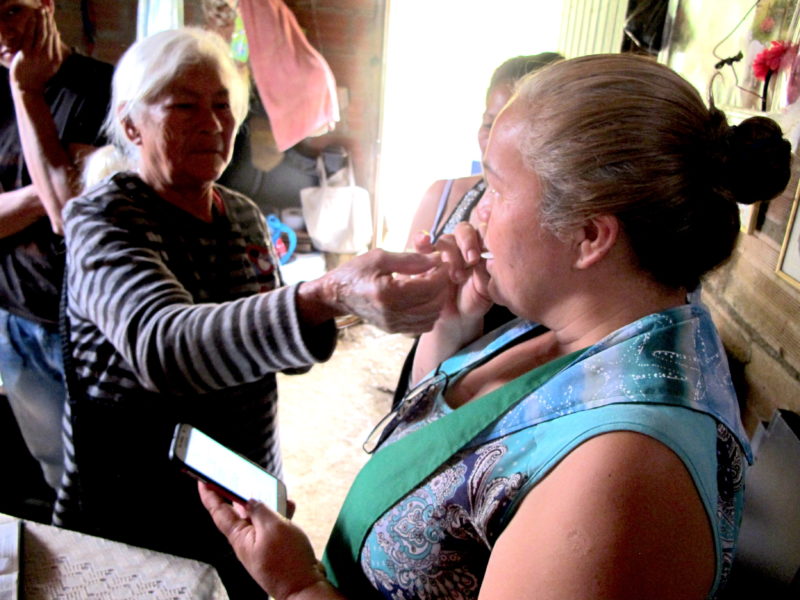
Olga Lucia incorporates the church into the service. Grandma Anita distributes communion to her daughter Lucero.
She became a Catholic Lay Missionary, working with Afro-Colombians and Indians, in places accessible only by boat or donkey, and with people in the slums of big cities. She listened to them, talked to them about the gospel, and tried to find practical solutions to their problems; for example, by building workshops and encouraging women to study.
As a priestess, she continues to go where she is needed. She works with women released from prison, who have no one to talk to, with prostitutes and visits families who invite them.
On a ship near Passau the first priestesses consecrated
Ih ren beginning took the international priestesses movement in Austria Founder is the former Benedictine and teacher Christine Mayr-Lumetzberger. "In the 70s, we women were expected to open the offices," says the bishop today. But Pope John Paul II declared the question of the ordination of women ended. That's why 20 years ago Mayr-Lumetzberger developed a training program for priestesses. 2002 excommunicated by the official church bishop and Argentine liberation theologian Romulo Braschi ordained i the first seven women priests - on a boat on the Danube near the Lower Bavarian Passau.
Today there are about 300 Roman Catholic priestesses worldwide. The most common is the movement in North America. In Latin America, there are currently ten, nine Colombians and one Venezuelan, plus seven candidates. There are about 20 priestesses in Austria and Germany, most of whom work in secrecy - mainly because of their additional role within church organizations. Guilt is the Concordat, the State Treaty with the Church. A
If they knew what they were doing, their job would be at stake Those priests who work with the women or allow them to officiate in their churches also want to remain unrecognized. "Thanks to word-of-mouth, they have a lot to do with baptisms, weddings, worship and pastoral care," says Mayr-Lumetzberger.
What Women Worldwide Share: They have a family behind them and are financially independent. That's important because the priestesses do not deserve anything. Also Álvarez decided only for this step, when she was already retired. Partner or children does not have them. Marriage, partnership, divorce or homosexuality, however, would not be an obstacle to a priestly ordination.
"I have read the Gospel and felt liberated," explains Alvarez, "I feel obliged to liberate others." She did not want to convert. "I have never gone through the slums and injected with holy water around me, but have lived my faith." Everything else can not be reconciled with the church's crimes against the indigenous people during the colonial era.
Above all, she worked for years alongside Bishop Gerardo Valencia Cano, whose secretary she became. Valencia was Bishop of Buenaventura, until today an area of ​​violence and poverty on the Pacific coast with mostly Afro-Colombian population. He not only deliberately promoted female missionaries and allowed them to take on these priestly duties. Valencia was a passionate exponent of liberation theology, whose child Álvarez calls herself.
This theology developed in the 1960s in several Latin American countries. The trigger was social injustice. The Liberation Theologians interpreted the Bible out of the experience of the poor. They wanted to help them to free themselves from exploitation and oppression - instead of waiting for salvation.
For the poor against resistance
The Liberation Theologians stood in the wings - in the dictatorial regimes, in the Roman Catholic Church, which often cooperated with these regimes, and in those who had power or socialism behind it. Repeatedly priests were murdered, even in Colombia. Armen Bishop Valencia died under dubious circumstances in a plane crash. The Liberation Theology office in Bogotá, where Álvarez worked, has been repeatedly attacked.
At the same time, Latin American liberation theology had far-reaching consequences for the Catholic universal Church. This was the experience of Álvarez in 1968 in Medellín as secretary of the General Assembly of Latin American Bishops. The bishops denounced the social injustices and, with the Pope's approval, raised the so-called option for the poor as a guideline of the church - that is to say that it wants to seize a special party for the poor - a thought that Pope Francis took up again.
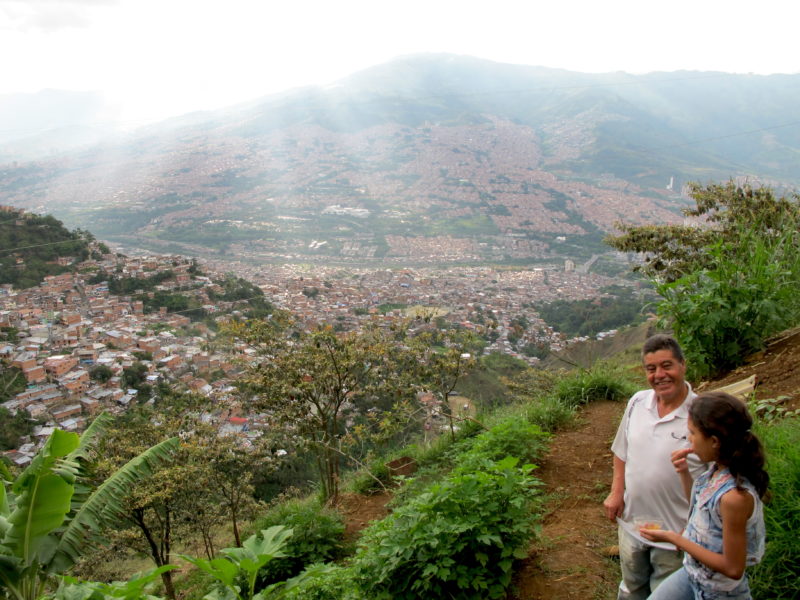
On the trail below the house of the grandmother: Here below her goats graze. In the picture son Norberto (left) and granddaughter Manuela.
Álvarez was there when a minority movement developed against the resistance of the church hierarchy and the world church finally changed. She hopes the same for the women's priest movement. In most Protestant, Anglican and Old Catholic churches and other Christian communities, women's ordination is allowed. Converting is out of the question for them, because their goal is nothing less than the revolution of the Roman Catholic Church.
Rejection of women's ordination is controversial in the church
But the bishops in the Vatican continue to reject the ordination of women. Canon law allows consecration only to a baptized man. Theologically, this is controversial. Advocates of women's ordination point to Mary and Mary Magdalene, whom the risen Jesus Christ was the first to ask to spread the Gospel around the world. The retired history and theology professor Dorothy Irvin of the University of Tübingen has found in excavations evidence from the first eight centuries after Christ that women were active as Christian priestesses.
In 2016, Pope Francis set up a commission on the issue of the women's consecration - the lowest of the three consecration levels (deacon, priest, bishop), which until now have only been reserved for men. However, he dampened the hope for change: The Commission should only examine the historical role of deaconesses in the early church. The result is still pending. "I like Francis very much," says Olga Lucía Álvarez, "but he is like the friend who tells you many beautiful things, but never talks about marriage."
On the occasion of his visit to Colombia in 2017, she wrote an open letter to the Pope, offered him her services and asked him for an interview. An answer she did not get until today. "But since then, I have regularly posted visits from the Vatican to my website, " says Alvarez. She is convinced: "Sooner or later that will come. We have laid the foundations. "The faithful would always have accepted her as a priestess. Or with Grandma Anita's words: "You can learn everything - even as a woman!"

Ordination to the Priesthood of Linda Kapuananiokalaniakea Lalakea RCWP in Portland, Oregon on Feb. 23, 2019, Presiding Bishop Suzanne Avison Thiel RCWP and Co-Presiding Bishop Jane Via RCWP


Rome Has Spoken and Rome Is Finished: The Vatican’s Sexual Abuse Summit ‘Failed Miserably’ by Mary Hunt

The recently concluded Vatican summit on sexual abuse in the church was framed in the same old top-down way that's at the heart of the problem. Lay people, both women and men, experts in the law, psychology, and theology were excluded. What could be more wrong with this picture?

Pope Francis Getty Images


Survivors of sexual abuse, women religious, LBGTIQ advocates, and some journalists made impressive showings during the recent “Protection of Minors in the Church” meetings in Rome. Pope Francis, cardinals and bishops, not so much. The Vatican had lowered expectations going into the meeting once it became clear that Catholic people around the world demand action not just words. From all that I saw and read—talks and press conferences were live streamed; press coverage was extensive—the clerics came in well below even their own low bar.
As I surmised beforehandthe meeting was “held at the wrong time with the wrong people about the wrong issues.”

Just imagine if the meeting had been held in September 2018, right after the Pennsylvania Grand Jury report was issued with its shockingly large number of victims and offenders. That would have also been right after reports came out that Cardinal Theodore McCarrick had abused countless seminarians and priests. The Vatican crowd could have saved themselves a lot of grief.


Think of what would not have been on the table. Many terrible revelations have emerged since September:
Lists of hundreds of credibly accused priests from dozens of dioceses and provinces of men’s religious orders are now public.
A report on the many children who have been fathered by the fathers, as it were, is under review.
The sordid details of the McCarrick saga are clear, including his abuse of someone in the confessional, which was a major reason for his subsequent defrocking.
Reports of clerics sexually abusing nuns in India and elsewhere are now common knowledge.
A page-turner of a study of the incidence of allegedly gay, sexually active, but most of all duplicitous priests in high positions in the Vatican entitled In the Closet of the Vatican: Power, Homosexuality, Hypocrisy opens another vista.
Report of the Apostolic Nuncio to France, Archbishop Luigi Ventura, under investigation for molesting a government staffer just surfaced.

In fact, all of that data was part of the backdrop of the meeting, but no one peeped about most of it. Maybe next time the clerics will learn to act faster for their own good.


Pope Francis gathered 190 heads of bishops’ conferences as well as ten women religious who lead their orders and their equivalent in men’s congregations for the summit. But the real action was in the streets and surrounding buildings, where scores of sex abuse survivors and their supporters protested, told their stories, and gave interviews.

The more the clerics droned on in endless platitudes and careful parsing in lieu of implementing policy, the more the survivors garnered credibility and sympathy. A skilled facilitator would have invited the survivors into the hall, paired them each with a bishop, and invited them together to lay out constructive next steps for the church. Alas, no such forward-looking person was in a position to do so, least of all the much-touted and deeply disappointing pontiff.

Instead, the official meeting featured videos of survivors at yet one more remove from the bishops, many of whom had never listened to survivors in their own dioceses. It’s no wonder. These stories are hard to hear. One woman in a video told of being forced as an underage teen into sex with a priest; he paid for her three abortions. Some bishops expressed genuine shock, leading observers to wonder where they have been for the last two decades.

Still others continued to externalize the problem as a Western issue, suggesting, for example, that problems like child soldiers demand equal time. No doubt, good brothers, but the stated focus of the meeting was on the protection of minors, with the implied tagline “from priest/bishop abusers.” There are many actionable forms of abuse of children, but this time the focus was on that perpetrated by and covered up by clerics. The Vatican was not trying to solve the world’s problems, but to look at its own.

By many measures it failed miserably. The gathering was too homogenous to be useful. It was framed in the same old top-down way that’s at the heart of the problem. Lay people, both women and men, experts in the law, psychology, theology, and the like were excluded. Clerics met in small groups to talk with other clerics. What could be more wrong with this picture?

Pope Francis in his final statement captured the egregious miss that was this meeting. He started off generally: “Our work has made us realize once again that the gravity of the scourge of the sexual abuse of minors is, and historically has been, a widespread phenomenon in all cultures and societies.” Then he went on to contextualize clerical abuse by talking about the high incidence of abuse at home. He’s right, of course, but the difference is that families don’t have as their reason for being the well-being of the world’s people. That is the Church’s (now empty) claim.

He painted a broader picture of pornography, sex trafficking, and other precipitating forces that make up “the mystery of evil, which strikes most violently against the most vulnerable.” There is no mystery here. His priests and bishops abused minors and some covered it up. What’s so mysterious about that? A large number of minors have been sexually abused by a large number of clerics. Period. Full stop. It’s simply the beginning of a hideous story that includes the abuse of seminarians, nuns and other women, children of priests, and more, all of whom merit summits of their own.

Francis’ discussion of power fell flat. He claimed that the sexual abuse of minors is an abuse of power. He completely passed over the structures of vastly unequal power between clergy and laity that are the bedrock of this power differential, a causative factor in church-related abuse. Without changing those structures the chances of eradicating sexual abuse of minors by clergy are nil.

Francis concluded with nothing new, concrete, or effective, using vacuous terms like “impeccable seriousness” and “genuine purification,” highly spiritualized notions that might ground new policies. I do not think so. And I know that few are going to wait around to find out.

Survivors and their supporters left empty handed while bishops toddled off to their dioceses without clear direction. On the one hand, one can applaud Francis for not imposing new laws by fiat, for inviting people to a “personal and communal conversion.” But “zero tolerance” is hardly a new idea or something around which consensus has to be built. It does not mean someone must leave the church as the McCarrick case proved, only that the person be dealt with by civil authorities and leave ministry where the possibility of abusing power remains. Is that too much to ask in the face of mounting evidence of criminal behavior and cover-ups?

On the other hand, Francis’ approach might mean that church teachings and polity will be handled locally as abuse cases are. Catholics can rejoice that such moral sticky wickets as abortion and homosexuality, and such disputed matters of ecclesiology as the ordination of women and married men to the diaconate and presbyterate, will soon be announced as local options as well. I doubt sincerely that this is in the cards, but it follows logically. Logic was at a premium in Rome during the summit.

This dilemma, this selective use of papal power, points to the fundamental problem at hand. It’s the need for new ecclesial structures rooted in a realistic theology that would mitigate power inequities and begin to reshape the global Catholic Church into safer, more participatory communities with the full participation of women and lay men in every facet of church life.

To that end, the undisputed highlights of the meeting were the three presentations by women. Some of the clerics expressed surprise that Canon Lawyer Linda Ghisoni, Nigerian Sister of the Holy Child Jesus, Veronica Openibo, and longtime Mexican journalist, Valentina Alazraki, had such powerful and well-grounded analyses, and that they minced no words in their articulation. Apparently the men have been asleep for the last four decades when Catholic women have developed such competencies with no help from the institutional church.

Dr. Ghisoni challenged the overuse of official forms of secrecy in the Vatican, the so-called “pontifical secrets,” claiming that much of what had been hidden for the sake of protecting good names and the institution was relevant for public discussion. She knows that Canon Law can and must change. Pope Francis’ bizarre comment about feminism being “machismo in a skirt” following her talk suggests that she might have struck a little close to home.

Sister Openibo asked the clerics why they had persisted in silence for so long: “Why have other issues around sexuality not been addressed sufficiently, e.g. misuse of power, money, clericalism, gender discrimination, the role of women and the laity in general? Is it that the hierarchical structures and long protocols that negatively affected swift actions focused more on media reactions?” She concluded with the need to “be proactive not reactive in combating the challenges facing the world of the young and the vulnerable, and look fearlessly into other issues of abuse in the church and society,” marching orders for those who want to solve this problem.

Valentina Alazraki, a veteran Vatican journalist who has worked during five pontificates over four decades taking 150 papal trips, was equally frank. She left these words ringing in the ears of the assembled: “… we journalists are neither those who abuse nor those who cover up. Our mission is to assert and defend a right, which is a right to information based on truth in order to obtain justice. We journalists know that abuse is not limited to the Catholic Church, but you must understand that we have to be more rigorous with you than with others, by virtue of your moral role.”

She recommended that the clerics turn over a new leaf with the new onslaught of information about the abuse of women in the church. This time, she counseled the institution to “play offense and not defense, as has happened in the case of the abuse of minors. It could be a great opportunity for the Church to take the initiative and be on the forefront of denouncing these abuses, which are not only sexual but also abuses of power.” Nothing that emerged from Pope Francis’ finale, nor from the final press conference that included Vatican spokespeople, indicated that this would happen. Nonetheless, the women speakers pointed the way forward.

No one expected a miracle or a magic solution to the deeply entrenched problem of sexual abuse of minors at this meeting. Given that the abuse of women, including nuns, has not been addressed at all, and that the cases and lists of perpetrators continue to roll out (along with the conviction of George Pell, Pope Francis’ handpicked leader of the Vatican’s finances), there’s little reason to expect anything at all from Rome.

There’s solace in the strength of survivors, the savvy of these women speakers, and the solidarity of people around the world. When asked for bread, the Roman Catholic Church can no longer get away with giving a stone (Matthew 7:9). Roma finita est

After Vatican Summit on Sexual Abuse: Path to Full Inclusion of Women and Laity is the Change We Need by Bridget Mary Meehan ARCWP

The path toward the full inclusion of women as equals at all levels and an expanded role for the entire people of God in the governance of the Church are important changes the Church should embrace to move forward after the Vatican Summit on the protection of minors from sexual abuse.  

Mary Mother of Jesus Inclusive Catholic Community celebrates Liturgy in Florida

One of the bright lights advocating structural reform is Dr. Linda Ghisoni, undersecretary for the Dicastery for the Laity, Family, and Life.  In her keynote address the mother of two challenged Pope Francis and the bishops to drop the pontifical secrecy and to adopt new councils at a diocesan or regional level “that operate in a co-responsible manner with the bishops and religious superiors, supporting them in this task with competence.” 
https://www.americamagazine.org/faith/2019/02/22/vatican-official-urges-revision-pontifical-secret-and-role-laity-abuse-crisis

 In his response to Dr. Ghisoni's powerful address, Pope Francis demonstrated that he does not understand the impact of ecclesiastical feminism as a catalyst for the transformation of clericalism that is a root cause of the sexual abuse crisis in the Church. 

 Pope Francis said: "To invite a woman to speak is not to enter the mode of an ecclesiastical feminism, because in the end every feminism ends up being machismo with a skirt," 

 Kate McElwee, executive director of the Women's Ordination Conference wrote In Response to the Summit: "Well, not including women as equals in the Church ends up being misogyny with a mitre. "

 The Roman Catholic Women Priests advocate the full equality of women in a renewed priestly ministry in a community of equals model of Church.  I believe that our inclusive communities offer  a pathway toward healing misogyny because we  minister as equal members of the people of God in living compassion and justice -seeking in our world. As Catholics experience our liturgies, we receive more invitations to preside at baptisms, weddings, annointings of the sick and memorials. Why? The feedback is because they value women's spiritual presence and leadership in egalitarian, welcoming communities and ministries. 

Mary Hunt, a feminist theologian, said in  response to the summit on sexual abuse in the Church: "The institution flames out in paroxysms of clericalism, sexism and homohatred. We women of faith seek not to clean up a mess that is not of our making, but to live a new democratic and egalitarian church open to all. ..There’s solace in the strength of survivors, the savvy of these women speakers, and the solidarity of people around the world. When asked for bread, the Roman Catholic Church can no longer get away with giving a stone (Matthew 7:9). Roma finita est. https://rewire.news/religion-dispatches/2019/02/27/rome-has-spoken-and-rome-is-finished-the-vaticans-sexual-abuse-summit-failed-miserably/

 In sum, the Christ Presence shines most brightly when everyone has an equal place at the table of love, compassion and justice-making.  So I rejoice that women priests are here serving survivors of sexual abuse, advocating for reform by living Gospel equality, inclusivity and justice seeking now. 

Bridget Mary Meehan ARCWP, https://arcwp.org
 sofiabmm@aol.com


Tuesday, February 26, 2019

Church in crisis: Can the Rome meeting bring about change? Issues facing today’s Catholic Church are deep-rooted and systemic OPINION Feb 20, 2019 by ROSEMARY GANLEY Special to The Examiner


Members of the ECA (Ending of Clergy Abuse) organization and survivors of clergy sex abuse pose outside St. Peter's Square at he Vatican on Monday (Feb. 18). Organizers of Pope Francis' summit on preventing clergy sex abuse is meeting this week with a dozen survivor-activists who have come to Rome to protest the Catholic Church's response to date and demand an end to decades of cover-up by church leaders. - Gregorio Borgia , The Associated Press

"The potential for this large faith community, Roman Catholicism, to be a force for good is immense. Its very numbers, its reach, its progressive theological work, its small communities that are bringing life and doing good. But that potential is mostly squandered today.

Pope Francis, an Argentine Jesuit with a strong sense of the poor, issued a powerful letter in 2016 on the environmental crisis. Such is the disunity in the church that traditionalists, who are a mighty factor, have dismissed it, and ordinary clerics have not read it or taught from it. Never mentioned in the parishes I know.

The Pope is just back from the Arabian Peninsula, where he led mass for 135,000 people and spoke about war, violence, freedom of religion and the exclusion of immigrants. He is undoubtedly a good, often brave, person. But he is a victim of history, and is blind about women and sexuality, which are rather major topics. All that impedes him from leading the radical changes that are called for.


He is no feminist, but he has a sense of discerning the times. For him, 2018 was like a bad dream. He had a disastrous visit to Chile and almost as bad a visit to Ireland. Abuse-related reports from Mexico, Australia, the U.S., India, Germany, France, Spain and Poland were issued, and a bombshell of an expose from the state of Pennsylvania on the same subject. It reported on 300 offenders. It seems some thousands of clergy from around the world have been implicated over 40 years in the sexual abuse of minors. Just as bad has been the coverup by dozens of bishops, not reporting to the police, moving offending clerics around and closing their eyes to the obvious.


Could there be a systemic flaw here? An addiction to power? A phobia about sexuality, a privileging of the celibate over the sexually active? Could we describe the fixation on sexual prohibitions a kind of "procreationism"? That was illustrated last week by the pronouncement from an elderly Vatican cleric that in some cases hysterectomies may be permitted, but only if the uterus has ceased to be capable of carrying a child. Such absurd policy-making could only come from a group that has not one woman's voice.

The summit will "take consciousness of the seriousness of abuse" and outline procedures for bishops to follow to protect children. There was a half-hearted attempt to set up a Vatican committee including victims of clergy abuse a few years ago, but it has floundered. Decades of a terrible affliction are now exposed.

Mary E. Hunt, a leading U.S. Catholic feminist who appeared on CBC NewsNetwork this week, speaks of her deep disenchantment with institutional Catholicism. "The apparatus of the Vatican is unable to carry the gospel," she says. "The institution flames out in paroxysms of clericalism, sexism and homohatred. We women of faith seek not to clean up a mess that is not of our making, but to live a new democratic and egalitarian church open to all. Invite other leaders from other faith traditions, and secular professionals, to step forward to help our communities."

Many call a for a church that is locally based and circular: people being involved in selecting bishops, for example, a task that now in the hands of the Papal Nuncio who submits three names to the Vatican.

Meanwhile, in the Peterborough area, Rev. Rebecca Fuller of the Roman Catholic Women Priests movement, who lives in Bethany, has written to Bishop Gendron, and copied local Bishop Daniel Miehm, that the church has been the "primary carrier of the global toxic virus of misogyny, and the cure for that virus is equality." Fuller is one of some 275 Roman Catholic women priests worldwide, about 30 in Canada. They respond to invitations for the sacraments, have no parishes, and support themselves financially.

Pushing back against both structural and personal injustice may be the best we can do for now: being watchful and critical, and living out an alternative. "

In the Wake of the Summit by Kate McElwee, Women's Ordination

The summit of bishops from around the world called to address clergy abuse of minors has fallen tragically short of concrete actions for survivor justice and reform of clerical structures. While perhaps some bishops are experiencing a "transformation of the heart," it was the survivors, advocates, and women who truly showed up and spoke up for transformative justice. 

Headlines from the summit celebrated the contributions of women at the meetings and the witness of activists in the streets. Women's testimonies were strong, challenging, and a "breath of fresh air," according to Archbishop Scicluna. 

And yet, women are still treated as guests in our own Church. 

The summit showed, yet again, both the power of women's voices in the Church and their continued second-class status as "invited guests." We continue to advocate for a day when women are not guests, but equals.

The institutional Church is experiencing a crisis of leadership and credibility. Without radical equality in our structures and policies we cannot communicate and live the Gospel. 

Please consider making a donation to Women's Ordination Conference during this critical time. 

There is no greater reminder of the urgency of our work than Pope Francis' remarks after Dr. Linda Ghisoni, under-secretary of the Dicastery for Laity, Family and Faith addressed the assembly. He was clearly moved by her words, but painfully fails to understand the basics of equality, feminism and inclusion. 

"To invite a woman to speak is not to enter the mode of an ecclesiastical feminism, because in the end every feminism ends up being machismo with a skirt," Pope Francis said. 

Well, not including women as equals in the Church ends up being misogyny with a mitre. 

Our advocacy for feminist liberation theologies and radical equality is changing the public conversation within and about the Church. More than ever, as survivors and women continue to be silenced and subjugated, our work is a critical corrective. 

For equality,


Kate McElwee
Executive Director

The Catholic Church’s ‘Ravenous Wolves’ The pope promises action on clerical sexual abuse. Again. By The Editorial Board, New York Times, I Agree, Time for Action!

CreditCreditDaniel Stolle


To many Roman Catholics worldwide, the very fact of senior bishops listening to victims of clerical sexual abuse and the pope condemning the evil in vivid language no doubt came as a shock. The main body of the church has long shifted away from the United States and Western Europe, and the faithful in Africa, Asia and Latin America have not yet confronted the blight of predatory clergymen and institutional deafness to the extent of Americans or Europeans.

That is likely to be the explanation given by the Vatican for the lack of concrete measures to combat the crisis after a meeting heralded as a mighty counterattack by hierarchy and its activist pope against the evil ravaging their church: The global flock needs to see and hear first, and the change must arise from their own episcopate, they’ll say.
It doesn’t wash.

And not only because activists in the West are fed up with pledges of change in the 17 years since The Boston Globe revealed systematic abuse in the Boston diocese. The revelations have accelerated in recent years — the grand jury report from Pennsylvania of abuse by hundreds of priests over many years; a similar report from Illinoisnuns finally speaking out about what they’ve been subjected to.

As the revelations have escalated, so has the rhetoric. “Prepare for divine justice,” Pope Francis warned abusive priests at Christmas. “Ravenous wolves,” he called them in his speech to the Vatican gathering. But when it came to action, the talk was once again of changing hearts and minds, of changing a centuries-old culture.

It doesn’t wash because what is happening is not a personal moral lapse, to be treated as a sin to address through penitence and prayer, but a crime in which the church has been an accomplice. Priests who are credibly shown to abuse children should be thrown out of the pulpit and identified to civil authority; bishops who cover up their actions should be laicized and exposed, and the order to do so must come from the top, from the pontiff.

The church has always been harsh on matters of sex, whether demanding celibacy of its priests, condemning birth control or prohibiting homosexual sex. Once the pope publicly acknowledges that priestly pedophilia is prevalent, the shock will not be softened by deferring action.

Of course, it is important that the church investigate what in its culture gives rise to such perversity. Pope Francis has demonstrated an admirable openness on many once-taboo issues, and his anguished remarks on the clerical abuse scandal no doubt come from the heart.
But a malignancy whose primary victims are trusting children must be treated by immediate and radical measures, not by appeals or hand-wringing. The time for that is past.

Listen to the gentle voice of God within your own soul and you will discover the Holy One everywhere you go and in everyone you meet, Bridget Mary Meehan ARCWP


Monday, February 25, 2019

Inclusive Liturgy at Castle Otttis, St. Augustine, Florida with Women Priests: Miriam Picconi ARCWP and Wanda Russell ARCWP

https://www.facebook.com/watch/?v=2049883345303016


Left to right: Miriam Picconi ARCWP, Wanda Russell ARCWP presiding at inclusive Liturgy at Castle Otttis, St. Augustine, Florida


LITURGY FOR ORDINARY TIME

OPENING HYMN:                   
415    All Are Welcome  by Marty Haugen

Presider: In the name of God, our Creator, and of Jesus, our Redeemer, and of the Holy Spirit, our Sanctifier.
All: Amen


Presider: The grace of Jesus, the anointed One, and the love of God and the friendship of the Holy Spirit be with you all.

All: And also, with you.


PENITENTIAL RITE


Presider: Jesus, you call us to love our sisters and brothers as you love us. For the times when we have failed to love like you, Jesus have mercy.
All: Jesus, have mercy.

Presider:Jesus, you call us to welcome all in your name.

For the times we have responded to others with indifference,
Jesus have mercy.
All: Jesus, have mercy.

Presider: Jesus, you call us to be instruments of your peace in our homes our communities, and our world.

For the times we chose harsh words, fear, hatred, or violence over peace ,Jesus have mercy.
All: Jesus, have mercy.

Presider:    May our loving God have mercy on us, forgive us our sins, and bring us to life everlasting now and forevermore.                 
All:             Amen.                       

All:             Glory to God in the highest, and peace to God’s people on earth. We praise you, we love you, we worship you.  Jesus, beloved Son of God, our healer, teacher, liberator, you  free us to live in your love.  You are one with the Creator, in the unity of the Holy Spirit, One God forever and ever.    Amen.  

OPENING PRAYER
Presider:   O Gracious God, pierce our souls with your love so that we may always long for you.  May our hearts always hunger and thirst for you, the source of life and wisdom. Be our hope, our peace, our refuge and help whom our hearts are rooted.   Amen.  

LITURGY OF THE WORD
February 24, 2019 Seventh Sunday in Ordinary Time Y C

Lector:         A reading from the first book of Samuel                                               I SAMUEL 26:2, 7-9, 12-13, 22-23

In those days, Saul went down to the desert of Ziph
with three thousand picked men of Israel,
to search for David in the desert of Ziph.
So David and Abishai went among Saul’s soldiers by night
and found Saul lying asleep within the barricade,
with his spear thrust into the ground at his head
and Abner and his men sleeping around him.

Abishai whispered to David:
“God has delivered your enemy into your grasp this day.
Let me nail him to the ground with one thrust of the spear;
I will not need a second thrust!”
But David said to Abishai, “Do not harm him,
for who can lay hands on the God’s anointed and remain unpunished?”
So David took the spear and the water jug from their place at Saul’s head,
and they got away without anyone’s seeing or knowing or awakening.
All remained asleep,
because God had put them into a deep slumber.

Going across to an opposite slope,
David stood on a remote hilltop
at a great distance from Abner, son of Ner, and the troops.
He said: “Here is the king’s spear.
Let an attendant come over to get it.
God will reward each man for his justice and faithfulness.
Today, though God delivered you into my grasp,
I would not harm God’s anointed.”

Lector:         The Word of God.               
ALL:              Thanks be to God.

Response:  God is kind and merciful.
Bless God, O my soul;
and all my being, bless God’s holy name.
Bless God, O my soul,
and forget not all God’s benefits.

R. 
God is kind and merciful.

God pardons all your iniquities,
heals all your ills.
God redeems your life from destruction,
crowns you with kindness and compassion.

R. God is kind and merciful.

Merciful and gracious is God,
slow to anger and abounding in kindness.
Not according to our sins does God deal with us,
nor does God requite us according to our crimes.

R. God is kind and merciful.

As far as the east is from the west,
so far has God put our transgressions from us.
As parents have compassion on their children,
so God has compassion on those who fear God.

R. GOD is kind and merciful.


Lector:     A reading from the first letter of Paul to the Corinthians
                      I CORINTHIANS 15:45-49
Brothers and sisters:
It is written, The first man, Adam, became a living being, 
the last Adam, a life-giving spirit.
But the spiritual was not first;
rather the natural and then the spiritual.
The first man was from the earth, earthly;
the second man, from heaven.
As was the earthly one, so also are the earthly,
and as is the heavenly one, so also are the heavenly.
Just as we have borne the image of the earthly one,
we shall also bear the image of the heavenly one.

Lector:  The Word of God.                      ALL:  Thanks be to God.


Alleluia     JOHN 13:34
R. Alleluia, alleluia.

I give you a new commandment, says Jesus:
love one another as I have loved you.

R. 
Alleluia, alleluia.


Lector:  A reading from the Holy Gospel according to Luke.
              LUKE 6:27-38
ALL:      Glory and praise to you, O God.
Jesus said to his disciples:
“To you who hear I say,
love your enemies, do good to those who hate you,
bless those who curse you, pray for those who mistreat you.
To the person who strikes you on one cheek,
offer the other one as well,
and from the person who takes your cloak,
do not withhold even your tunic.
Give to everyone who asks of you,
and from the one who takes what is yours do not demand it back.
Do to others as you would have them do to you.
For if you love those who love you,
what credit is that to you?
Even sinners love those who love them.
And if you do good to those who do good to you,
what credit is that to you?
Even sinners do the same.
If you lend money to those from whom you expect repayment,
what credit is that to you?
Even sinners lend to sinners,
and get back the same amount.
But rather, love your enemies and do good to them,
and lend expecting nothing back;
then your reward will be great
and you will be children of the Most High,
for God is kind to the ungrateful and the wicked.
Be merciful, just as your God is merciful.

“Stop judging and you will not be judged.
Stop condemning and you will not be condemned.
Forgive and you will be forgiven.
Give, and gifts will be given to you;
a good measure, packed together, shaken down, and overflowing,
will be poured into your lap.
For the measure with which you measure
will in return be measured out to you.” 
-->
Lector:  The Good News of our salvation!                                                                                                        
 All: Glory and praise to you, Jesus Christ!                                                                                                                 

HOMILY


PROFESSION OF FAITH


All: We believe in God, the Creator and lover of all. We believe in Jesus, the Christ, who shows us how to live in the fullness of God’s love. We believe in the Holy Spirit, the breath of God, who empowers us with spiritual gifts for loving service. We believe in God’s dwelling among all people and nations. We believe in the nurturing presence of Christ who fills us with abundant life as the Body of Christ at the table, on the table and around the table at the Banquet of Love. Amen.


GENERAL INTERCESSIONS
OFFERTORY HYMN:    671    Loving and Forgiving        Scott Soper   
                                        OFFERTORY COLLECTION
                                                                                                                              2


PREPARATION OF THE GIFTS


Presider: Blessed are you, gracious God of all creation, through your goodness we have this bread to offer, which earth has given and human hands have made. It will become for us the bread of life.

All: Blessed be God forever.

Presider: Blessed are you, gracious God of all creation, through your goodness we have this wine to offer, fruit of the vine and work of human hands. It will become our spiritual drink.

All: Blessed be God forever.

Presider: Pray my sisters and brothers, that as we celebrate this breaking of bread and blessing of wine, we accept more fully the mission of our Creator by actively living our response to God’s call.


All: May our gracious God accept these gifts for the praise and glory of God’s name, for our good, and the good of all God's church.


EUCHARISTIC PRAYER

Presider: God is with you. All: And also with you.


Presider: Lift up your hearts.


All: We lift them up to God.


Presider: Let us give thanks and praise to our gracious God.


All: Indeed, it is right and just.


Voice 1: Ever loving God, we do well always and everywhere to give you thanks. In you we live and move and have our being. Each day you show us your love. Your spirit dwelling in us gives us the hope of unending joy with you. With thankful praise in the company of the angels, we glorify the wonders of your love as we proclaim:


All: Holy, Holy, Holy, God of tender compassion. Heaven and earth are filled with your glory. Hosanna in the highest. Blessed are you who dwell in all things. Hosanna in the highest.


Voice 2: Gracious God, you set the table before us and invite all to share in this meal that celebrates your indwelling love everywhere. You call us to see the sacred in our everyday lives, to see your presence in each other and in all creation.

Voice 1: Nurturing God, we thank you for Jesus, your love made flesh, who came to show us how to live and love in communion with our sisters and brothers, especially those who suffer from poverty, illness and grief, and those who are rejected and marginalized by the church and society.

Presider: The night before Jesus died he showed the depth of his love. Jesus took bread in his hands, said the blessing, broke the bread and shared it with all those present saying:


(Please all extend hands as we recite the consecration together.)


All: “Take this, all of you, and eat it. This is my body which will be given up for you.”


Presider: At the end of the meal, Jesus took a cup of wine, and again he gave you thanks and praise, and then shared the cup with those present saying:


(Please all extend hands as we recite the consecration together.)


All: “Take this all of you, and drink from it. This is the cup of my blood, the blood of the new and everlasting covenant. It will be shed for you and for all, for the forgiveness of sins. Do this in memory of me.”

Presider: Let us proclaim the mystery of our faith:


All: In every creature that has ever breathed, Jesus has lived. In every living being that has passed on before us, Jesus has died. In everything yet to be, Jesus will come again.


Voice 2: Remember, O God, your church spread throughout the world. Make us one body in Christ. We honor the holy women and men, who have revealed your compassion, mercy and justice with the witness of their lives. We thank you for all who show us how to love unconditionally, and who have revealed by their witness, the inclusiveness of the Heart of God.


Voice 1: We remember those who are sick and suffering. May they be healed and comforted. We remember our loved ones and all who have died: (Pause briefly to remember and name the departed.) May they experience the joy and fullness of everlasting life in the embrace of our Compassionate God.

All: Through Jesus, with Jesus, and in Jesus, the love of God is poured out into the whole world through the power of the Holy Spirit forever and ever. Amen.


THE PRAYER OF JESUS


All: Our Father/Mother, who art in heaven, hallowed be your name…. All: For yours is the kindom, the power, and the glory, now and forever.

Amen.

THE SIGN OF PEACE

Presider: Jesus, You said to your disciples, “My peace I leave you.


My peace I give you.” Look on the faith of all and grant us the peace and unity of your kindom where you live forever and ever.


All: Amen.


Presider: May the peace of our gracious God be with you always.


All: And also with you.

Presider: Let us offer each other a sign of peace.

LITANY FOR THE BREAKING OF BREAD

All: Loving God, you call us to speak truth to power. Grant us wisdom. Loving God, you call us to live the Gospel of peace and justice. Grant us courage. Loving God, you call us to be your presence in the world. Grant us peace.


Presider: This is Jesus, who liberates, heals and transforms our world. All are invited to partake of this sacred banquet of love.


All: Jesus, you make us worthy to receive you and become you for others. We are the body of Christ. Amen.


COMMUNION HYMN: The Beloved of God David Haas


PRAYER AFTER COMMUNION
Presider Life-giving God, through this sacrament of love which we have just received, nourish us and give us strength for the journey. Through the power of the Holy Spirit at work within us, may we continue to be faithful to the mission and ministry of spreading the Good News of Jesus’ love in the world. We ask this in the name of Jesus, the anointed one.


All: Amen.

CONCLUDING RITE

Presider: May God be with you. All: And also with you.

Presider: Let us call upon our gracious God as we share blessings with each other.
All: Amen.

BLESSING
(Everyone please extend your hand’s in mutual blessing.)
All: May our gracious God, bless all here gathered in the name of God our Creator, our Redeemer and Sanctifier as we care and minister to one another in love for we are the people of God. Amen.

DISMISSAL


Presider: Go in peace. Let the service begin! All: Thanks be to God.

CONCLUDING HYMN: 636 Lead Me, Lord John Becker
