Clarissa Pinkola Estés has spent many years gathering and sharing stories of the Divine Feminine across cultures and religions. In her book Untie the Strong Woman she helps us connect with the Holy Mother’s comfort, guidance, and vision. Read Estés’ words through your heart center more than your rational mind:
In a world that is often heart-stopping in horror and breath-taking in beauty, but too often scraped down to the bone by those who leak scorn with such soul-sick pride, it is the Blessed Mother, who is so unspeakably gracious with brilliant inspirations that pour into us—if we listen, if we watch for them.
Thus, there is such blessed reason to seek out and remain near this great teaching force known worldwide as Our Lady, La Nuestra Señora, and most especially called with loyalty and love, Our Mother, Our Holy Mother. Our very own.
She is known by many names and many images, and has appeared in different epochs of time, to people across the world, in exactly the shapes and images the soul would most readily understand her, apprehend her, be able to embrace her and be embraced by her.
She wears a thousand names, thousands of skin tones, thousands of costumes to represent her being patroness of deserts, mountains, stars, streams, and oceans. If there are more than six billion people on earth, then thereby she comes to us in literally billions of images. Yet at her center is only one great Immaculate Heart. . . .
In blessed Mother’s view, all are lovable; all souls are accepted, all carry a sweetness of heart, are beautiful to the eyes; worthy of consciousness, of being inspired, being helped, being comforted and protected—even if other mere humans believe foolishly or blindly to the contrary.
If, following the pathways laid down in the stories of the “old believers,” if after the old God . . . who seemed to spend inordinate time creating and destroying, thence came to us in huge contrast, the God of Love—then Our Blessed Mother is the ultimate Mother Who Gave Birth to Love.
She is the Mother who ascended whole, the Mother who has lived through wars, conquests, conscriptions. The Mother who has been outlawed, done outrage to, squelched, carpet bombed, hidden, stabbed, stripped, burnt, plasticized, and dismissed.
Yet she survived—in us and for us—no matter who raised a hand against her or attempted to undermine her endless reach. She is writ into every sacred book, every document of the mysteries, every parchment that details her as Wind, Fire, Warrior, Heart of Gold, La que sabe, the One Who Knows, and more.
And most of all, she is writ into our very souls. Our longings for her, our desires to know her, to be changed by her, to follow her ways of acute insight, her sheltering ways, her trust in goodness—these are the evidences that she exists, that she continues to live as a huge, not always invisible but palpably felt, force in our world right now.
Gateway to Presence: If you want to go deeper with today’s meditation, take note of what word or phrase stands out to you. Come back to that word or phrase throughout the day, being present to its impact and invitation.
Clarissa Pinkola Estés, Untie the Strong Woman: Blessed Mother’s Immaculate Love for the Wild Soul (Sounds True: 2011), 1-3.
Image credit: Our Lady of Guadalupe (detail of the original image as it appeared on the tilma or cloak of Juan Diego when he experienced a vision of Our Lady on top of Tepeyac Hill, outside of Mexico City). The tilma is enshrined within the Minor Basilica of Our Lady of Guadalupe in Mexico City.
My Response: The bishops are incapable of policing themselves in responding to the sex abuse crisis. The solution is in plain site: turn it over to the police and the lay people- with accountability panels of equal numbers of women and men in their dioceses. Bridget Mary Meehan ARCWP, https://arcwp.org
"The crisis appears to be taking a toll on how active Catholics are in their faith lives. More than a quarter of U.S. Catholics, 27 percent, say they have scaled back on how frequently they attend Mass, while 26 percent say they have reduced their financial contributions to their parishes or dioceses. The numbers are slightly lower among Catholics who normally attend Mass each week, with 15 percent of that group saying they now go less frequently and 20 percent saying they are reducing financial contributions."
Bishops meeting in Baltimore this week to deliberate new protocols aimed at holding themselves accountable for managing sexual abuse by priests are facing skepticism from U.S. Catholics, who believe the crisis is ongoing and in need of better management.
A poll released Tuesday by the Pew Research Center found that 69 percent of U.S. Catholics believe the clergy sexual abuse scandal is “an ongoing problem.” Non-Catholic Americans are more likely to think the sex abuse crisis is still an issue, with 81 percent saying they believe it is a continuing crisis.
A poll released Tuesday found that 69 percent of U.S. Catholics believe the clergy sexual abuse scandal is “an ongoing problem.”
Tweet this
The crisis appears to be taking a toll on how active Catholics are in their faith lives. More than a quarter of U.S. Catholics, 27 percent, say they have scaled back on how frequently they attend Mass, while 26 percent say they have reduced their financial contributions to their parishes or dioceses. The numbers are slightly lower among Catholics who normally attend Mass each week, with 15 percent of that group saying they now go less frequently and 20 percent saying they are reducing financial contributions.
Still, a slight majority (55 percent) of U.S. Catholics believe Pope Francis has done an “excellent” or “good” job managing the abuse crisis. Among weekly Mass-goers, that number increases to 64 percent. Asked about “the bishops,” however, just 36 percent of U.S. Catholics give the same high marks, though that number increased to 51 percent among weekly Mass-goers.
A slight majority of U.S. Catholics believe Pope Francis has done an “excellent” or “good” job managing the abuse crisis.
Tweet this
The findings are similar to the results of a survey released last month of Canadian Catholics, many of whom expressed frustration at how church leaders have handled abuse.
Bishops are considering at least three proposals meant to hold themselves accountable for properly managing accusations of sexual abuse. They are similar to a new policy passed down by Pope Francis in the motu proprio “Vos estis lux mundi,” which went into effect earlier this month. Under the new procedures, certain archbishops known as “metropolitan bishops” are charged with handling investigations of claims of mismanagement.
Bishops are considering at least three proposals meant to hold themselves accountable for properly managing accusations of sexual abuse.
Tweet this
Critics have argued that bishops are incapable of holding one another accountable, pointing to more than 20 state and federal law enforcement inquiries into church’s handling of abuse. Just last week, a U.S. archbishop apologized for not including a list of names of bishops who received cash gifts from a now-retired bishop who is accused of misusing diocesan funds and of making unwanted sexual advances toward adult seminarians.
Archbishop William Lori of Baltimore is managing an investigation of Bishop Michael J. Bransfield, who recently was the head of the Diocese of Wheeling-Charleston, W.Va. A report in The Washington Post found that investigators discovered Bishop Bransfield had sent checks to several U.S. bishops, including Archbishop Lori. But the report that the archbishop submitted to the Vatican did not include that list of names. Archbishop Lori apologized for his actions.
When bishops met last November, they were scheduled to vote on several provisions aimed at bishop accountability. But a last-minute intervention by the Vatican delayed the vote. Church officials in Rome said they were not given ample time to review the materials, and the Vatican wanted U.S. bishops to hold off on a vote until after a February meeting on sex abuse in Rome with prelates from around the world. Bishops are expected to debate updated proposals this week and vote on the measures Thursday.
DETROIT (AP) — Hundreds of boxes. Millions of records. From Michigan to New Mexico this month, attorneys general are sifting through files on clergy sex abuse, seized through search warrants and subpoenas at dozens of archdioceses.
They're looking to prosecute, and not just priests. If the boxes lining the hallways of Michigan Attorney General Dana Nessel's offices contain enough evidence, she said, she is considering using state racketeering laws usually reserved for organized crime. Prosecutors in Michigan are even volunteering on weekends to get through all the documents as quickly as possible.
For decades, leaders of the Roman Catholic Church were largely left to police their own. But now, as American bishops gather for a conference to confront the reignited sex-abuse crisis this week, they're facing the most scrutiny ever from secular law enforcement.
In the wake of the royal commission into child sexual abuse, Christian churches in this country need not only radical reform of their principles and practices, but also ways of recovering their integrity. For the Catholic Church, with its patriarchal structures, ordaining women to the priesthood is one way to achieve this.
In 2016, Pope Francis appointed a commission to report on women in the early church, asking the question of whether women could be ordained as deacons. (Deacons are the first level of ordination in the Catholic Church before priesthood.)
Now the pope has said the commission was divided on the issue. The commission agreed there were women deacons in the early church, but disagreed on whether they had any power. The pope has handed the report to a gathering of the heads of female religious orders, and may call the commissioners back for further input.
Note that, in all this, the Catholic Church has not even begun to debate the question of whether women can be priests (the second and more powerful level of ordination in the church). Yet if we look closely at the Bible and the history of the church, there are very good reasons why women should hold these positions of high authority.
As the mother and grandmother of Catholic children, it pains me that women cannot be ordained in the Catholic Church. I can tell my grandson that he might think about becoming a Catholic priest when he grows up, but I cannot say the same to my granddaughters.
As an Anglican priest, I have seen ordained women of extraordinary capacity working in the Anglican Church and exercising authority. I know women deacons, women priests and women bishops, and can testify to the marvellous work of ministry they are doing.
I also know scores of Catholic women who would make truly remarkable priests. They are loving, self-giving, intelligent and responsible, with spiritual depth and wisdom. They would do much to restore the church’s integrity.
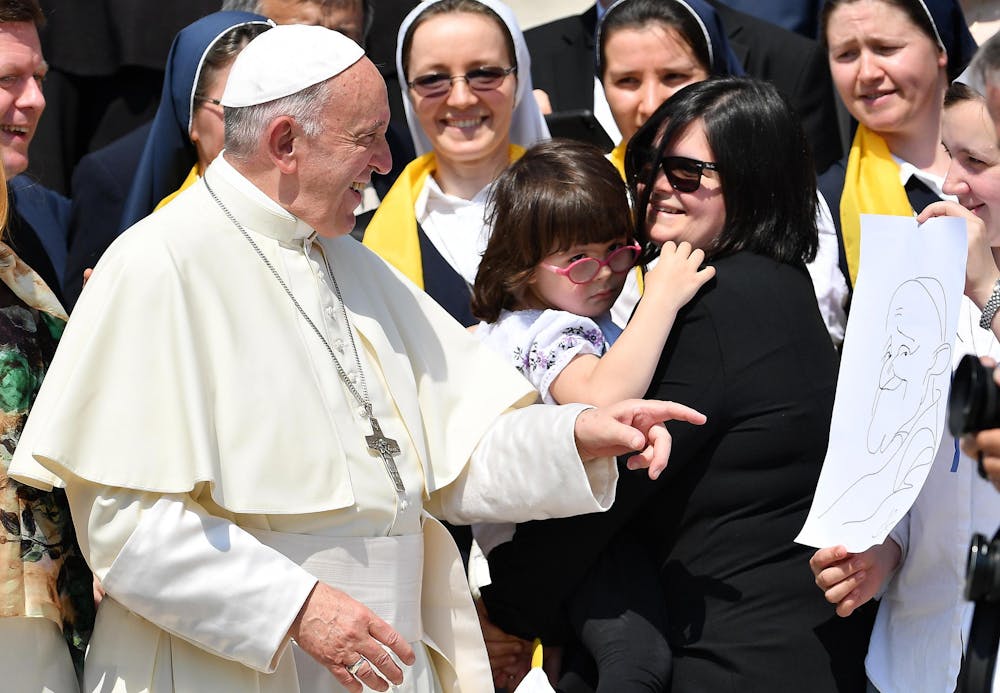
Pope Francis at the weekly general audience in Saint Peters Square, Vatican City, in June 2019.Ettore Ferrari/EPA/AAP
Idolatry of maleness
The main argument used in the Catholic hierarchy to exclude women from priesthood is that, to represent Christ at the altar in Mass, the priest must be male. The priest stands in for Jesus and therefore has to have a “natural resemblance” to him, and that resemblance is his maleness.
Opponents to women priests also claim that, at the Last Supper, Jesus ordained the 12 male apostles and no women. In subsequent church tradition, they say, women were never priests and to ordain them now would make the church contradict its own tradition.
Yet there are a number of arguments, from within the church’s own theological framework, that strongly support the ordaining of women as priests. At the most basic level, the church baptises (christens) females as well as males; there is no gender barrier around baptism. This has enormous implications.
In baptism, a person takes on something of the identity of the Risen Christ. He or she now belongs to Christ in a unique way. Not only are they committed to living a Christlike life of love and justice, they are also able to represent Christ in loving service to others. Yet supposedly only at the altar are they unable to represent Christ!
Jesus was not only male but also Jewish. Priests in the Catholic Church are not required to be Jews, but can represent Christ from widely divergent ethnic and cultural backgrounds.
Maleness, in other words, is given a significant weighting over all other social and cultural differences, including femaleness. In this sense, this belief represents an idolatry of maleness – an exalting of male over female, despite the inclusive impetus of baptism and despite the fact that, in creation, women as well as men are made equally in God’s image. The “natural resemblance” to Christ that is needed is not maleness but rather humanness.
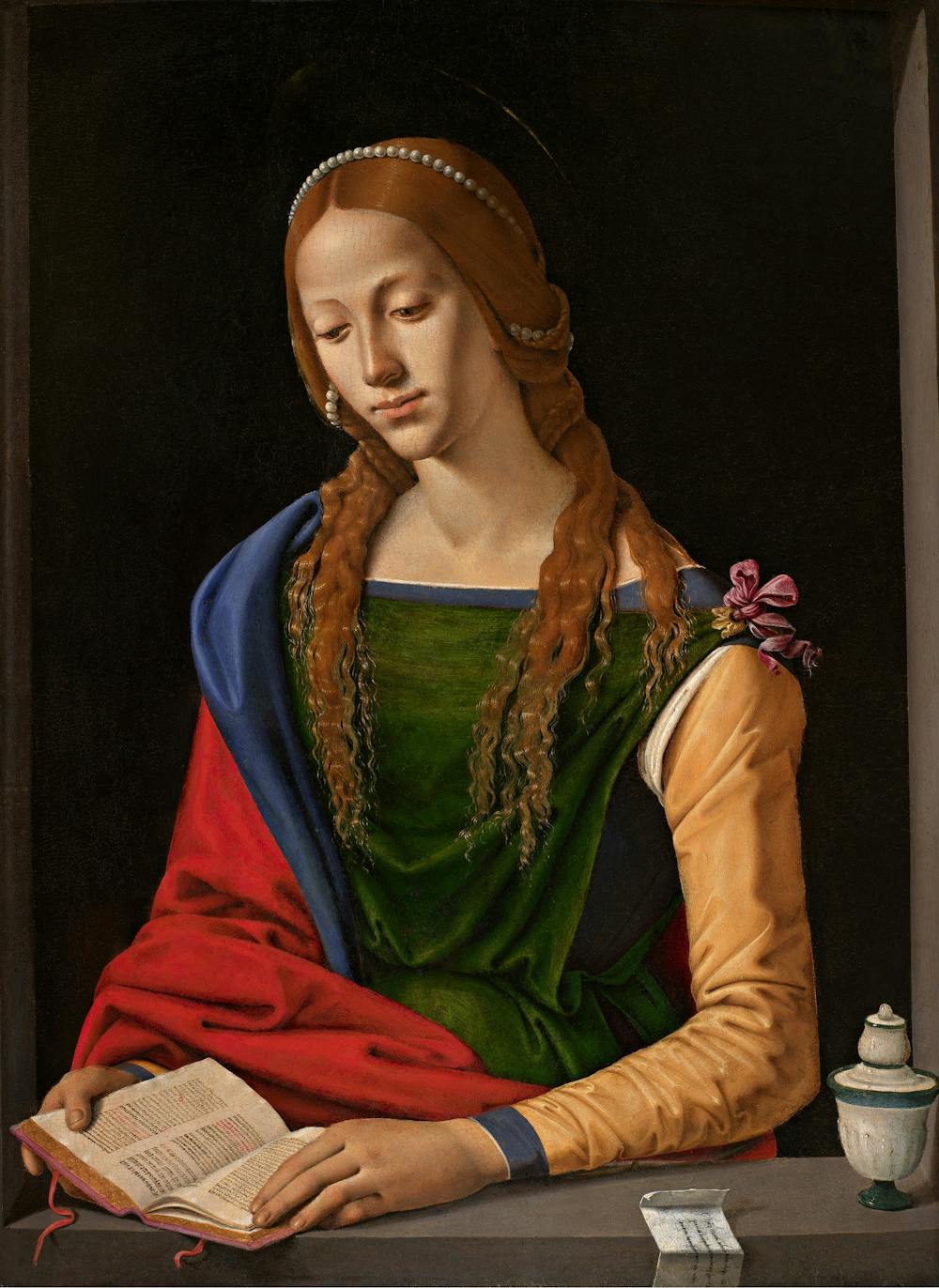
There is compelling evidence that women, in the ministry of Jesus and the early church, held positions of leadership and authority. Mary Magdalene was the first to meet the risen Christ and the first to proclaim its message to the other disciples; the later church called her the “apostle of the apostles”.
Piero di Cosimo, ‘Mary Magdalene’, 1500-1510, oil on panel.Wikimedia Commons
We find references in the New Testament to a female deacon (Phoebe), to a female apostle (Junia) and to a host of women who were leaders in ministry. The same is true for the early centuries where there is evidence of women deacons and priests, and even of a female bishop.
The exclusion of women from leadership in the church came at a later date (possibly in the fourth century and later in some places) when it lost something of its radical beginnings, inherited from Jesus. Here the argument from tradition – that women never were ordained or held positions of leadership – simply does not hold.
Change is necessary
The Catholic Church believes that tradition is dynamic: unfolding and developing throughout history (this was most famously articulated by John Henry Cardinal Newman in 1845). New perspectives and understandings can and do come in new contexts. The ordination of women belongs arguably in this category of new and emerging truths.
In a number of Anglican churches, particularly in places where terrible abuse occurred in the past, the appointment of senior, ordained women has had a vital role to play in reforming and transforming the church.
Women’s ordination is necessary in the current climate of the Catholic Church. There is no better time for it to happen than now. It will confirm, in ways beyond mere words, the church’s determination to move beyond the sins of the past. It will mean a significant move beyond the old structures where only men made decisions and a protective boys’ club existed within leadership.
This is not a call coming only from outside the Catholic Church. Many of the faithful within believe the same thing, and Catholic women in places such as Ireland and Germany are becoming more vocal and organised in their fight for women’s ordination.
In Australia, too, there are Catholic women working to be heard on the issue, supported by both laity and priests. Now is the time for something new to emerge from the ashes of the past.
Bishop Jose H. Gomez of Los Angeles, vice president of the U.S. Conference of Catholic Bishops, speaks on the first day of the spring general assembly of the USCCB in Baltimore June 11, 2019. (CNS photo/Bob Roller)
Jose H. Gomez of Los Angeles, vice president of the U.S. Conference of Catholic Bishops, speaks on the first day of the spring general assembly of the USCCB in Baltimore June 11, 2019. (CNS photo/Bob Roller)
Preliminary discussion about proposals aimed at bishop accountability evinced some frustration among U.S. bishops at their spring general assembly this week in Baltimore, especially when it comes to the degree of lay involvement that can be mandated to be part of the process. Bishops expressed their intention to adopt protocols aimed at accountability, but they are still hammering out the details ahead of a vote on Thursday.
Bishop Robert P. Deeley, who heads the U.S. Conference of Catholic Bishops committee on canonical affairs and church governance, told the assembly on June 11 that any rules they adopt cannot exceed a policy promulgated by Pope Francis last month in the moto proprio “Vos estis lux mundi.” In that document, the Vatican decreed that allegations of sexual abuse or misconduct, as well as mismanagement, leveled against a bishop must be investigated by a metropolitan bishop or someone he appoints, or by a senior suffragan bishop if the metropolitan is accused.
It suggests that bishops rely on lay experts to carry out the investigation but stops short of mandating lay involvement. Several U.S. bishops have said that as a result, they cannot mandate lay involvement in their own protocols. But they also said it would be highly unusual for a metropolitan bishop not to take advantage of lay expertise.
Some bishops sought reassurances that lay people will be involved in every stage of any future investigations.
Some bishops sought reassurances that lay people will be involved in every stage of any future investigations.
“A number of us are looking for ways to insert into the plan more robust lay involvement,” Bishop Robert McElroy of San Diego told the plenary group. He asked if the U.S.C.C.B. could adopt a rule that says that anyone enlisted to examine allegations of misconduct or mismanagement by a bishop “needs to be a lay investigator.”
Bishop Deeley said no.
“We have said that he ‘should’ use laypeople,” the bishop said, but added, “we cannot say ‘must.’”
The possibility that bishops would have the option of handling claims of misconduct or mismanagement without the involvement of laypeople troubled the head of the church’s highest sexual abuse commission.
“A review board whose membership includes laity must be tasked with the review of allegations against bishops to restore the trust of the faithful in the bishops and even in the Holy See’s own processes for holding bishops’ accountable,” Francesco Cesareo, the chairman of the National Review Board, said in an address to bishops Tuesday morning. “The N.R.B. urges that this must be the case in the United States through the establishment of an ad hoc lay commission, either on the national or local level.”
“The church is inherently incapable of policing itself,” Robert Hoatson, the founder of Road to Recovery, told Faith in Public Life.
Tweet this
Cardinal Blase Cupich, the archbishop of Chicago, proposed a model of bishop accountability last November that is similar to the policy adopted by Pope Francis for the universal church in May. On Tuesday morning, the cardinal pointed out that the Vatican document allows for a metropolitan bishop to use “an ecclesiastical office” in carrying out an investigation and said lay review boards may be a useful model “to institutionalize” the inclusion of laity. Such a move, he said, would send a signal that bishops understand the gravity of the challenges they face.
“That’s an important message to send,” Cardinal Cupich said. In an interview with America later in the day, Cardinal Cupich said that metropolitan archbishops already rely on lay experts for assistance through various institutional offices in their dioceses and that he expects that practice to extend to bishop accountability should the new protocols be adopted.
The Most Rev. Steven Biegler, the bishop of Cheyenne, said in an interview with America that another possible way to ensure lay voices are part of the process is to require that the contents of any investigation be forwarded to Rome. He added that beyond policy changes, a culture of accountability remains an ongoing goal for bishops.
Though proposals include a mandate for church leaders to alert civil authorities if a crime is alleged, some victim advocate groups seem alarmed that bishops may try handling allegations of mismanagement without the aid of laypeople.
“The church is inherently incapable of policing itself,” Robert Hoatson, the founder of Road to Recovery, told Faith in Public Life, an advocacy group in Washington. He said the proposal for metropolitan bishops to handle the investigations of other bishops is “ridiculous.”
He said bishops must “respond to Pope Francis’s call for universal accountability” and “add clear new procedures to our existing protection programs.”
Tweet this
“We know that doesn’t work,” he said of “bishops policing bishops,” pointing to the case of former Cardinal Theodore McCarrick, who was removed from the priesthood following allegations that he sexually abused minors and harassed adult seminarians.
Boston’s Cardinal Seán O’Malley, who serves as the chair of the Vatican commission charged with protecting children, said U.S. bishops should consider adopting language that would mandate rapidity when it comes to responding to allegations of misconduct or mismanagement against bishops.
He noted that once the Vatican is informed of an allegation, it has 30 days to respond and to provide further directions to the metropolitan bishop. Cardinal O’Malley said that this timeline may not work in the United States, saying, “waiting a month before you can begin the investigation...is a far cry from the usual practice.”
“I wonder if we can urge the Holy See to respond rapidly,” he added.
Earlier in the day, Cardinal Daniel DiNardo, the U.S.C.C.B. president and the archbishop of Galveston-Houston, said bishops must act boldly.
“Brothers, we gather this week to further the sacred work of rooting the evil of sexual abuse from our church,” said Cardinal DiNardo. He said bishops must “respond to Pope Francis’s call for universal accountability” and “add clear new procedures to our existing protection programs.”
Cardinal DiNardo has faced recent accusations that he mishandled a case involving a priest who carried on an affair with a woman the priest was counseling about marital troubles. In November, the cardinal’s office was raided by law enforcement investigating claims that a Houston priest sexually assaulted two teenagers decades ago. Cardinal DiNardo has denied wrongdoing in both instances, but that has not stopped some Catholics from calling for him to resign as head of the U.S. bishops conference.
“It is very hard to see how the conference can continue this way, with a president who is even worse than a lame duck,” the Villanova University church historian Massimo Faggioli told CNN. “The credibility of the U.S. bishops is in freefall, which can only be stopped by a visible change in leadership.”
In addition to the proposal on how to handle investigations of bishops, the body of bishops is expected to vote this week on establishing a third-party system for people to report allegations against bishops of misconduct or mismanagement and a code of conduct for bishops. They are set to vote on a 10-point statement, "Affirming Our Episcopal Commitments," in which the bishops hope to regain “the trust of the people of God” and commit themselves to the standards applied to priests in the Charter for the Protection of Children and Young People.
The document, presented on June 11 by Cardinal Joseph W. Tobin of Newark, N.J., chairman of the bishops' Committee on Clergy, Consecrated Life and Vocations, has been updated from a version mailed to bishops in May. The previous document, then titled "Acknowledging Our Episcopal Commitments," had nine points. The current version has 10.
The newest point reads, “We are also committed...to include the counsel of lay men and women whose professional backgrounds are indispensable.”
Other points in the proposed document include explicit prohibitions on sexual harassment of adults, reiterating “that there can be no 'double life,' no 'special circumstances,' no 'secret life' in the practice of chastity," and a pledge to promote procedures for reporting allegations of abuse or misconduct.
Shortly after their discussion of sexual abuse, bishops heard a presentation from Auxiliary Bishop Robert Barron of Los Angeles about the large numbers of young Catholics leaving the church. Topics of discussion included distractions from electronic devices, a need to speak more forthrightly about religion to young people in the style of controversial YouTube star Jordan Peterson and the impact of “the wasteland of atheism,” as Archbishop Joseph Naumann of Kansas City put it.
One item not mentioned as a primary reason young people are leaving the church: the sexual abuse crisis.
Content from Catholic News Service was used in this report.
Revelers carry a rainbow flag along Fifth Avenue during the L.G.B.T. Pride Parade in New York on June 24, 2018. (AP Photo/Andres Kudacki, File)
"In recent years the Vatican (including popes, congregations and dicasteries) have expressed concern over “gender theory” and “gender ideology.” The latest document from the Congregation for Catholic Education, titled “Male and Female He Created Them,” is the most comprehensive treatment of the topic yet. As America’s Vatican correspondent, Gerard O’Connell, reports, the document comes from a Vatican Congregation and was not signed by Pope Francis, so it is not intended as the “final answer” on the topic.
Gender theory is a notoriously slippery term. Broadly, it refers to the study of gender and sexuality and how those two realities are determined naturally (that is, biologically) and/or socially (that is, culturally). Usually it includes the study of the experiences of gays and lesbians, bisexuals and transgender people, and all those who identify as “queer,” another often-ambiguous term that can mean (but does not always mean) a decision to identify oneself outside of categories like male or female, or gay or straight.
The congregation’s new document is an explicit call for dialogue, which all should welcome.
Tweet this
For some critics, gender theory also represents an “ideology” that seeks to impose itself on others, “encouraging” or “forcing” some people, especially youth, to question and restate their own sexuality and gender. In some church circles, especially in the developing world, it is often linked to a form of “ideological colonialism” that seeks to impose Western ideas of sexuality and gender on developing nations. Pope Francis has several times adverted to this belief.
The congregation’s new document should be praised for its call for “listening” and “dialogue.” The subtitle is important: “Towards a Path of Dialogue on the Question of Gender Theory in Education.” It is an explicit call for dialogue, which all should welcome. It speaks of a “path,” which indicates that the church has not yet reached the destination. It focuses on the “question” of gender theory in education, which leaves some degree of openness, and is thus addressed mainly to educators and “formators,” including those responsible for the training of priests and members of religious orders.
Another positive aspect of this document is its clear call to “respect every person in their particularity and difference” and its opposition to “bullying, violence, insults or unjust discrimination.” It also praises “the ability to welcome all legitimate expressions of human personhood with respect.”
The document’s conclusion speaks of the path of dialogue, which includes “listening, reasoning and proposing.” As such, it leaves open room for further developments and also avoids some of the harsh language of other Vatican pronouncements on sexuality and, especially, on homosexuality.
This traditional view, however, is contradicted by what most biologists and psychologists now understand about both sexuality and gender.
Tweet this
Let me, then, engage in the respectful dialogue called for, as someone who ministers to L.G.B.T. people.
What does the congregation propose? Essentially, and unsurprisingly, its document restates the traditional Catholic view of sexuality: Men and women are created (as heterosexuals) with fixed sexual and gender roles. This traditional view, however, is contradicted by what most biologists and psychologists now understand about both sexuality and gender. These contemporary advances in understanding human sexuality and gender have been set aside by the congregation in favor of a binary understanding of sexuality. Even the term “sexual orientation” is put into quotes in the document, as if to call that very notion into question.
The crux of the congregation’s argument is in this understanding of gender: “This separation [of sex from gender] is at the root of the distinctions proposed by different ‘sexual orientations’ which are no longer defined by the sexual difference between male and female, and can then assume other forms determined solely by the individual, who is seen as radically autonomous.”
One objection to that proposition is that it ignores the real-life experience of L.G.B.T. people. In fact, the document’s primary partners for conversation seem to be philosophers, theologians and older church documents and papal statements—not biologists or scientists, not psychiatrists or psychologists, and not L.G.B.T. people and their families. If more people had been included in the dialogue, the congregation would probably find room for the now commonly held understanding that sexuality is not chosen by a person but is rather part of the way that they are created.
If more people had been included in the dialogue, the congregation would probably find room for the now commonly held understanding that sexuality is not chosen by a person but is rather part of the way that they are created.
Tweet this
In fact, for a document that relies so heavily (albeit implicity) on natural law, it ignores what we increasingly understand about the natural world, where we see men and women attracted to the same sex, men and women feeling a variety of sexual feelings throughout their lifetimes, and men and women finding themselves more on a spectrum than on any fixed place when it comes to sexuality and, occasionally, even gender.
The congregation also suggests that discussions about gender identity involve an intentional choice of gender by an individual. But people who are transgender report that they do not choose their identity but discover it through their experiences as human beings in a social world.
Again, the document largely neglects to engage in discussions about new scientific understandings and discoveries about gender. It relies mainly on the belief that gender is determined solely by one’s visible genitalia, which contemporary science has shown is an incorrect (and sometimes even harmful) way to categorize people. Gender is also biologically determined by genetics, hormones and brain chemistry—things that are not visible at birth. The congregation’s document relies heavily on categories of “male” and “female” that were shaped centuries ago, and not always with the most accurate scientific methods.
The document relies mainly on the belief that gender is determined solely by one’s visible genitalia, which contemporary science has shown is an incorrect (and sometimes even harmful) way to categorize people.
Tweet this
The document is also undergirded by the notion of “complementarity,” which means that based on their gender (male and female), men and women have separate roles. In a sentence sure to raise eyebrows the congregation writes, “Women have a unique understanding of reality. They possess a capacity to endure adversity…” Not men? Such ideas reinforce stereotyping and prevent both men and women from rising above precisely those cultural constructs that the Vatican often rightly decries.
The most unfortunate aspect of this document is the way the congregation understands transgender people. (Oddly, in a document about gender and sexuality, the words “homosexual” or “homosexuality” are absent.) Consider this passage: “This oscillation between male and female becomes, at the end of the day, only a ‘provocative’ display against so-called ‘traditional frameworks’, and one which, in fact, ignores the suffering of those who have to live situations of sexual indeterminacy. Similar theories aim to annihilate the concept of ‘nature’ (that is, everything we have been given as a pre-existing foundation of our being and action in the world), while at the same time implicitly reaffirming its existence.”
In this formulation, transgender people are being “provocative” and are either consciously or unconsciously trying to “annihilate the concept of ‘nature.’” Friends and family members who have accompanied a transgender person through their attempts at suicide, their despair over fitting into the larger society, or their acceptance that God loves them will find that sentence baffling and even offensive.
Perhaps the most thoughtful response to this approach comes from a Catholic deacon, Ray Dever, who has a transgender child and wrote about his family’s experience in U.S. Catholic. As he writes, “Anyone with any significant first-hand experience with transgender individuals would be baffled by the suggestion that trans people are somehow the result of an ideology. It is a historical fact that long before there were gender studies programs in any university or the phrase gender ideology was ever spoken, transgender people were present, recognized, and even valued in some cultures around the world.”
The most likely short-term result of “Male and Female He Created Them” will be to provide ammunition for Catholics who would deny the reality of the transgender experience, who would label transgender people as simple ideologues, and who would deny their real-life experiences. It will most likely contribute to a greater feeling of isolation, a greater feeling of shame and a greater marginalization of those who are already marginalized in their own church: transgender people.
Let us return to the more positive aspect of this document, which could be the long-term result: the call for listening and dialogue. The congregation seems sincere in its invitation. The church, like the rest of society, is still learning about the complexities of human sexuality and gender. The next step, then, could be for the church to listen to responses from those that this document most directly affects: L.G.B.T. people themselves.