Translate

Wednesday, August 28, 2024

AFTER HER REMARKS POPE JPII WAS NEVER THE SAME — CONTROVERSIAL, BELOVED SR THERESA KANE’S EFFECT ON THE CATHOLIC CHURCH ENDURES By Mary Hunt

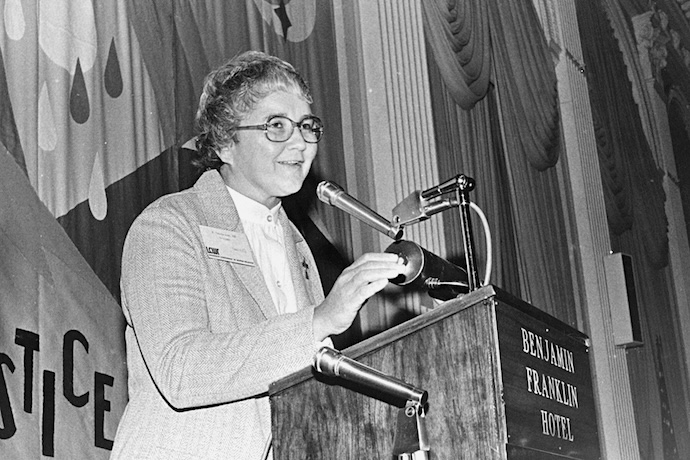
Mercy Sr. Theresa Kane in August 1980. Image: National Catholic Reporter photo/Mary Bader Papa

The Sisters of Mercy of the Americas announced her death in this simple, traditional way: “We pray in thanksgiving for the life of Sister Mary Theresa Kane, who died August 22, 2024, in Watchung, New Jersey. A Sister of Mercy for 69 years, she was 87 years old.” Theresa Kane was, in my view, the most consequential, respected, and beloved American Catholic woman of the last half century, without whom enormous changes could not have happened. 

Theresa was born Margaret Kane in 1936 into a large family with Irish immigrant parents. She entered the Sisters of Mercy in 1955, studied at Manhattanville College, and went on to a career in Mercy ministries focusing on health care. She was the CEO of a hospital well before she was 30. In the 1970s, she became president of the community as well as President of the Leadership Conference of Women Religious which encompasses leaders from congregations that make up about 90% of US nuns. It was in that capacity that she was tapped to welcome Pope John Paul II to the US on behalf of American religious women. His life was never the same.

On November 7, 1979, at the National Shrine of the Immaculate Conception in Washington DC, thousands of nuns gathered for their special time with John Paul II. Some stood silently during his remarks wearing blue armbands to signal their support of women’s ordination. It was all quite genteel, including Theresa’s historic remarks delivered calmly without rancor or regret:

As I share this privileged moment with you, Your Holiness, I urge you to be mindful of the intense suffering and pain which is part of the life of many women in these United States. I call upon you to listen with compassion and to hear the call of women who comprise half of humankind. As women we have heard the powerful messages of our Church addressing the dignity and reverence for all persons. As women we have pondered upon these words. Our contemplation leads us to state that the Church in its struggle to be faithful to its call for reverence and dignity for all persons must respond by providing the possibility of women as persons being included in all ministries of our Church. 

Loud applause by what the Vatican mistakenly thought were docile nuns greeted Theresa’s mention of women’s pain and the full inclusion of women “in all ministries of our Church.” But Pope John Paul II and his colleagues took her words as a shot across the bow. They reacted as if hers were a cheeky affront to their absolute patriarchal authority to make decisions, preside at the Eucharist, and run the Roman Catholic Church as the dysfunctional boys’ club it was revealed to be in subsequent decades. When asked by Roman authorities to clarify her remarks, to say that she really didn’t mean the O word—ordination—Theresa made clear that indeed she did. 

Other affronts followed both to Theresa and to the Mercy community, affronts aimed at  American women religious but affecting all women, as the Vatican realized that it was game-over for patriarchy. For example, the Vatican pushed the Mercies aggressively not to permit medically-indicated tubal ligations—which would prevent future pregnancies—in their hospitals. A Mercy sister, Agnes Mary Mansour, was forced to choose between her membership in the community or her job in Michigan social services through which funding for abortions was administered. This happened while Theresa was in Rome, despite the assurance of the papal nuncio to the US, Cardinal Pio Laghi, that no action would be taken in the Mansour case while Theresa was out of the country. 

Christine Schenk, CSJ, captures Theresa’s story as part of the larger movements for ecclesial and social change in American Catholicism in her welcome, detailed, and comprehensive book, To Speak the Truth in Love: A Biography of Theresa Kane, RSM. I highly recommend it for the history of Theresa, the Mercy Sisters, and the American Catholic scene of the late 20th and early 21st centuries.

Disillusioned Catholics are moving on

Theresa Kane was enormously consequential. She spoke truth to power, paid a price for it, and made significant change despite the fact that little is different in the Vatican today. She said the quiet part out loud in 1979; in front of her God and everybody, she said that Catholic women expect to be included fully in the life of the church. Period. Full stop. Drop the mic. Vatican officials couldn’t say they’d never heard it. That so little progress on women has been made in the institutional church 45 years later is entirely on them.

Roman Catholic women are still not ordained, neither to the diaconate nor to the presbyterate. Prohibitions on contraception, abortion, tubal ligations, and the like remain intact. American nuns have experienced an Apostolic Visitation (2008-2014) with the Vatican unsuccessfully nosing around in their business to figure out who’$ who and what’$ what (dollar signs very much intended). The Leadership Conference of Women Religious was subjected to a Doctrinal Assessment (2009-2015) which ended more with a Vatican whimper than a bang. Yet today, the same patriarchal power dynamics still hold sway.

Nonetheless, Theresa’s public utterances, her enduring graciousness, and her continued, decades-long insistence on women’s equality in the face of institutional intransigence have facilitated important changes beyond the institution. Many disillusioned Catholics—disproportionately women—have simply moved on, taking their money and their children with them. Weekly mass attendance among US Catholics is in the neighborhood of 25% (according to Pew and Gallup polls) in contrast to near universal attendance just a generation ago. Catholic parishes are closing by the dozens. Many, if not most, dioceses have lost market share and are saddled with legal bills to settle clergy sexual abuse cases. The church’s future is not bright in an increasingly secular culture. By contrast, women are engaged in myriad forms of ministry, doing the work of justice well beyond church boundaries. 

Theresa’s reasonable request, and similar efforts by equally well intentioned leaders have been ignored or actively refuted by Catholic Church officials. Church policy on optional celibacy for clergy, LGBTQ2S+ inclusion, reproductive justice, and other plain readings of the Christian justice imperatives remain unchanged. The result is that the institution’s influence is waning, many leaders’ reputations are in ruins, and Earth is spinning quite efficiently on its axis without them. Thank you, Theresa Kane. 

What you see is what you get

It’s hard to overstate the difference and distance between Theresa Kane’s qualifications to lead a congregation, a diocese, even the church at large, and those thin resumes of most priests and bishops. She had long years of administrative experience and a background in finance. She had decades of spiritual formation, community living, theological reflection, and committed work with those who are made poor and consigned to the margins. 

Contrast that with a wet-behind-the-ears, Roman-collared seminarian ordained on Saturday and unleashed on a parish on Monday morning. No wonder bankruptcy, poor preaching, inadequate pastoral care, and dwindling congregations are increasingly normative in Catholic churches. No wonder new, community-based models of church and new job descriptions for ministers are replacing the old.

In Mercy circles, “integrity of word and deed” is a high value. Think of that in light of the double crossing by Pio Laghi and the insulting request by the Vatican that Theresa “clarify” (i.e., walk back) her statement on ordination. Not likely, gentlemen, and not done. Theresa Kane modeled what you see is what you get

Theresa spent her later years in campus ministry and teaching Women’s Studies at Mercy College (now University) where her colleaguesvalued her being a Mercy presence on the now independent, nonsectarian campus and in the classroom. She believed she was qualified to be a bishop, though perhaps not pope because she wasn’t great at languages (I’m not sure that was the major obstacle!). I suspect that even Vatican officials respected her authenticity and effectiveness. I hope news of her death prompted some to reflect on the missed opportunity to make use of the stunning talents of Theresa Kane and other women in ministry.

Theresa was a role model who valued both insider efforts and outsider achievements. She did what she could as an inside player—the head of a large and influential order that Rome had to take seriously. But what she came to realize was that what she could not get done on the inside required collaboration with groups like Women’s Ordination Conference, Call to Action, Future Church, Dignity USA, Women’s Alliance for Theology, Ethics and Ritual (WATER), and others whose very existence chills the bones of ecclesial patriarchs. 

She strategized and collaborated with many groups, always realistic about what was possible. She once said that it was fruitless to look to the institutional church for things it was constitutionally incapable of being, like egalitarian. She gave license to people to ‘be’ church themselves. And many are. 

The changes endure

Theresa Kane was beloved. Like all leaders and prophets, she was controversial—perhaps even in her own community, and undoubtedly in the larger world. But she was beloved by so many, especially women, whom she encouraged to claim their truth and act on it. I was a lucky recipient of her abundant support. She loved progressive feminist Catholic women, and showered us with enthusiastic encouragement.

She supported LGBTQ2S+ people before it was safe and popular, indeed when it was quite risky. Scant years after her up-close and personal encounter with John Paul II, she agreed to give the keynote address at the first Conference of Catholic Lesbians held at Kirkridge Retreat and Study Center in Pennsylvania in November of 1982. It was a bold choice given the hot holy water she was in, but one she embraced with grace and gratitude. 

Forty years later, the words of her lecture remain indelibly etched in the minds and hearts of the women gathered. Many were former nuns; all were seeking ways to be both Catholic and lesbian. Despite how she was rejected by the institutional church, she was for us a person who embodied the best of the Catholic tradition: a welcoming and accepting presence at a time when we needed just that. 

Dedicated as she was to equality, Theresa realized it would take generations to make change, so we might as well enjoy ourselves along the way. She arrived early and stayed late at parties. She danced. She never stood on ceremony or exploited her position; she was always part of the group. I recall her once ducking out of a conference session a tad early to stake out a table in the hotel bar where she sat into the night with young women encouraging them with her wisdom and care.

Theresa Kane and her generation paved the way for Catholic women’s efforts to be full members of a church that still doesn’t want us. She did so with extraordinary courage and integrity every step of the way. 

When popes die, their rings are smashed to thwart imposters and a secret conclave is held where men elect their successors. When Theresa Kane died, people mourned and told vivid stories, rejoicing in the richness of her contributions, her remarkable goodness, and her impact. Her successors of all genders and walks of life are legion, gathering in the wide open, welcoming spaces where her spirit dwells. The changes she made endure. 
Tuesday, August 27, 2024

Interview with Christina Moreira ARCWP

 Christina Moreira, Catholic priest: "I would tell the Pope that we would be a breath of fresh air for the Church"

  • In 2002, three Catholic bishops ordained the first seven women priests, bringing the total to more than 300.
  • They are excommunicated by the rules of the Catholic Church although they comply with the apostolic succession

By
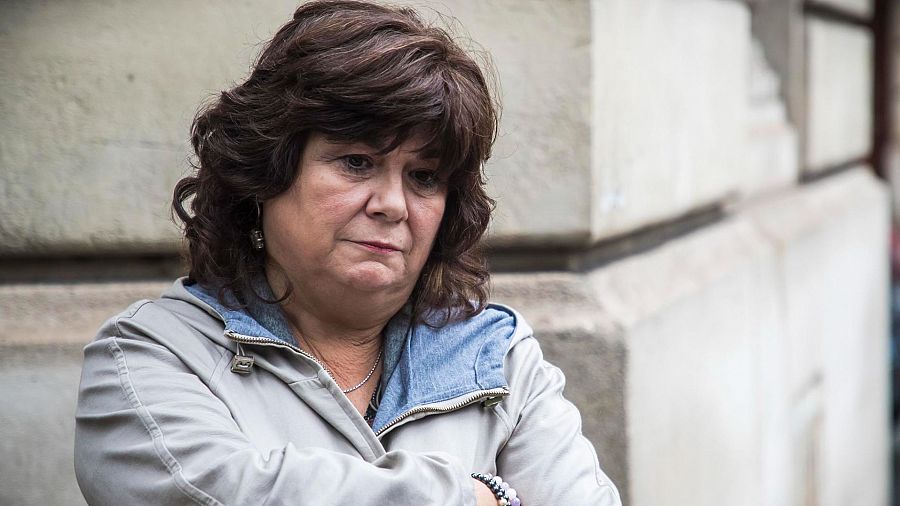
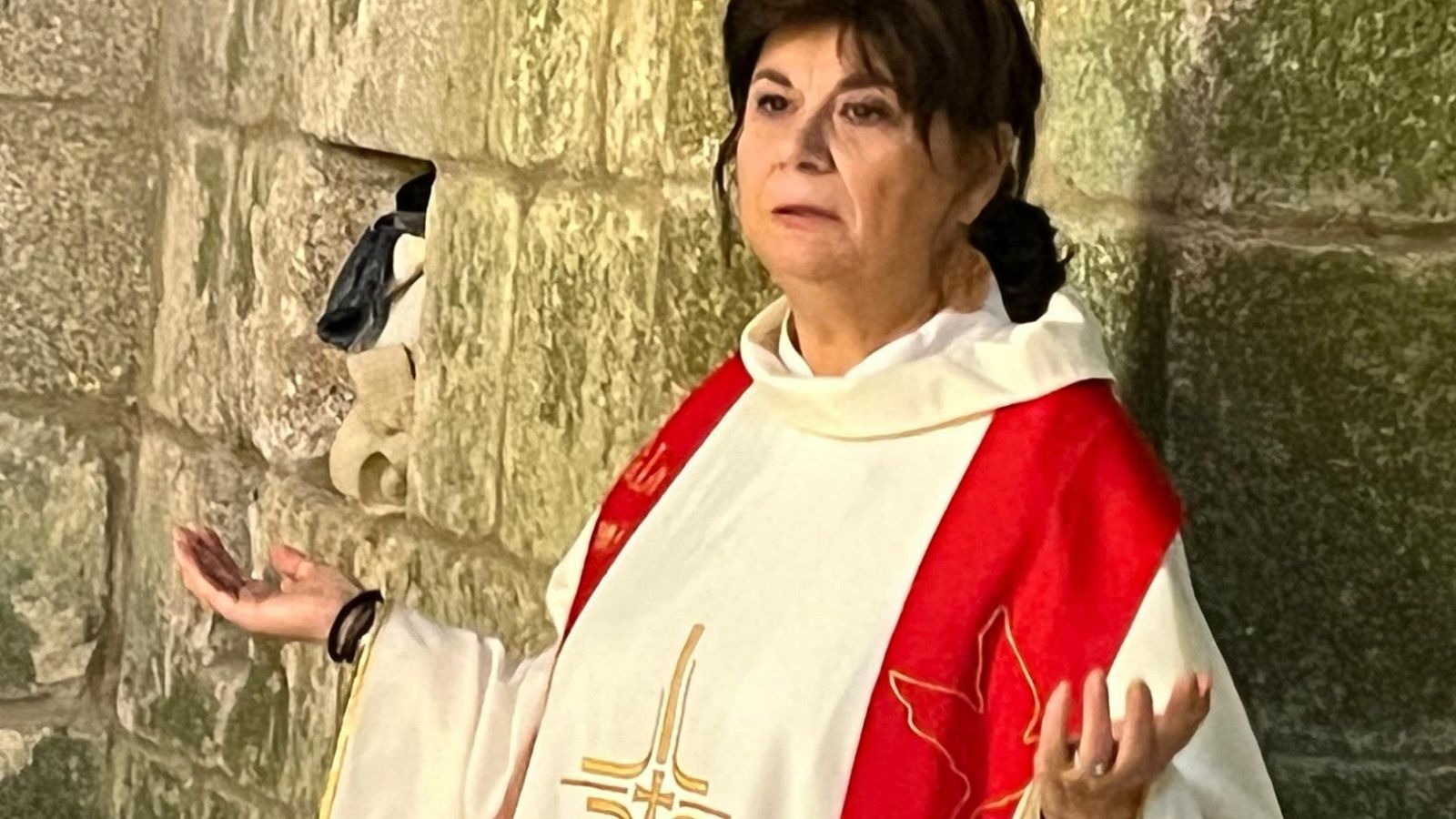
Christina Moreira was ordained a priest in 2015.
Christina Moreira was ordained a priest in 2015. PRIVATE ARCHIVE CM
12 min.

Christina Moreira is a leading figure in the women's ordination movement within the Roman Catholic Church . Born in France, although she has lived in Galicia for over 30 years, she is an active member of the Association of Roman Catholic Women Priests(ARCWP), an organization that advocates for the ordination of women and aims to create inclusive Catholic communities . Moreira serves as a presbyter, celebrating liturgies and promoting the inclusion of women in all aspects of the church's ministry.

Christina is also involved in other groups advocating for gender equality within the Church, such as Toutes ApĂ´tres ("All Apostles" in France) and the ComitĂ© de la Jupe ("Skirt Committee", a feminist and Catholic association, also in France). Her work focuses on challenging the traditional exclusion of women from sacred roles and on fostering a more egalitarian understanding of Catholicism. She is critical of clericalism which she sees as a barrier to true equality and calls for a rethinking of the structures of the Church to be more inclusive and representative of all its members.

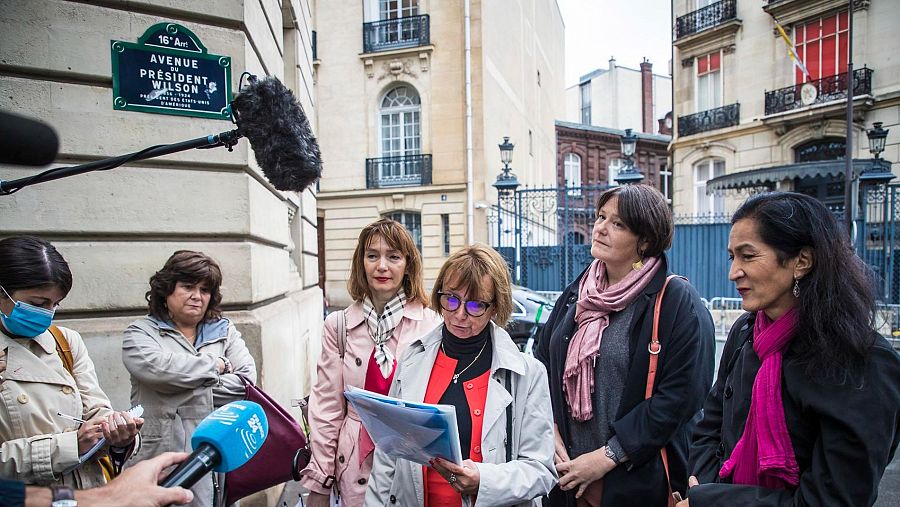
Christina and her companions were received by the nuncio of the Catholic Church in France.

Christina and her companions were received by the nuncio of the Catholic Church in France.  ARCHIVE / EUROPA PRESS

Q: How is it possible that a woman can be ordained as a priest within the Roman Catholic Church, given that, according to Canon Law, it is impossible? 

A: There are ordinations within the Catholic Church because we are Catholics, therefore, we belong to this church. We have been baptized in this Church, in it we move and exist. And baptism does not expire, it is indelible and leaves its mark. As for the Canon Law in force today, it should be noted that it only exists since the 19th century. Before, there was tradition, customs and unwritten rules.

 Canon law has only existed since the 19th century; before that, there were traditions, customs and unwritten rules .”

This law says that only men can access sacred orders - diaconate, priesthood and episcopate - in a lawful manner or authorized by law. But there were some inspired, intelligent and courageous women who in 2002 decided to meet to ask some bishops, also courageous and inspired, to ordain them. First as deaconesses and then as priests. The first ordination of seven women took place in the Danube in 2002. We are now more than 300 and have communities all over the world.  

"I am Catholic, Apostolic and Roman"

Q: This guarantees apostolic succession, because a Catholic bishop is the one who has presided over these ordinations. 

A: Exactly. But it was not just one bishop, there were three. The thing is that we cannot reveal their identities because we want to protect them. The apostolic succession is transmitted by the presence of duly consecrated Catholic bishops. We have referenced and endorsed our apostolic succession, because the ordinations are always recorded before a notary and the apostolic lineage is established, otherwise they would not be valid. As I was saying, I am Catholic, apostolic and Roman. And for me and for my colleagues this apostolic lineage is very important. If not, I would be in another tradition. 

Christina Moreira considers herself a priest of the Roman Catholic Church.

Christina Moreira, considers herself a priest of the Roman Catholic Church.  FRANCE PRESS

Q: And what does the official Church that has excommunicated them say?

 We are automatically excommunicated along with child rapists and all kinds of abusers 

A: Some of my colleagues received their official notice of excommunication or whatever you want to call it. The following ones have fallen under different decrees promulgated by Benedict XVI. Now Pope Francis has reinforced it with an article in book six of the Code of Canon Law which says that we are automatically excommunicated along with child rapists and all kinds of abusers. They tend to lump us together. This is what the official Catholic Church says. Otherwise, in our communities we care for the people, we each work in our own field and we live in peace with the local church.

Q: The 300 Roman Catholic women priests are married, widowed, single… What is their situation?  

A: Well, I am married, I have a daughter from a previous marriage that was annulled for obvious reasons, and I remarried many years ago to a Catholic priest who decided to have this life project with me. We both take care of the community, which is a small preview of what we would like the Church to be in our dream of the future. Our spiritual and religious commitments have nothing to do with whether or not we have a family of a certain shape and color. That has no influence.

Q: I was going to ask you how your family was coping, but I understand that you have their full support.

A: My husband is my most faithful ally, my partner in ministry, in life, and, frankly, I think I am enjoying an absolutely privileged situation. It is a gift.

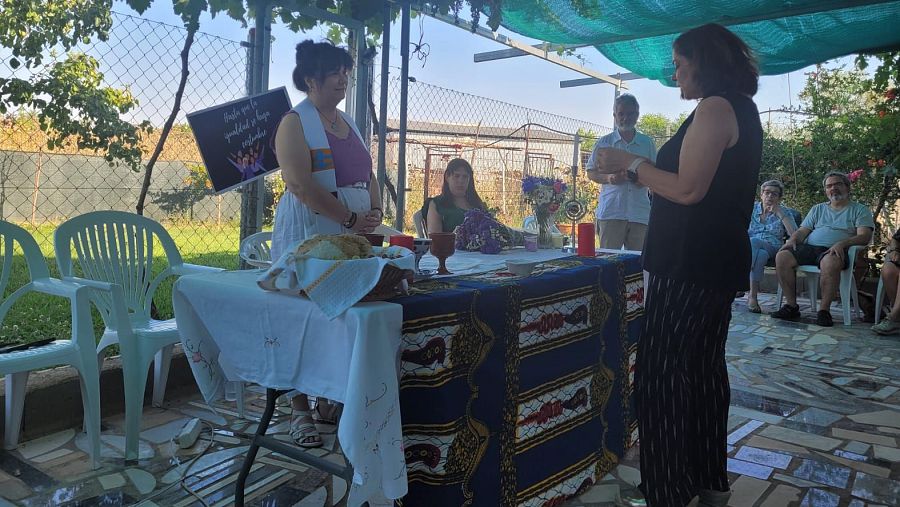
Christina Moreira presides over an outdoor religious celebration.

Christina Moreira presides over an open-air liturgical celebration.  PRIVATE ARCHIVE CM

Q: Where is your community located and when do they gather to celebrate the liturgy?

A: To celebrate life, the word, the Gospel, the breaking of bread in joys and sorrows, a community of Christians meets every Sunday at 12:00 in La Coruña, near Juan Flores, in the heart of the city.  

Q: How many are there?  

A: Yesterday we were eleven or twelve, I can't remember. Sometimes we are 15 and sometimes we have been more. It fluctuates. People are free. So when you can, when you need to. But yes, we are usually between ten and 20. 

Q: Well, Jesus started with twelve…

A: Yes, and some went wrong.

Clerical machismo

Q: What challenges have you faced as a priest in a traditionally male institution? Although the first Christian communities seem not to have been so sexist…

 The role of women in the Church, from the first centuries, has been gradually erased and blurred 

A: The first challenge is to face the historical reality that hits all of us women when we are interested in this topic. It means visiting the catacombs in Rome and seeing that since the first century women have been breaking bread and praying in public in a leading role. It is there, in full colour, on the walls of those ancient cemeteries that collected life and death. It means realising that the role of women in the Church, in the first centuries, has been little by little erased and blurred. The challenge today is to recover the visibility of women in the Church. Not only those of us who have more or less recognised ministries, but all of them: catechists, those who lead the singing, those who manage the finances, those who keep the registers of baptisms, those who welcome people in churches, those who celebrate funerals... The variety is so enormous! The challenge is to make them visible and to begin to create structures that are equal, fair and, above all, loving and of good treatment.

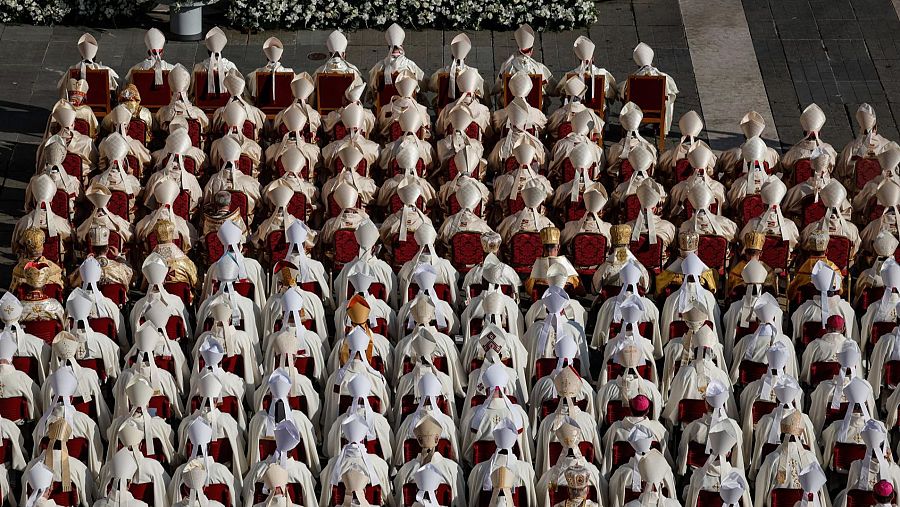
Pope Francis presides over the opening Mass of the Synod 2021-2024.

Pope Francis presides over the opening mass of the Synod 2021-2024.  EFE FILE

Q: What would you say to people who think that the Church is an institution that has its laws and that if they don't like them they will have to look for another religion?

A: To begin with, the Church is not an institution. The Church is the family of the people of God, that is, of all baptized people. The Church as an institution is only a tool that allows us to manage and situate in time and space this great family of the people of God.

 Let us remember that the Church supported slavery and it cost a lot to undo that rule 

But the Church, above all, is a family of faith and heart. A family that adheres to the project of Jesus and his Kingdom. So, the institution that is that tool, creates rules. But we must remember that those rules can change. They have changed in the past. Let us remember that the Church supported slavery and it cost a lot to undo that rule. In the past, the Church doubted whether women, Indians or blacks had a soul. The Church can change its rules, because that part of the “church” with a small letter, which is the institution, can change because we, human beings, have created it. We have the hope that God will go through all those institutions and rules in some way, that the Spirit will be there working and will give us the strength to change what needs to be changed because it is not fair. And it is not fair that half of all that people of God, who are the daughters of God, are separated from preaching his Word, from announcing the Good News, from breaking bread, from reconciling communities, from bringing comfort… Because it is necessary. Because we are needed. 

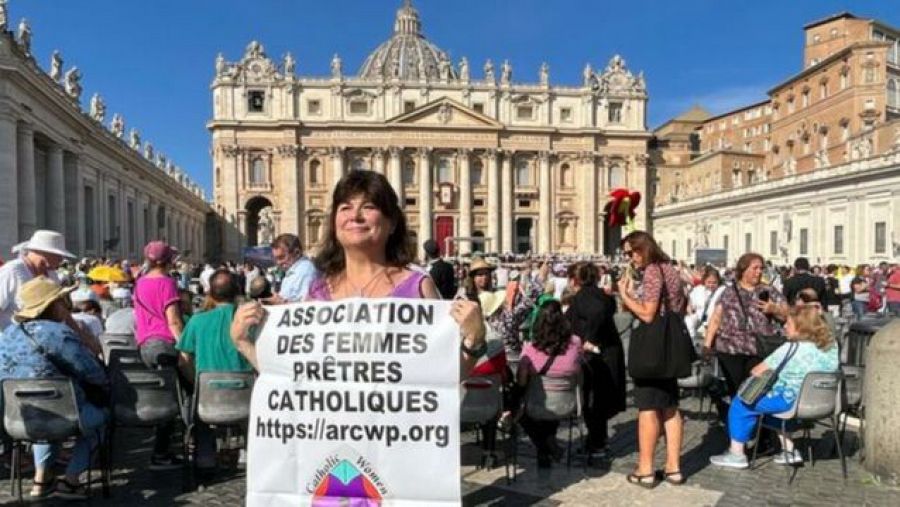
Christina Moreira with a protest sign in St. Peter's Square.

Christina Moreira with a protest sign in St. Peter's Square.  PRIVATE ARCHIVE CM

Q: With this great Synod 2021-2024, Pope Francis seems to want to renew the Catholic Church. Has the issue of women's priesthood played any role? Because you attended the initial celebration and were arrested by the police. 

A: We know that women have spoken about ministries, about equality. Now comes the second part of the Synod in October. At this time it is known that the subject of women's ordination will not be touched upon in the working document and Pope Francis has already announced, in an informal interview, that the diaconate for women, if it existed, would be without ordination. The whole problem that is being presented now is that of the privilege of sacredness.

 The problem that is being presented now is that of the privilege of sacredness 

The privilege of sacramental ordination, which, according to the old dogmatics, transforms a person into an interstellar being, super-holy, marvellous, closer to God, God himself on earth. Which is absurd. This stumbling block of the priest's sacredness is really a privilege of men and must be revised because it is not fair. We are in the 21st century and we must be able to debate about it and unravel everything that it contains that is impure and toxic for half of the baptized. 

Q: Do you think the Catholic Church is afraid of women?

 We would like to provide the DNA of Mary Magdalene who had the courage to go to the tomb knowing that there were Roman soldiers there. 

A: The first bishop of the Church (Saint Peter) - on whom we founded this Catholic Church - had already betrayed his friend and Lord (Jesus Christ), and he was overcome with fear. That fear is in the DNA of the Church. And we would like to bring another DNA. The DNA of Mary Magdalene, who had the courage to go to the tomb knowing that there were Roman soldiers there, deadly soldiers like those who had killed her Lord. That is the courage we want to bring into the Church. But yes, the feeling is that they are afraid of us. One cannot speak of the fear of others, but we can smell it. And that is what happened when I was arrested in Rome. 

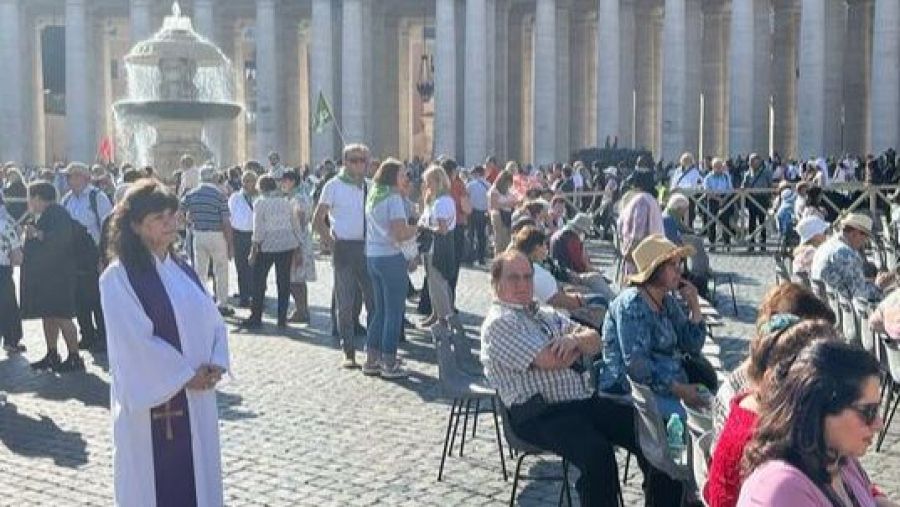
Christina Moreira dressed in alb and stole in St. Peter's Square.

Christina Moreira dressed in alb and stole in St. Peter's Square.  PRIVATE ARCHIVE CM

Q: What exactly happened? 

A: We were actually filming a movie and doing a little experiment. I was dressed in the alb and stole to see how people would react. It was extremely beautiful. All the reactions were positive. People asked me if I was really a priest, if I could celebrate Mass and what it was like. There were even people who asked me to bless them. Others have taken photos with me. What you could see was that the voice of the people, which is the voice of God, was saying: 'Hey, it's happening, it's happening, it's about time.'  

Q: It was in St. Peter's Square, right? 

A: In St. Peter's Square, just after the opening Mass of the Synod. A policeman passed by and was annoyed. A lot of them had passed by before. But this one was annoyed and had a hard time accusing me of anything. He had to gather seven more policemen to find an old law in the Italian Penal Code that prohibits people from dressing in something they don't wear when walking around the street. It's fear. They are afraid.

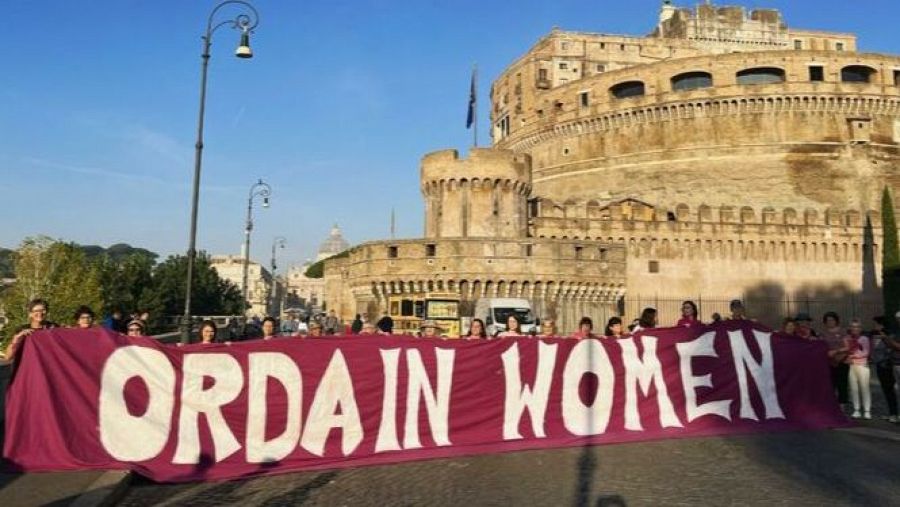
The Association of Roman Catholic Women Priests (ARCWP) behind a banner at the Vatican.

The Association of Roman Catholic Women Priests (ARCWP) behind a banner at the Vatican.  ARCWP

Q: Would you like to send any message to Pope Francis regarding the ordination of women? 

A: I'm going to tell you something very clearly: listen to us. Those of us who are in this are not here just for fun, or to get publicity or because we like to appear in the press. We are here because we have been called.

 We would love to contribute in the most loving way to the growth of the Church and to bring that courage of which we are specialists 

The women priests I know are living the realization of an authentic, discerned vocation, and above all, one that has been through the crucible of suffering, waiting, patience and faith. And we want to put these vocations at the service of our Church with love, affection and respect. We only need you to listen to us and to be able to tell you what we are doing in our communities. We would love to contribute in the most loving way to the growth of the Church and to bring the courage of which we are specialists.

Q: Has Pope Francis never received you to listen to you?

A: No, never. He has received Episcopalian bishops and some Lutheran ones. He has also received Anglican bishops from Scotland, all of them companions of other Christian families, but not us.  

Q: It doesn't seem to fit in very well with this pope's effort to unite Christian churches.

A: Francis has wonderful projects. From time to time we hear things and other times we are surprised because we do not understand why he does not call us. We have told him this actively and passively. We send him messages through all channels. I have written to him several times and I have sent him a letter through the nuncio who received me in Paris. Not a wink, not a sign, not a response, not a word. Nothing at all. Why is he afraid of us? Why does he receive so many people and listen to everyone except us?

Q: What would you say if you received them?

A: That we are here, that we would be a breath of fresh air to enter the Church now and that we can contribute our experience of these 22 years in our circular communities.

Friday, August 23, 2024

A Tribute to Sister Theresa Kane RSM - Memories of Her Welcoming Address of Pope John Paul 11- by Bridget Mary Meehan ARCWP


"As women we have heard the powerful messages of our church addressing the dignity and reverence for all persons. As women we have pondered upon these words. Our contemplation leads us to state that the church in its struggle to be faithful to its call for reverence and dignity for all persons must respond by providing the possibility of women as persons being included in all ministries of our church. I urge you, your Holiness to be open to and respond to the voices coming from women in this country who are desiring of serving in and though the Church as fully participating members." Sister Theresa Kane RSM


The Sisters of Mercy announced yesterday the passing of Sister Mary Theresa Kane who died August 22, 2024 in Watchung, New Jersey. A Sister of Mercy for 69 years, she was 87 years old."

I am deeply grateful for Theresa Kane’s life-long support of women’s ordination. She is a prophet of gender equality whose legacy lives today in the hearts of Catholic women called to ordination.


 I witnessed history being made on October 7, 1979 in the Shrine of the Immaculate Conception in Washington DC.


 As Sister Theresa Kane called on Pope John Paul 11 to open all of the church's ministries to women, It felt like an energy wave moved through me that sparked a new awakening of possibilities that I never before considered.


I had come with my dear  friend, Sister Regina Madonna Oliver.  Both of us -at that time -were Philadelphia IHM's on home leave. 


The Shrine was packed with women religious different orders - some in habit and some -like me- in secular dress.  Nuns stood on the pews (gasp, I never saw that before) and other nuns -not in habits -wore blue armbands in support of women's ordination. 


The air was electric -it felt like something really important was going to happen on this papal visit.  When Sister Theresa Kane addressed the Pope and  courageously called on him to open all ministries to women, you could hear a pin drop. 


I am sure that she was aware that the Pope had just stated his opposite to women’s ordination in a speech to seminarians the day before. 


Wow, we left wondering what would happen?  Would ordination ever happen?


Some media coverage portrayed her challenging words as an attack on the Pope. 


But, in my view, she started a Catholic revolution for gender equality and justice. Sister Theresa planted the seeds for a Women's Ordination world wide movement- that after 40 years- is still growing  in support  of women's call to ordination. 


Sister Theresa Kane also planted the seeds that led 7 women to be ordained on the Danube in 2002. 


Now there are 300 in the  worldwide Roman Catholic Women Priests Movement birthing an emerging Church for everyone in small inclusive communities in which all are welcome and there is gender equality ! 


Thank you Sister Theresa Kane, prophet of gender equality and supporter of women priests!


May you dance with angels!


https://documents.alexanderstreet.com › ...


Bridget Mary Meehan ARCWP


Tuesday, August 20, 2024

Roman Catholic Women Priests: Booka, Articles Links, Bridget Mary Meehan ARCWP


 Roman Catholic Women Priests are a "prophetic challenge to transform hierarchical and sexist structures that claim that males only can be ordained for priestly service to God and the community."

Women Called to Catholic Priesthood: From Ecclesial Challenge to Spiritual Renewal Paperback – March 19, 2024


Sharon Callahan and Jeanette Rodriguez explore the contexts, calls, journeys, spirituality, and theology of women called to priesthood in the Roman Catholic Church in this compelling and carefully crafted ethnographic work. Posing the questions of how womenpriests' stories illustrate both ecclesial challenges and spiritual renewal, the authors encourage readers to thoughtfully engage these women on their own terms.

Women Called to Catholic Priesthood draws on the stories of forty-two women serving in the United States, Canada, Colombia, Europe, and South Africa. Ranging in age from their early thirties to their late eighties, these women tell stories that help us understand the spirituality and deep sense of call womenpriests experience despite the challenges they face in challenging Roman Catholic canon law. Callahan and Rodriguez's work is both moving and timely as the global church engages in synod work aiming to discern where the Spirit of God is calling Roman Catholics in the twenty-first century.


Womanpriest: Tradition and Transgression in the Contemporary Roman Catholic Church (Catholic Practice in North America) 1st Edition Amazon

The Case for Women Priests

https://www.youtube.com/watch?v=qGBlRvc6J2k

Women Priests Then and Now


https://www.youtube.com/watch?v=2WTs3rhaZKw

Association of Roman Catholic Women Priests 2013 Update


https://www.youtube.com/watch?v=xTBrJSZk5t0

Books:


Amazon.com: Women Find A Way: The Movement and Stories of Roman Catholic ... Elsie Hainz McGrath, Bridget Mary Meehan, Ida RamingBooks. ... 


Living Gospel Equality Now, Bridget Mary Meehan https://www.amazon.com/Living-Gospel-Equality-Now-Catholic/dp/B00854C39O


Amazon.com: Exclusion of Women from the Priesthood (9780810809574): Ida Raming, N.B. Adams:Books.
Ida Raming's book sheds much light on the canonical roots of the Roman ... to thoroughly understand the church's teachings on women and priesthood, this is a ...

Articles:
A /Brief Overview of Womenpriests in the History of the Roman Catholic Church https://www.romancatholicwomenpriests.org/RCWP_Resource.pdf

This book is openly available in digital formats thanks to a generous grant from the Andrew W. Mellon Foundation.


While some Catholics and even non-Catholics today are asking if priests are necessary, especially given the ongoing sex-abuse scandal, The Roman Catholic Womanpriests (RCWP) looks to reframe and reform Roman Catholic priesthood, starting with ordained women. 
Womanpriest is the first academic study of the RCWP movement. As an ethnography, Womanpriest analyzes the womenpriests’ actions and lived theologies in order to explore ongoing tensions in Roman Catholicism around gender and sexuality, priestly authority, and religious change.

In order to understand how womenpriests navigate tradition and transgression, this study situates RCWP within post–Vatican II Catholicism, apostolic succession, sacraments, ministerial action, and questions of embodiment. Womanpriest reveals RCWP to be a discrete religious movement in a distinct religious moment, with a small group of tenacious women defying the Catholic patriarchy, taking on the priestly role, and demanding reconsideration of Roman Catholic tradition. Doing so, the women inhabit and re-create the central tensions in Catholicism today.


National Catholic Reporter: https://www.ncronline.org/news/people/advocates-dismayed-reaffirming-ban-women-priests

Advocates dismayed by reaffirming ban on women priests


web 20111017nw282.jpg


Janice Sevre-Duszynska is engaged by Italian police as she approaches the Vatican during a demonstration for women's ordination in 2011. (CNS/Paul Haring)
Advocates for the ordination of women in the Roman Catholic Church said they are "deeply dismayed" by a newspaper article penned by the Vatican's doctrinal chief that reaffirmed the church's ban on women priests as "definitive" and "a truth belonging to the deposit of faith."
"Archbishop [Luis] Ladaria's arguments are unconvincing and simply nothing new," said a statement from the Women's Ordination Conference, following the release of Ladaria's article. "How long can the Vatican hide behind its sexist arguments that because Jesus was a man, he intended only men to become priests?" the statement read.
Get NCR delivered to your inbox. Sign up for free newsletters.
Writing for the May 30 issue of the Vatican newspaper L'Osservatore Romano, Ladaria, prefect of the Congregation for the Doctrine of the Faith, said that Jesus decided to reserve the sacrament of priestly ordination "to the twelve apostles, all men, who, in turn, communicated it to other men."
"The church has always recognized herself bound by this decision of the Lord, which excludes that the ministerial priesthood can be validly conferred on women," Ladaria writes.
Ladaria's article, "The definitive character of the doctrine of 'Ordinatio sacerdotalis,' " re-examines Pope John Paul II's 1994 apostolic letter that outlined the reasoning behind the ban on the priestly ordination of women.
The archbishop said he decided to write "in response to doubt" about John Paul's teaching, adding that expressing doubt about the barring of women from the priesthood "creates serious confusion among the faithful."
"The only 'serious confusion' among the faithful is just how long the Vatican will continue to parade indefensible arguments that attempt to limit the reaches of God's call," Kate McElwee, executive director of the Women's Ordination Conference, told NCR.
According to British theologian John Wijngaards, "Yes, there is confusion among the faithful, but not because they doubt the validity of their inner sense of what is genuinely Christian and Catholic, but because the persons who are supposed to guide them keep ignoring their just concerns."
"Confusion is healthy if it leads to a process of honest reassessment," added Wijngaards, professor emeritus of Missionary Institute London and founder of the Wijngaards Institute for Catholic Research.

web 20180521T1337-17380-CNS-CARDINALS-THUMBNAILS.jpg


Archbishop Luis Ladaria (CNS/Paul Haring)
Statistics have shown that a majority of educated Catholics believe women should be ordained, he said. "Their belief stems not from theological studies but from their 'Catholic sense,' their considered judgment that Jesus, who always treated women like the men, would not ban women from ordination in our present world."
"This sensus fidei is at the foundation of the teaching authority of the whole church, a foundation hierarchical leaders should take note of in any magisterial decision," he said.
In his essay, Ladaria, who is to be made a cardinal by Pope Francis June 28, addresses the debate over the character of John Paul's Ordinatio Sacerdotalis, especially the question of whether it is to be considered an infallible papal teaching.
Ladaria argues that although John Paul did not formally proclaim the teaching ex cathedra — as outlined by the First Vatican Council document Pastor Aeternus as part of the process of a pope declaring something infallibly — the pope "formally confirmed ... what the ordinary and universal magisterium considered throughout the history of the Church as belonging to the deposit of faith."
"To hold that it is not definitive, it is argued that it was not defined ex cathedra and that, then, a later decision by a future Pope or council could overturn it," he stated. "Sowing these doubts creates serious confusion among the faithful, not only about the Sacrament of Orders as part of the divine constitution of the Church, but also about the ability of the ordinary magisterium to teach Catholic doctrine in an infallible way."
Wijngaards told NCR: "As history shows, many popes have made statements they believed to be 'definite,' which have turned out to be flawed. The 'definitive' character of a papal statement does not only derive from the intention of the pope in question. It is intimately linked to its context.
According to Wijngaards, Ordinatio Sacerdotalis does not fulfill the five criteria of an infallible decision by the "ordinary and universal magisterium," as outlined by the Jesuit theologian Karl Rahner.
"Ordinatio Sacerdotalis," he said, "first, was not a collegial exercise of the teaching authority. Second, the bishops of the world had not acted as judges. Third, they had not listened to the ordinary faithful. Fourth, the issue in question does not involve revealed faith or morals. Moreover, fifth, the bishops of the world had not wanted to impose a final judgment on the matter."
He continued, "The belief that only men can be priests because all the 12 apostles were men is scripturally unsound. The appeal to an 'unbroken tradition' of excluding women is as faulty as asserting that the world was created in six days because the fathers of the church, medieval theologians and all bishops thought so."
The statement from the Women's Ordination Conference also notes that even in his 1994 document John Paul acknowledged the question of women's ordination was "at the present time in some places … considered still open to debate."
"The continued presence of a strong movement clamoring for the ordination of women shows that Ordinatio Sacerdotalis is far from definitively held as doctrine by the faithful of the Church," the statement said.
McElwee told NCR, "While the institutional church continues to reject and dismiss the priestly vocations of women, communities of Catholics recognize women's gifts and walk with them on a path of radical inclusion." Kate McElwee is married to NCR Vatican correspondent, Joshua McElwee.
Among those walking "a path of radical inclusion," is Bridget Mary Meehan, one of four bishops in the Association of Roman Catholic Women Priests and pastor of the Mary Mother of Jesus Inclusive Catholic Community in Sarasota, Florida. The international Roman Catholic women priests movement, of which the Association of Roman Catholic Women Priests is one member, claims about 250 priests worldwide.*
"The Vatican's affirmation of its ban on women priests as 'definitive' teaching rests solely on patriarchal church authority," Meehan said. "In doing so, it denies the workings of the Spirit within the people of God."
"The Vatican's affirmation of its ban on women priests as 'definitive' teaching rests solely on patriarchal church authority. In doing so, it denies the workings of the Spirit within the people of God."
-- Bridget Mary Meehan
Janice Sevre-Duszynska, ordained a Roman Catholic Woman Priest in 2008, said, "Our movement is growing with enthusiasm among Catholics in grassroots communities, especially with marginalized LGBTI and divorced [Catholics], and all who seek a bigger table where God's beloved family gathers to celebrate sacraments and to serve their sisters and brothers in mutual love in a community of equals."
Both women priests noted that Ladaria's newspaper article coincides with the 10th anniversary of the Congregation for the Doctrine of the Faith issuing a general decree excommunicating the members of their movement and its supporters. The decree stated, "Both the person who attempts to confer holy orders upon a woman, and the woman who attempts to receive holy orders, incur the excommunication latae sententiae [automatically]." 
The decree doesn't mention the group or its members by name, but it followed a number of high-profile ordinations of women that year and the year before.
"Why [bring this up] now, 10 years later?" Meehan asked NCR. "What's up with that? Maybe they want us to issue a progress report."
Tell them, she said, "Yes, we keep growing and flourishing."
[Dennis Coday is NCR editor. His email address is dcoday@ncronline.org. Vatican correspondent Joshua J. McElwee contributed to this report.]
*Editor's Note: This sentence has been changed to clarify that the Association of Roman Catholic Women Priests is just one organizational member of the larger women priests movement. Other member organizations in the movement include, for example, Roman Catholic Womenpriests-USA and Roman Catholic Womenpriests Europe East. The full movement claims to have ordained 250 priests. 
This story appeared in the June 15-28, 2018 print issue under the headline: Vatican's doctrinal prefect reaffirms ban on women priests 

Contact : Bridget Mary Meehan ARCWP: sofiabmm@aol.com
703-505-0004
https://www.romancatholicwomenpriests.org/