

 |
| With my brother Patrick |
 |
| With my sister- in-law Valerie |
 |
| Jim Marsh ARCWP and Joan Chesterfield ARCWP |
 |
| Dotty Shugrue ARCWP and Mary Theresa Streck ARCWP |
 |
| Joan Pesce ARCWP |
 |
| Kathryn Shea ARCWP |
 |
| Jim Marsh ARCWP |
 |
| Mary Theresa Streck ARCWP |
 |
| Bridget Mary Meehan ARCWP with Sofia |


 |
| Dotty Shugrue ARCWP |


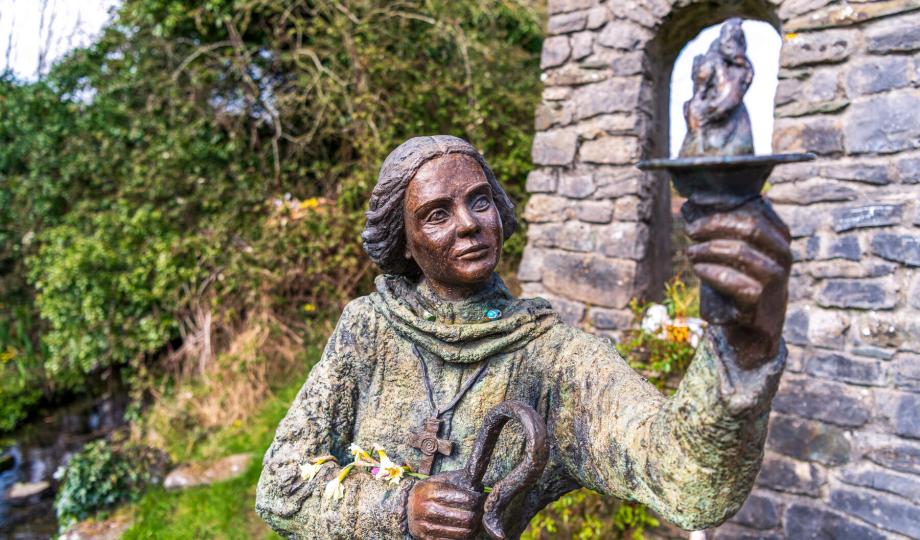
St. Patrick isn’t the only saint that gets a day of global celebration. Ireland’s second-most beloved saint, Brigid, has her special day on February 1. Brigid is associated with many miracles related to healing, and it's fitting that the day to commemorate her is also the traditional first day of spring in Ireland. Celebrations have been going on in Ireland for centuries, and in recent years have spread to the Irish diaspora.
Brigid: a generous soul - and a brewer of ale
How much do you know about this inspiring saint? Here are a few of our favorite facts about St. Brigid:
1. St. Brigid shares a name – and maybe more - with a Celtic goddess
St Brigid was born in 451 in Dundalk in Ireland and died in 525. Born to a Christian slave who had been baptized by St. Patrick and a father who was both pagan and a wealthy chieftain in Leinster, she shares a name with the Celtic pagan Goddess of fire. She was a slave from birth, and was returned to her father as a child to be his servant. There is some controversy over whether she existed at all, with some speculating that she was invented to Christianize the old Celtic goddess, while others suggesting she was simply named after her.
2. Brigid’s compassion is legendary
Known for her generous nature, Brigid was freed from a life of bondage after her father, named Dubhthach, tired of her giving away his possessions to the needy. Dubhthach had brought Brigid to the King of Leinster, intending to sell her. While her father spoke to the king, Brigid gave away Dubhthach’s jeweled sword to a leper, enraging her father but prompting the Christian king to recognize her holiness. The king declared that her father should leave her alone, “for her merit before God is greater than ours”, freeing Brigid to follow her faith.
3. She established a monastery in Kildare
Brigid would go on to become a nun, and a disciple of St. Patrick. She founded several monasteries, including a vital center of religion and learning in Kildare, as well as a school of art that taught metalwork and illumination. The ornate beauty of an illuminated manuscript done by the scholars of Kildare prompted a medieval scholar to say “all this is the work of angelic, not human, skill”; sadly, the book has been lost for centuries. But today, the cathedral of Kildare stands on the site of one her early churches.
4. Her feast day marks the traditional beginning of spring in Ireland
February 1 was originally celebrated as a pagan festival called Imbolc, marking the midpoint between the winter equinox and spring solstice, and the arrival of longer, warmer days. February 1 is when the daffodils start to bloom, the evenings start to lengthen, and the gloom of winter goes on its way. Brigid would be symbolically welcomed in Irish homes on the day, with a symbolic offering of food and drink. It is also traditional to make St. Brigid’s crosses out of rushes (a straw-like plant); people believed in olden days that these crosses would protect their thatched homes from fire.
5. Brigid is the patron saint of poets…
But that’s not all – she’s also the patron saint of midwives, newborns, Irish nuns, fugitives, blacksmiths, dairymaids, boatmen, chicken farmers, cattle, scholars, sailors, and no doubt many more. She is also, along with Patrick and Columcille, one of the three patron saints of Ireland.
6. Brigid has a special place in the hearts of brewers
Like many women of her time, Brigid was a brewer of ale, and several of her miracles are associated with beer. In those days, beer was regarded as a sanitary, more nutritious alternative to water. Once asked for help by a party of thirsty lepers, Brigid spotted some bathwater being prepared; after she blessed the water it was transformed into beer. Similarly, she once transformed dirty bathwater into clean beer for visiting priests.
Her fondness for beer is commemorated in this delightful poem from the 10th century, in the voice of Brigid:
I'd like to give a lake of beer to God.
I'd love the heavenly
Host to be tippling there
For all eternity.
I'd love the men of Heaven to live with me,
To dance and sing.
If they wanted, I'd put at their disposal
Vats of suffering.
White cups of love I'd give them
With a heart and a half;
Sweet pitchers of mercy I'd offer
To every man.
I'd make Heaven a cheerful spot
Because the happy heart is true.
I'd make the men contented for their own sake.
I'd like Jesus to love me too.
I'd like the people of heaven to gather
From all the parishes around.
I'd give a special welcome to the women,
The three Marys of great renown.
I'd sit with the men, the women and God
There by the lake of beer.
We'd be drinking good health forever
And every drop would be a prayer.
Museum.ie
St Brigid’s Day - a weaving tradition of Celtic rituals, Christian faith and enduring folk customs
With its origins in the Celtic fertility festival of Imbolc(giving birth), St Brigid’s Day on February 1 signals the beginning of spring and an end to the darkness of winter, ushering in a new season of hope and growth on the land and the birth of animals on the farm and in the wild.
Our rural ancestors celebrated the day with a festive meal and a host of customs, all aimed at securing St Brigid’s protection and promise of new life and abundance for the year ahead.
The ancient goddess Brigid was associated with the main deities of pre-Christian Gaelic Ireland, the mythical Tuatha Dé Danann. As a fertility goddess she had links to other spring deities across Europe associated with rebirth of nature.
The Christian church adopted the ancient Celtic feast days that were linked to nature and amalgamated them into the Christian calendar. St Brigid’s Day was one of the ‘quarter days’ that marked a transition from one season to the next.
There followed Bealtaine at the start of summer (May 1); Lúnasa, which heralded the harvest season (August 1); and Samhain(November 1) was the beginning of the dark season. These quarter days and many Irish calendar festivals were linked to dates near to solar cycles of solstices and equinoxes.
Brigid the holy woman was a member of the Fogharta sect and has strong connections to the Leinster counties of Kildare and Louth, with hills, wells, shrines and churches in Faughart, north Louth (where she was born) and throughout Kildare where she founded her church. The possible foundations of a fire temple which held an everlasting flame is located in the lands of Kildare Cathedral (a flame continues to burn in the Solas Bhríde centre nearby).
Brigid the saint, along with the other patron saints of Ireland, Patrick and Columba, was never officially made a saint by any Pope (in 1999, however, Pope John Paul II declared another Brigid, St Bridget of Sweden, founder of the religious order of Bridgettines, a patron saint of Europe).
St Brigid in Ireland is associated with nurturing, caregiving and protection from illness - attributes inherited from her ancient namesake.
The interlacing and merging of the characteristics of the goddess and the pagan symbolism of fire and water into those of the saint is similar to the weaving of the natural materials to form the St Brigid crosses.
Irish feast days were most often (or mostly) celebrated on the eve of the day itself as this was considered a very liminal time when the otherworld was very close and appeals for protection and blessing were most effective.
The festive meal in honour of the saint was a supper of potatoes and freshly churned butter; colcannon was made by adding chopped cabbage to the mashed potatoes.
Family members would take turns at pounding the potatoes. This was thought to bring luck and is prevalent in folk traditions, like taking a dash of a churn when making butter.
The feast meal was in thanksgiving for the previous year’s crops, tempered with hope and protection sought for the vegetable crops still to be sown. Afterwards the family made their St Brigid’s crosses.
The St Brigid’s Cross, pinned up above the front door or in the kitchen, is still a familiar feature in many Irish homes. The most recognisable cross is the four-armed St Brigid’s cross (popularised since 1961 by its use as an emblem for the national broadcaster RTÉ). This style was much favoured in the north of Ireland, yet the most popular throughout all of Ireland were variations of diamond-shaped crosses.
Regional styles and variations of St Brigid’s crosses existed and often numerous styles were made in each home. Traditional designs were diamond, interlaced or wheel-shaped and could have two, three or four arms.
The simplest crosses consisted of two strips of wood or straw plaits tied together to form a cross. Straw, rushes and reeds were the most common materials used but grass, hay, wood, goose quills, wire and fabric were also employed, and even sheaves of ripe corn and potatoes. The material was sprinkled with holy water before been made into a cross, while a prayer to welcome the saint into the home was often recited.
St Brigid’s Crosses were also hung in animal sheds. Leftover materials were sprinkled on the crops or incorporated into ropes or bedding for animals to invoke the saint’s blessing as she passed through the country on the eve of her feast day.
The previous year’s cross was often left in its place and the new one placed beside it or the old dried out one broken into fragments and scattered over the land or animals. Newlyweds or those with a new home were often gifted a St Brigid’s Cross for protection and to wish the couple well in starting a family.
On the eve of St Brigid’s day, a cake of bread or a piece of cloth or ribbon (Brat Bríde or Ribín Bríde) was left outside on the windowsill or near the door. It was believed it would be touched by St Brigid on her travels and have the power to ward off illness and pain in both humans and animals. The material was safely kept and used for healing, or incorporated into clothing to offer protection to the wearer.
As for St Brigid’s brat (mantle or cloak); legend has it that in Co Kildare the local king agreed to give Brigid the amount of land that her cloak covered. Once laid, her cloak expanded over much of the county and the king had to forgo much of his land! (A relic of St Brigid’s cloak is kept in St Saviour’s Cathedral in Bruges, Belgium).
Spring, the season of hope, brought better weather and longer days. With it came new life on the farm and new growth on the land. St Brigid offered protection towards fertility for the household, farm, and land, and safeguarded people from illness and disease.
Communities venerated the saint and there were processions where her effigy was paraded represented as a doll. ‘Biddy Boys’ (or girls) went from house-to-house with ‘Biddy’, often a straw doll in a veil (like a bride) and cloak, collecting money and food for a St Brigid’s party, while reciting a rhyme similar to this one:
Here is Brigid dressed in white.
Give her something for the night.
She is deaf, she is dumb,
For God’s sake, give her some.[i]
The Biddy Boys were especially popular in Co Kerry where the dressed straw Brídeogs(brides) were almost life-size and were carried through the streets in elaborate parades.
In parts of Connacht, the Biddy Boys would carry a large plaited straw belt (Crios Bríde) often with incorporated straw crosses. The inhabitants of each home passed through the circle of the belt while reciting a prayer to St Brigid in the hope of gaining the saint’s protection from illness during the coming year.
The belt was raised over the heads of the women and dropped down for them to step out of it. The male occupants had to go through sideways from left to right – arm, leg, head, then the other leg and arm.
This idea of passing through a portal is replicated at many of the holy wells dedicated to St Brigid. One can be found at Brideswell, Co Roscommon. The well was reconstructed in 1625 by the Earl of Antrim, Randal Mac Donnell (he had come with his wife and she partook of the spring waters and later became pregnant with their first child). The stone enclosure around the well allowed for pilgrims to make a stepped journey, as through a portal, to the depths of the well.
Holy wells are found all over Ireland. They are often located by a tree where votive offerings, usually of ribbons and rags are left by pilgrims, in the hope that their prayers will be remembered. It was traditional to visit these holy wells the evening before or on St Brigid’s feast day.
Blessed water from the wells was believed to be a cure for infertility, and for eye cures, based on the legend of St Brigid removing her eye so as not to be married to a suitor.
Beannachtaí na Féile Bríde oraibh go léir!
This article by Clodagh Doyle, Keeper of the Irish Folklife Collection, National Museum of Ireland, was first published in the Irish Arts Review, Volume 39 (4), Winter Edition December 2022 - February 2023, page 128
References:
[i] Danaher, Kevin, The Year in Ireland, Cork, 1972, p30
Further reading:
Danaher, Kevin, “The Year in Ireland”, Cork, 1972.
O’Dowd, Anne, “Straw Hay and Rushes in Irish Folk Tradition”, Dublin, 2015.
Ó Dúinn, Seán, “The Rites of Brigid, Goddess and Saint”, Dublin, 2005.
Ó’hÓgáin, Dáithí, “Myth, Legend and Romance - An encyclopedia of Irish Folk Tradition”, London, 1990
https://www.vatican.va/content/john-paul-ii/en/motu_proprio/documents/hf_jp-ii_motu-proprio_01101999_co-patronesses-europe.html
McClintock, H. F. “The ‘Mantle of St. Brigid’ at Bruges.” The Journal of the Royal Society of Antiquaries of Ireland, vol. 6, no. 1, Royal Society of Antiquaries of Ireland, 1936, pp. 32–40.
Connolly, Sean, and J. M. Picard. “Cogitosus’s ‘Life of St Brigit’ Content and Value.” The Journal of the Royal Society of Antiquaries of Ireland, vol. 117, Royal Society of Antiquaries of Ireland, 1987, pp. 5–27,
No comments:
Post a Comment
Note: Only a member of this blog may post a comment.