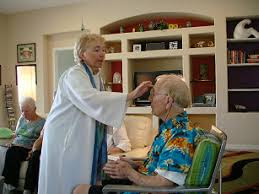
From July 14 – 17, The Inclusive Catholic Community of the Capital Region of New York --the Upper Room is hosting the annual gathering of the international Association of Roman Catholic Women Priests. It is being held at the Albany Radisson, 205 Wolf Rd.
The local progressive community meets on Sundays at 11 a.m. at 415 River St., Troy, New York. It began with the ordination of Mary Theresa Streck, ARCWP on September 15, 2013. The 40+ member community is served by four priests and two deacons, including women and men, and LGBTQI people. Media are welcome to interview participants about their ministries to transform the Roman Catholic Church into a more welcoming and just community.
As the Vatican upgrades the feast day of Mary of Magdalene on July 22nd, Roman Catholic Women Priests celebrate 10 years of creating communities that include and dismantling barriers that exclude. This means that everyone has a place at the Eucharistic table and all are welcome to receive sacraments.
On July 31, 2006, 12 women were ordained on the Majestic Riverboat on the three rivers near Pittsburgh, thus beginning the movement for gender justice in the Catholic Church in the US. The international Women Priest Movement has grown from the Danube Seven in 2002 to over 225 in 13 countries in 2016. As we celebrate our 10-year anniversary of priesthood in the U.S., we continue to work for the full equality of women in the church and in the world.
The Vatican has literally cracked open its door in a gesture of openness to women priests for the first time.
In previous years as an activist for women priests, our efforts in Rome were met with demonstrable resistance.
In 2001 our Women’s Ordination Conference (WOC) banner hung on the street directly on the edge of the Vatican. It read “Ordain Women” in seven languages.
When the captain of the Italian police saw it at our banner blessing, he asked me for its legal documentation.
Fifteen years later, in 2016, Italian authorities approved photo-journalist Giulia Bianchi’s collection of posters of women priests displayed all through the streets of Trastevere and throughout Rome.
Posters Promoting Women Priests Available from Photo Journalist Nausicaa Giulia Bianchi
In May 1994, Pope John Paul 11 wrote Ordinatio Sacerdotalis proclaiming the door closed to women's ordination.
On June 29, 2002, seven women were ordained on the Danube, initiating the international the Roman Catholic Women Priests Movement, which today numbers 225 in thirteen countries.
When progressive Catholics gathered in Rome in 2011 we showed the movie, "Pink Smoke Over the Vatican,” the Jules Hart documentary about the struggle for justice for women in the Church.
As we processed along the Via Conciliazione approaching the Vatican, Maryknoll Catholic priest Father Roy Bourgeois and Women’s Ordination Coordinator, Erin Hanna, were met by the Italian police. They were shoved into police cars and held in custody for several hours. Their banners were confiscated. Deacon Donna Rougeux ARCWP and I, in my priestly vestments, were blocked from entering St. Peter’s Square.
In March 2013, our community, the Association of Roman Catholic Women Priests (ARCWP) sent me back to Rome for the Conclave. After meeting with media and shielded by the columns of St. Peter’s Square, I walked away, holding my “Women Priests Are Here” banner.
Soon after the Italian police grabbed my banner and questioned me. “Why are you dressed like a priest?” the officer asked. “Because I have been a priest for five years. I lead the Resurrection Community in Cincinnati and the Emmaus Community in Lexington, Kentucky," I said. "Here’s my card. "Would you like a blessing?” His face revealed confusion. “How many women priests are here?” he asked in an agitated voice. “How long are you staying?” I answered "about a week." Then, he walked back to the squad and dialed the Captain for further orders. Meanwhile, a crowd had gathered in the rain as a Spanish radio journalist , who had also never seen a woman priest, interviewed me. When the officer returned, he told me to get into the squad car. After considering my options at further resistance, I complied. When the car drove off, I didn’t know where they were taking me. They told me I needed to show them my passport, which was at the convent where I was staying. When I explained that I didn’t want them to disturb the conservative Italian nuns by revealing my priestly identity and facing eviction, the police kindly acquiesced. They waited outside until I returned with passport in hand. They ordered me not to appear on the streets of Rome in my priestly attire again.
However, I did not obey their command: Five hours later, I presided at Eucharist in a community center in Rome. Later that evening I was in St. Peter’s Square with another “Women Priests Are Here” banner hidden in my clothing as white smoke swirled over the Vatican and the newly elected Pope Francis appeared on the balcony.
Immediately, the whole world fell in love with him.
Three years later, from May 28 – June 4, 2016, ARCWP Christina Moreira from Spain and I participated in a Jubilee of Women Priests in Rome organized by Women’s Ordination Worldwide. Meanwhile, the Vatican was celebrating a Jubilee of (male) Priests .
This time, a different atmosphere prevailed.
Not only were there posters of women priests displayed near the Vatican, our group was given permission to witness alongside Castel Sant Angelo as seminarians processed by to St. Peter’s Square. Some gave us a thumbs-up as they passed by and took flyers from WOC's co-leader, Erin Hanna.
Christina and I, in our priestly garb, held up our banners: “Women Priests Are Here” in Spanish and English” as well as South African artist Dina Cormick’s banner of Phoebe celebrating an early Church Eucharist.
In addition at our prayerful June 3rd witness, WOW picked up on Pope Francis’ theme of “opening the door to dialogue” symbolized by a cardboard phone booth.
As before, the police were present during our witness for women priests. I recognized one of them from my other Vatican encounters with law enforcement. However, the surprise this time was that a female police officer spoke with us, informing Christina and I that we needed to remove our stoles and fold our banners. She assured us that these items would be at the police station and available for pickup after the papal liturgy.
After an interview with Sylvia Poggioli from National Public Radio, the female police officer and three other officers escorted us to our designated seats in St. Peter’s Square for the celebration of the Jubilee of Priests liturgy at which Pope Francis presided.
In this Francis -designated Year of Mercy another “miracle” occurred.
On May 31st, 2016, the doors of the Vatican Curia opened to us women priests. Christina Moreira and I made a connection with a senior Vatican official who is close to Pope Francis.
After waiting in line in the hot sun in St. Peter’s Square along with hundreds of other pilgrims from around the world, we were cleared to enter the Curia offices. Upon speaking with two Swiss guards, we entered an office with two lines: one for archival documents and the other for permissions to visit with Vatican officials.
When the Vatican official verified our confidential contact, he informed us of our appointment time. After we returned, we were given directions to walk to the Curia. I gulped when I heard this infamous place, which I associated with secrecy, injustice and even torture. Once inside the building, we misinterpreted the Swiss guards directions. Instead of taking the elevator, we walked up a winding marble staircase with no railings, and huge statues of Roman goddesses towered above us. It felt like a trip back to antiquity. I wanted to take photos but then caught myself in case we were being watched. At the top of the stairs, we came to a dead end, facing a gigantic wooden door. Careful not to fall ,we retraced our steps. Back on the first floor, we took the elevator.
When we reached our final destination, a courteous official led us to a reception room. After a few minutes, the Monsignore appeared and welcomed us warmly.
Christina shared her call to priesthood with him. Then, I presented him with the envelope that held the online petition of support for the women priests movement. In this petition, women priests are requesting that Pope Francis lift our excommunications and all punishments against our supporters and begin a dialogue. I also included a copy of the DVD "Pink Smoke Over the Vatican".
In an impassioned plea for dialogue with Francis about women priests and gender justice in our church, I addressed the following issues:
-The history of women’s leadership as deacons, priests and bishops in early Christianity
- Activism for Women's Ordination throughout the years, including our banner in Rome, the WOC’s billboard campaign and the Irish “New Last Supper Painting."
- Our women priest communities are non-clerical and circular in decision-making.
- We use feminine as well as masculine images of God who is beyond gender. That using predominantly masculine images of God puts God in a box that leads to male hubris, the domination of women and damages women’s souls. I said that we need women at the table to image the imago dei , the sacred with our holy feminine bodies and I mentioned the overwhelming femicide in the world, and that the Gospels should also be interpreted from women’s lived experiences.
- In our inclusive communities , the entire community celebrates Eucharist. They are invited to raise their hands in consecration, mutual blessings and to participate in shared homilies. Everyone is welcome at our table including former Catholics, ( 33 million in the US), divorced and remarried and the LGBTQI community.
-The church must make the connection between the discrimination of women in the Catholic Church and violence toward women in the world. Two-thirds of the world’s poor are women and their dependent children. -I talked about Fr. Roy Bourgeois and named other priests who have supported us.
With a sweep of my hand across my body I motioned that our call to priesthood is a "yes' response to the Spirit.
During this entire time, the Monsignore listened intently and appeared open to our words. He suggested we dialogue with Francis and asked how long we were staying, and gave us each a piece of paper to write our names and phone numbers.
This experience felt like healing balm to my soul after so many years of rejection by the hierarchy. Indeed, the door has opened.
Today’s post is from guest blogger Roy Bourgeois, a former Roman Catholic priest and the author of My Journey From Silence to Solidarity. Bourgeois is a nationally-known speaker on conscience and church reform. He founded the School of the Americas Watch, which holds an annual protest against the training of Latin American soldiers at Ft. Benning, Georgia. He was nominated for the Nobel Peace Prize in 2010.
Homophobia, according to Webster’s dictionary, is “the irrational hatred or fear of homosexuals.”
Roy Bourgeois
The language we use breeds hatred and fear, which often leads to violence. It’s time to disarm hatred and fear. A good place to start is with church teachings. According to the official teaching of the Catholic Church, as stated in its Catechism, section 2357:
“Basing itself on Sacred Scriptures, which presents homosexual acts as acts of grave depravity, tradition has always declared that ‘homosexual acts are intrinsically disordered.’ They are contrary to the natural law. They close the sexual act to the gif of life. They do not proceed from a genuine affective and sexual complementarity. Under no circumstances can they be approved.”
This teaching instills shame and self-hatred. It has contributed to gay people being rejected by their families, fired from their jobs, bullied, and even killed. Throughout history, the Bible and “tradition” have been used to justify discrimination. The Bible was used to support slavery, as it was used to oppose the right of women to vote. Growing up in Louisiana, we used our “tradition” and the Bible to justify our segregated schools and worshiped in a Catholic Church that reserve d the last five pews for blacks. And today, once again, we are using the Bible and tradition to discriminate against gay people. Over the years, I have had to deal with Catholic church teachings. I served as a priest with the Maryknoll Fathers for 40 years. In 2012, I was expelled because of my public support for the ordination of women. Being kicked out of the priesthood and my community of long-time friends was very painful. However, this experience gave me a glimpse of what millions of people have gone through, on a much deeper level, because of their race, gender, or sexual orientation. Since my expulsion from the priesthood, I have been hearing the stories and experiences of gay people Two stand out and kept me awake at night:
Catholic parents told me about their high school son who was gay. While they expressed unconditional love for him, he was bullied at school and did not feel welcome at their church. Two weeks before graduation, he committed suicide. They told me that the Catholic Church’s teaching on homosexuality contributed to the death of their son, and they left the church.
On a recent human rights delegation to El Salvador, we met with LGBT people. They told us about the danger of coming out in El Salvador and how some of their good friends were killed. El Salvador is a very Catholic country. When asked about support from the church, they said Catholic bishops and priests were their biggest enemies.
Outside the Catholic Church, others see homosexuality differently:
Tim Cook, CEO of Apple, said, “I’m proud to be gay, and I consider being gay among the greatest gifts God has given me.”
In 1973, the American Psychiatric Association declared that homosexuality is a normal variation of human sexuality.
On June 26, 2015, the U.S. Supreme Court ruled that same-sex marriage was a constitutional right.
According to the Human Rights Campaign, “Nearly two-thirds of LGBT Americans report having experienced discrimination in their personal lives,” and “only 19 states explicitly prohibit discrimination based on sexual orientation.” Today, 25 countries have legalized gay marriage, while 75 nations treat homosexual behavior as a crime. In 10 countries, it is punishable by death. When we are born, we do not choose our race, gender, or sexual orientation. No matter how hard we may try to justify discrimination against others, including using the Bible and tradition, in the end, it is not the way of a loving God who created everyone of equal worth and dignity. There are no exceptions. It is time for the Catholic Church and other churches to change the oppressive teachings on homosexuality. –Roy Bourgeois
Bridget Mary's Response: The women's liberation movement is the voice of God in our times that challenges all churches and religious institutions to treat women as equals. I believe Pope Francis is in discernment mode and there are signs of progress. While I welcome the appointment of a woman as #2 spokesperson for the Vatican Communications Office, I think he could have named a woman as the #1 spokesperson. https://www.washingtonpost.com/news/acts-of-faith/wp/2016/07/11/pope-francis-names-first-american-and-first-woman-as-his-1-and-2-spokespeople/ I am also hopeful that Pope Francis will begin a dialogue with our international Roman Catholic Women Priests Movement as a concrete step toward healing,justice and equality for women in the church. Bridget Mary Meehan, ARCWP, www.arcwp.org Article: Could Pope Francis Be a Feminist?
In response to Pope Francis, Amoris Laetitia "The headlines zeroed in on the pope’s statements regarding divorced and remarried couples and his latest commentary regarding gay marriage. Below the radar, however, were Francis’s words on the progress of women’s rights: “Even though significant advances have been made in the recognition of women’s rights and their participation in public life, in some countries much remains to be done to promote these rights. Unacceptable customs still need to be eliminated.
"Even bolder were Francis’s strong condemnations of those who blame societal woes on the women’s liberation movement: “There are those who believe that many of today’s problems have arisen because of feminine emancipation. This argument, however, is not valid. … The equal dignity of men and women makes us rejoice to see old forms of discrimination disappear, and within families there is a growing reciprocity...
As journalist David Gibson wrote in December 2014, “When he speaks about women, Francis can sound a lot like the (almost) 78-year-old Argentine churchman that he is, using analogies that sound alternately condescending and impolitic, even if well-intentioned.” One of his worst moments was earlier that month, when he tried to compliment leading female theologians by calling them “strawberries on the cake.”
Francis has said the church must enter a period of discernment regarding how it relates to issues of family life, love and sex. Clearly Francis has learned a lot in his own discernment."
"Pope Francis on Monday overhauled the staff that presents the public face of the Vatican, naming a former Fox and Time correspondent from St. Louis as his personal spokesman and director of the Vatican press office — the first American to hold that position. The pope also appointed a Spanish journalist to the second-in-command spot, the highest spot a woman has held in the church’s communications power structure...
Longtime Vatican analyst John Allen, with Crux, on Monday called Burke’s appointment a “Steph Curry” moment for Francis — a so-called three-pointer. The decision, Allen said, does three things: puts to rest the feeling that the Argentine pontiff is anti-American (or at least America-reticent), shows that he cares about competence in his high-level staff picks and gives a high spot to a Catholic of the more conservative bent. Burke is a member of Opus Dei, a more traditional Catholic community. Allen notes that Burke is a “numerary,” which in Opus Dei means a lay person who is celibate.
Pope John Paul II for many years had an Opus Dei layman as his spokesman, a man named Joaquin Navarro-Valls. He was seen as a powerful close adviser to the pope, unlike Lombardi, who is well-liked but often seen as unable to authoritatively decipher the intentions of Francis.
Allen said the choice of García, a woman, is “in particular a game-changer. For a pope whose warnings against the dangers of clericalism have become the stuff of legend, this is a case in which Francis is, quite literally, putting his money where his mouth is.”
"Our life of prayer can be first a move toward the Beloved; then we are with the Beloved; finally, we are the Beloved. We move from dialogue, twoness to a oneness in which all divisions are revealed as illusory.
All our young lives, we loved Mary as our mother in heaven. We were supplicants who asked for her graces. This corresponds to a movement toward her while she was above us. As we matured in faith, we began to see that, the mysteries of her life were exemplars of what we were meant to be. We then felt her beside us. Finally, we dared to recognize ourselves in her and experienced her energy within and as her own souls. We saw that she is the feminine reality of what we are. This is a progression correspond to the stages of contemplative prayer. We now love her in the core of our souls as the core. Before we loved a picture, but now we love the motherly, virginal, royal reality of our own humanness that boasts such a powerful Source within and ever enfold us. Mary is the new Eve because she is the new potential of divinity in the cosmos and in all humanity. The mystic philosopher, Pythagoras, reflected that the threefold goddess represented the phases of a woman's life: virgin, mother, wise old woman gaining power that is queenliness. The great goddess was simultaneously the mistress of the underworld (virgin), the earth (mother), anance d the heavens (queen). The three dimensions reflect the phases of the moon, new, waxing, and dying in preparation for renewal. We begin to see the cosmic implications of the goddess energy and the divine feminine. For instance, in some traditions, the earth was considered to the Great Mother. Mary, on the archetypal/metaphorical level, can be seen as a container of the ancient threefold energy that characterized the great goddess. The excesses of devotion over the past two millennia regarding Mary become understandable once we see them in the light of the perennially venerated threefold goddess, rather than to the Mary of the Gospels. What may seem like idolatry when applied to the woman from Nazareth is, however quite understandable when applied to her spiritual meaning in spiritual consciousness. In fact, no one has yet praised her enough. There can be no excesses for the Source of and the guide to the mystery of the divine life in us and in all the cosmos. Mystically, Mary is the "yes' by which the timeless divine life entered into time. (This book) examines "each of the three qualities of the divine feminine- virgin- mother, queen- both in ancient pagan times and in the Litany of Loreto. " pp. 37-39, When Mary Becomes Cosmic, by David Richo
Celebrating Our Mystical Oneness in the Cosmic Christ
Receiving
the stole:
Welcome
Presider 1:Welcome
to our inclusive catholic community. We celebrate with joy the indwelling of
our God among us. Our liturgical style is highly inclusive and you are invited
to participate in the words of the consecration. We are happy you are here with
us today. Our theme for this liturgy is celebrating our mystical oneness in the
Cosmic Christ. All are welcome to share in our simple Eucharistic meal around
this friendship table.
Opening
Prayer
Presider 2:
Nurturing God, You embrace each person and every living thing with delight. May
we, who are stardust, be filled with awe as we experience our mystical oneness,
with all creation in the Heart of Love. May we cherish every amazing day,
conscious of your presence and abundance all around us.
All. Amen.
Presider
1: Please
join in singing our Gathering Song.
We believe
in God, the fountain of life, flowing through every being. We believe in Jesus,
the Christ, who reflects the face of God and the fullness of humanity. We
believe in the Holy Spirit, the breath of God in the cosmos, who calls us to
love and serve without counting the cost. We believe in our global communion
with all in the circle of life. Amen to loving actions on behalf of justice,
healing, compassion and equality for all in our world!
Presider
1: As we prepare for the sacred meal, we lay our stoles upon the table as a
sign that just as Jesus is anointed, so is each of us. And we bring to this
table our blessings, cares and concerns.Please feel free to voice your concerns beginning with the words “I
bring to the table….”
Presider
1: We pray for these and all unspoken concerns. Amen.
Please
join in praying the Eucharist prayer together:
Eucharistic
Prayer
All: Ever
gentle God, as co-creators of our planet, we offer you the gifts of bread, wine
and our lives. May we celebrate our oneness with all creatures great and small
in your precious family.
As one
with You, we gather as a community to celebrate your gift of life pulsating
within and around us and in the glories of nature everywhere.
O Birthing
God, you stirred the waters of creation; you dwell on earth, and in every
living being. We lift up our
hearts to you and with thanks and praise we sing:
Holy,
Holy, Holy by Karen Drucker
We are
holy (x3),
We are
whole.
Spirit
divine, Come to me
Feeling
love, Healing me
Open my
heart, Allow me to see
Beauty
& love lives in me.
You are
holy (x3),
We thank
you for our brother, Jesus, who showed us so simply, so tenderly, how the world
is in our hands. He had nothing in this world but your love, companions on the
journey, and his very self. Together, that was more than enough, and that
remains our clarity in the midst of confusion: the miracle of healing, new
hope, nurturance, nourishment, liberation and life.
(All
Extend Hands)
ALL: On
the night before he died, while at supper with his friends, Jesus took bread,
said the blessing, broke the bread and gave it to them saying, “Take this, all
of you, and eat. Do this in memory of
me.”
(Pause)
In the
same way, Jesus took the cup ofwine.
He said the blessing, gave the cup to his friends and said, “Take this all of
you and drink. Do this in memory of me.”
Presider
1: Let us pray the mystery of faith:
ALL: This
bread is you, this bread is me. We are one body, a reflection of God’s
treasures, in communion with all creation.
All:
Christ of the Cosmos, we thank you that there are 18 galaxies for every person,
that our bodies are made of stardust. Every place we turn, you are present,
loving us. You call us, “beloved” and invite us to join the dance of creation
in a mystical celebration of our oneness with all living things in your divine
love.
Christ of
the Cosmos, we rejoice that You, who are more than we can imagine or dream of,
dwell in mystery beyond all comprehension. We remember that it was you, who
said: “Anything I have done in the name of the Holy One, you can do, too…and
even more.”
Christ of
the Cosmos, we remember Mary, mother of Jesus, faithful disciple and St.
Francis who sang canticles to brother sun and sister moon. We remember our
sisters and brothers, the great cloud of witnesses who have cared for earth’s
creatures and have blessed our world with their loving service to God’s
people.
We praise
you in union with them
we awaken
to your Spirit within,
Moving us
to worship you truly,
O Holy One,
At this time
and all time and in all ways.
Amen.
Presider
2: Let us pray together the prayer of Jesus:
Adapted
from Miriam Therese Winter
O Holy One
who is within, around and among us,
We celebrate your many names.
Your wisdom come; your will be done,
unfolding from the depths within us.
Oh, Each day you give us all that we need.
You remind us of our limits and we let go.
You support us in our power, and we act with courage.
For you are the dwelling place within us,
the empowerment around us,
and the celebration among us,
now and forever. Blessed be!"
Presider
1: Let offer each other a Sign of Peace
Song:
Presider
2: Please join in praying the prayer for the Breaking of the Bread.
All:
Christ of the Cosmos, we will live our oneness with you and all creation.
Christ of
the Cosmos, we will work for healing of the earth.
Christ of
the Cosmos, we will celebrate justice rising up in a global communion
everywhere.
Communion
Presider 1:
This is the Cosmic Christ in whom all creation lives and moves and has its
being. All are invited to partake in this banquet of love and to celebrate our
oneness with all living beings on the planet.
ALL: We
are the Body of Christ.
Communion Song
On This Day O Beautiful Mother by Colleen Fulmer
Prayer
after Communion
Presider 2:
Lover of
the Universe, we are full of awe at your extravagant love flowing through all
living things. We immerse ourselves in the beauty of nature that surrounds us
each day.
Weare one with our brother Jesus, in union
with the Holy Spirit.ALL:
Amen
Concluding
Rite
Presider 1:
Christ of the Cosmos is with us.
ALL: And
loves through us.
Presider
2: Please extend your hands in praying the blessing:
ALL: The
blessing of God is upon us as we go in the peace of the Cosmic Christ to live
justice! Thanks be to God.
Closing
Song
Woman Spirit by Karen Drucker
Adapted
from Cosmic Christ Liturgy by Bridget Mary Meehan