Translate

Friday, August 1, 2025

August Issue of the Review/RCWP Canada

 https://rcwpcanada.altervista.org/

Featured Articles in This Issue:

• Rest Is Sacred – Even the Pope Agrees. Discover why Pope Leo XIV’s summer retreat is more than time off—it’s a call to sabbath as spiritual resistance and renewal.

• Bishop’s Message: Mary of Magdala and the Audacity of Faith. Bishop Jane Kryzanowski reimagines justice and priesthood through the lens of Mary of Magdala’s courage and prophetic voice.

• Spotlight: Spirit of Grace Church in Beaverton, Oregon. A newly ordained Roman Catholic Woman Priest co-leads this vibrant, LGBTQ+ affirming community that bridges Catholic and Lutheran traditions.

• Reflective Voices. Readers respond to last month’s “Grisette papesse” feature, with calls for bold feminist theology and more inclusive storytelling.

🧡 Listen and Learn from Indigenous Voices. A powerful twelve-part series by Teresa Elder Hanlon, priest and servant leader in Lethbridge, AB, concludes this month. Each article illuminates Indigenous wisdom, traditions, and the path toward reconciliation. Topics include:
  • The meaning of regalia and sacred ceremony
  • Indigenous relationships with water, land, language, and prayer
  • Truth and trust as foundations for authentic allyship
  • Re-indigenization and how non-Indigenous people can actively support decolonization
From stories of ancestral bundles to reflections on treaties and place-names, these writings invite deep listening and meaningful engagement.

📬 Read the full issue of The Review on our website: https://rcwpcanada.altervista.org/

Monday, July 28, 2025

What Hans Would Say to Leo


Miriam Duignan

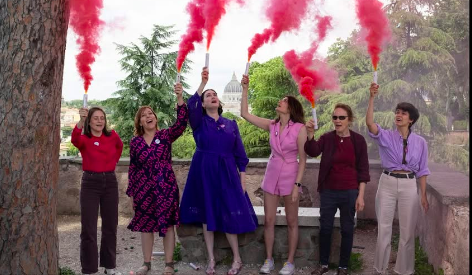
On the morning of the start of the Conclave in Rome, pink smoke billowed above one of the hills in Rome accompanied by song and prayer. Global advocates including Miriam Duignan, Executive Director of Wijngaards Institute for Catholic Research, called for the cardinals gathering together to heed the voices, vocations, and longing of women of the Catholic Church who are denied ordination, leadership and  decision-making roles .
An American Peruvian Cardinal, Archbishop of Chiclayo Robert Prevost was elected and chose to became Pope Leo XIV. Francis’ Legacy continues. In one of his early pronouncements to his fellow cardinals, he promises to be a bridge of peace, guided by the Holy Spirit, opening hearts through dialogue and healing the wounds of a divided world.
Interestingly enough when the then Robert Prevost was studying for his Masters of Divinity at Catholic Theological Union in Chicago, he chose Sister Lyn Osiek RSCJ as his spiritual director. Osiek is a leading authority on the role of women in the early church, she is co-author of two books on the subject: A Woman’s Place: House Churches in Earliest Christianity and Ordained Women in the Early Church: A Documentary History.  Pope Leo should be comfortable with working with women in ministry though he has expressed scepticism about ordaining women as Catholic clergy, repeating a line Francis often used about the risk of “clericalizing women”. One of the CTU’s slogans is ‘bold and faithful’ and their comment on one of their alumni being elected pope was that ‘Pope Leo would have been grounded in faithfulness to the Catholic tradition but bold in bridging the Catholic tradition into the future.’
It is this future that Dr John Wijngaards, known to his friends as Hans, was most concerned about. He fought for equality and justice in the Catholic Church, creating websites full of well researched information and shortly before his death in January 2025, his last book and testament ‘Why Christ Rejects all Church Prejudice Against Women’ was published. To order https://www.equalityforwomen.org/how-to-order/.


In an online session organised by Root and Branch group and hosted by Miriam, Dr Luca Badini Confalonieri (Director of Research, Wijngaards Institute) and Dr Kocurani Abraham, a theologian working in India, called ‘What would Hans say to Leo’, Miriam’s opening comment was that Hans would have said in his forthright Dutch way ‘For God’s sake do it now!’ She envisaged 7 discussions points that Hans would have wanted to stress

  1. He would have heartily agreed with Pope Leo when he said ‘An indispensable commitment for all those in the Church who exercise a ministry of authority is to move aside so that Christ may remain, to make oneself small so that He may be known and glorified, to spend oneself to the ultimate so that all may have the opportunity to know and love Him’. Hans was very adamant that the focus should be switched away from clericalism and focused on Jesus and what he taught. 
  2. Hans would have emphasised that both men and women have an equal capacity for exercising authority in the church, so that women’s equality must include their sacramental authority. 
  3. Hans was a fellow missionary and he was keen that the focus should be on a global church. The role that women play in keeping the Church flourishing should be recognized, as should the impact that denying women their priestly ministry makes on a local level. 
  4. Hans would urge the Church to tell the truth about the leadership role of women in tradition and the teaching of Jesus 
  5. Canon Law 10.24 (Only a baptised man can validly receive sacred ordination) hides the long history of women’s ministry in the Church and is a mediaeval and unjust law and should be scrapped. 
  6. Misogyny could be described as an illness and Professor Thomas O’ Loughlin describes Hans’ book as being a course of therapy for the dysfunctional church. 
  7. Finally, Hans would challenge Leo to be brave and be bold as he was throughout his ministry. 

Kochurani contributed an article for Hans’ last book to reflected on the pain and frustration that Hans felt about the injustices in the Church and described Hans as a prophet. Hans wrote in the forward to the section of the book that the church is far from getting rid of ancient prejudices. Undoubtedly Pope Leo comes across to the world a man committed to peace and social justice. Kochurani said she thinks Hans would remind Leo that true peace is founded on justice, justice that cannot be complete if women remain on the periphery only. Further she commented on Leo’s acknowledged intention to continue Francis’ commitment to a synodal church, but this cannot be a reality if the ecclesiastical clerical nature of the current church remains.
Luca in his contribution said ‘In order to survive as a force for good in the world, the Roman Catholic Church needs to update herself. Human rights – which official Catholic teaching encourage states to respect – should be fully incorporated in Canon Law. “Synodality”, co-responsibility, and democratic accountability should be implemented at all levels of church decision-making. Women should be restored to full equality, including access to ordained ministry. Sexual ethics must be stripped of ancient misunderstandings.’ Hans would challenge Leo to be brave and bold.
The full recording of the evening is here https://www.youtube.com/watch?v=CIDq7KgLxRY


We hope and pray that Pope Leo remains open and listens to the people in the pews.
 

Twitter
Facebook
Website
Copyright © 2025 Wijngaards Institute for Catholic Research, All rights reserved.
You are receiving this email because you subscribed to our newsletter through our website or because one of your contacts forwarded it to you. 

Our mailing address is:
Wijngaards Institute for Catholic Research
NortholtMiddlesex UB5 4LG
United Kingdom

Add us to your address book


Want to change how you receive these emails?
You can update your preferences or unsubscribe from this list

Email Marketing Powered by Mailchimp

“We Should Learn Something New Every Day” Luke 11:1-13 July 27, 2025 Rev. Annie Watson, Holy Family Catholic Church


I was a public school special education teacher in Kentucky for many years, so nothing makes me happier than people who want to learn. Someone once said, “We should learn something new every day.” That’s not just an empty slogan. Learning something new every day is good for our minds, well-being, and quality of life. 

Jesus’ disciples wanted to learn something newOne day, after watching Jesus pray, one of them said to him, “Lord, teach us to pray just as John taught his disciples.” Apparently, John was a teacher as well as a baptizer

Jesus loved teaching opportunities, so he taught them a verybrief prayer, one they could remember. This prayer is what Catholics call the “Our Father.” The version we read a moment ago from the Gospel of Luke is shorter and worded a little differently than what we recite during Mass, which is based on Matthew 6. But each version says pretty much the same thing.

So, let’s take a closer look at this prayer that Jesus taught his disciples. Afterwards, I hope we will all be able to say, “I learned something new today.” If not, there’s always tomorrow J.

Here’s what Jesus taught them (and us):

1. Jesus says, “When you pray, say: Father, hallowed be your name.”

Prayer is first and foremost an act of reverence for GodThis is important because it lays a foundation for the proper relationship between the one who prays and the One we pray to. It is an act of humility and reverence for God, which is always a good place to start. Prayer is a conversation with our Creator, so to get off on the right foot, we need to honor God.

2. Jesus prays, “Your kingdom come.”

This means that prayer is an act of welcoming the realm of God into our space and into our souls. This opens us to the presence of God in our lives, and increases an expectation that God will act on our behalf. It is a way of expressing the hope that the kingdom of God in heaven will now come near to us in the kingdom of God on earth

3. Jesus prays, “Give us each day our daily bread.”

Here, Jesus teaches us that there is room in our prayers for an expression of hope for our basic needs, such as our daily bread or sustenance. Notice that Jesus is not teaching us to pray thatGod will solve all our trivial problems, such as finding a parking space in front of Walmart. 

Instead, he is teaching us to pray for real problems, such as hunger. To put this in its proper context, Jesus is teaching poor people how to pray, because most of the people he ministered to were poor and hungry. So, as we pray, let us always remember those who are hungry and thirsty and hurting and suffering. 

4. Jesus prays, “And forgive us our sins.” 

Prayer should also include an expression of sincere guilt and our need for forgivenessThis moves us past our basic physical needs to our basic spiritual needs. It get to the heart of our deepest problem, which is our reluctance to recognize sin in our lives. We need to confront our sin so that we can free ourselves from the guilt that often overwhelms us. 

5. Jesus prays, “For we ourselves forgive everyone in debt to us.”

Just as we should pray to be forgiven, we should also pray that God will give us strength to forgive othersThis is super-important because it moves our prayers from focusing on ourselves to focusing on others. Forgiving other people turns a potentially selfish prayer life into an unselfish prayer life.

6. Jesus concludes his lesson by praying that God does not “subject us to the final test.”

Prayer is a way to express our hopes about the future, even if we have to pass a “final test.” We’re not exactly sure what this testis, but as a retired teacher, that doesn’t sound like a fun test to me. Whatever the future holds for us, either in this life or the next, we pray that it doesn’t involve a difficult test, but if it does, we pray that Jesus has our back.

I hope we learned something new about prayer today. If not, there’s always tomorrow J. Amen.