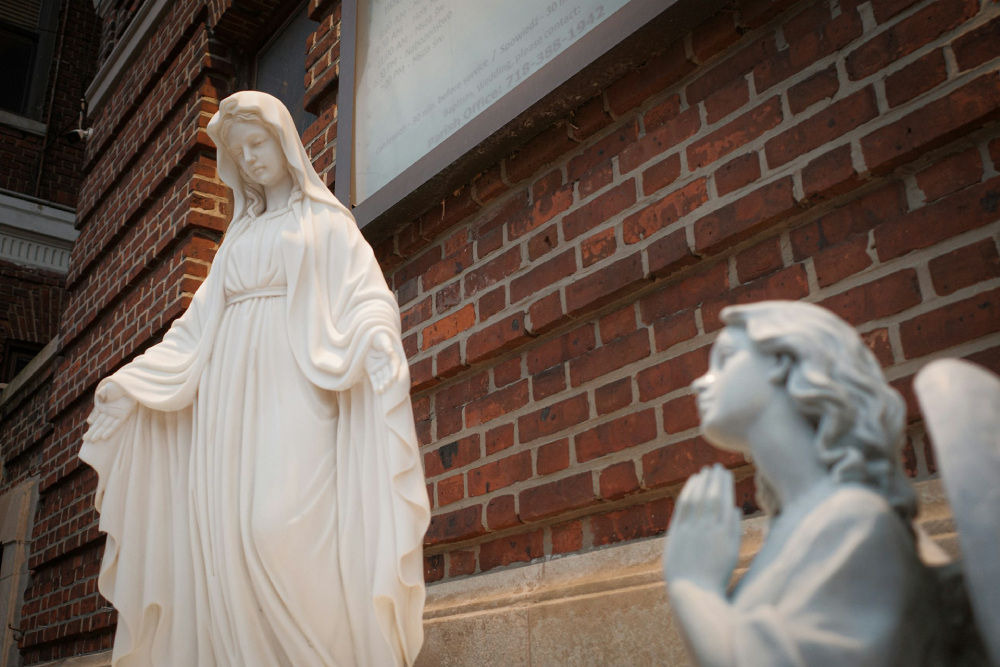
 Unsplash/Qihai Weng)

BY DIANE SCHARPER
Join the Conversation
Send your thoughts to Letters to the Editor. Learn more

Mary is arguably the most notable woman in history. Billions of Christians and Muslims alike honor her memory. Yet there is little information about her in the New Testament, and what is there has been shaped for a story about Jesus, the apostles and the early church. So who is this woman revered by half the world?
A brand new book attempts to answer that question.
In The Lost Mary: Rediscovering the Mother of Jesus, James D. Tabor demythologizes Mary, inviting us to consider her through an historical, critical lens. A retired professor and an archeologist, Tabor is the author of numerous articles and 10 books focusing on Judaism and early Christianity. Like author and scholar John Dominic Crossan, Tabor sees the historical Jesus and Mary as part of a political dynasty and of royal lineage, and translates many incidents in the New Testament as theological statements rather than literal recountings. (For example, the virgin birth as a metaphor for holiness and not a physical reality.)
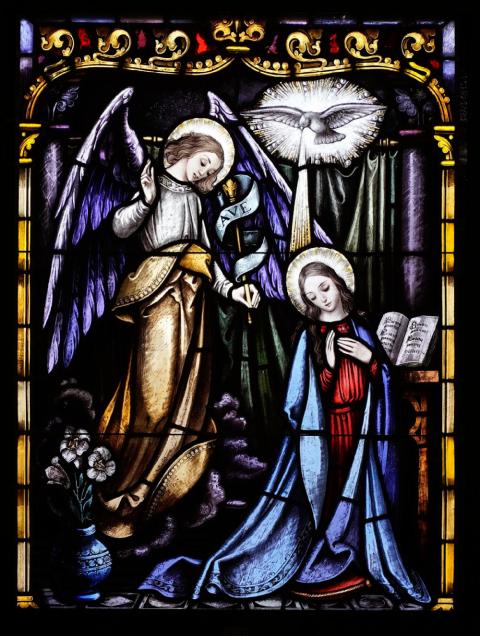
The appearance of the angel Gabriel to Mary proclaiming that she is to be the mother of Jesus is depicted in a stained-glass window at St. Therese of Lisieux Church in Montauk, N.Y. (OSV News/Gregory A. Shemitz)
Using the Bible, the writings of Josephus and a small number of other historical documents, Tabor draws speculations that are thought-provoking, if at times lacking in enough factual evidence to convince.
Mary (or Miriam, in Hebrew, or Maryam in Aramaic, the language spoken at the time of Jesus) was the daughter of Anna and Joachim, whom many Catholics are familiar with. Less familiar are Tabor's assertions that Mary was born in 19 BC into a fairly wealthy family who owned property and livestock in Sepphoris, about four miles from Nazareth — or that, as a descendent of King David and of Levi, the first high priest of Israel, she was "doubly royal."
The Lost Mary specifically examines the years between 167 BC and 135 AD and focuses on the conflicts raging between Jews and Romans, showcasing the various aspirants to the title of "King of the Jews" — including Herod the Great and family, who were willing to even kill their own offspring for the title. Tabor does a compelling job of discussing how these conflicts might have affected the political atmosphere of the time, as well as the mindsets of Mary, her parents and her son Jesus.
Tabor argues that after Mary's death, early Christians reshaped Jesus’ message that the kingdom of God had arrived on earth into one about finding salvation in heaven. This change, he believes, reached a climax in 431 A.D. during the Council of Ephesus, when Mary's identity as a Jewish woman took a back seat to her identity as the Theotokos, or God-bearer.
ADVERTISEMENT
The book's final chapters describe early Christianity's diminishment of Mary’s role in the founding of the religion, even as she was exalted as the Queen of Heaven. Christians increasingly emphasized the divinity of Jesus and placed Paul and Peter at the helm of the Jesus movement, according to Tabor, downplaying Mary in the process. Tabor believes that the leadership role of James, controversially identified in Scripture as the "brother" of Jesus, was also diminished. He refutes the explanation offered by many Catholic theologians that the word used for "brother" can also mean "cousin." In fact, Tabor contends that Mary had eight other children by Joseph, but is unable to provide definitive proof for these assertions.
Paintings of Mary dominate major museums throughout the world, from the National Gallery of Art in the United States, to the Prada in Spain, to the Louvre in France. Botticelli and Raphael show her "bathed in a heavenly light," and yet her factual story has been erased from history. In its place, the church has molded her into a "passive, nonsexual, nonpolitical woman." However mysterious the truth about her life might be, that mold, Tabor rightfully insists, does her a disservice.
ADVERTISEMENT
ADVERTISEMENT
Most Read Stories


ADVERTISEMENT
ADVERTISEMENT
Latest News

From pulpit to picket line: Religion and labor rights long connected in coal country

From Fisk Jubilee Singers to megachurch hits, new museum celebrates Christian music

Cardinal says joy over Israel-Hamas ceasefire overshadowed by 'pain' of loss in war

No comments:
Post a Comment