My Response: I appreciate Jamie Manson's reflection that makes a direct connection between the institutional church's ban on women's ordination and poverty, violence, abuse and injustice toward women in society. The hierarchy's oppression of women violates the human rights and God given call of women to live as spiritual equals in every area of life. Until the institutional Roman Catholic Church changes its teachings, women will continue to be treated as second class citizens in the world. The full equality of women must encompass equal rights and equal rites! Human Rights is Equal Rights! Bridget Mary Meehan ARCWP, https://arcwp.org
Unsplash; Sash Freemind
Jamie L. Manson NCR Article
..."In those pieces on women's equality, I made a direct connection to the ways in which the church's teachings on women reinforce women's disproportionate suffering from starvation, violence, poverty and lack of education. "How will women ever see true equality when the hierarchy teaches that even God believes that a woman's body is inadequate and invalid when it comes to possessing certain forms of power?" I asked then. I won't ever stop asking.
I've also kept a close watch on the U.S. bishops' unfolding exploitation of the concept of religious liberty, beginning in 2012 when they attempted to block the contraceptive mandate in the Affordable Care Act — and succeeded to an unfortunate degree. Their wins keep mounting in the courts, thanks to the Becket Fund and its avatar, the Little Sisters of the Poor.
I have continued to speak out against the church's ban on all artificial contraception, even though many colleagues have told me "that ship has sailed" because Catholics have rejected the teaching. My columns on the sufferings of the people of the Philippines demonstrate that this ban has life-or-death consequences. Filipino bishops spent 15 years on the courts trying to block the Reproductive Health Act, which only exacerbated sickness, poverty and environmental destruction in the country.
My research and writing on the Philippines transformed my priorities as an activist and helped me see more clearly that, around the world, untold numbers of women and other vulnerable people have suffered serious health consequences and even death as a direct result of not having access to contraception, abortion and sexual education. Too often, the denial of these services is a direct result of Catholic doctrine and the policies of Catholic health services.
I have discussed this often in my column, but in recent years this reality has disturbed my inner peace to the point that I feel called to dedicate all of my energy and my gifts to fighting back on these issues specifically.
This weekend's nomination of Amy Coney Barrett to the Supreme Court makes my new work at Catholics for Choice particularly urgent. Barrett is staunchly anti-abortion and a member of a charismatic Catholic movement that requires strict gender roles, like the submission of a wife to her husband as her "head." Even though the majority of Catholics in the U.S. believe that abortion should be legal in all or most circumstances and 68% believe Roe v. Wade should not be overturned, few are willing to speak publicly about it. The anti-abortion movement has created such an all-consuming atmosphere of taboo and shame around the issue that they have effectively silenced Catholics who support abortion rights.
But there are far more of us than there are of them, and I hope in my new work I can help create space for Catholics to be educated about the nuances and to empower them to speak honestly and without fear of retribution. This issue alone is the reason we may have another Trump presidency. We have to take the risks of having these crucial conversations and standing together against the global oppression of women..."
"It may be tempting to focus primarily on Amy Coney Barrett’s membership in People of Praise. But we shouldn’t. As a Catholic, I find that organization to be concerning and her involvement, maybe also concerning. Its charismatic practices are certainly out of line with mainstream Catholicism. And its, authoritarian, often cult-like operation raises important questions, especially when one considers its view on wifely submission to her husband. Her involvement raises questions that do need to be discussed that will be touched on below. As someone who attends Mass on a regular basis, I do not see that within the creed of my Church.
But the main issue before us is, would an Associate Justice Barrett use her position to deny religious freedom to others?
The issue with the Barrett nomination for me as a Catholic is quite simple: I choose to dissent from my Church on certain issues such as choice, birth control and embryonic stem cell research. Judge Barrett, on the other hand, follows a more orthodox approach to the Church. That is her right to do so. It is also the Church’s right to set such doctrine. But what concerns me is that she may use the power of the federal government to impose her particular Catholicism, one that is clearly not in sync with most American Catholics, on me and those that share my faith who look to the government to shield me from the excesses of Church hardliners.
A number of my co-religionists, the ones who are anti-choice have a peculiar habit of looking at the issue of abortion only through the lens of orthodox Catholicism. What of a SCOTUS justice that sees abortion as “always immoral”? That sounds like someone that is primed and ready to substitute her Church’s particular teaching on the matter as the only true religious position on the matter.
Of course, the Vatican view is not the only religious view on this.
There are numerous Christian denominations, not to mention other religions that are pro-choice on a theological basis as there are other religious denominations that believe that abortion is a matter of individual conscience. And yet there are other denominations whose position is more complicated. Different faiths and denominations disagree on abortion.
For example, in Judaism when a mother’s life is endangered by a pregnancy, it is Jewish law that the mother’s life, a life in being, takes precedent (as a Catholic, I would posit that there is a strong presumption that Jesus, being Himself Jewish, would accept this position). Would an Associate Justice Barrett rule that a pregnant Jewish woman who will risk death if the pregnancy is carried through be denied an abortion? If that would be her ruling, then she can no longer claim the mantle of religious freedom, but of religious supremacist.
And therein lies the conundrum. The Jewish (or any similarly situated) woman would be having a late-term abortion. Would a Justice Barrett deny that woman the life saving procedure? In a law review article she co-authored while teaching at Notre Dame Law School, Judge Barrett grappled with whether a Catholic federal judge could recuse herself in death penalty cases. Catholicism is opposed to the death penalty. In her justification she tried to distinguish death penalty cases from either abortion or euthanasia by stating, “We might distinguish between executing criminals and killing the aged and the unborn in this way: criminals deserve punishment for their crimes; aged and unborn victims are innocent.”
But this statement is too open-ended to be conclusive. After all, isn’t the woman whose life is in danger from a dangerous pregnancy also innocent? And what of the woman who was raped and is made pregnant by her attacker? Would a justice Barrett rule that she too would have to carry to term? Again, if the answer were yes to either question, Amy Coney Barrett would not be practicing religious freedom, but religious supremacy.
At the heart of the abortion question for the orthodox Catholicism is the belief that life begins at conception. But the bigger question is, at what point does an individual human exist? Initially, an embryo can either split into two separate embryos or even merge with another embryo to form a singular embryo. And the embryo itself contains what will be discarded as the placenta – something that is objectively understood not to be a distinct human life.
That is not a position of science, but a position of both faith and of specific creed. For Jews and Muslims, the first forty days an embryo’s existence has the equivalence of water: it is not considered an individual human being. Ask any objective doctor when a human being first exists and you will be told that science cannot provide an answer to that question. The answers to these questions matter as they go to both access to legal birth control and stem cell research.
Briefly, with regard to Judge Barrett’s involvement with the group People of Praise, it should be noted that this is not a Catholic organization but an ecumenical group that has members of various Christian denominations. The issue here is one of hierarchical submission. We know the organization advocates submission of the wife to the husband. Will that impact in any way upon her decision-making? But that opens the door to other questions. Does the husband, in turn, answer to someone or some group above him that instructs him how to instruct his wife how to act in positions of public power? These are questions we do not have the answer to. Indeed, while there may be nothing of concern the question still needs to be asked.
Again, would an associate justice Barrett impose her personal religious interpretation of when life begins upon all Americans?
And it is fair to ask these questions of her. After all, she herself has opened the door on the application of her faith to her judicial decisions. Judge Barrett may claim that she is exercising religious freedom but in reality she is imposing her interpretation of faith on the American people and that is the exact opposite of religious freedom.
In the end, this is about reciprocity. As a Catholic, and an American, I am obliged to respect the religious views of others, and I oppose the imposition of our faith (and its variants) by Catholic members of the judiciary on my fellow, non-Catholic Americans. If a Catholic justice of the U.S. Supreme Court were to impose on all other Americans her specific religious views on such a personal issue as reproductive rights, that would be a reckless confirmation of the anti-Catholic bigotry spewed when Catholic ethnics first started arriving on these shores in significant numbers. The fear was that they would make non-Catholics subject to their particular teachings.
Let’s not go there."
My Response: The RC Church is comprised of 1.3 billion members. We the people of God are the Church, not the hierarchy alone. Vatican ll defined the Church as the people of God.
Judge Barrett does not represent the mainstream Catholic perspective on reproductive rights including contraceptives, If Judge Barrett, as Supreme Court Justice imposes her deeply held religious beliefs on everyone in the United States, including the anti-contraception teachings of the Roman Catholic hierarchy, the primacy of conscience and religious freedom of people from diverse faith traditions on moral issues and no faith tradition would be destroyed. Bridget Mary Meehan ARCWP
In his Sunday Meditation today, "Mystics and the Margins", Richard Rohr writes about ordinary Catholics who "take their small and sufficient place in the great and grand scheme of God by “living on the edge of the inside.” They build on the solid tradition (“from the inside”) but from a new and dynamic stance (“on the edge”) where they cannot be co-opted by a need for security, possessions, or the illusions of power." (Sunday, Sept. 27, 2020)
From its beginning when seven courageous women were ordained priests in 2002 on the Danube River to today with over 275 members, the Roman Catholic Women Priests Movement offers hope to 1.3 billion Catholics who comprise the membership of the Church. The women priests are a visible expression of women's equality that is now a reality in an ordained ministry on the inside edge of our community of faith.
Even though the women priest initiative is marginalized by the condemnation of the institutional Church, we choose to live on the margins and provide women the option of living their call to ordination in public ministry on the inside edge of Catholicism. We offer a renewed model of priestly ministry rooted in the solid foundation of the prophets and mystics who have gone before us.
Grounded in the faith of mystics and prophets, we follow the example of Jesus who called both women and men to ministry around an open table where everyone is welcome at the extravagant feast of divine love. On the "inside edge of Catholicism," our movement is deconstructing medieval practices and reconstructing sacramental rituals that are meaningful for contemporary Catholics. Some examples are: In inclusive liturgies, the entire assembly is often invited to share in the homily and to pray the Eucharistic Prayer. In the celebration of baptism, parents are invited to take an active role which can include pouring the water over their child's head as the priest prays the formula. When a community gathers to anoint the sick, often a loved one anoints the forehead and hands with sacred chrism as the entire group prays for healing and wholeness. At ordinations, the bishop lays hands on the ordinand and so does the entire assembly and/or representatives of the community.
There are no punishments, excommunication, or man-made laws that can stop our Spirit-filled movement for women's equality in the Church. As we move forward with love and faith, we are moving mountains in a "holy shakeup" that will reverberate through history for centuries to come!
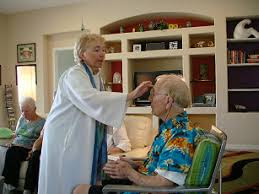
Welcome! This morning we will begin with an anointing of our brother Dennis as he prepares to have surgery tomorrow. It is right and faithful to anoint our brother because we are all companions in this journey of life. Our liturgy today will highlight this theme. The kindom is created here and now if we but live what we say we believe.
Dave: We will now anoint Dennis as he prepares for his healing journey.
Donna: Blessed are you, Loving Spirit, the boundless love of Your presence blesses us at every moment of our lives.
Your compassion radiates through each of us and brings the blessing of Your healing, tender touch to Dennis.
Kim: As we pray for you, Dennis, we pray also for your medical team. May they be guided by Holy Wisdom.
Deven: Dennis, the same Spirit that moved in Jesus, dwells in you and fills you with love and peace beyond all imagination. All of your loved ones in this community and in the Communion of the Saints join you in prayer.
Mary T:In their name and in the name of the Holy One, we now anoint you, dear Dennis for your journey.
All extend hands toward Dennis. Jeanne anoints Dennis’s forehead and hands as the following is read:
Dave: May the power of Divine Love within you, heal, comfort, and strengthen you. Amen.
Prayer for Presentation of Prayer Shawl: Margaret Dilgen:
Dear Dennis,
The Upper Room Inclusive Catholic Community presents you with this prayer shawl and we pray:
O loving one, renew Dennis this day in your love.
Grant him life as a gift of your faithfulness.
Grant him light to journey by,
Grant him hope to sustain himself.
May this mantle be for Dennis a sign of your healing presence.
May it warm him when he is weary.
May it surround him with ease of his suffering.
Dennis, receive this shawl.
Curl it around you,
Close it over you,
And enter into
The warm peaceful quiet stillness of God's love.
Amen
LITURGY OF THE WORD
Readings
Joan: First Reading
Matthew 21:28-32
Jesus said to the chief priests and elders of the people:
“What do you think? There was a landowner who had two children. The landowner approached the elder and said, ‘My child, go out and work in the vineyard today.’ This first child replied, ’No, I won’t,’ but afterwards regretted it and went. The landowner then came to the second child and said the same thing. The second child said in reply, ‘I’m on my way,’ but never went. Which of the two did what was wanted?”
They said, “The first”
Jesus said to them, “The truth is, tax collectors and prostitutes are entering the kingdom of God before you. When John came walking on the road of justice, you didn’t believe him, but the tax collectors and the prostitutes did. Yet even when you saw that, you didn’t repent and believe.
These are the inspired words from the gospel of Matthew and the community affirms them by saying: Amen
Tim: Second Reading
Philippians 2:1-11
If our life in Christ means anything to you-if love, or the Spirit that we have in common, or any tenderness or sympathy can persuade you all—then be united in your convictions and united in your love, with a common purpose and a common mind. That is the one thing that would make me completely happy. There must be no competition among you, no conceit, but everybody is to be humble: value others over yourselves, each of you thinking of the interest of others before your own. Your attitude must me the same as that of Christ Jesus:
Christ, though in the image of God, didn’t deem equality with God something to be clung to— but instead became completely empty and took on the image of oppressed humankind: born into the human condition, found in the likeness of a human being. Jesus was thus humbled— obediently accepting death, even death on a cross! Because of this, God highly exalted Christ and gave to Jesus the name above every other name, so that at the name of Jesus every knee must bend in the heavens, on the earth and under the earth, and every tongue proclaim to the glory of God: Jesus Christ reigns supreme!
These are the inspired words from Paul’s letter to the Philippians and the community affirms them by saying: Amen
Dennis: Gospel Acclamation
Alleluia
Margaret: The Third Reading
The early church taught that paradise was a place, a way of life, even an ecosystem. The church, as a community that dispensed the “medicine of life,” nourished human life in paradise. This was a place where strengths, weaknesses, needs, and contributions of each member could complement each other. Their life in paradise was a shared accomplishment in which the exercise of human powers and the imperatives of human need worked together to save and sustain life. People could come to see the value of their own lives and learn that their actions mattered to others, to see power in a personal sense of agency. They could learn to negotiate power and its responsible use for the good of the whole. Heavy burdens and difficulties that might have crushed individuals could instead be borne on the shoulders of many.
Christians were instructed to be the earthly manifestation of God. Like Jesus, they were to become fully human and fully divine. A Jewish peasant carpenter and teacher had revealed God, and he had left the Holy Spirit with his community. Christians shared a power that nothing could destroy, a power that affirmed the freedom and dignity of humanity and grounded their work for justice; they did not await the arrival of justice. The church offered marginalized and privileged people alike the power of divinity and supported them to live together as gods in paradise here and now.
These are the inspired words adapted from Saving Paradise by Rita Brock and Rebecca Parker and the community affirms them by saying AMEN.
Shared Homily
The gospel reading is one that has been described by scholars as perplexing, partly because Jesus does not answer the question that is posed re: which son was the more favored. Also, scholars have expressed doubts that this story was actually told by Jesus. Nonetheless, there does seem to be some agreement that the story is intended to highlight the importance of having our words match the actions we take.Jesus’ reminder to the chief priests and elders that the tax collectors and prostitutes would have an easier time reaching the kingdom suggest that he is not impressed with those who say the right things. Instead, fulfillment comes to those who believe and act on those beliefs. Donna and I, in discussing this reading, agreed that when there is congruence between what we say and how we act, we experience an inner peace as we live out our true selves.
If the gospel is about moving beyond words into actions, the two readings that follow are about the nature of those actions. Notice that Paul, who is writing to the Philippians from prison, asks them to be united in their conviction to a common purpose. He asks them to avoid ego and competition, both of which would detract from the important work that must be done. He encourages them to stand with the oppressed, embrace the human condition, as Jesus did, and remain united in love.And the reading from Brock and Parker confirms that members of the early church did live this way because they knew that paradise was not some far off distant hope that would have to be earned if only they could be good enough, but rather it was right there in front of them--mother earth. The authors also note that members of the early church did not await justice; they worked bravely for it as a way to protect paradise and make it a reality for all. That paradise still is right here in front of us and still needs us to protect it and extend its reach.
In all honesty, it can be more than difficult to see the world, in its present state, as paradise. Literal storms rage with hurricanes in the south and wildfires in west.And different kinds of storms sweep across the nation -one of racial inequality and prejudice and another that continues to threaten our health and well-being.But now more than ever we cannot lose our conviction. Now more than ever we need to, as Paul asks us, take on Jesus’ attitude in humbly valuing others in order to remain true to the gospel message and to the paradise that we have been gifted.
Finally, as I was reading the description of the early church members and how they lived out their faith, I was reminded of this community. We are clearly being guided by the Spirit and although these times are challenging, we are not doing this alone; we have each other and the spirit and together we will continue to do what we can to sustain our brothers and sisters and our world.
Statement of Faith
We believe in the Holy One, a divine mystery beyond all definition and rational understanding, the heart of all that has ever existed, that exists now, or that ever will exist.
We believe in Jesus, messenger of the Divine Word, bringer of healing, heart of Divine compassion, bright star in the firmament of the Holy One's prophets, mystics, and saints.
We believe that We are called to follow Jesus as a vehicle of divine love, a source of wisdom and truth, and an instrument of peace in the world.
We believe in the Spirit of the Holy One, the life that is our innermost life, the breath moving in our being, the depth living in each of us.
We believe that the Divine kin-dom is here and now, stretched out all around us for those with eyes to see it, hearts to receive it, and hands to make it happen.
Dave: As we prepare for the sacred meal, we bring to the table our prayer of intentions:
Dave: We pray for these and all unspoken intentions. Amen.
Donna: With open hearts and hands let us pray our Eucharistic prayer in one voice:
O Holy One, you are always with us. In the blessed abundance of creation, we gather to celebrate Your nourishing gift of life. May our hearts be open as You invite us to participate in the wise and wonderful work of co-creation. May we be ever aware of Your Spirit within and among us as our world unfolds amid pain and beauty into the fullness of life.
We are grateful for Your Spirit whose breath inspired the primal waters, calling into being the variety and abundance we see around us. Your Spirit sustains and animates our every endeavor, inviting us to act in wisdom and in truth.
In gratitude and joy we embrace our calling and we lift our voices to proclaim a song of praise:
Dave: As a community, we gather in the power of your Spirit, refreshing wind, purifying fire and flowing water, for the variety and diversity of Creation. We seek to live as Jesus taught us, wise and holy as Spirit-filled people, courageous and prophetic, ever obedient to your call.
Please extend your hands in blessing.
We invoke Your Spirit upon the gifts of this Eucharistic table, bread of the grain and wine of the grape, that they may become gifts of wisdom, light and truth which remind us of our call to be the body of Christ to the world.
On the night before he faced his own death, Jesus sat at the Seder supper with his companions and friends. He reminded them of all that he taught them, and to fix that memory clearly with them, he bent down and washed their feet. When he returned to his place, Jesus took bread, gave thanks and offered it to them saying:
All lift their plate as the community prays the following:
Take this bread and eat it;
This is my very self.
(consume bread and pause)
All lift their cup as community prays the following:
Donna: Jesus then raised a cup of blessing, spoke the grace and offered the wine saying:
Take and drink of the covenant
Made new again through my life in you.
Whenever you remember me like this,
I am among you.
(drink and pause)
In union with all peoples living and dead, we unite our thoughts and prayers, asking wisdom to discern more wisely your call to us in the circumstances of our daily lives.
We seek to act justly and courageously in confronting the suffering that desecrates the Earth and its peoples; to take risks in being proactive on behalf of the marginalized who suffer the environmental injustices of fouled air, tainted water, and a poverty of parks and public spaces that bring people together to enjoy nature. We pray for inspiration to act with the harmony and unity and synthesis that is modeled for us by the trees of the forest, and the stars of the evening.
Holy One, your transforming energy is always moving within us and working through us. Like Jesus, we will open up wide all that has been closed about us, and we will live compassionate lives,
for it is through living as Jesus lived, that we awaken to your Spirit within,
Moving us to glorify You, O Holy One,
At this time and all ways.
Amen.
Dave: Let us pray as Jesus taught us with an eye toward this Season of Creation:
Generous Creator, the intricate and elegant biodiversity of our world is your hallowed autograph on our lives, on our souls and in our hearts.
We yearn for the wholeness of being in harmony with Your will and with all living things.
Each day we draw on your creative, life-giving energy with gratitude and awe as we find nourishment in, seed and field, river and forest.
May we be stewards and co-creators with you in caring for the gifts of Your Creation.
We acknowledge our shortcomings, especially our neglect of the environment on this Creation Sunday. We seek to be reconciled with those we have hurt and we resolve to do better.
With your unfailing wisdom and the wind of Your Spirit, inspire us that we may reach out and love one another and care for the world, our home.
Strengthen us to work for local and global justice so that we may one day reap a harvest of equality and fairness as if they were wildflowers, propagating spontaneously, unerringly and in surprising abundance. Amen.
Donna: We are called to live the Gospel of Creation in harmony and gratitude with all our sisters and brothers across the Earth. We will live justly, love tenderly and walk with integrity in Your Presence.
Communion song: The Voice by Celtic Woman
https://youtu.be/BxGE65pn2vg
Donna: Let us pray together our closing blessing:
Creator most generous and kind, your gift of Earth and sky reveals your omnipotence and glory. May we go forward boldly to live in the glory.
May we treat all of Creation as sacred and discern the best path to an equitable distribution of the resources we share with our sisters and brothers across the globe. Let us live as if the future depends on it. Amen.