Translate

Wednesday, October 18, 2023

Closing of Lay Led Assembly by Victirino Pérez Prieto

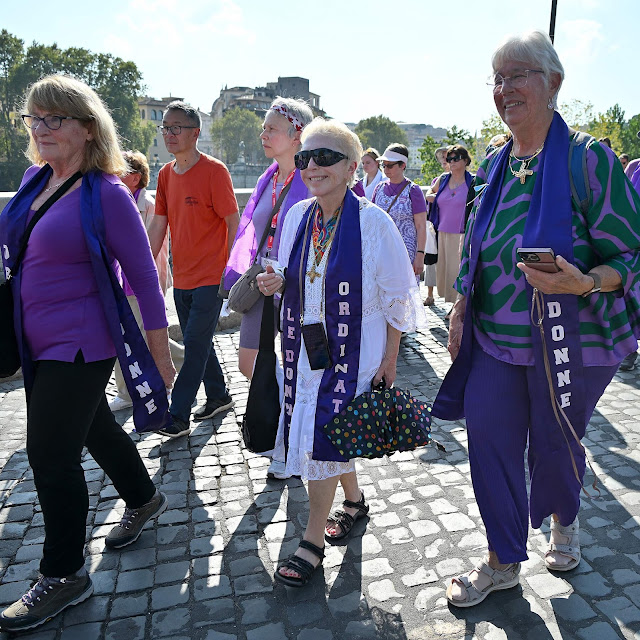
It was a joy to be at this alternative lay-led Synod that was broadcast around the world and to meet courageous leaders of Catholic organizations dedicated to promoting human rights and equality in the Church. See this wonderful article featuring some highlights of this historic Synod written by Victorina Pérez Puerto 
 
Joan Chittester: “The Church has to change, change, change!”

Closing of the 'Shadow Synod': “Shut us up!”

Closing of the alternative Synod

The meeting bears the significant title of “Human rights in an emerging Catholic Church”, convened by the international organization Spirit Unbounded (“Spirit without borders”), with the support of more than forty Church organizations

One of the participants was a prominent person: Raúl Vera , bishop emeritus of Saltillo (Mexico), collaborator of Samuel Ruiz in Chiapas and one of the critical episcopal voices in the Latin American Church

“The fundamental challenges of society today are the humanization of human rights and the Christianization of the Church,” said Chittister.

Mary McAleese:  "The Church is not credible because it is not transparent"; in this way, it is not consistent with the message of its Master.

The  Lay-led Synodal Assembly” or “Shadow Synod” has concluded its meeting at dusk on October 14 with these words from Joan Chittester and Mary McAleese with which I title my post, two of the most valuable women in the Church, although it was not wanted to include them in the Vatican Synod, or Synod of Synodality, described as an open and participatory path for the entire Church, in the spirit of Francis.

The first is a well-known Benedictine nun, former university professor and renowned international lecturer, one of the most prominent North American Catholic theologians, with more than fifty published books, some of them bestsellers published in several languages. The second is a Catholic laywoman, with a doctorate from the Gregorian University, former professor and former chancellor of Trinity College Dublin, and former president of Ireland. Both lucid, critical and free women in the Church.

We give you 'RD Report – Keys to the Synod of Synodality'

Although my previous article has provoked very critical and even insulting comments from the usual intolerant ultras - some of those insults have had to be eliminated by the moderator of these blogs -, although I also received words of gratitude through other means, I continue to speak of this superb meeting in Rome - whose program I have already spoken about in a previous post -. The meeting bears the significant title of “Human rights in an emerging Catholic Church” , convened by the international organization Spirit Unbounded (“Spirit without borders”), with the support of more than forty Church organizations known especially beyond our borders (WOW , WOC, ARCWP, CfCh, Donne per la Chiesa... ) and some Spanish ones like Redes Cristianas. This name has come in handy for this alternative Synod, in which we have heard words said with peace, but with energy, with freedom interior and exterior.

It's a shame that everything took place in English, with the difficulty it poses for Spanish-speaking people who do not know that language and without being able to have simultaneous interpretation, due to the precariousness of the media; I hope it will be taken into account on another occasion, because it may have been one of the reasons why only two Spaniards participated (my wife Christina, an interpreter who has been a great help, and I) and some Hispanic Americans. One of them is a prominent person: Raúl Vera , bishop emeritus of Saltillo (Mexico), collaborator of Samuel Ruiz in Chiapas and one of the critical episcopal voices in the Latin American Church, with whom I had the opportunity of a conversation that will appear here in a few days.

Meeting organizations

Although most of the talks and debates were online since last Sunday the 8th (with participation by prominent theologians such as Leonardo Boff and Diarmuid O'Murchu and others), on the 13th-14th there was the face-to-face meeting simultaneously in Rome and Bristol , as well with some notable people.

There were interesting conferences by specialists on women in the Italian Church (Dora. Paola Lazzarini ), in the German Church (Dora. Claudia Nothelle ) and in the Zimbabwe Church ( Martha Musonza ); others on the female disciples of Jesus with two English specialists from the universities of Edinburgh (Dora. Helen Bond ) and King's College London (Dora. Joan Taylor ), on sexual scandals in the Church (Dor. Luca Badini ), and conferences such as “Who and what we miss in the Synod and why” ( Jamie Manson ) or “We have already won”, by Dora. German Martha Heizer , co-founder of We Are Church, which was sanctioned years ago in the Church: “We do not need,” she said, “for the Church to teach us how couples should love each other.”

Bridget Mary Meehan , American and Irish bishop and theologian with numerous publications, spoke hopefully of her Association of Women Priests in the Catholic Church (ARCWP), which already has an important group not only of priests but also of bishops.

Bishop Bridget Mary Meehan

The two most important conferences were given by the two women I mentioned at the beginning. Joan Chittester spoke about “Living the discipleship of equals” . She began by saying with humor that she did not want to come to Rome, because she was afraid that what happened to Jesus of Nazareth would happen to her, that she did not want to go to Jerusalem either, because she was afraid that what happened to her would happen to her... But she did. In fact, she got into serious trouble with the hierarchy more than twenty years ago for participating in the first major meeting of the WOW (Worldwide Network for the Ordination of Women).

“The fundamental question is what do Church communities really need?” he said at the beginning. And the answer was resounding: “The Church has to change, change, change!” He told a well-known anecdote about a girl whose mother took her to church one day, and when she saw that there were only men leading the celebration, she asked why it was like that; and her mother responded: “It's just that in the Church those who lead are only men.” And the girl answered: “Then what are we doing here?”

Christina Moreira and J. Chittister

“The fundamental challenges of society today are the humanization of human rights and the Christianization of the Church,” said Chittister . "Because," he continued later, "the Church is seriously failing with all the people with whom it should not do so: children, women, minorities, the marginalized and the poorest... Those most hurt by society." She is demanding true equality between women and men in the Church, with access to ordained ministries.

The Christian commitment - he repeated - is to live as disciples of Jesus and be consistent with it; that is, “living the way he lived: free and committed to the most marginalized.” The Church today has to find the path of true discipleship: for herself, for women and for everyone, being “consistent with baptism . ”

For her part, Mary McAleese titled her long and lively talk, very critical of the current Church hierarchy , “The discipleship of equals is denied ” She began with a resounding phrase: “All inequalities scandalize Christ,” and this especially affects the largest religious institution in the world, with a seat at the UN: the Catholic Church. This must change above all in being faithful to the equality that the discipleship of Jesus Christ entails. And also in other aspects. “The Church is not credible because it is not transparent”; In this way, it is not consistent with the message of the Master of it.

However, this discipleship of equals does not even appear in the Instrumentum laboris of the Vatican Synod. Even praising Francis' courage in defending the poorest and creation, McAleese was critical of him because that is not the case in the Church and he does little to change the face of this patriarchal and sexist Church. She went so far as to say: “Despite his fresh spirit and his innovative statements, Francis's theology ends up being sexist, unjust and violating human rights in the Church, by denying the real equality of women in it.”

Former president of Ireland

Both women had the final debate with questions from people who were participating in Rome and Bristol . They gave us phrases like:

“At the Synod they ended up talking about what should be talked about in it, instead of talking about what they already received from the communities,” although there were brave words like those of the German delegation (McAleese). “The authentic discipleship of Jesus is not submissive obedience, it is being critical like him of all the injustices and patriarchal inequalities… This is what the Apostles did, they imprisoned them and they announced the message again”; “We are like an army of soldiers who carry an atomic bomb, but do not pay attention to them”; “Explain to the people why you have come here and what we have talked about, that will change things in the Church”; “What we do here is very different from what they are doing in the Vatican Synod”; “A synodal Church is a Church that really listens and that does not remain silent, silencing questions” (Chittister). McAleese added harsh words about the lack of this communication that kills the Church: “What is out there is the empire of fear.”

Former President of Ireland M. McAleese

To the question of a journalist The Synodal Times , a newspaper created for the occasion, about whether “Pope Francis is “taking away with one hand what he gives with the other,” the former president answers: “ The Pope is only willing to change what that can change, which is little; It seems that he is more concerned about being loved, that's why he says what people want to hear " ; “The Pope is about to swim and put away his clothes (or “give one of lime and another of sand”, a traditional translation of the expression used by “flip flop pope”)… Nobody knows what he really thinks… Although in this way he has created a space so that the Spirit may express itself.” Chittister finished with the hopeful words of the old Bob Dylan song: “Times are changing… And they will change more if we think and decide for ourselves… Don't be silent!”

alternative synod
alternative synod

Prayers for Peace and Justice in the Middle East and in Ukraine


Let us pray day and night for peace and justice for all the people in this horrific war in the Middle East and in Ukraine.

Peace in the Middle East

God of mercy and compassion,
of grace and reconciliation,
pour your power upon all your children in the Middle East:
Jews, Muslims and Christians,
Palestinians and Israelis.
Let hatred be turned into love, fear to trust, despair to hope,
oppression to freedom, occupation to liberation,
that violent encounters may be replaced by loving embraces,
and peace and justice could be experienced by all.

- Reverend Said

Bring Justice and Peace

God of all creation, bring justice and peace to our world.
Teach us to be peacemakers. Guide us in our pursuit of
justice and the common good. Inspire us to welcome all, forgive
all, and love all. Direct us as we walk in the shadow of Jesus: the
Way, the Truth, and the Life. Inspire us to perceive the world
through your eyes, that we might find hope and joy each day,
supportive of each other.


Father and Mother of All Mercies

Father and Mother of all mercies, we pray for the families who have fled their homes in fear. We lift up the mothers and fathers who have escaped with only their children, leaving everything else behind. Their country has changed, their lives will never be the same and they are afraid of the future.

You are the God who heals. Please bring your comfort and healing to those who are hurting.

We lift up the communities who have taken in refugees and displaced people, even though they may be struggling themselves. We thank you for their generosity and compassion towards those in distress.

Holy One, you are the God who provides. We pray that timely help and support will reach all who are in need.

Father/Mother God, there is so much pain and conflict across the Middle East. We pray for leaders throughout the region and ask you to turn their hearts towards peace. As our leaders and those around the world consider how to respond, please grant them wisdom and insight.

Jesus, you are the Prince of Peace. We pray for an end to the violence and bloodshed, and ask you to bring a new dawn of peace across the Middle East.


Saturday, October 14, 2023

Bridget Mary Meehan ARCWP: Presentation on Roman Catholic Women Priests at People’s Synod in Rome sponsored by Spirit Unbounded Topic : Living Gospel Equality and Inclusivity Now Oct. 13, 2023


Living Gospel Inclusivity and Equality Now


Drawing by Gary Harness

Bishop emeritus of Saltillo-Mexico Raul Vera was present for this presentation. I had a wonderful conversation with him about our movement.


Secretarial international pot la solidaridad con Los pueblos Oscar Arnulfo Romero

Veraraul@me.com

Secretary: jcampbel@me.com Jacqueline Campbell 


By Living Gospel Equality and Inclusivity Now- Bridget Mary Meehan

(Talk in Rome for Spirit Unbounded, Oct. 13, 2023)


This lovely drawing by artist Gary Harness of a woman priest walking on water is a powerful symbol for me.  Every day Roman Catholic Women Priests face the challenge of patriarchal resistance to co-create a new model of ministry that honors the gifts of all God’s people and to provide a place for everyone at the table especially the marginalized and excluded.  


According to the story of Jesus walking toward the disciples on a stormy sea, Peter responds to Jesus’ invitation to “come” by leaping out of the boat and walking on water. (MT: 14:22-32)


Like Peter responding to the Spirit’s call, Roman Catholic Women Priests are coming out of the patriarchal boat and challenging an exclusive male priesthood by ordaining women for public ministry in a companionship of equals. 


This prophetic call has placed us on the edge of the inside of the Church as we follow the teachings and example of Jesus that sets us free to love and to set others free from laws and structures that oppress.


 “Outside the camp”, writes Richard Rohr, “is a prophetic position on the edge of the inside, which is described by the early Israelites as “the tent of meeting outside the camp” (Exodus 33:7). Even though this tent is foldable, moveable, and disposable, it is still a meeting place for “the holy” which is always on the move and out in front of us. “


In this Synod, Pope Francis has called for “enlarging the tent,” to create a Church where all are welcome. 


This is what Roman Catholic Women Priests have been doing for 21 years

We foster radical hospitality in the community of the baptized by inviting everyone to celebrate sacraments including LGBTQ+, the divorced and remarried, and all who no longer feel at home in the Church. 


I first experienced my call to ordination when I was a pastoral associate at Ft. Myer Chapel in Arlington, Virginia in the 1980’s. At that time, there was a priest shortage, so my job description included everything except presiding at Mass and sacraments. Often, when I conducted a communion service in the absence of a Catholic priest, the people would express their gratitude for the “lovely Mass.” Even though I made it clear that this was a Communion Service, they often called it a Mass. So, it dawned on me- if only- I could be ordained they would easily accept me as their priest.  And that would happen only if I left my comfort zone and was ordained in another denomination. 


Then that call to Ordination finally came. In 2005 I was invited by a group of women from different faith traditions in our Florida community to lead discussions on women in the Bible. During one of these sessions, I shared with them that I was invited to attend the first North American ordinations of Roman Catholic Women Priests, on the St. Lawrence Seaway. The women were delighted and told me that not only should I attend, but that I should be ordained and that they wanted me to be their priest! One woman even donated her frequent flyer miles so I could fly free to Canada. 


I was inspired by the courage of the nine women who were ordained on the St. Lawrence River in the first North American Ordination of Roman Catholic women Priests. I knew then that it was time for me to jump out of the boat and prepare for Ordination. 


On July 31, 2006 I was ordained a priest by three women bishops, Patricia Fresen, Gisela Forster, and Ida Raming.  The ordination took place in Pittsburgh, on the river boat “Majestic.” As the bishops and over a hundred people laid hands on us, I felt Spirit’s presence moving through all of us like an electrical current in what I  call- a holy shakeup!


After returning to my home in Florida, I received a telephone call from Dick Fisher asking when I was going to schedule Mass. A few weeks later, six people gathered around my dining room table to celebrate our first house church liturgy. We named our community Mary Mother of Jesus Inclusive Catholic Community (lovingly nicknamed MMOJ). 


After our local Bishop, Frank Dewane warned Catholics not to attend our Masses because they were not real Masses and did not count, our weekly gathering outgrew my mobile home. This growth led us to rent St. Andrew United Church of Christ in Sarasota for our Saturday evening liturgy. When the bishop threatened to excommunicate everyone who came to our first ordination over two hundred people filled the pews.   Every time the bishop criticized us or threatened excommunication, our community tripled in size! In my experience, hierarchical opposition to women priests sometimes has been the gift that keeps on giving! The call for the full equality of women and for gender justice is the voice of God in our times that no one can silence.


I am a member of the Association of Roman Catholic Women Priests, which is part of the international RCWP movement that began in 2002 with the ordination of seven women on the Danube. Our first women bishops were ordained by an anonymous Roman Catholic male bishop from a well- known line of apostolic succession. On April 19, 2009, I was ordained a bishop by women bishops who were ordained by Bishop X. 

Therefore, our ordinations are valid, but in violation of Church law. Canon 1024, states that only a baptized man can receive Holy Orders. 

In 2008, the Vatican issued a decree of automatic excommunication for the ordination of a woman. We reject this unjust punishment rooted in sexism. Women priests practice prophetic obedience to the Spirit by breaking an unjust man-made law in order to change it. We affirm the Church’s teaching of the primacy of conscience. Our movement offers a path toward gender justice and the healing of centuries-old misogyny in the institutional Church. 

We walk in the footsteps of heroic women saints like Hildegard of Bingen, Joan of Arc, Mother Theodore Guerin and Mother Mary Mackillop who followed their consciences and withstood hierarchical oppression including interdict, excommunication and death. 

Church leaders have reversed outdated teachings, unjust laws and harsh punishments in the past. Sometimes this happens when the person is safely dead! In Joan of Arc’s case, she was declared a saint after being burned at the stake. In our times, Pope Benedict canonized St. Hildegard of Bingen and the two formerly excommunicated nuns, Mother Theodore Guerin from the United States and Mother Mary MacKillop from Australia. Apparently, excommunication is not a barrier to sainthood! 

Women priests are renewing sacramental theology and liturgical rites by emphasizing a theology of blessing, accompaniment and community empowerment. We are turning the pyramid of hierarchical domination into open, participatory circles in which the community of believers makes decisions about ministries, spiritual programs, liturgical celebrations, and governance. 

For example, at our ordinations, after the bishop lays hands on the Ordinand, the entire community is invited to do so too. For me, the highlight of every ordination is watching the faces of people as they bless the newly ordained. In a people-empowered Church, the community is taking their rightful role in affirming the call to ordination in communities of equals. 

I will never forget seeing Marie weep after receiving communion in our house church. She said that after a hostile encounter with a priest years ago, she felt unworthy to receive the Eucharist in her parish community, but  now knew that she was accepted in a caring faith community. 


During COVID, my neighbor, Pearl, asked me to baptize her grandson, Champ, in her home. As we gathered around in a circle on her lanai, I began by affirming that Champ was loved by God from the first moment of his existence and now welcomed into the Christian community by his family and friends. I invited the baby’s mother to pour the water as I recited the words. Grandmother Pearl and the entire family participated in the anointing with oil.  


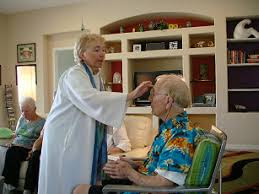
When people are sick and infirm, I gather with their family and friends in their own surrounding to celebrate the sacrament of the anointing of the sick in a communal setting, inviting others to also anoint and pray together for healing and wholeness. 


When my friend, Jack Duffy, one of the founding members of MMOJ community was dying in July of this year, his adult children asked to receive the Sacrament of the Anointing of the Sick with their Dad. As they said goodbye to Jack. I sat with the children and the dog on his bed, and cried with them. Before cremation, we gathered again to say a final farewell to his earthly remains and to affirm our eternal connection in the community of saints. 


One time I co-officiated with a Lutheran pastor at a Catholic Mass at a large wedding on Englewood Beach in Florida. Sheila, the bride, had been married three times and was not interested in jumping through the annulment hoops. Now in her seventies, she met Ed, the love of her life and wanted both the Lutheran minister and me to co-preside at a ecumenical liturgy that reflected both of their faith traditions.


In June of this year, I took care of my dear friend Peg in her home during the last two weeks of her life. Peg was a support member of the Association of Roman Catholic Women Priests from the beginning days of the movement who made things run smoothly and efficiently.  She decided that she would like to be present at her own Celebration of Life. 


So, together, we planned a beautiful Eucharistic Liturgy and invited her friends, colleagues and women priests to participate on Zoom. We sang her favorite songs, viewed a special video called “Soul Sister” that I had created for her featuring photos from different times in her life. During the homily time, everyone was invited to share tender words of gratitude and love. We saw tearful faces and heard many wonderful heart-warming stories about Peg and the impact she had on so many lives. As I anointed her body, the entire gathering held out their hands in blessing.  When Peg held up the Cup at the Consecration, she embodied the love of the feminine divine embracing and connecting us spiritually forever.


Roman Catholic Women Priests are redefining the ancient tradition of Eucharistic table sharing that builds community wherever we are including cyberspace. Like Jesus’ followers in the first centuries, we are gathering together to break open our lives, to share bread and wine in memory of Jesus, to reconcile and heal each other, and to live the Christ-Presence in our lives.

Since COVID shuttered Churches, our community has become a Church without walls. Our weekly celebration of Eucharist occurs through a live online gathering in which the priest and online community participate in a shared homily and pray the words of consecration of the bread and wine that each member brings to the celebration. Then each member of the community receives Communion in their own home. 

In our Eucharistic gatherings there has been a growing awareness that the Real Presence of Christ is experienced not only in the bread and wine that we consecrate, but also in the words we say to each other when we receive Communion: “you are the Body of Christ,” or, “You are the face of God.” The experience of the Real Presence of Christ in us is drawing us more deeply into the Divine Mystery in which we live and move and have our being beyond anything we can describe or even imagine. 

Theologians today are reimagining the Eucharist as a profound act of cosmic love in which the whole expanding universe- all the stars, galaxies, black holes, and the entire planet- are present. 

In the encyclical Laudato Si, Pope Francis wrote: “In the Eucharist, the whole cosmos gives thanks to God. Indeed, the Eucharist is itself an act of cosmic love.” 

In this mystical vision of Eucharist, the Real Presence of Christ encompasses all people and all creation in an ever- expanding act of transforming love. 

The two-year Synod -that includes women as voting members for the first time- is a positive step forward for gender justice. I hope our brother, Francis’ call for an open dialogue with the marginalized includes Roman Catholic Women Priests. 

Here we are! We are ready! 

We come from the inside edge to share our lived experiences of widening the Church’s tent by providing a spiritual home where everyone is welcome, and where justice and equality for women is a lived reality!

Come join us on this exciting journey. Get out of the boat and walk on water with us!! 


New York Times


I had a conversation with Bishop Raul Vera at the break time requesting a meeting with Pope Francis to share our stories and to lift all punishments against us. 


Sunday, October 8, 2023

From Richard Rohr- Energizing Hope


Energizing Hope


It is the task of the prophet to bring to expression the new realities against the more visible ones of the old order. Energizing is closely linked to hope. We are energized not by that which we already possess but by that which is promised and about to be given.  
—Walter Brueggemann, The Prophetic Imagination 

In 1980, Richard Rohr gave a series of talks on the Hebrew prophets. Here he speaks of the hopeful imagination to which the prophets and God invite us:  

Prophets nurture and evoke a new way of thinking. They give us images and words which subvert our system and tell us that we haven’t seen the whole picture yet. Prophets are not just concerned about social change for the sake of social change. They are concerned above all with transformation and freedom of the heart, and then out of that free heart, the prophet says, “Listen.” The prophet creates a new, freeing consciousness which allows us to hear the divine word.  

In the midst of that freedom, the prophets plant a promise, an alternative and new vision. In the Hebrew imagination, this became the promised land. But the promise never really gets fulfilled. It both tantalizes and torments us with dissatisfaction—and nevertheless calls us forward! It isn’t that God or the prophets are playing games with us. It’s that we are energized by the hope of God’s promises. What gives us the energy and power to keep moving is the promise, the dream, the vision of what could be and what’s beyond the moment. The prophet knows that, and God knows that. In the exodus, God plants the promise in Moses’ heart, and then Moses gives it to the people. 

These promises are not lies. They’re true, but they’re not always what we expect or hope for, and so God calls us a little further. This is the way that divine love stretches our hearts. This is the real rebirth. This is the way we’re reborn again and again until we enter, through death, the promise of a deeper life.  

The established and dominant culture does not have authentic promises because it seeks to maintain itself. The system has materialistic and self-protecting promises for more money and a better life; it encourages us to consume more and more. It cannot offer a promise which fills and expands the heart beyond itself to the larger world.  

God’s promises energize and expand the heart, deepening our capacity for life and our quality of being in this world. They put the authority inside us. This, finally, is the only overcoming of death, the only answer to the absurdity that this time is going to end. That’s what the promises of God do—lead us to the experience of deeper life. The Gospel writers call it resurrection.  


Adapted from Richard Rohr, The Prophets(San Antonio, TX: Catholic Charismatic Bible Institute, 1980), audio recording. No longer available for purchase. 

Image credit: A path from one week to the next—Alma Thomas, White Daisies Rhapsody (detail), 1973, acrylic on canvas, Smithsonian. Alma Thomas, Snoopy—Early Sun Display on Earth (detail), 1970, acrylic on canvas, Smithsonian. Alma Thomas, Snow Reflection on Pond (detail), 1973, acrylic on canvas, SmithsonianClick here to enlarge image

A rainbow hope, curved and welcoming, bends toward the horizon. 


The Prophetic Path 

A winding path with four tufts of grass.
 

Practice with Us

Two hands in near clasp.


Explore Further

A foldable geographical map opened.
 

Meet the Team

Three abstract portrait images connected by a hanging line.


Story From Our Community

Reading the Daily Meditations has broadened my spiritual practices beyond the dualistic thinking that I was stuck in before. This new both/and frame of mind fills me with a profound peace that has made my job as a public elementary school teacher just a little bit easier. The 2023 theme of the Prophetic Path in particular has offered me the courage to take the bold step of applying to get a Master of Divinity at Loyola University Chicago…. What touches my heart most of all, though, are the stories from other readers. I hope that everyone who has contributed their story feels the deep love and prayers from all of us strangers as we receive their experiences. When someone shares something that reflects my own experience, I feel the thread of unity between me, them, and our Living God.… As I share my own story, I am sending love to all of you reading my words today. —Loralie C.  
Share your own story with us.


Was this email forwarded to you? 
Subscribe now to the Daily Meditations.


CAC 35th Anniversary Logo
 
FacebookTwitterYouTubeInstagram
 

Sign-up for the monthly newsletter from the Center for Action and Contemplation for the latest news about our programs, including new books, podcasts, events, and online learning opportunities.

The work of the Center for Action and Contemplation is possible only because of people like you! Learn more about how you can help support this work.

If you would like to change how you receive these emails you can update your preferencesor unsubscribe from our list.