Translate

Sunday, December 3, 2023

Blanca Azucena Caicedo, ARCWP Presbytera - Priest in Colombia Led Reflection for the Elimination of Violence Against Women- "Releasing Chains of Violence Against Women"

Blanca Azucena Caicedo, ARCWP Presbytera


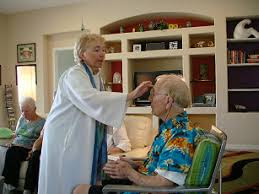
Blanca Azucena Caicedo ARCWP ( with microphone- leading Prayer Service) 


 I share with you the message that I gave at the vigil within the framework of 25N, international day for the elimination of violence against women, making visible the religious violence against women that has been carried out systematically for centuries.

On one occasion a child wanted to test the wisdom of a wise man, asking:

“If you are so wise, tell me, is what I have behind me in my hand alive or dead?”

Well... that boy had a bird in his hands and thought: if the wise man says that it is alive, I squeeze my hand and grab it, but, if the wise man says that it is dead, I let it fly.

So the wise man looked at the face of that child and sighed to respond:
“THE LIFE OF WHAT YOU HAVE IN YOUR HAND, ONLY DEPENDS ON YOU. LIFE, FREEDOM, RESPECT, GRATITUDE... ONLY DEPENDS ON YOU."


It is up to you to BE HAPPY and seek help,

It is up to you to BE FREE and stay away from those who want to tie up your dreams,

It's up to you to SPEAK and report in time...


It depends on you,

It is recognizing that the life of that other person is also in our hands, and there is the wisdom to make decisions at the right time.


Today we are here... to tell you:WOMAN

You are the tenderness of someone who caresses other people's wounds,

You are the sweet fragrance of those who sense the need of others,

You are that bouquet of roses that is delivered without conditions...


Because if you look in the mirror you will find a gift of love,

You are the mischievous smile when it flirts with life, with time,

You are the melodious word to the ears of your loved ones...

Because you can't lose the gift of being in the here and now,

because you can't let the dreams that you build to get ahead fly away,

because you can't expect things to change if you leave everything for later...


Because first you must recognize yourself as a treasure, as a diamond, which is only acquired to the extent that you decide to give it.


Today say, Lord, here I am like the woman of the Gospel who says: “Behold the servant of the Lord, but not the servant who kneels to humiliate herself but the one who knows what is best, who respects the steps of others, who knows how to walk.” in the midst of obstacles... “They don't have wine”, he senses the needs of others, he anticipates events, he feels pain for which he cries and anguishes and above all he has a solution to other people's problems, he knows how to respond , how to act at the right moment, knows that you are hungry, that you need shoes, that you do not understand the task, that you fight with true and wise arguments... “they don't have wine” and you need your distance to be respected and you need to be heard or heard.


Here we are, Lord, with the firm position of standing, even though we have had to fight for the position that rightfully belongs to us...


–                                     fight against social discrimination, where jobs are exclusive, believing that decent work is one that does not need preparation, because according to the imagination of sexist society, men are more capable than women and therefore earn more, and In response to this, only laws are created and nothing happens.


–                                     fight against sexual violence, because dignity has been reified, and even selling a pencil requires her to bare her body, and they are hired depending on their figure and body for the sole fact of selling products, women who are raped, groped, touched without not knowing that on many occasions the main executioners are in their homes, and sometimes we see those in the park who undress our girls with vulgar looks and words... and nothing happens.


- fight against verbal, emotional, psychological violence, where grotesque words seem to be the daily bread in many families, in thousands of relationships that nullify dignity and degrade the condition of being a woman, and in the face of it, nothing happens. ..


-fight against religious violence, because in the midst of a sexist society it is believed that men have the divine word, they have the power to discern even the Gospel and we return to the time of the Inquisition where the systematic persecution and punishment of the so-called heretics and religious dissidents, believing that its only purpose is to purify and sanctify a single creed and word interpreted by men, and in the face of this, nothing happens.


- fight against intellectual violence, where only men believe they have a greater capacity to acquire knowledge and many women end up studying other careers because according to their IQ, it does not matter, and nothing happens.


- fight against workplace violence, just look at the positions in our competent entities, men are entrusted with positions of power and women with positions of service, and nothing happens.


- fight against the violence of “NO”… you cannot, you should not, you are not capable, it is not enough,


- fight against gender violence... where some believe they limit the freedom of their sexual condition, for the simple fact of having a different orientation to traditions, because to wear someone else's shoe you have to feel the skin of the person It demands and demands respect from those who raise their voices even if they go against the supposed hypocritical principles of those who believe themselves to be pure from their convictions, and in the face of this, nothing happens.


Unfortunately, in the OSPS publication, it is highlighted that the population groups most vulnerable to domestic violence are women and minors, with the home being the main place where the events occur, and men being the main perpetrators. Likewise, it was evident that in Santander there are 4,554 cases of violence against women, domestic and sexual, distributed as follows: physical violence (1,473); psychological violence (170); deprivation and neglect (2,265); sexual violence (645).


In addition to these results, it stands out that the maximum level of education of 80% of the aggressors is primary and/or secondary, with men being the main aggressors in cases of physical violence (72.3%), psychological violence (74, 7%) and sexual abuse (97.3%); while women were mainly responsible in cases of deprivation and neglect (80%).

Likewise, in Santander for every male victim there are two women attacked, and 33.0% of the cases occur in children under 6 years of age.

Alarming figures, even more so knowing that Santander occupies 2nd place in domestic violence and the first places in sexual violence in children and adolescents --- and Lebrija, where are we?...

The cases that are reported are not always resolved cases, and there is no guarantee of being protected by the State. We see years-old cases that remained on paper and the route was activated... and they end up archived as paper stories. , but still, many girls continue to live with the executioner, in the same places where for years and years they have suffered violence and the abuser continues to walk through our streets with the freedom of not having been touched.


It is time for us to wake up, to know that we are not alone, that the State must guarantee our rights, that we are the voice of those who have remained silent, that our flag joins the flag of all those who follow seeking justice and truth.


Friday, December 1, 2023

The December Issue of The Review- RCWP Canada


 The December 1st issue of Roman Catholic Women Priests Canada's online magazine, The Review, at

 rcwpcanada.altervista.orgfeatures the following original and linked articles:

  • Associate Member of RCWP Canada joins CNWE delegation to Synod Assembly
  • My final day of preparation for the Synod Assembly 2023 — or What to do on a Sunday in Florence?
  • Moving “Church”
  • Drug Free Kids: Watch the video to find out more about who we are and what we do!
  • Lack of a definitive answer generates deeper thought
  • Comments to the Editor form

  • Synod  2021 - 2024
Synod coverage
Synod Documents
Complete 41-page Synthesis Report
The Catholic Synod Offers Little Hope for Real Change in the Church
Synthesis Report hints at inviting married priests back into ministry
'Excuse me, Your Eminence, she has not finished speaking'

  • Reflections and Homilies on the Sunday Readings of the Roman Missal and the Revised Common Lectionary
  • Francis Comics
  • StatCounter.com for the previous issue of The Review (November 15 to November 30, 2023):
  • RCWP Canada Bishop's Message:  Welcome Advent

  • EcoJustice
Laudate Deum: the Pope’s cry for a response to the climate crisis
Text of Apostolic Exhortation Laudate Deum
COP28 to have first-ever 'Faith Pavilion' at a UN climate summit
More on COP28 from the National Catholic Reporter

  • The New Cosmology
The World Will Change by Creating a New One

Felix Kryzanowski
Editor, RCWP Canada's The Review

Monday, November 27, 2023

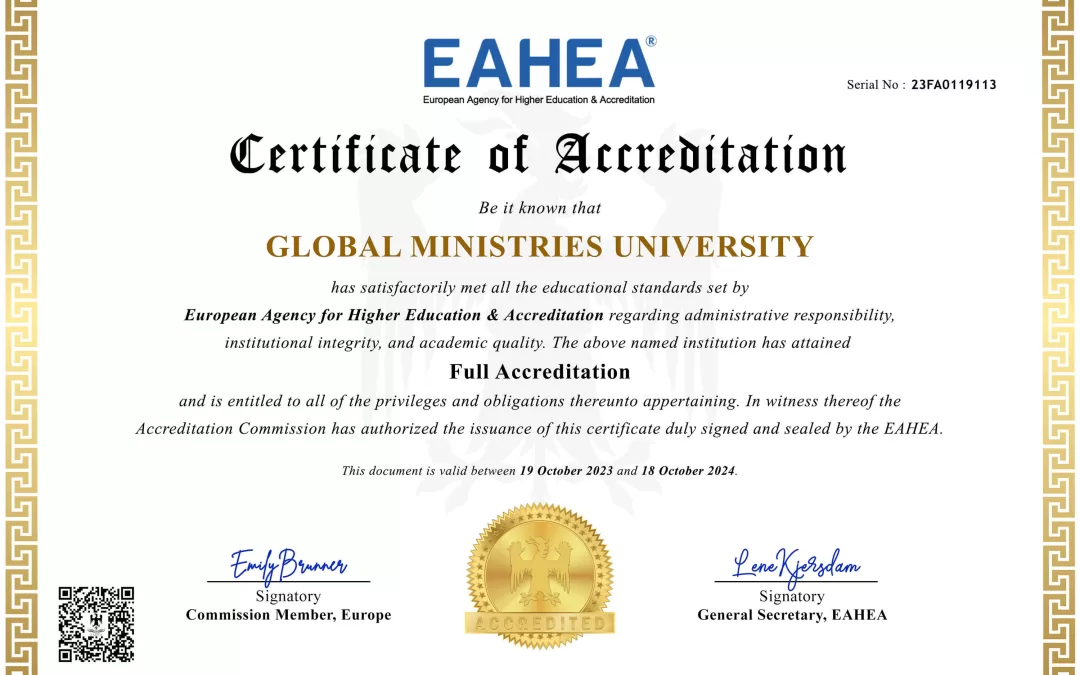
Global Ministries University Receives Accreditation from the European Agency for Higher Education

https://www.globalministriesuniversity.org/gmu-receives-full-accreditation-from-eahea/


GMU Receives Accreditation from the European Agency for Higher Education

The European Agency for Higher Education Accreditation has granted Global Ministries University a grade of "A - Full Accreditation." EHAEA evaluated GMU's Administrative Responsibility, Institutional Integrity, and Academic Quality.


EAHEA accreditation focuses primarily on educational quality from a global and international perspective, not national interests.

Read the complete audit report.


The European Agency for Higher Education Accreditation has granted Global Ministries University a grade ” A-Full Accreditation.” EHAEA evaluated GMU’s “Administrative Responsibility, Institutional Integrity, and Academic Quality.”

EAHEA accreditation focuses primarily on educational quality from a global and international perspective, not national interests. EAHEA is aware of the differences among countries that may arise regarding fulfilling the quality standards set forth, so EAHEA follows a non-discriminatory policy and examines each higher education institution respecting their institutional autonomy.

Due to this global policy, the EAHEA is not part of any country’s governmental agencies. Accredited institutions’ academic mobility and credit transferability will always be subject to the receiving country’s or institution’s policies.

While accreditation with EAHEA may not meet the requirements of some US employers and academic institutions, it increases GMU’s stature in the global community. Since many of GMU’s students now come from Africa and Asia, it is important for GMU to be accredited by an international agency.© 2023 Global Ministries University

The Overwhelming Case to Restore Women to Ordained Ministry Alongside Men as their Equals

 https://www.thetablet.co.uk/blogs/1/2617/the-overwhelming-case-to-restore-women-to-ordained-ministry-alongside-men-as-their-equals-

By Miriam Duignan published in the Tablet

The overwhelming case to restore women to ordained ministry alongside men as their equals


by Miriam Duignan
email sharing button
facebook sharing button
twitter sharing button
pinterest sharing button
linkedin sharing button


A fresco believed to show a woman priest in the early church, in the Catacombs of Priscilla in Rome, Italy.
Abaca Press/Alamy Live News

“We are still hopeful, but not particularly optimistic.” This was the response of the campaign group, Catholic Women’s Ordination, to the first synodal meeting in Rome.

During the synodal process, Church leadership heard Catholics everywhere express a strong desire to see women recognised for their vocations to ministry and for the priestly work they do in parishes everywhere. In so many of our churches, it is women preparing families for baptisms, marriages and funerals and, in the absence of a male priest, they conduct Communion services on a Sunday. Women are chaplains in hospitals where they care for the sick and the dying, but must call for a male priest to administer the last rites or hear confession. This glaring and illogical injustice can no longer be ignored.

And yet, the topic of women priests was banned at the Synod. Instead, after one month of discussions and constant edits, the summary document’s paragraph on the female diaconate (a question that was allowed) was a watered down, vague statement about the need for further study. If yet another study were to be taken up, this would be the third go-around in seven years to examine the case to restore the women’s diaconate. We have to ask, how much longer can this possibly take?

The vocation to be a deacon is undoubtedly a valid calling for those who do not want the responsibility of running a parish or holding other roles of responsibility in the leadership of the Church. CWO is hopeful that this ministry will soon be opened up for women who feel called to serve as a deacon, the way Catholic men can now. But a Deacon cannot celebrate mass or consecrate the Eucharist, the central sacrament of Catholicism, the heart of church life and of which parishes are in desperate need. The lack of priests has reached a critical stage and most clergy are now exhausted and overworked. The Church hierarchy is excluding a group of willing and able women workers who have the skills and experience to officiate today.

Our ambivalence about the possibility of women deacons also stems from the fear it would entail “bolting us on” to  current hierarchical structures in a way that limits the vocations of women and continues to render them as inferior to men. The post-synodal signs point to the desire of the Church hierarchy to create a lay ministry of women deacons that strictly rules out ordination. This would mean women won’t be sacramentally recognised as having a commitment to a life of ministry. CWO is concerned women would therefore not qualify to receive the same training as male deacons and would lack formal confirmation of a permanent role within parishes. We suspect that female lay deacons’ ability to preside at baptisms, weddings and funerals would always be subject to the goodwill and whims of local priests and bishops.

This continued restriction of the Sacrament of Holy Orders to men only (“permanent” deacons included) is a blatant discrimination that has no basis in tradition or theology. There is overwhelming evidence that women were sacramentally ordained as deacons in the early church. To allow this tradition to be denied would be to pander to the prejudicial desire to ensure that no woman will ever be recognised as the peer of a man.

We often hear that the body of evidence proving women were deacons means this is the only ministry women can claim to hold. But this is mistaken. Christ instituted an equal baptism for women and men, indicating openness to all sacraments including ordination. And at the Last Supper, women were present when Jesus said: “Do this in memory of me.” When Jesus sent out his apostles and disciples, he blessed them – men and women – with his authority for their mission. Whatever men did in the early Church, women did too, as equals and not subordinates. It was only in the fourth century that we first see a separate hierarchical rank of ordained male priests when the Roman culture of excluding women from leadership roles took hold. And so, for as long as priesthood exists as a role and a requirement to run parishes, administer all sacraments and participate in decision-making about how the Catholic Church is run and what it teaches, women can and must be among their number.

We welcome Synod discussions about tackling what Pope Francis calls “the scourge of clericalism”. But those opposed to any ministry for women are increasingly using this term to position women’s vocations in a negative light. To associate women’s genuine call to ministry with abuse of power and suggest that their ministry would be corrupt before it even starts, is a judgment never levelled at men who claim a vocation to priesthood. Those who claim concern about clericalism should note that this affliction often arises when priests believe they are a superior caste of men, because no woman can ever be their peer. And so, the most effective way to diminish clericalism and start to reform the priesthood would be to restore women to ministry alongside men as their equals.

CWO envisages flourishing,  inclusive, active Eucharistic communities, where women will be ordained to sacramental and pastoral care. We are confident that the Synod’s lack of meaningful commitments to act on equality will galvanise Catholics to demand their local dioceses have further listening sessions. This would increase the pressure on the Vatican to not only give the illusion of inclusion with vague references to study women but actively to include women in the leadership structure of the church. Our hierarchy needs to act now because the very future of our church is at stake. Any further delay only exacerbates the pastoral crises that leave the dying neglected, the vulnerable with no support, and parishes adrift. These communities are desperate for priestly service and leadership – the very care that women are already offering and are ready to give more fully.


Miriam Duignan is Executive Director of the Wijngaards Institute for Catholic Researchwhich is dedicated to bringing about reform in the Catholic Church via educational websites as well as multi-disciplinary reports by academics on the most disputed areas of church teaching. Miriam was born in England to Irish parents, educated by Dominican nuns and completed post graduate studies at the Jesuit School of Theology in Berkeley, California.  

email sharing button
facebook sharing button
twitter sharing button
pinterest sharing button
linkedin sharing button

Friday, November 24, 2023

Women theologians dare the Church to reform or die In a new book, seven women theologians, each with their own perspectives, address the challenges facing the Catholic Church today


By Isabelle de Gaulmyn (in Paris) | France
November 24, 2023


The disadvantage of a book written with several authors is that it necessarily goes off in several directions. Such is the case with a new 180-page book on the Catholic Church written by seven women theologians, six French and one Italian. The title – Se réformer ou mourir – pretty much says it all – the Church must "reform or die". 

Biblical scholar Anne-Marie Pelletier (a member of thePapal Study Commission on the Women's Diaconate) and Marie-Jo Thiel (a medical doctor and theology professor at the University of Strasbourg) outline the obstacles and prospects regarding the role of women in the Church. Italian historian and author Lucetta Scaraffia (former editor of "Donne, Chiesa e Mondo", the monthly women's magazine issued by the Vatican daily, L'Osservatore Romano) adds her own views on the issue.  


Meanwhile Véronique Margron, the Dominican sister who is currently president of the Conference of Men and Women Religious in France (CORREF), reminds us what the sex abuse crisis has brought to Catholics, particularly with regard to the relationship between power and abuse. 

Ursuline Sister Laure Blanchon, professor at the Jesuit Faculty of Theology (Centre Sèvre) in Paris, looks at the Church's preferential option for the poor. And Isabelle de la Garanderie, a consecrated virgin who has a doctorate from Centre Sèvre and teaches highschool religion, shares reflections on Church reform.                                

Reforming a Church that's still too clerical
But we would like to express a particular preference – albeit a subjective one -- for Anne Soupa's. Readers may remember that she's the lay theologian who "applied" to be Archbishop of Lyon in 2020. Soupa offers a beautiful reflection reforming a Church that she sees as overly clerical. She starts from what seems most promising to her, namely the baptismal way. Baptism is the only sacrament "capable of lifting all the muted but powerful exclusions that structure the Church", and, in particular, the difficult relationship between the laity and the clergy.

Soupa thus moves away from overly ecclesial debates to focus on a more spiritual vision, and insists on the role of the baptized in the Church she so earnestly desires. She refuses to despair in the face of the crisis facing the institution, asserting that we must continue to bear witness, "because Christianity can only be transmitted from face to face. And all it takes is a few".

The institutional Church, she insists, must not hide the Church of Christ, which is something much more. Catholics must return to a "vigorous, ardent and well-argued proclamation of the resurrection", prepare for the Kingdom, and place love at the heart of their message, she says. In this way, the Church's "purified, scintillating" Christ-like purpose must emerge from its now anachronistic structure.

Se réformer ou mourir (Paris: Salvator, 2023)

Laure Blanchon OSU 

Thursday, November 23, 2023

For this group of trans women, the pope and his message of inclusivity are a welcome change, by Nicole Winfield and Trisha Thomas AP Story

 https://apnews.com/article/vatican-transgender-lgbtq-b3d67868504ba701cce09da9ecc94de0


TORVAIANICA, Italy (AP) — "Pope Francis’ recent gesture of welcome for transgender Catholics has resonated strongly in this working class, seaside town south of Rome, where a community of trans women has found help and hope through a remarkable relationship with the pontiff forged during the darkest times of the pandemic.

Thanks to the local parish priest, these women now make monthly visits to Francis’ Wednesday general audiences, where they are given VIP seats. On any given day, they receive handouts of medicine, cash and shampoo. When COVID-19 struck, the Vatican bussed them into its health facility so they could be vaccinated ahead of most Italians.

On Sunday, the women — many of whom are Latin American migrants and work as prostitutes — joined over 1,000 other poor and homeless people in the Vatican auditorium as Francis’ guests for lunch to mark the Catholic Church’s World Day of the Poor.

The menu was evidence of Francis’ belief that those most on the margins must be treated with utmost dignity: cannelloni pasta filled with spinach and ricotta to start; meatballs in a tomato-basil sauce and cauliflower puree, and tiramisu with petit fours for dessert."

Wednesday, November 22, 2023

A Thanksgiving Prayer by Bridget Mary Meehan ARCWP


 I give thanks that we are all one- connected 
in infinite love. 
It does not  matter what religion, race, gender, race or culture we belong to.
Each  of us is a magnificent image of  God  
with access to boundless grace flowing
 through every cell inside us and all around us.  
Let us be grateful for this sacred energy
that enables us to live life boldly, courageously 
 in service to our sisters and brothers.
As we give thanks for our blessings, this Thanksgiving Day, may we live as blessings in service of others.
May see the face of God in  those who are  marginalized, impoverished, ridiculed, hated and abandoned. 
May we share our abundance with them and work together for a more compassionate, just and peaceful world.
Amen. May it be so.
Bridget Mary Meehan

Sunday, November 19, 2023

Disclosing God’s Love by Robert McElroy

 https://www.ncronline.org/opinion/guest-voices/disclosing-gods-love?utm_source=NCR+List&utm_campaign=c4b79d3c53-EMAIL_CAMPAIGN_2023_11_14_12_45&utm_medium=email&utm_term=0_6981ecb02e-c4b79d3c53-%5BLIST_EMAIL_ID%5D


From National Catholic Reporter:

Disclosing God's love

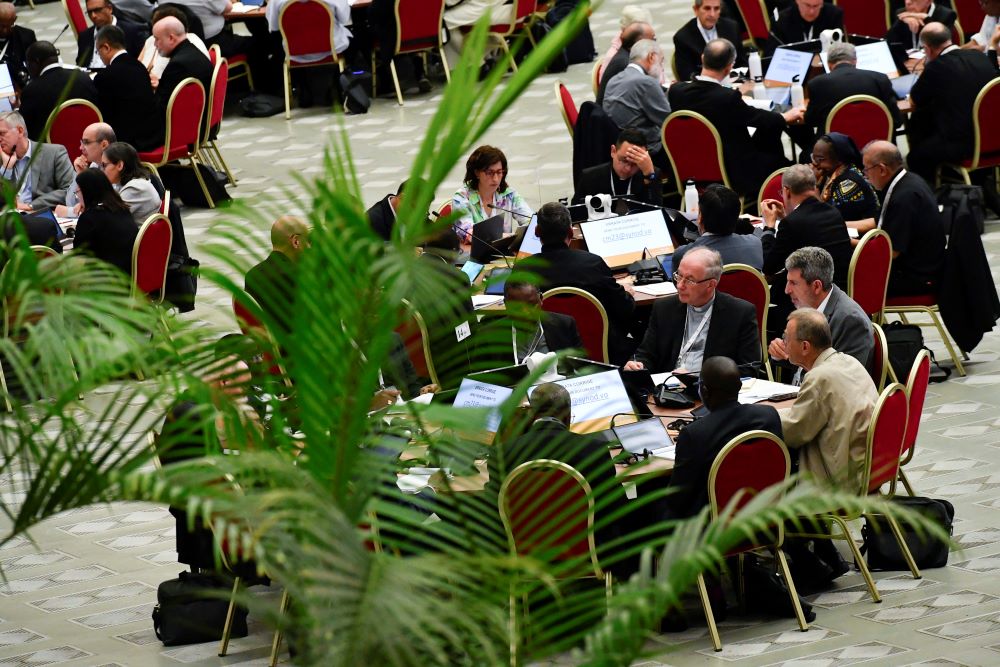
Members of the assembly of the Synod of Bishops, organized into 35 groups based on language, begin their small-group discussions

Members of the assembly of the Synod of Bishops, organized into 35 groups based on language, begin their small-group discussions Oct. 5. in the Paul VI Audience Hall at the Vatican.The Oct.4-29 assembly concluded with the release of a synthesis statement, which included recommendations. (CNS/Vatican Media) 

BY ROBERT MCELROY 

View Author Profile

Join the Conversation

Send your thoughts to Letters to the EditorLearn more

Editor's note: Following is the transcript of San Diego Cardinal Robert McElroy's address to the Religious Formation Conference on Nov. 10 in Chicago, which is published here with permission. 

“It is with great joy that I join with you today. For last month's meeting of the synod in Rome has convinced me with even greater depth that the conversion to a synodal church constitutes the call of the Holy Spirit to the people of God in this epoch of history. And I am ever more convinced, also, that the degree to which religious communities have already enshrined synodality in their life and ministries equips them to become uniquely powerful witnesses to the synodal conversion to which the spirit is leading us.

The very nature of the synodal assembly in Rome testified to the identity of the church as the entire people of God in a piercing manner. Bishops, laywomen and men, religious, priests and deacons all sitting around common tables together in union with the pope, dialoguing in deep faith and insight, and voting equally upon the interim report — that will be the basis for future action. These dimensions of the assembly experience point to the reality that we were truly all journeying together on this pilgrimage on Earth in the name of Jesus Christ. It was a stark contrast with past synods, where bishops alone voted and the bulk of the sessions were spent listening to a seemingly endless series of speeches that left participants passive and disengaged. 

The "i" had to become the "we," and the "we" had to seek, at every moment, the grace of the Holy Spirit to ensure that our earthly perspectives, interests, alignments and desires did not cloud the call of the Gospel.

TWEET THIS

The starting point for the synod was the instrumentum laboris, which reflected the global process of discernment that brought together the experiences, the joys, the sorrows and the hopes that millions of Catholics shared about the faith that animates their lives.

Uniting these testimonies of faith was a deep devotion to the fundamental and enduring mission of the church which it receives from Christ, the one sent by the Father. Guided by the Holy Spirit, the church witnesses to the Gospel in its fullness and thus cooperates with the coming reign of God. It is this mission which is the heart and soul of a synodal church.

The method of dialogue in Rome was conversation in the Spirit, a process of deep discernment which truly opened up the hearts of the synod participants. Beginning with the word of God and prayer, the participants at each table would share their initial reflections on the question at hand, each listening to the other, with substantial pauses between contributions for prayer and reflection. Then, building upon a series of such rounds, each table moved toward more directly addressing the issue for that session.

This method diminished frictions and magnified commonalities, precisely because all came to see with a greater understanding the faith of the other. As you in religious life fully recognize, such a process of discernment allows the grace of God to be recognized more clearly in our midst, and points to the commonality of our identity as disciples of Jesus Christ, bound together in our love for God and the church, even amidst sometimes contentious topics.

The synod was a profound experience of the universality of the church. Because we switched tables five times during the course of the synod, each of us came into contact with the face of the people of God in every continent and across a multitude of cultures. It was fascinating, transformative and powerfully transcendent to witness God's diverse tapestry of grace at work throughout the world.

There were enormous issue areas on which there was broad consensus — the centrality of the kerygma; the missionary identity of the church; the importance of placing the Eucharist at the center of every element of ecclesial life; the need to expand and invigorate ministries open to the laity; the church's imperative to go out of itself to embrace and advocate for the poor, the marginalized, the oppressed and the hopeless; the importance of a paradigm shift in the church's invitation to, and treatment of, women; and the need for a global rather than a national or mono-cultural perspective. 

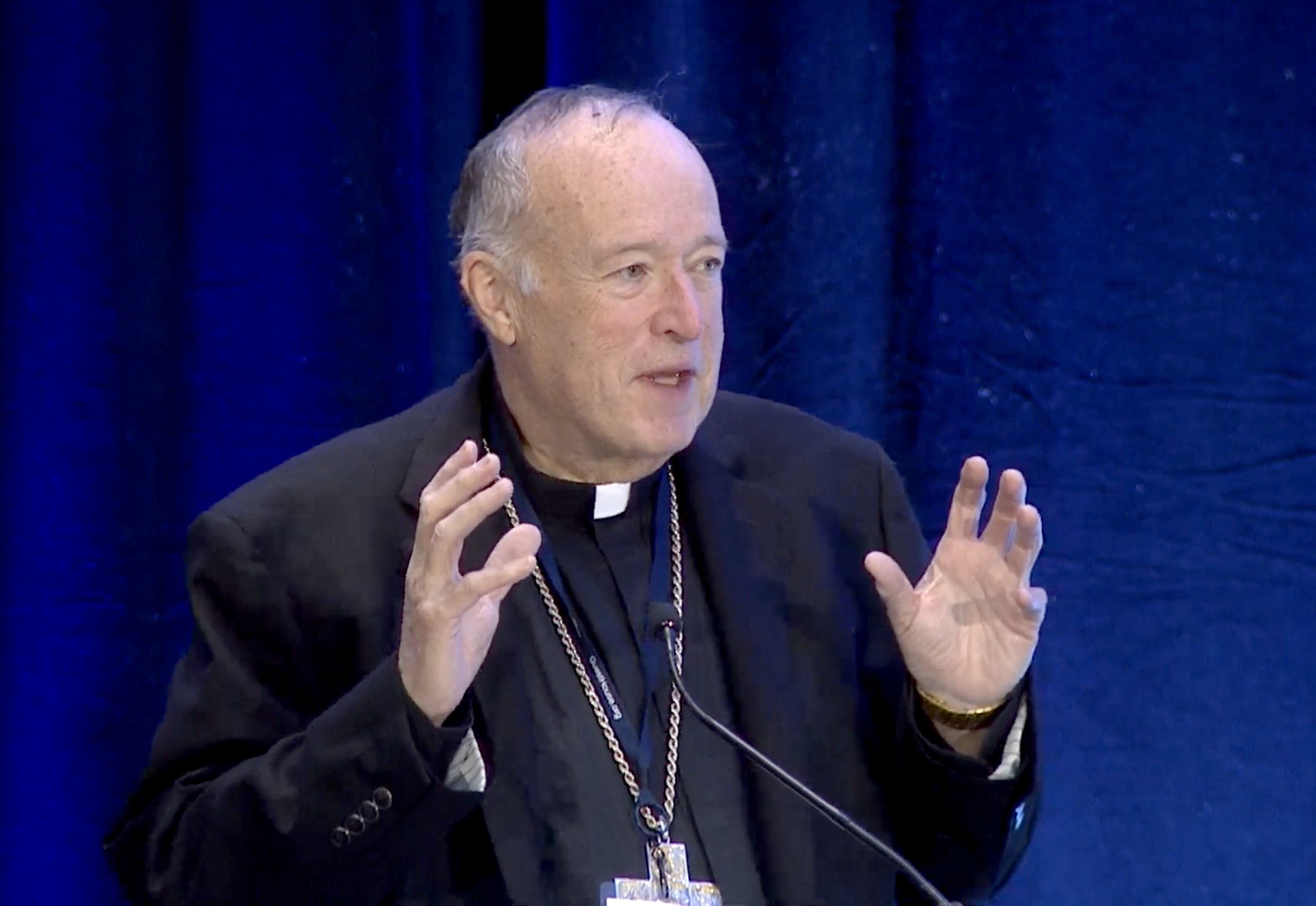
Cardinal Robert McElroy speaks.

Cardinal Robert McElroy of San Diego speaks Nov. 10 to the Religious Formation Conference's 2023 Congress in Chicago, on how women and men religious can help transform the Catholic Church into a synodal church following the path of the Holy Spirit. (NCR screenshot/Religious Formation Conference) 

But there were also areas of deep divide — on how to meaningfully include the laity in the church while maintaining the integrity of its hierarchical nature; on how deeply inculturation and decentralization should proceed in the Catholic community; on questions of the diaconate; and inclusion for LGBT communities.

Yet both the areas of consensus and those of division only served to underscore more deeply that the vision of synodality which Pope Francis has proposed for the church will be critical to guiding the people of God along the pathway to which the Holy Spirit is calling us.

Synodality is not rooted in specific outcomes, no matter how important. It seeks nothing less than a recasting of the culture of the church that will endure for generations. For this reason, the Holy Father has insisted the synodal reflection and action that we are undertaking throughout the world must be thought of as a process of conversion. 

A specific architecture of synodality underlies Pope Francis' call to transformation in the life of the church. It is rooted in the methodology of seeing, judging and acting, and it springs from his belief that synodality is vital to "plant dreams, draw forth prophecies and visions, allow hope to flourish, inspire trust, bind up wounds, weave together relationships, awaken a dawn of hope, learn from one another and create a bright resourcefulness that will enlighten minds, warm hearts, give strength to our hands."

It is essential to understand 10 distinguishing marks that characterize Pope Francis' vision of a synodal church, and the manner in which these distinguishing marks shaped the global dialogues which have taken place during the past two years and the dialogues of the assembly in Rome. 

1. Synodality points to the reality that the whole of the people of God are journeying together in the life of the church and in synodal action. This means that we cannot operate from a mindset of complacency or one that accentuates the differences among the baptized. Rather, we must view ourselves as the people of Israel were called to do in the desert, united in their faith and in their understanding that God was calling them to an ever new way of life. As we were reminded at the Roman assembly, our individualistic perspectives on issues needed to be replaced by a communal understanding rooted in our common identity as disciples of Jesus Christ. The "i" had to become the "we," and the "we" had to seek, at every moment, the grace of the Holy Spirit to ensure that our earthly perspectives, interests, alignments and desires did not cloud the call of the Gospel.

Discernment, both individual and ecclesial, is not primarily cognitive, but spiritual and intuitive. Our intellect provides critical guidance, but is not the central element in apprehending the mystery and the call of God within our souls and within the soul of the church. 

The synthesis of the synodal assembly . ..”