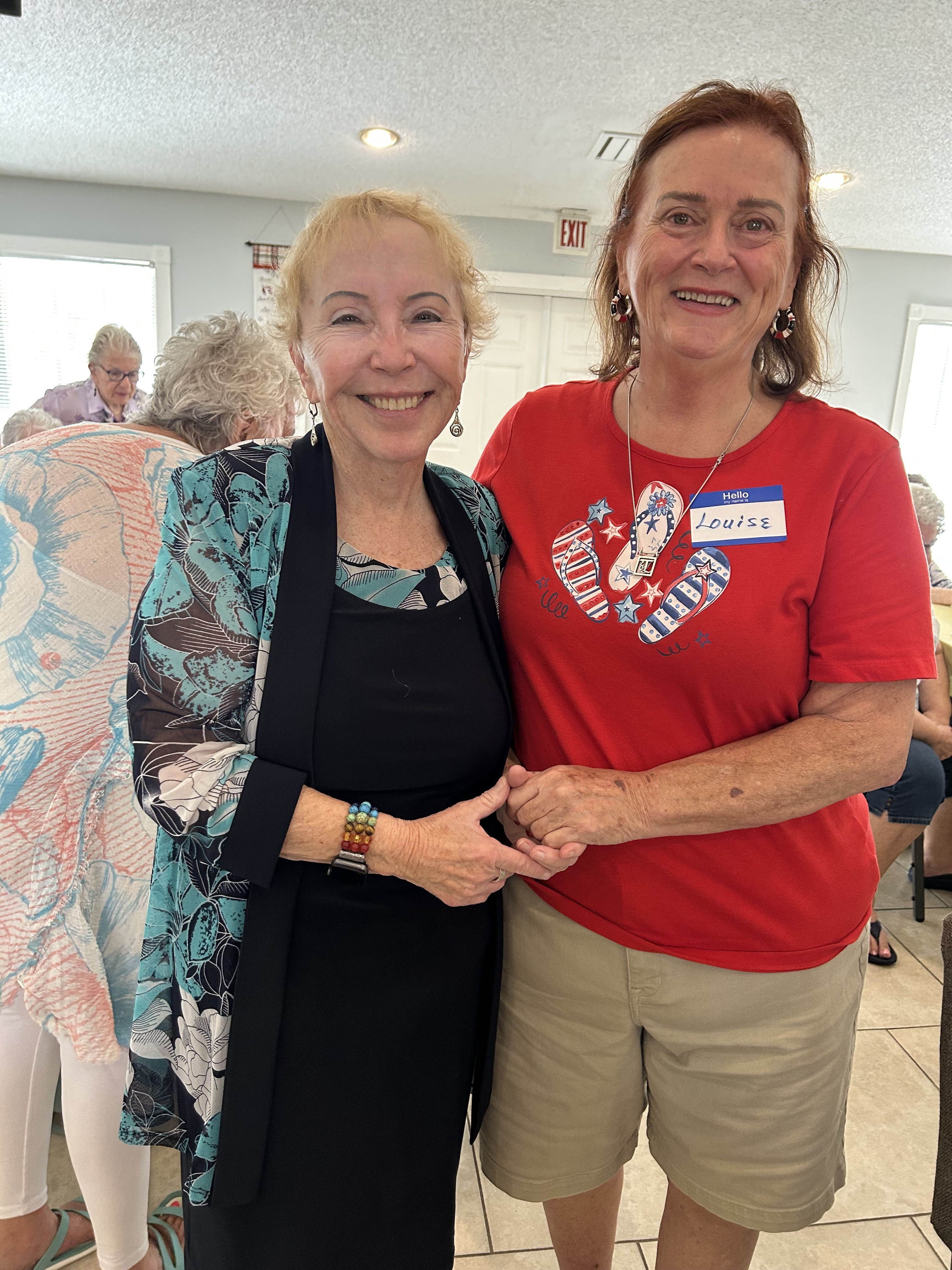
Today, I had the honor of being the Speaker for the Fall Program 2024 of the Women's Interfaith Network, a lively gathering of women from different religious beliefs and traditions in the Sarasota area. I shared stories based on our October 17 th Ordination on the Tiber in Rome and answered many questions about our international Roman Catholic Women Priests Movement.
Prepared text:
On Thursday, October 17, 2024, the Association of Roman Catholic Women Priests ordained six 4 women and 2 transgender persons on the Tiber as a prophetic witness that gender equality in ordained ministries is a reality now. Our movement, which I call a holy shakeup, is a spiritual revolution that is bringing new life and inclusivity to the Roman Catholic Church was covered by international media from France, Germany, Austria, Spain, Italy and the United States.
So, it should come as no surprise that Mary Theresa Streck and I were stopped by the Roman Police and Vatican guards as we entered St. Peter’s Square for the Canonization Mass of eleven martyrs on the following Sunday.A security guard approached me and said: Are you Bridget Mary Meehan? Suddenly, we were surrounded by several guards with badges, some of whom, were in uniforms. They asked for our passports and examined our bags.WE noticed that no one else was detained. They did not ask us any questions and assured us sometimes they do enhanced checks. I noticed that one official in the group was speaking to someone on the telephone. I wondered who he was speaking to and what was being said!.Finally, after about 25 minutes, one of the security guards escorted us to our seats. Obviously, someone approved of our attendance and the canonization liturgy was beautiful. In the end, we enjoyed seeing Pope Francis riding around the Square in his pope mobile!
On Friday, we gathered at the Jesuit center in Rome for a book signing of Rev. Jim Martin’s new book, Lazarus, Come Forth. I asked Fr. Jim if he would share our request for a conversation in the Spirit with Pope Francis in the coming Jubilee Year. He assured me that he would do so and asked that I send a formal request directly to the Pope which we did.
While Pope Francis is not comfortable ordaining women as deacons, the Synod on Synodality voted by a two-thirds majority to keep the ordination of women deacons on the table for ongoing discernment. In their words: “the question of women’s access to diaconal ministry remains open. This discernment needs to continue.”
The synod calls for greater involvement of women in the church, in decision-making. “There is no reason or impediment that should prevent women from carrying out leadership roles in the Church,” …what comes from the Holy Spirit cannot be stopped.”
And this is where I stand in faith, hope and love!
Indeed, nothing will stop the global movement toward gender equity- includingour movement for gender equality in ordained ministries. We are walking in the footsteps of Rabbi Jesus who invited everyone to an open table of outpouring of love for all people and all creation.
I believe that what has been missing in the discernment process on women deacons is a conversation in the Spirit with Roman Catholic Women Priests on our 22 years of ministerial experience in fostering a church in which all are welcome to receive and celebrate sacraments including the divorced and remarried and LGBTQ+.We have grown from 7 to over 270ordained ministerswho are serving people-empowered, non-clerical sacramental communitiesof equals in 14 countries around the world.
Our holy shakeup is a spiritual revolution, that is building builds bridges of compassion and reconciliation by making connections between hurting hearts and broken spirits at the disengaged edges of Catholicism to create what Pope Francis calls a “church for everyone.”
We are prophets of the future engaged in the work of justice, inclusivity equality, and evolutionary openness to growth.
Let us plunge into infinite love , let it embrace ever cell of our bodies and let us hold one another in the embrace of love and be part of the world’s healing- one thought and one word at a time!
“The president of the German bishops, Monsignor Baetzing, acknowledged the “enormous frustration” caused by the umpteenth postponement of the issue of the diaconate.”
Bridget Mary Meehan, a US "bishop" in full rebellion against Pope Francis. Photo: Filippo MONTEFORTE / AFP Image: 1/2
" The Synod of Bishops concluded a few days ago without any news on the subject.And the Pope said that the question "is not yet ripe" for debate. German women are at the forefront of the protests and are deeply disappointed."
"A significant proportion of women, more than half of the 1.4 billion Catholics, are protesting. The Synod of Synods of Bishops ended two weeks ago after meeting in two phases in 2023 and 2024, without having taken a substantive decision on the question of the female diaconate , which has been postponed to a commission of ten that will present its conclusions to the Pope in June 2025 and will deal with other difficult issues that explain the decision to postpone them beyond the Synod.
German women are at the forefront of the protests and are very disappointed. Claudia Lucking-Michel, vice-president of the Committee of German Catholics, said: “My capacity for suffering has come to an end. Women are valued for their capacity for suffering and this makes me very nervous.”
“Should we be happy that they have not yet banned the female diaconate and have left the door open for us? But how long do they think women can wait for something to be done and say something like: ‘Oh yes, now you can become a deaconess’?”
A significant proportion of women, more than half of the 1.4 billion Catholics, are protesting. The Synod of Synods of Bishops ended two weeks ago after meeting in two phases in 2023 and 2024, without having taken a substantive decision on the question of the female diaconate , which has been postponed to a commission of ten that will present its conclusions to the Pope in June 2025 and will deal with other difficult issues that explain the decision to postpone them beyond the Synod.
German women are at the forefront of the protests and are very disappointed. Claudia Lucking-Michel, vice-president of the Committee of German Catholics, said: “My capacity for suffering has come to an end. Women are valued for their capacity for suffering and this makes me very nervous.”
“Should we be happy that they have not yet banned the female diaconate and have left the door open for us? But how long do they think women can wait for something to be done and say something like: ‘Oh yes, now you can become a deaconess’?”
The president of the German bishops wrote a first letter to Fernández accompanying the document of the Synod of German bishops with the evolution of the issue of women.
The second letter responded to the position that Cardinal Fernández took when, in the final phase of the Synod, he announced that the Pope considered that the issue of the female diaconate “was not yet mature.”
"I see this issue in a very different light," wrote the president of the German bishops.
Since Francis had firmly blocked proposals to allow women to become priests, the diaconate seemed like a way out. In the early days of Christianity, there were deaconesses , women who helped with mass, could perform births and weddings, but could not celebrate mass. They were not priests, but they had climbed a step with the diaconate, which declined over the centuries and became extinct in the 12th century.
The president of the German bishops, Monsignor Baetzing, acknowledged the “enormous frustration” caused by the umpteenth postponement of the issue of the diaconate.
Can women become deacons? The Synod on Synodality marked the question as open, subject to review by the Pope.
Deacon Loan Roacher ordained on Tiber on October 17 2024
Newly ordained ARCWP deacons: Loan Rocher , from Spain :Maria Teresa Ribeiro Rosa, and Txus Garcia Pascual
“Cardinal Walter Kasper considers the ordination of women as deacons to be theologically possible and pastorally significant. In an interview with the magazine "Communio", the former Vatican official responsible for ecumenism said that he had struggled for some time looking for the answer to this question. "Each local church would be free to decide whether or not to make use of this possibility," Kasper continued. The cardinal stressed that he was talking about permanent deaconesses, not the ordination of deaconesses as a transitional stage to priestly ordination.
According to Kasper, the argument in favour of ordaining women as deacons is that both Western and Eastern churches were familiar with this ministry in the early centuries. Nor can it be said that the ordination of deaconesses was a sacrament at that time, as these theological concepts were only developed later. It would be inappropriate to view ordinations of that time merely as symbolic blessings: "The fact that, as far as I know, the forms of ordination for deacons and deaconesses were the same also speaks against this."
The unity of the sacrament of ordination is not an argument
Kasper was also not convinced by the argument that women cannot be ordained as deacons because the ordinations of deacon, priest and bishop are a sacrament inseparable from the "ordo." Pope Benedict XVI (2005-2013) made it clear that deacons, unlike priests and bishops, do not represent Jesus Christ as head of the Church. On the other hand, the ordination of bishops was not definitively recognised as a sacrament until the Second Vatican Council (1962-1965). "Therefore, there have been and are not insignificant differences within the single sacrament of the ordo, as well as historical developments that have been oriented towards pastoral needs," Kasper stressed.
The question of whether women can be ordained as deacons has been a contentious issue within the Catholic Church for years. Various commissions set up by the Popes have already dealt with the issue without reaching a clear conclusion. A decision by Pope Francis is also pending. In 1994, Pope John Paul II (1978-2005) merely declared that the Church had no authority to ordain women as priests. The document did not contain a statement on women deacons. The Synod on Synodality, which concluded last Sunday, described the question of the ordination of women deacons as open in its final document.”
"The Synod of Bishops, the meeting of ecclesiastical hierarchies that has the challenge of deciding the future of the Church , has met again in October 2024, but the debate process will not be closed until spring of next year.
This call, which began in the autumn of 2023, was innovative from the very beginning. In an unusual way, the female vote was introduced and the debate on the role of women in Catholicism began to be addressed . But the complexity of this issue, which pits the feminist struggles of many ecclesiastical sectors of women against centuries of immobility, seems to be at a standstill . The final document has established that “there are no reasons that prevent women from assuming leadership roles in the Church ”, but the key will be to know what that phrase, still open, means.
Equality in the Church
In fact, during this month of October, the Argentine Pontiff explicitly asked the participants of the synodal journey, such as bishops, nuns, lay people and experts, not to focus on the issue of the female diaconate . The female diaconate is the greatest demand for equality within the Church and would mean that women could also access the step prior to a priest being ordained a priest and would allow, among many other tasks, to celebrate the word. Cardinal Victor Manuel Fernandez , prefect of the Dicastery for the Doctrine of the Faith, and one of Bergoglio 's most trusted people , spoke about this issue in a recent press conference. "We know that the Holy Father has expressed that, at this moment, the question of the female diaconate is not ripe and he has asked that we not dwell on this possibility now," he added.
Previous steps are missing
According to Cardinal Fernandez, the Pope 's interest is to work, however, "on the role of women in the Church " by asking his dicastery to explore the possibility of development without sacred ordination. "To rush to ask for the ordination of deaconesses is not today the most important response to promote women ," added this cardinal, because "it does not resolve the question of women in the Church" since he believes that previous steps are missing. Fernandez concluded his statements by asking for the help of women who are heads of a Catholic religious community and who hold positions of authority to work together .
These statements, which came out in October, fit perfectly with the imprecision of the final document of the Synod published in recent days , which calls for further discussion of the issue and postpones a broader decision until next spring. But this impasse increases the disappointment of some sectors of the Church , which had placed all their hopes in this synodal path. The atmosphere is one of controversy and discontent because, as has often happened in his papacy, Francis has reflected with this issue an acceleration and the subsequent sudden stop. For example, in 2016 he announced the creation of a Study Commission on the diaconate for women , renewed in 2020, and now he closes doors through the words of one of the most trusted cardinals. Many interpret that he himself has lit a fire that he now intends to put out. Clarify the position
One of the most influential cardinals at the moment, the Archbishop of Kinshasa, Fridolin Ambongo Besungu , has placed his trust in this commission. He said that all the questions are being studied in depth “in order to clarify them”, according to the magazine ‘ Vida Nouvelle’ . But, at the same time, in a briefing held a few days ago in the context of the Synod, he said that “the Church in Africa and I, personally, are not opposed to the possibility of studying the female diaconate , of considering this opening to having women deacons”. Ambongo is part of the famous C9, the Council of the nine cardinals with the most power in the Church who advise the Pope.
Pope Francis during a visit to the women's prison in Venice
Her statement provides clarity on a key point in understanding where this debate is heading in the Church: numbers . At present, the number of believers in the Catholic Church is growing only in the so-called global south. The data show that, especially since 2022, the number of baptized people has been growing in Africa . There, many women nuns already do much more than their role requires, equalling or even surpassing the importance of a priest. These women are crucial to the religious and social development of some communities, and part of their demands focus on making it clear to Rome that they already take care of many aspects because there are not enough priests or because they simply attend to the needs of the parishes in which they are located. “Daughter, wife and mother”
Over the years, the Pope has reiterated an idea of women as representing the maternal side of the Church . He said in : “The Church needs this, because the Church is a woman: daughter, wife and mother, and who else but a woman can reveal her face?” But the great demand of women fighting from within is focused on a recognition that is not based on their role of care and accompaniment, but that also includes them in decision-making and administrative power, just like a priest has.
Pope Francis leads the weekly general audience in St. Peter's Square, Vatican City
In fact, just a few days ago a group of women belonging to the International Association of Roman Catholic Women Priests (ARCWP) decided, in a symbolic way, to be ordained as priests a few kilometres from the Vatican. The place is quite unusual, on a floating building on the Tiber converted into a kind of Church, where a “bishop” has ordained three Catholic “priestesses” and three “deaconesses”, according to the Vaticanist of the Italian daily ' Repubblica' Iacopo Scaramuzzi . A ceremony without canonical value, but which serves to provoke a debate that seems blocked at the moment by Pope Francis himself despite the steps taken in recent months. What are your demands?
Kate McElwee is the executive director of the Women's Ordination Conference , which tries to unite the voices of women fighting for female ordination and equality within the Church. “Women, including the Church, have been silenced for generations. Our role is to make them feel welcomed so that they can raise their voices ,” she explains to Article 14. This is a debate that is still completely open, but the disappointment for this group of women is that the appointments of some to high ranks of the ecclesiastical hierarchy during this decade of Bergoglio's papacy are exceptions and that the Vatican itself has wanted to remove this issue from the discussions of the Synod , a fundamental place to decide the future of the Church. “I think that Francis is blocked on this issue and this saddens us,” she adds.
Pope Francis and Italian Prime Minister Giorgia Meloni
“They want to be human beings with full rights in the Church, just like men . We want baptism to become, truly, the proof of equality between men and women . Many, even if they do not wish to be ordained priests, understand that this is a debate that the Church has to face in order to regain its credibility,” adds McElwee. And, according to the numbers, to ensure its survival."
The closing document from the Synod on Synodality states -what is already the practice in places like the Amazon- that under specific circumstances the basic duties of a deacon can be performed by a lay woman or man. This ordinarily includes preaching, leading liturgies, baptisms and witnessing marriages. The synod promotes expanding these opportunities in response to pastoral needs.
This is a backdoor into a "defacto diaconate" for women without ordination. In other words, women can do diaconate service, but without the public authorization that the Rite of Ordination provides.
While Pope Francis is not comfortable ordaining women as deacons, the Synod voted to keep this controversial topic on the table for ongoing discernment.
The real issue of women deacons has nothing to do with some of the excuses given like "needs more study," a niche issue, "unripe", but, rather, with the actual act of ordination to the clerical state and what that means.
Pope Francis has said he does not want women ordained because of clericalism.
Yet, he continues to ordain men into this same clerical state.
I agree with him that clericalism is a major problem and that a new model is needed.
This is where Roman Catholic Women Priests have 22 years of lived experience to offer! We do not interpret ordination as a state apart from the people with special privileges that makes us more holy or Christ-like. Rather, ordination is an act of consecration to serving God's people as animators, community builders, sacramental facilitators, soul friends, and faith-filled companions on the journey.
We have been pioneering a new model of priestly ministry in inclusive communities of equals in which the entire community celebrates sacraments and participates in decision- making, not the ordained alone. We offer a path to healing for centuries of misogyny and a spiritual home for marginalized groups and communities such as LGBTQ+ and divorce and separated Catholics.
Here I see an open invitation to a sacred conversation in our common mission of fostering a Synodal church for everyone especially the wounded. There are many calls, many gifts and all the baptized are equal images of Christ. Therefore all ministries should be open to all genders. As Fr. Jim Martin says, ''We are on this road together."
Let it go my love my truest, Let it sail on silver wings Life's a twinkling that's for certain, But it's such a fine thing
There's a gathering of spirits There's a festival of friends And we'll take up where we left off When we all meet again.
I can't explain it. I couldn't if I tried How the only things we carry Are the things we hold inside Like a day in the open, Like the love we won't forget Like the laughter that we started And it hasn't died down yet
Let it go my love my truest, Let it sail on silver wings Life's a twinkling that's for certain, But it's such a fine thing
There's a gathering of spirits There's a festival of friends And we'll take up where we left off When we all meet again.
Oh yeah, now didn't we And don't we make it shine Aren't we standing in the center of Something rare and fine Some glow like embers Like a light through colored glass Some give it all in one great flame Throwing kisses as they pass
Let it go my love my truest, Let it sail on silver wings Life's a twinkling that's for certain, But it's such a fine thing
There's a gathering of spirits There's a festival of friends And we'll take up where we left off When we all meet again.
Just east of Eden But there's heaven in our midst And we're never really all that far From those we love and miss Wade out in the water There's a glory all around And the wisest say there's a 1000 ways To kneel and kiss the ground
Let it go my love my truest, Let it sail on silver wings Life's a twinkling that's for certain, But it's such a fine thing
There's a gathering of spirits There's a festival of friends And we'll take up where we left off When we all meet again.
COMMUNITY RECONCILIATION RITE:
Presider:Let us pause now to pray with one another for forgiveness for the times we failed to trust in the Spirit speaking within us and through others in our world.
(Pause for silent reflection)
Community Raises hands in gesture of mutual forgiveness
Presider and all: I am sorry, Please forgive me, I love you and I thank you.
GLORIA
Presider: Let us rejoice in the companionship we share with all the saints as we sing the Gloria:
ALL Sing: Glory to God, glory, o praise God, alleluia, Glory to God, glory, o praise the name of our God (3 times)
OPENING PRAYER
Presider:
Let us pray: we rejoice that we are in the Holy One from the first moment of life until we pass into the fullness of eternal life. We are called to follow Jesus path to blessedness by living the Beatitudes in our world today. By the power of the Spirit working in us, it will be so.
We pray today as one family in the communion of saints, the holy women and men who have crossed over into the fullness of eternal life from our Community. We give thanks for each of them who have left your footprints on our hearts.
All: Amen.
LITURGY OF THE WORD
Lector: First Reading:
Our first reading is from the first Letter of John
See what love Abba God has bestowed on us in letting us be called children of God!
Yet that, in fact is what we are.
The reason the world does not recognize us
Is that it never recognized Christ.
Dearly beloved, we are God’s children now;
What we will later be has not yet come to light.
We know that when it comes to light,
We will be like Christ,
For we will see Christ in reality.
These are the inspired words ofJohn, the evangelist: Thanks be to God.
All around us and within us And yet it's only at times we notice As real as rain, and soft as stardust We know deep down, what nobody told us
Can't you feel it ever closer We breathe it in and we then we exhale We touch both sides and now eternal Standing closer to the veil
Now is just a, moving image Not a ribbon, a start and end There is a bird, a hidden singer That calls and listens, and calls again
Can't you feel it ever closer We breathe it in and we then we exhale We touch both sides and now eternal Standing closer to the veil
Centered down and moving outward Sometimes almost, to sweet to bare There are endless ways to reach home Just keep walking and I'll meet you there
Can't you feel it ever closer We breathe it in and we then we exhale We touch both sides and now eternal
Standing closer to the veil
Lector: Second Reading:
Our second reading is from Lumen Gentium #38
Each individual must be a witness before the world to the resurrection and life of the Risen Christ, and a sign of the living God. They, to the best of their ability, must nourish the world with spiritual fruits(c. Gal. 5:22). They must diffuse in the world the spirit which animates those poor, meek and peace-makers whom Jesus in the Gospel proclaimed blessed (cf. Mt. 5:3-9). In a word: 'what the soul is in the body, let Christians be in the world.' These are the inspired words from the Dogmatic Constitution on the Church.
Lector: A Reading from the Holy Gospel According to Matthew (5:1-12)
When Jesus saw the crowds, he went up the mountainside, and after Jesus sat down, the disciples gathered around him and he began to teach them,
How blessed are the poor in spirit; the reign of God is theirs.
Blessed too are the sorrowing; they will be consoled.
Blessed are the lowly; they will inherit the land.
Blessed are they who hunger and thirst for holiness; they will have their fill.
Blessed are they who show mercy; mercy will be theirs.
Blessed are the single-hearted; they will see God.
Blessed too are the peacemakers; they will be called children of God.
Blessed are they who are persecuted for holiness’ sake; the reign of God is theirs.
Blessed are you when they insult you and persecute you and utter every kind of slander against you because of me. Be glad and rejoice for your reward in Heaven is great; they persecuted the prophets before you in the very same way. These are the inspired words of the evangelist Matthew, and we respond.
Reader Jill and All: Thanks be to God.
(Pause for silent reflection)
Janet Blakeley ARCWP: Homily Starter:
In elementary school, lunchtime in the cafeteria was the time you heard what other children were taught at home. My first awareness of “saints” came over bologna sandwiches with comments like “My grandmother is a real saint! She walks to church every single day for Mass, she says the Rosary every single night, and she never, NEVER, eats meat on Fridays!” So that was a saint. When I became a Catholic in Europe, the saints were described as respected but remote individuals of the past. The cathedrals were named after them, they looked after the affairs of our town. Our own St. Nicholas had a colorful history of appearing before Christmas and throwing coal at the bad children. In Boston, the saints were much more attractive and more contemporary. They were known to have done some amazingly kind act of charity, but to have done it in secret, only to be discovered much later. That might indicate a local grocer who knew a family in dire financial straits to whom he gave extended credit for food. Now THAT was a saint! Eventually I understood that, given the diversity of cultures, values, education, etc., people have differing ideas about what makes a saint.
The idea of “saints” is thousands of years old. Jews recognized a holy person, not by his extreme behavior, but by his recognizable manifestation of the presence of God in his own person. It was understood that the person who revealed God in himself could only do so because he lived in communion with God. THAT was a holy person. As the culture became more Romanized, such a person was called “sanctum” from which we draw the name “saint.”Christian bishops kept calendars of these saints and the days they died in order to carry out the traditional Jewish/Christian custom of holding an overnight candle-lit vigil for them.Eventually a sixth-century pope proclaimed an “all saints day” and we continue that custom even now. As for an overnight vigil, perhaps the only one we have actually experienced is the Easter Vigil for Jesus.It is good to put that in context and to recall
that the community knew he lived in communion with God,
they recognized the presence of God in his person,
and they called him the Holy One.
If God is seen as the fullness of holiness,
and Jesus is the Holy One,
if whole communities have recognized the saints among them and had that affirmed by their bishops,
we see how Bridget Mary can say, as she did at Sally’s memorial service, “Sally is right up there with the saints and all the saints of MMOJ!”!
What, then, must we think about our own sanctity?
Before closing, let’s look at what the Church is saying about sanctity today. In the reading from Lumen Gentiumthere is no call for Catholics to be saintly. Instead we hear the Church call all Christiansto be aware of the disastrous state of the world as it is now, and to be the soul of the world. The “soul” is the life principle – God’s life – that lives in each person. Clearly it is all of us who are asked to be that life principle for the entire world, God’s life, which is holiness itself. We must manifest the life of God in our own person, live in communion with God, and be life for others. Joined with other human beings and with God, we will know each other and ourselves to be the Communion of Saints.
(Pause for silent reflection)
Homily Sharing: Community
Profession of Faith:
All:
We believe in God, the creator and lover of all. We believe in Jesus, the Christ, who shows us that the overflowing presence of the One beyond all comprehension dwells within us and is nearer to us then we are to ourselves. We believe in the Holy Spirit, the breath of God, who empowers us with spiritual gifts for loving service and compassionate action. We believe in the great homecoming reunion of all God's people where all tears will be wiped away in a joyful gathering of God's holy people in the communion of saints. Amen
General Intercessions: Prayers of the Community
Prayer Leader:
As we prepare for the sacred meal, we pray for the needs of the people of God in our community and around the world. "I bring to the Table." Our Response to each prayer is Amen
Please share your spontaneous prayers.
Prayer Leader:
We give thanks for all whom we held in the circle of grace and will continue to pray for and serve. Amen.
LITURGY OF THE EUCHARIST
PREPARATION OF THE GIFTS
Presider: Blessed are you, God of all Life. Through your goodness we offer these gifts: bread, wine, our lives and the lives of those we love.
BMM and ALL: Blessed be God Forever.
EUCHARISTIC PRAYER
Prayer Leader: God dwells in you.
ALL: And also in you.
Prayer Leader: Lift up your hearts.
ALL: We lift them up in the Christ Presence everywhere.
Prayer Leader: Let us give thanks to the Holy One.
ALL: With the saints we give God thanks and praise.
Prayer Leader:
We thank you, Holy One, for the saintly women and men of old, the cloud of witnesses who have gone before us, and who accompany us on our journey. With your angels and saints, we sing your praise for all who continue to live as the Christ presence in our world.
We thank you for the courage and fidelity of all the ones you sent to prepare a path for us to follow - the holy women and men of every age, race, and culture. We especially thank you for our dear ones in our faith Community who have passed into your loving embrace.(Pause for silent reflection)
Prayer Leader:
We thank you, Nurturing God, for Jesus, who accompanies us on our journey into the depths of God's infinite love for us, and who inspires us and energizes us to live the Beatitudes in our world today.
Community extends hands in blessing toward bread and wine
Presider and All: Come Holy Spirit deepen your Presence within us and in these gifts of bread and wine.
(Pause)
On the night before he died, Jesus gathered at the table with his friends, he spoke the blessing, broke the bread and shared it with them saying:
Take and eat of the Bread of Life
Whenever you remember me like this
I am among you.
(pause)
Presider and All:
(lifts the cup as community prays the following:)
Jesus then raised a cup of blessing, spoke the grace saying:
Take and drink of the covenant
Made new again through my life in you.
Whenever you remember me like this,
I am among you.
(pause)
Prayer Leader and All:
As we share this bread and cup, we proclaim Christ dies, Christ rises and Christ comes again and again.
Prayer Leader:
Holy One, Your creativity flows through our beings. Your joy fills us and Your empowerment bubbles up inside us as we celebrate your presence always within us and within all our saints.
Prayer Leader:
For you are the Love that dwells in our depths, the Wisdom of the Ages that speaks within us and through us, and the Divine Passion that makes us all one.
Community members hold their plates and cups during Doxology
Presider and All:
Through Christ, with Christ, in Christ, in union with the Holy Spirit, all glory is yours, gracious God.
Please join in the prayer for the breaking of the bread:
(Presiders break the bread)
Presider and All:
O God of Courage, You call us to live the Gospel of peace and justice. We will live justly.
O God of Compassion, You call us to be Your presence in the world. We will love tenderly.
O God of Truth, You call us to speak truth to power. We will walk with integrity in your presence.
(Presider hold up bread and wine)
This is the bread of life and the cup of blessing. Through it we are nourished and we nourish each other. All are welcome to the Feast. Eat and drink and delight in Christ's Presence everywhere.
Communion Meditation: I'll be Always Loving You by Tricia Watts
PRAYER AFTER COMMUNION
Presider:
Creator Spirit, you move through the circle of grace connecting the living and the dead, a sacred community of kinship and support. We give thanks for this Cloud of Witnesses who have gone before us, leaving behind s rich treasury of faith and service. We hold in our hearts today our beloved, family, friends and members of MMOJ community whom we miss and will always love.
ALL: Amen.
Prayers of Gratitude, Introductions, Announcements
CONCLUDING RITE
Presider:
The Holy One dwells within you and illuminates our world through all our saints.
ALL: And is also within you and within all saints in the making!
BLESSING
(everyone please extend your hands in mutual blessing)
Presider and All:
May the God of Sarah and Abraham bless us.
May the God of Jesus and Mary Magdalene bless us.
May the God of all our MMOJ Saints bless us and may we always celebrate our oneness in the communion of the saints. Amen