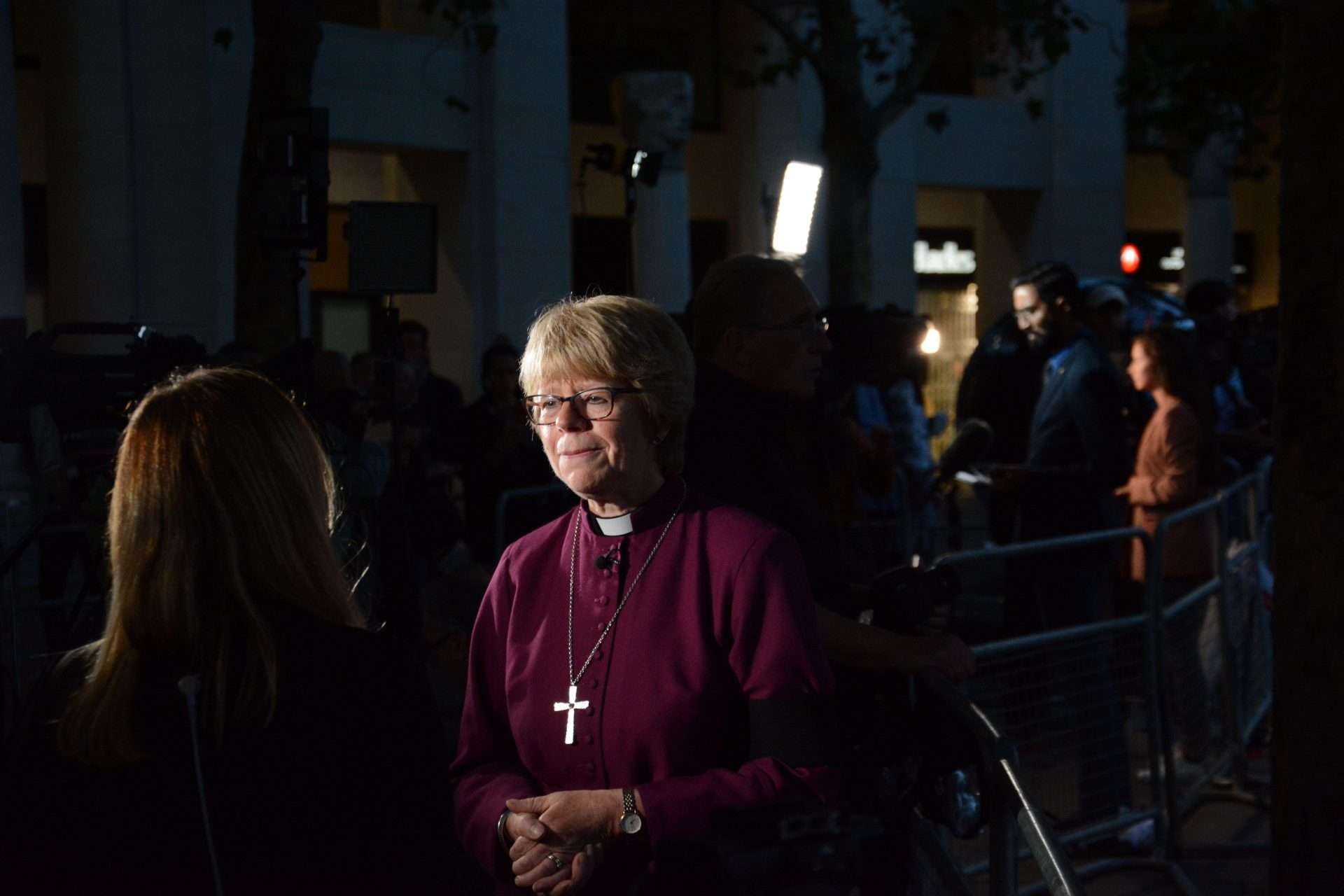
The Church of England has moved forward on women’s ordination with a woman chosen as Archbishop of Canterbury for the first time.
Alamy
The Church’s claim to have no authority to ordain women as priests has been likened to the “tardy” Christian response to the “scandal of slavery” by Irish theologian Fr Gerry O’Hanlon SJ.
The author and member of the Jesuit Centre for Faith and Justice described the core arguments for the exclusion of women from the priesthood as “unpersuasive”.
He was speaking as a woman, Bishop of London Sarah Mullally, was chosen as Archbishop of Canterbury for the first time.
O’Hanlon said it was time the Church “stopped beating about the bush and undertook a fair and open re-examination of current teaching”.
The Jesuit urged the hundreds of delegates, including bishops, who are due to attend the pre-synodal assembly of the Irish Synodal Pathway in Kilkenny later this month to request the Vatican to revisit the question of the ordination of women.
The preparatory document for the Irish pre-synodal assembly, Baptised and Sent, shows that the role of women, including ordination, is still a lively and contested topic, he noted.
Speaking at the launch of Soline Humbert’s memoir A Divine Calling about her vocation to priesthood, he said if God were truly behind this exclusion and this could be convincingly shown, then many would accept it. But “failing a persuasive explanation, one must suspect bias”.
Highlighting how the Pontifical Biblical Commission in the 1970s found that there was no Scriptural warranty for the Church’s position on excluding women from ordained ministry, he noted that theologian Karl Rahner, in the late 1970s, argued that the burden of proof should be with the Church to show this. “This burden has not been discharged,” Fr O’Hanlon said.
Describing himself as “disturbed, ashamed even” that it is taking so long to address the issue of female ordained ministry, he highlighted an article on the permanent diaconate in The Tablet last year by Cardinal Walter Kasper.
In it the German prelate wrote, “There are good reasons that make it theologically possible and pastorally sensible to open the permanent diaconate to women…each local church would be free to decide whether to make use of this possibility or not.”
Fr O’Hanlon said, “Let’s grasp this nettle and act from the gospel refrain: do not be afraid.”
Synod members, along with Pope Francis, attend the morning session in the Paul VI Audience Hall at the Vatican Oct. 15, 2024. Credit: CNS photo/Lola Gomez
My response: Looks like more “kicking can down the road” on women deacons.
“On the question of the possible ordination of women to the diaconate, the report said that materials from the synod and contributions received more recently have been forwarded to the commission Pope Francis had set up in 2020 to continue studying the issue and which he “revived” during the Synod of Bishops on synodality.”
VATICAN CITY (CNS) — The study groups Pope Francis had established to provide an in-depth reflection on controversial, complex or “emerging” questions raised during the Synod of Bishops on synodality have published interim reports.
The groups were asked to look at questions including the formation of priests, the selection of bishops, women’s leadership in the church and ministry to LGBTQ Catholics.
The late pope had asked the groups to complete their work by June 2025, but Pope Leo XIV extended the deadlines to the end of the year.
However, Cardinal Mario Grech, secretary-general of the synod, said Nov. 17 that the work of some groups—“given the richness and complexity of most of the topics entrusted to them—has required more time than originally anticipated.”
The reports, the cardinal said, also include the initial work of a study group on “the liturgy in a synodal perspective,” which began working in late July.
The interim reports published Nov. 17 vary in their depth and detail, with some groups listing their members and providing concrete proposals and with others giving only a vague description of the methodology they were using.
The study group on priestly formation, which was focused ways to ensure future priests are educated in synodality—listening, discernment and shared responsibility with laypeople—said its members concluded that “a complete overhaul” of the Vatican and national guidelines for priestly formation “does not currently seem appropriate” because the guidelines are so recent.
But the group identified “a series of needs,” which it said “cannot be ignored.” These included: “the need to deepen the identity of ordained ministry in relational terms”; “joint formation moments involving laypeople, consecrated persons, ordained ministers and seminarians”; greater participation of women and families in formation; and a focus on missionary outreach.
The group’s final report, it said, would include: “Significant female figures in the history of the church; personal accounts from women currently engaged in church leadership; personal accounts from women serving within the Roman Curia”; the nature and exercise of authority in the church; “critical tensions regarding clericalism and male chauvinism”; and “the contribution of Pope Francis and Pope Leo XIV concerning the role of women in the church.”
On the question of the possible ordination of women to the diaconate, the report said that materials from the synod and contributions received more recently have been forwarded to the commission Pope Francis had set up in 2020 to continue studying the issue and which he “revived” during the Synod of Bishops on Synodality.
The study groups on the ministry of the bishop and on the role of nuncios and other papal representatives had a joint meeting to discuss a topic they both were looking at: the choice of bishops, the report said.
The group looking at bishops said its first focus was “the selection of candidates to the episcopacy in the perspective of a synodal and missionary church, highlighting the participation of the bishops of the territory and of the entire people of God in the process coordinated by the apostolic nunciature.”
The work was aided by the fact that Pope Francis gave then-Cardinal Robert F. Prevost, prefect of the Dicastery for Bishops, “the faculty to examine the confidential Instructions sent to Pontifical Representatives concerning the procedure for episcopal appointments.” The report gave no further details, however.
The group said its conclusions would include “the need to promote an understanding of the process of selecting candidates to the episcopacy as a spiritual journey, characterized at every stage by the search for the will of God for his church.”
Members of the group, it said, are not hoping just to get more people involved in the process of identifying potential bishops, “which could unduly slow down episcopal appointments, but rather to pursue qualitative improvement, for instance by ensuring balanced participation of clergy and laity, of men and women, and by valuing the role of participatory bodies within the local church.”
Commonly referred to as “Study Group Nine,” another group was focused on “Theological criteria and synodal methodologies for shared discernment of controversial doctrinal, pastoral and ethical issues,” including ministry to LGBTQ Catholics.
The final report of the synod in October 2024 had called for reflection on “the relationship between love and truth and the repercussions that it has on many controversial issues.”
The study group’s mandate also included a note from Pope Francis’ apostolic exhortation “Amoris Laetitia” that “not all discussions of doctrinal, moral or pastoral issues need to be settled by interventions of the magisterium. Unity of teaching and practice is certainly necessary in the Church, but this does not preclude various ways of interpreting some aspects of that teaching or drawing certain consequences from it.”
The two quotations, the report said, risk suggesting that love and truth as well as moral teaching and pastoral practice are separate issues but in the church’s view they always intersect.
The final report, it said, would deal with three main topics: “homosexuality; conflicts and the nonviolent practice of the Gospel; and violence against women in situations of armed conflict.”
“For these cases, a concise presentation will be offered of the positions upheld by tradition and the magisterium, the new questions that have recently emerged, concluding with some questions to be addressed in the discernment process, mentioning the principal references drawn from Scripture and anthropology, including contributions from the scientific disciplines,” it said.
We may live in the same country, the same city, or even under the same roof, but we live in different realities.
—Brian McLaren, Learning How to See
CAC faculty memberBrian McLaren is concerned about the cost of our increasingly limited ability to see beyond our religious or political points of view.
Over the last decade, I have felt increasingly alarmed about the vitriol, distrust, and destructive miscommunication that are tearing people apart everywhere I turn … in nations, in religious communities, in businesses, in non-profit organizations, in friendships, even in families.
On social media, name-calling, misinformation, and propaganda squeeze out intelligent, honest, respectful conversation. In the mass media, accusations of “fake news” fly in all directions, leaving people wondering who to trust. In the world of religion, shallow, mean-spirited, or profit-hungry preachers draw huge crowds week after week, and they consistently appeal, not to the better angels of human nature, but to our unspoken fears and unacknowledged prejudices.
In the world of politics, uninformed, dishonest, and manipulative candidates keep winning elections, telling people not what they need to hear, but what they want to hear. Because of our polarization and paralysis, major problems are going unresolved, which intensifies frustration on all sides, and leaves (literally) billions of us vulnerable to populist demagogues.
The social fabric seems to be stretching so tight that it might rip apart. That scares me. “What’s going on here?” I keep asking myself….
Philosopher George Lakoff challenges the mistaken idea that arose during the Enlightenment that it is possible to see issues clearly, based entirely on reason:
Enlightenment reason says everybody reasons the same way…. Enlightenment reason says that all you need to do is get the facts, and everybody will reason to the right conclusion, since everybody has the same reason. No. If they have different worldviews, they’ll reason to different conclusions. Enlightenment reason does not recognize different worldviews. Enlightenment reason doesn’t admit framing. It doesn’t admit metaphorical thought. It doesn’t admit the way people really work. [1]
McLaren describes how bias results when our worldviews become solidified:
Here’s the simple truth I began to see as I observed the decline in reasonableness, monitored the rise in dysfunctional and even dangerous discourse, and reviewed the academic literature:
People can’t see what they can’t see.
We all, yes, even me—and more shockingly, even you, have a whole set of assumptions and limitations, prejudices and preferences, likes, dislikes and triggers, fears and conflicts of interest, blind spots and obsessions that keep us from seeing what we could and would see if we didn’t have them.
We are almost always unconscious of these internal obstacles to seeing and understanding, which makes it even harder for us to address them. We are, you might say, blind to what blinds us. The name for these unconscious internal obstacles is bias.
Bias makes us resist and reject messages we should accept and accept messages we should resist and reject. In short … we can’t see what we can’t see because our biases get in the way.
References: [1] George Lakoff, in Patt Morrison, “Linguist George Lakoff on what Democrats don’t understand—and Republicans do—about how voters think,” Los Angeles Times, Nov. 28, 2018. Accessed October 1, 2025.
Image credit and inspiration: Bud Helisson, untitled (detail), 2021, photo, Brazil, Unsplash. Click here to enlarge image. The lenses symbolize how our inherent biases—like favoring what confirms what we already believe or seeing only those like ourselves—can cloud our vision, reminding us that true clarity comes from looking again and being willing to see differently.
Mary Theresa and I traveled to Ireland to share the good news about the Association of Roman Catholic Women Priests.
Fr. Roy Donovan referred several women to us.
Annie Watson ARCWP and Anne Latour ARCWP
The Irish clergy could face collapse if retirement rules hold.
The future of the Catholic Church's clergy in Ireland could be in jeopardy, with one Limerick priest claiming that every diocese would collapse if all priests retired at the current age of 75.
The warning came from Father Roy Donovan, a spokesperson for the Association of Catholic Priests (ACP) and parish priest in Caherconlish and St. Lawrence's in Limerick, following the ACP's recent Annual General Meeting (AGM) in Athlone.
According to Father Donovan, the Irish clergy is becoming increasingly "top-heavy at the age level", with older priests finding themselves taking on more work and covering multiple parishes.
Speaking on Live 95's In the County, he said, "As we get older, we should have less work to do, and instead it's the very opposite. We're taking on more work, more parishes. We had a meeting for over 60s. In the group that I was in, most of the guys were over 75, and they were saying we can't stop now, the people need us, we've got to keep going, there'll be no one there to replace us."
This has resulted in priests in their 80s facing increased, demanding workloads, sometimes even being "more or less forced to keep going," even as their health declines.
Father Donovan characterised the current situation as a "crisis that has been in the making for 50 years" and a "man-made problem."
He pointed to the significant loss of personnel since the 1970s and 80s as evidence of the Church hierarchy's failure to adapt and listen.
The core issue, according to the ACP, lies in the extremely narrow pool from which sacramental leaders can be chosen.
"The pool from which priests are coming from at the moment, you could say, is 0.0001%. You can’t be married, you can’t be a woman, so that excludes almost 99.99% of the people."
"Action should have come decades ago and opened up this pool to women and to married people and to ex-priests... We priests belong to the most exclusive club in Ireland. Every other organisation in Ireland have women and men as equals. We're the last ones, and we're still stubborn and refuse."
The ACP are calling for a shift toward person-centred decision-making regarding changes and transfers, rather than an administration-centred approach.
Father Donovan said that the entire structure and teaching of the Catholic Church requires major reform, especially at the highest levels, to reflect modern developments and move past centuries of gender inequality.
It’s hard to see what the Roman Catholic Church finds so threatening about women leaders when Denise Hackert-Stoner of Albany describes her Upper Room Inclusive Catholic Community. She’s been excommunicated from the traditional Church since her ordination and sees little prospect of it dropping its ban on women priests at least in her lifetime despite the massive pedophile priest scandal plaguing the institution. Women priests demand engagement, charity, compassion, beauty and see themselves as renegades.Denise Hackert-Stoner is an ordained priest in the Association of Roman Catholic Women Priests, and an active member of the Upper Room Inclusive Catholic Community in Albany, NY. As a presider in this community she prepares and participates in church celebrations, and sacramental occasions. She is also in direct service ministries along with friends at the Upper Room catering to the poor, immigrants and refugees. As a nature photographer, she can often be found out on a trail with her husband Scott, often on her knees or belly, inspecting some tiny living thing. Amazed at the beauty of nature and the Divine Presence in all of it, she records her thoughts in a weekly Substack in essays called Walking on God. She also uses her own and Scott’s images to illustrate music used in liturgies at the Upper Room. You can reach Denise at denisehstoner@aol.com, and you can read her Substack at https://denisehackertstoner.substack.com/
Ireland “where everyone is valued” inclusive and diverse -
… Where All voices are heard!”
I am grateful for Catherine Connolly and her vision for my homeland!
As a member of the Association of Roman Catholic Women Priests walking in the footsteps of Brigit of Kildare, I believe there is a thread connecting us with our cherished Celtic tradition and a new vision of inclusivity, diversity and equality that offers hope for our world today!
Today, I called my brother, Patrick, who served in Vietnam, to share my gratitude for his service.
I offer this prayerful blessing for Patrick and for all veterans—those who returned home, those still carrying invisible wounds, and those who never made it back.
Patrick was drafted after high school.
In 1966, I had entered the convent and was learning the basics of religious life—nunhood 101—while my brother, like thousands of young soldiers, was thousands of miles away in harm’s way.
He served with the 101st Airborne Division. He wrote home a few times from Vietnam—just enough for us to know that things were bad, though he didn’t say much. He was hit once by shrapnel, thankfully not a serious injury, and he finished his full tour.
I wrote to him assuring him that the nuns were praying for him and for all those in the war.
In those days, we had no access to TV or newspapers in the convent, so I did not see the daily horrors of war the rest of the world watched. I only prayed and hoped for his safe return.
By grace, Patrick came home without visible scars.
It wasn’t until years later that we discovered a medal of honor tucked away in a box in the garage—something he never mentioned. He rarely talked about Vietnam, not to me, and not to our parents. Like so many veterans, he carried his memories privately.
He served his country honorably, returned home, married Valerie, and stayed close to family and friends.
So today, I remember my brother, and I remember all veterans—those who returned and rebuilt their lives quietly, those who carry wounds that the world cannot see, and those who paid the ultimate price.
A Blessing for Veterans
Loving God,
We ask your blessing on our veterans,
on those who served in distant lands,
on those who returned home changed forever,
and on those who gave their lives.
Bless those who still struggle with the memories of war,
those who bear scars—visible and invisible—
and those whose nights are too often filled with disturbing dreams.
Heal every wound:
the body’s pain, the spirit’s ache, the silent struggles of the heart.
Bless the families who waited, who prayed, who worried,
and who grieve.
May our gratitude not be limited to a single day
or to words alone.
Give us courage to work for peace and justice,
that no one has to engage in war again.
May we honor our veterans service
by building a world worthy of their sacrifice.
God of compassion and God of peace,
wrap our veterans in your tender embrace
and hold in eternal light those who have gone home to you.
“This book serves as an invitation to discover greater cohesion and human solidarity on a resource-depleted planet. It arrives at a critical juncture in our planetary history. As Thomas Berry poignantly reminded us: ‘We will go into the future as a single sacred community, or we will all perish in the desert.’”—From the foreword by Ilia Delio, author, The Not-Yet God
“Unity and Harmony is a timely and inspiring call to awaken ecological consciousness within and beyond faith traditions. Rooted in a relational understanding of reality, this work courageously moves toward creating a new ecospirituality that honors the sacred interconnectedness of all life. It offers a prophetic challenge to explore new pathways of human solidarity and systemic transformation to foster the fullness of life in a more just and compassionate world.” —Rev. Dr. Bridget Mary Meehan, Global Ministries University, People's Catholic Seminary
The great problem of our time, according to Victorino Pérez Prieto, is superficiality—living on the surface, indifferent to Reality, unaware of our relationship with everything. The consequences are both spiritual and existential, since they directly threaten the health of our planet and all its creatures. Science, philosophers, the intuitions of the mystics, the “green” tradition in Christianity, and the wisdom of the great religious traditions all point to the interrelationship of all things. Pope Francis confirmed this perspective inLaudato Si’,describing reality as a seamless garment, where everything is connected and intertwined. This is the essential principle of ecology, and it is the basis inUnity and Harmonyfor a comprehensive ecospirituality that meets the challenge of our time.
Victorino Pérez Prietoreceived his doctorate in theology from the Pontifical University of Salamanca and in philosophy from the University of Santiago de Compostela. He taught at the University of San Buenaventura (Bogotá) and at the University of La Salle, Madrid. An authority on Raimon Panikkar, he is the author of many books, of which this is his first English translation.
I am looking forward to reading Pastor Jimmy Watson's new book!
Christianity is collapsing under its own weight. In much of its institutional, localized, and individualized forms, the church has become a bastion of heavy-handed dogma and unrelenting limitations. Its ethos appeals primarily to those who see no other option but to get in line and stay in their lane. There is no shortage of thinkers that would love to forge a new path through this malaise. As a pastor who has witnessed firsthand the last thirty-five years of this quandary, Jimmy R. Watson stumbled upon a philosophical approach—an attitude—that could help the church throw off its ankle weights so it can run the race of faith with freedom and flexibility. After reading the late Daniel Dennett’s comment about “Religion Lite” in Atlantic Monthly in late summer of 2023, Watson thought that just as we are being asked to leave behind a lighter carbon footprint, maybe we should consider leaving behind a lighter Christian footprint. From that moment on, he began writing these essays, all of which reflect a Christianity that is less heavy-handed and more light-hearted, less constraining and more creative, less oppressive and more open, for a twenty-first-century church.
The Vatican’s Dignitas Infinita (2024), issued by the Dicastery for the Doctrine of the Faith, reaffirms the inalienable dignity of every human being. Yet, by condemning gender transition and trans identities, it reinforces a structural exclusion that contradicts the Gospel’s message of inclusion. This article reflects on how such a position prevents trans people from fully living their ecclesial citizenship and responding to their callings within the Church.
Universal Dignity, Practical Exclusion
From the very beginning, Christian faith has proclaimed that every person is created in the image and likeness of God (Gen. 1:26–27). When dignity is conditioned by body, identity or conformity to cultural norms, however, it ceases to be unconditional. Dignitas Infinita, signed by Cardinal Víctor Manuel Fernández and approved by Pope Francis, falls into that contradiction by declaring that “gender theory” and “sex-change interventions” are contrary to human dignity.
Such statements raise a theological and pastoral wall that marginalizes trans people from the fullness of life in the Church. If human dignity is truly ontological, as the document itself states, it cannot depend on one’s body or on how a person embodies identity. When the body becomes a condition for belonging, the very meaning of baptism as unconditional membership in the People of God is eroded.
Human experience, especially the experience of trans people, also reveals something sacred. Each journey of transition is one of inner reconciliation, truth and self-acceptance. To deny this experience is to deny that grace acts in the margins, where it often shines most clearly.
Across many Christian communities and pastoral settings, gender transition is recognized as a profoundly healing process. To pastorally accompany it is not to embrace an ideology, but to recognize that God acts in the concrete history of each person. True dignity is not imposed; it is discovered in encounter.
Incomplete Ecclesial Citizenship
The Second Vatican Council renewed the vision of the People of God, teaching that all the baptized share in Christ’s priestly, prophetic and royal mission. Yet for many trans people, that participation remains incomplete.
In practice, their ecclesial citizenship is limited by many barriers: the forced use of legal names in sacramental records, exclusion from lay ministries, or refusal to recognize their identities in liturgical spaces. Each of these obstacles carries the same message: “Your dignity depends on fitting a body you did not choose.”
This practical exclusion contradicts the theology of baptism and communion. If in Christ “there is neither male nor female” (Gal. 3:28), how can the Church still build walls around gender? The refusal to recognize trans people not only wounds them, it impoverishes the entire Church by silencing gifts and vocations that could enrich the community.
Silenced Vocations
Dignitas Infinita says nothing about trans people and vocation. Yet, by rejecting their bodies and identities, it effectively denies their right to discern a call from God. In Christian tradition, vocation has never been limited by social norms. God calls freely, often in ways that surprise institutions.
Many trans people feel a deep desire to serve God in religious life or ordained ministry, but they encounter structures that cannot imagine their existence. When the Church assumes that certain bodies or identities are incompatible with discipleship, it forgets that the Spirit blows where it wills.
The recent recognition of Brother Christian Matson’s vocation in the Diocese of Lexington, Kentucky shows that grace can open paths, even in the face of resistance. His story as a trans man accepted as a hermit after more than a decade of discernment demonstrates that fidelity to Christ is not defined by biology, but by love and commitment.
Vocation, as a response to divine love, cannot be silenced by fear of what is new. Every time a trans person is turned away from serving, the Church wounds not only that person, but the Body of Christ itself, refusing one of its own members.
Bodies That Reveal Grace
The internal tension of Dignitas Infinita is striking. On one hand, the document compassionately speaks of people affected by poverty, violence or migration. Yet that same compassion is not extended to trans people, who are described as products of an ideology. This selectivity undermines the universality of human dignity and turns a pastoral message into a doctrinal boundary.
The Gospel is not revealed in ideal bodies, but in wounded ones. The Risen Christ showed his scars as signs of glory (Jn. 20:27). In the same way, trans bodies transformed by truth-seeking and the pain of exclusion can be signs of divine grace at work. To deny their worth is to deny part of the Incarnation itself.
A Church faithful to the Christ who touches wounds and allows others to touch his own must look again at the bodies it has marginalized. Recognizing trans dignity is not about following a cultural trend; it is about returning to the heart of the Gospel, which is love without condition.
A Call to Ecclesial Conversion
Dignitas Infinita aimed to be an ethical light in a fragmented world, yet it has become a wall for those most in need of belonging. Even so, the same Spirit that inspired its drafting can move us toward a deeper understanding.
True Christian dignity does not distinguish between those who fit and those who don’t. It either includes everyone, or it ceases to be divine. The Church cannot proclaim inclusion while refusing to recognize trans people. The pastoral conversion we need today will not come from new documents, but from communities that see with the eyes of the Risen Christ: with compassion, openness and courage.
The reign of God excludes no one. If the Church seeks to be the living sign of God’s reign, it must allow trans voices to be part of its song, their wounds to be seen as sources of grace, and their vocations to be welcomed as gifts of the Spirit. Only then will infinite dignity cease to be conditional and become a lived reality!
Spanish:
La Dignitas Infinita del Vaticano (2024), emitida por el Dicasterio para la Doctrina de la Fe, reafirma la dignidad inalienable de todo ser humano. Sin embargo, al condenar la transición de género y las identidades trans, refuerza una exclusión estructural que contradice el mensaje evangélico de inclusión. Este artículo reflexiona sobre cómo esta postura impide a las personas trans vivir plenamente su ciudadanía eclesial y responder a su llamado dentro de la Iglesia.
Dignidad universal, exclusión práctica
Desde sus inicios, la fe cristiana ha proclamado que toda persona es creada a imagen y semejanza de Dios (Gén. 1,26-27). Sin embargo, cuando la dignidad está condicionada por el cuerpo, la identidad, o la conformidad con las normas culturales, deja de ser incondicional. La Dignitas Infinita, firmada por el Cardenal Víctor Manuel Fernández y aprobada por el Papa Francisco, cae en esta contradicción al declarar que la “teoría de género” y las “intervenciones de cambio de sexo” son contrarias a la dignidad humana. Tales declaraciones levantan un muro teológico y pastoral que margina a las personas trans de la plenitud de la vida en la Iglesia. Si la dignidad humana es verdaderamente ontológica, como afirma el propio documento, no puede depender del cuerpo ni de cómo una persona encarna su identidad. Cuando el cuerpo se convierte en condición de pertenencia, se erosiona el significado mismo del bautismo como pertenencia incondicional al Pueblo de Dios.
La experiencia humana, especialmente la de las personas trans, también revela algo sagrado. Cada camino de transición es un camino de reconciliación interior, verdad y autoaceptación. Negar esta experiencia es negar que la gracia actúa en los márgenes, donde a menudo brilla con mayor claridad.
En muchas comunidades cristianas y entornos pastorales, la transición de género se reconoce como un proceso profundamente sanador. Acompañarla pastoralmente no es abrazar una ideología, sino reconocer que Dios actúa en la historia concreta de cada persona. La verdadera dignidad no se impone; se descubre en el encuentro.
Ciudadanía eclesial incompleta
El Segundo Concilio Vaticano renovó la visión del Pueblo de Dios, enseñando que todos los bautizados participan en la misión sacerdotal, profética y real de Cristo. Sin embargo, para muchas personas trans, esa participación sigue siendo incompleta.
En la práctica, su ciudadanía eclesial se ve limitada por numerosas barreras: el uso forzado de nombres legales en los registros sacramentales, la exclusión de los ministerios laicos, o la negativa a reconocer sus identidades en los espacios litúrgicos. Cada uno de estos obstáculos transmite el mismo mensaje: “Tu dignidad depende de que te adaptes a un cuerpo que no has elegido”.
Esta exclusión práctica contradice la teología del bautismo y la comunión. Si en Cristo “no hay varón ni mujer” (Gal. 3,28), ¿cómo puede la Iglesia seguir construyendo muros en torno al género? La negativa a reconocer a las personas trans no sólo las hiere, sino que empobrece a toda la Iglesia al silenciar dones y vocaciones que podrían enriquecer a la comunidad.
Vocaciones silenciadas
Dignitas Infinita no dice nada sobre las personas trans y la vocación. Sin embargo, al rechazar sus cuerpos e identidades, se les niega efectivamente el derecho a discernir el llamado de Dios. En la tradición cristiana, la vocación nunca ha estado limitada por las normas sociales. Dios llama libremente, a menudo de maneras que sorprenden a las instituciones.
Muchas personas trans sienten un profundo deseo de servir a Dios en la vida religiosa o en el ministerio ordenado, pero se encuentran con estructuras que no pueden concebir su existencia. Cuando la Iglesia asume que ciertos cuerpos o identidades son incompatibles con el discipulado, olvida que el Espíritu sopla donde quiere.
El reciente reconocimiento de la vocación del Hermano Christian Matson en la Diócesis de Lexington, Kentucky, demuestra que la gracia puede abrir caminos, incluso ante la resistencia. Su historia como hombre trans aceptado como ermitaño tras más de una década de discernimiento demuestra que la fidelidad a Cristo no se define por la biología, sino por el amor y el compromiso.
La vocación, como respuesta al amor divino, no puede ser silenciada por el miedo a lo nuevo. Cada vez que una persona trans es rechazada para servir, la Iglesia hiere no sólo a esa persona, sino al propio Cuerpo de Cristo, rechazando a uno de sus miembros.
Cuerpos que revelan la gracia
La tensión interna de Dignitas Infinita es impactante. Por un lado, el documento habla con compasión de las personas afectadas por la pobreza, la violencia o la migración. Sin embargo, esa misma compasión no se extiende a las personas trans, a quienes se describe como producto de una ideología. Esta selectividad socava la universalidad de la dignidad humana y convierte un mensaje pastoral en una frontera doctrinal.
El Evangelio no se revela en cuerpos ideales, sino en cuerpos heridos. Cristo resucitado mostró sus cicatrices como signos de gloria (Jn. 20,27). Del mismo modo, los cuerpos trans transformados por la búsqueda de la verdad y el dolor de la exclusión pueden ser signos de la gracia divina en acción. Negar su valor es negar parte de la Encarnación misma.
Una Iglesia fiel a Cristo que toca las heridas y permite que otros toquen las suyas debe reconsiderar los cuerpos que ha marginado. Reconocer la dignidad trans no se trata de seguir una moda cultural; se trata de volver a la esencia del Evangelio, que es el amor incondicional.
Un llamado a la conversión eclesial
Dignitas Infinita pretendía ser una luz ética en un mundo fragmentado, pero se ha convertido en un muro para quienes más necesitan pertenencia. Aun así, el mismo Espíritu que inspiró su redacción puede impulsarnos hacia una comprensión más profunda.
La verdadera dignidad cristiana no distingue entre quienes encajan y quienes no. O incluye a todos, o deja de ser divina. La Iglesia no puede proclamar la inclusión si se niega a reconocer a las personas trans. La conversión pastoral que necesitamos hoy no provendrá de nuevos documentos, sino de comunidades que vean con los ojos de Cristo resucitado: con compasión, apertura y valentía.
El reino de Dios no excluye a nadie. Si la Iglesia busca ser signo vivo del reino de Dios, debe permitir que las voces trans formen parte de su canto, que sus heridas sean vistas como fuentes de gracia y que sus vocaciones sean acogidas como dones del Espíritu. ¡Sólo entonces la dignidad infinita dejará de ser condicional y se convertirá en una realidad vivida!