Translate

Friday, November 28, 2025

Mysticism East and West Reveal: We Are One in Love by Bridget Mary Meehan ARCWP


Mystic Teresa of Avila in her Church in Avila, Spain


From Thomas Merton to Bede Griffiths, from Julian of Norwich to Teresa of Ávila, and through the renewed priestly ministry of women priests and inclusive communities, the world’s great spiritual traditions are converging into a vision of Love without boundaries beyond all divisions. A renewed priestly ministry awakens us to a radical inclusivity that awakens us to our Oneness in Holy Mystery within and around all.

In the last century, a profound communion has arisen between Eastern and Western mysticism—a dialogue not of doctrines but of direct experience. At the heart of this encounter lies a recognition that the depth of human spiritual longing transcends language, creed, and culture. The East and West, once seen as separate rivers flowing toward different oceans, now meet in a deeper oneness in the Divine Mystery.

Thomas Merton, the Trappist monk and contemplative pioneer, helped reveal this common ground. After his encounter with the Dalai Lama and other Buddhist teachers, Merton wrote of the interior journey beyond concepts, where the self falls away and the core of being aligns with the Infinite.¹ In Zen Buddhism, the practice of no-mind (mushin) points to this same contemplative emptiness—what Merton called “the hidden ground of Love,”² where God is met beyond images and definitions.

Similarly, the Benedictine monk Bede Griffiths immersed himself in Hindu spirituality at his Christian ashram in India, discovering profound resonance between the Hindu experience of Atman-Brahman unity and the Christian experience of the indwelling God. In Griffiths’ reflections, Hindu Vedanta and Christian mysticism are different doorways into the same sacred presence.³ His life was a living sacrament of this synthesis—Western liturgy sung in Sanskrit, Eucharist celebrated with Indian gestures of reverence, scripture read alongside the Upanishads.⁴

Today, this East–West meeting finds new expression in contemporary Catholic renewal movements led by women and inclusive communities. Roman Catholic Women Priests embody a living mysticism of equality—where vocation springs from the interior call of Spirit, not external institutional permission.⁵ Their ministry asserts that the Divine Mystery speaks through women’s bodies, women’s experiences, and the feminine expressions of the sacred that were long repressed in Western Christianity. The vision of open-table Eucharist resonates deeply with Eastern hospitality and Vedantic non-duality, revealing a God not of exclusion but radical inclusion.⁶

Across the Roman Catholic tradition, spiritual leaders have slowly awakened to this shared mystical horizon. Richard Rohr speaks of a “universal Christ” who cannot be confined to Christianity, for Christ is the manifestation of Divine Consciousness in all creation.⁷ The Carmelite mystics—Teresa of Ávila and John of the Cross—taught that God is encountered in the interior depths where every label falls silent.⁸ Saint Francis of Assisi experienced Christ in the wind, the water, and the brotherhood of all beings—echoing the Buddhist reverence for sentient life and the Hindu awareness of divine presence in nature.⁹

The fruit of these convergences is a spirituality rooted not in exclusion but expansion—less about converting others and more about being converted into love itself. This meeting of East and West reveals the Divine not as an object of belief but as the Living Mystery at the heart of all existence. It invites us to “wake up”—as Buddhists say—to the true nature of reality,¹⁰ and to “become one with God,” as Christian mystics express it,¹¹ echoing the Hindu realization that Tat Tvam Asi—“Thou art That.”¹²

In this deeper oneness, the boundaries between religions become permeable, bridges of communion emerge, and contemplatives of all paths recognize each other as fellow travelers. What remains is the illuminating  Mystery—beyond comprehension—inviting the human spirit into the sacred unity that energizes all creation. 

In inclusive Catholic communities, a renewed model of ordained leadership is not about hierarchy but relationship. The purpose of sacramental ministry is to awaken the presence of the Holy within each person, and to affirm the indwelling of Love that flows through all creation.

Ordination, in this new paradigm, does not elevate one person above others — rather, it empowers the entire community:The same Spirit that anoints the priest is the Spirit that lives in the people. The function of priesthood is to amplify Love’s voice, by affirming the diversity of spiritual gifts of the people of God for spiritual transformation and service.

This understanding resonates strongly with Eastern traditions, where spiritual authority flows from awakening and compassion rather than institutional certification.

And with Catholic mysticism it shares the conviction that love- not law-  makes us all one. In Divine Mystery, there is one Love breathing through every soul, greater than religion  in whom we live and move and have our being, closer to us than our own heartbeat.

 Footnotes

  1. Thomas Merton, The Asian Journal of Thomas Merton.

  2. Merton, New Seeds of Contemplation.

  3. Bede Griffiths, The Marriage of East and West.

  4. Bede Griffiths, Return to the Center.

  5. Bridget Mary Meehan, Living Gospel Equality Now: Loving in the Heart of God, and ongoing episcopal leadership within ARCWP.

  6. Meehan’s writings and ordination work emphasize Eucharistic accessibility and community-centered priesthood, documented in Bridget Mary’s Blog and ARCWP public statements.

  7. Richard Rohr, The Universal Christ.

  8. Teresa of Ávila, Interior Castle; John of the Cross, The Dark Night of the Soul.

  9. Francis of Assisi, Canticle of the Creatures.

  10. Buddhist bodhi (awakening) and the Zen insistence on direct perception of reality.

  11. Meister Eckhart’s mystical theology and the tradition of unio mystica in Christian mysticism.

  12. Tat Tvam Asi, from the Chandogya Upanishad.

Thursday, November 27, 2025

A Thanksgiving Prayer by Bridget Mary Meehan ARCWP


Holy One of Abundant Love,
we give thanks for the blessings that flow like rivers through our lives—
for families and friendship that nurture us,
for communities of equals that sustain us,
for bread that is broken and shared,
for wine of joy poured freely into every open heart.

We give thanks for the sacredness of our bodies—
created in Your image,
alive with Your presence,
revealing Your beauty in every age, race, gender, and form of loving.

We give thanks for the Feminine Wisdom within and among us—
Sophia who whispers in the quiet,
Mary of Pentecost who stands among us,
and all the women—named and unnamed—
whose faith carried the Church when institutions would not.

We give thanks for the ordinary miracles of daily life—
for tears that soften us,
for laughter that heals us,
for wounds that have taught us compassion,
for struggles that have shaped us into deeper instruments of Your peace.

We give thanks for communities that dare to live the Gospel—
where leadership is shared,
where every voice matters,
where sacraments are not guarded but gifted,
where love is the only law
and welcome is our first language.

Gracious God,
we give thanks not only for what has been,
but for what is still unfolding—
for the new paths You are opening,
for the fresh winds of the Spirit rising among us,
for the hope born again each morning
in every heart still daring to believe
that love can transform the world.

May we be bread for one another,
wine for one another,
healing for one another,
thanksgiving for one another.

And may our lives—
like the Tree of Life—
bear fruit in justice,
flower in compassion,
and grow ever deeper in Christ’s liberating love.

Amen.

© 2025 Bridget Mary Meehan ARCWP. All rights reserved.


Wednesday, November 26, 2025

Thankful for ARCWP Women Priests Following their Call to Ordination in Service to God’s People

While the issue of women deacons in the institutional church may be hanging by a thread, the reality is women are following their God-given call to ordained leadership in the Association of Roman Catholic Women Priests.

I am grateful for women deacons and priests following their God-given call in  ARCWP and  RCWP  in inclusive communities and ministries throughout the world!

According to a recent article published by the Catholic News Agency: “The interim report on the group’s progress, published ahead of full reports, which are due at the end of the year, was signed by Father Armando Matteo, secretary of the doctrinal section of the Dicastery for the Doctrine of the Faith, which is overseeing the highly-watched expert panel.

Matteo confirmed to CNA that the synod is no longer examining a possible female diaconate and the question is in the hands of the now-revived 2020 commission, whose members “respond to the Holy Father.”

In April 2020, Pope Francis created a 10-person theological commission to study the question of a female diaconate, the second commission he formed on the topic during his pontificate.

An original member of the 2020 commission, permanent deacon and seminary professor James Keating, told CNA that “the commission still exists ‘until Pope Leo discerns its dissolution.’”

See photos of Barbara Hanley’s priestly ordination in Cincinnati, Ohio.


Tuesday, November 18, 2025

Interview in Spanish with Christina Moreira ARCWP

 https://youtu.be/cl8-AZ0vh50?si=7oIXYLkYPiHk_dJ7


Catholic Church must re-examine teaching on women’s ordination says Irish theologian Sarah Mac Donald , The Tablet

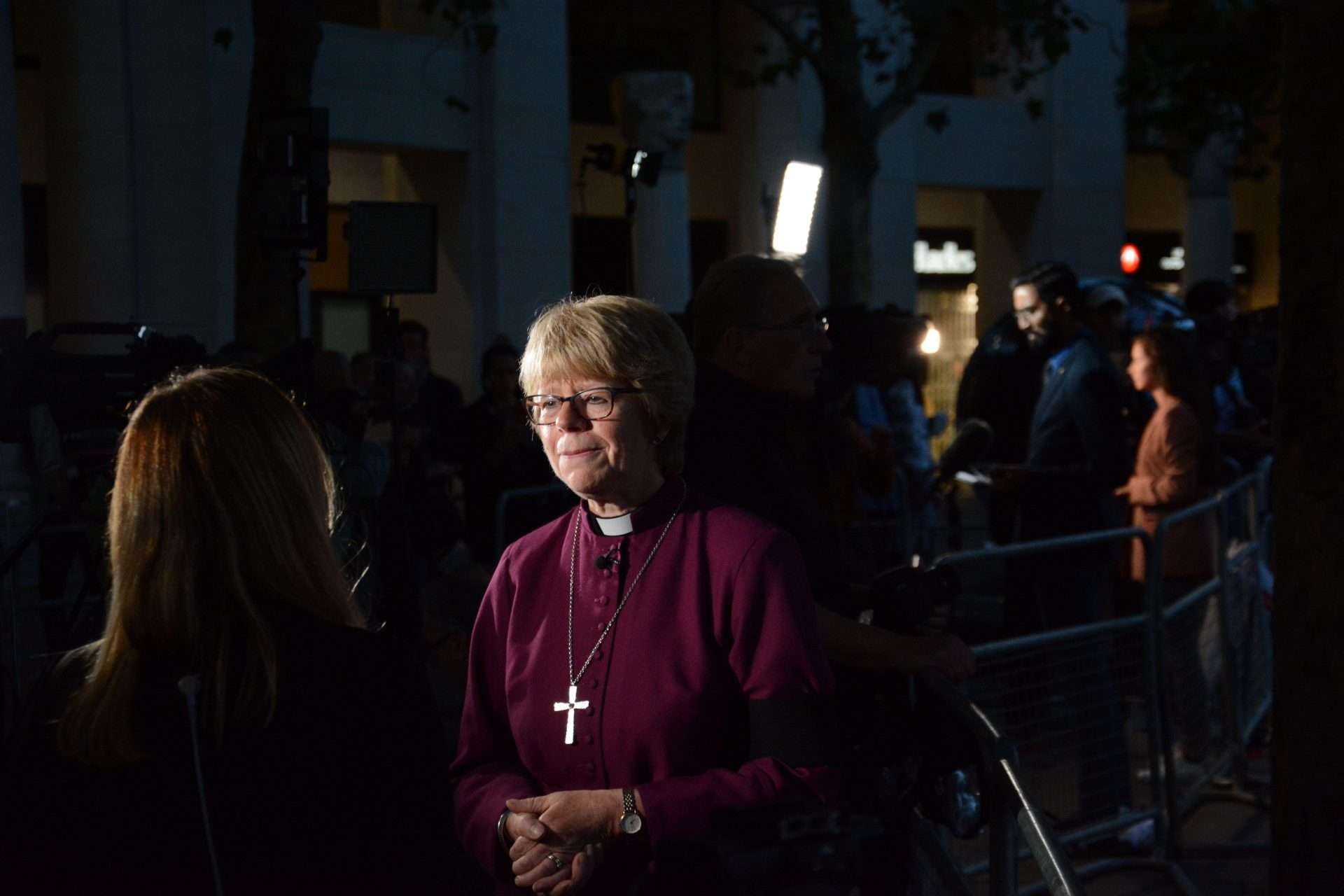
The Church of England has moved forward on women’s ordination with a woman chosen as Archbishop of Canterbury for the first time.

Alamy

The Church’s claim to have no authority to ordain women as priests has been likened to the “tardy” Christian response to the “scandal of slavery” by Irish theologian Fr Gerry O’Hanlon SJ.

The author and member of the Jesuit Centre for Faith and Justice described the core arguments for the exclusion of women from the priesthood as “unpersuasive”.

He was speaking as a woman, Bishop of London Sarah Mullally, was chosen as Archbishop of Canterbury for the first time.

O’Hanlon said it was time the Church “stopped beating about the bush and undertook a fair and open re-examination of current teaching”.

The Jesuit urged the hundreds of delegates, including bishops, who are due to attend the pre-synodal assembly of the Irish Synodal Pathway in Kilkenny later this month to request the Vatican to revisit the question of the ordination of women.

The preparatory document for the Irish pre-synodal assembly, Baptised and Sent, shows that the role of women, including ordination, is still a lively and contested topic, he noted.

Speaking at the launch of Soline Humbert’s memoir A Divine Calling about her vocation to priesthood, he said if God were truly behind this exclusion and this could be convincingly shown, then many would accept it. But “failing a persuasive explanation, one must suspect bias”.

Highlighting how the Pontifical Biblical Commission in the 1970s found that there was no Scriptural warranty for the Church’s position on excluding women from ordained ministry, he noted that theologian Karl Rahner, in the late 1970s, argued that the burden of proof should be with the Church to show this. “This burden has not been discharged,” Fr O’Hanlon said.

Describing himself as “disturbed, ashamed even” that it is taking so long to address the issue of female ordained ministry, he highlighted an article on the permanent diaconate in The Tablet last year by Cardinal Walter Kasper.

In it the German prelate wrote, “There are good reasons that make it theologically possible and pastorally sensible to open the permanent diaconate to women…each local church would be free to decide whether to make use of this possibility or not.”

Fr O’Hanlon said, “Let’s grasp this nettle and act from the gospel refrain: do not be afraid.”

Synod study groups on ‘controversial’ issues release interim reports by Cindy Wooden - Catholic News Service


Synod members, along with Pope Francis, attend the morning session in the Paul VI Audience Hall at the Vatican Oct. 15, 2024. Credit: CNS photo/Lola Gomez

My response: Looks like more “kicking can down the road” on women deacons. 

“On the question of the possible ordination of women to the diaconate, the report said that materials from the synod and contributions received more recently have been forwarded to the commission Pope Francis had set up in 2020 to continue studying the issue and which he “revived” during the Synod of Bishops on synodality.”

VATICAN CITY (CNS) — The study groups Pope Francis had established to provide an in-depth reflection on controversial, complex or “emerging” questions raised during the Synod of Bishops on synodality have published interim reports.

The groups were asked to look at questions including the formation of priests, the selection of bishops, women’s leadership in the church and ministry to LGBTQ Catholics.

The late pope had asked the groups to complete their work by June 2025, but Pope Leo XIV extended the deadlines to the end of the year.

However, Cardinal Mario Grech, secretary-general of the synod, said Nov. 17 that the work of some groups—“given the richness and complexity of most of the topics entrusted to them—has required more time than originally anticipated.”

The reports, the cardinal said, also include the initial work of a study group on “the liturgy in a synodal perspective,” which began working in late July.

The interim reports published Nov. 17 vary in their depth and detail, with some groups listing their members and providing concrete proposals and with others giving only a vague description of the methodology they were using.

The study group on priestly formation, which was focused ways to ensure future priests are educated in synodality—listening, discernment and shared responsibility with laypeople—said its members concluded that “a complete overhaul” of the Vatican and national guidelines for priestly formation “does not currently seem appropriate” because the guidelines are so recent.

But the group identified “a series of needs,” which it said “cannot be ignored.” These included: “the need to deepen the identity of ordained ministry in relational terms”; “joint formation moments involving laypeople, consecrated persons, ordained ministers and seminarians”; greater participation of women and families in formation; and a focus on missionary outreach.

The group’s final report, it said, would include: “Significant female figures in the history of the church; personal accounts from women currently engaged in church leadership; personal accounts from women serving within the Roman Curia”; the nature and exercise of authority in the church; “critical tensions regarding clericalism and male chauvinism”; and “the contribution of Pope Francis and Pope Leo XIV concerning the role of women in the church.”

On the question of the possible ordination of women to the diaconate, the report said that materials from the synod and contributions received more recently have been forwarded to the commission Pope Francis had set up in 2020 to continue studying the issue and which he “revived” during the Synod of Bishops on Synodality.

The study groups on the ministry of the bishop and on the role of nuncios and other papal representatives had a joint meeting to discuss a topic they both were looking at: the choice of bishops, the report said.

The group looking at bishops said its first focus was “the selection of candidates to the episcopacy in the perspective of a synodal and missionary church, highlighting the participation of the bishops of the territory and of the entire people of God in the process coordinated by the apostolic nunciature.”

The work was aided by the fact that Pope Francis gave then-Cardinal Robert F. Prevost, prefect of the Dicastery for Bishops, “the faculty to examine the confidential Instructions sent to Pontifical Representatives concerning the procedure for episcopal appointments.” The report gave no further details, however.

The group said its conclusions would include “the need to promote an understanding of the process of selecting candidates to the episcopacy as a spiritual journey, characterized at every stage by the search for the will of God for his church.”

Members of the group, it said, are not hoping just to get more people involved in the process of identifying potential bishops, “which could unduly slow down episcopal appointments, but rather to pursue qualitative improvement, for instance by ensuring balanced participation of clergy and laity, of men and women, and by valuing the role of participatory bodies within the local church.”

Commonly referred to as “Study Group Nine,” another group was focused on “Theological criteria and synodal methodologies for shared discernment of controversial doctrinal, pastoral and ethical issues,” including ministry to LGBTQ Catholics.

The final report of the synod in October 2024 had called for reflection on “the relationship between love and truth and the repercussions that it has on many controversial issues.”

The study group’s mandate also included a note from Pope Francis’ apostolic exhortation “Amoris Laetitia” that “not all discussions of doctrinal, moral or pastoral issues need to be settled by interventions of the magisterium. Unity of teaching and practice is certainly necessary in the Church, but this does not preclude various ways of interpreting some aspects of that teaching or drawing certain consequences from it.”

The two quotations, the report said, risk suggesting that love and truth as well as moral teaching and pastoral practice are separate issues but in the church’s view they always intersect.

The final report, it said, would deal with three main topics: “homosexuality; conflicts and the nonviolent practice of the Gospel; and violence against women in situations of armed conflict.”

“For these cases, a concise presentation will be offered of the positions upheld by tradition and the magisterium, the new questions that have recently emerged, concluding with some questions to be addressed in the discernment process, mentioning the principal references drawn from Scripture and anthropology, including contributions from the scientific disciplines,” it said.


River of Jordon by Peter Yarrow

 https://www.youtube.com/watch?v=rVWd7nPjJH8


Monday, November 17, 2025

Article by Brian McLaren on Dealing with Biases-Center for Action and Contemplation- Richard Rohr’s Meditations


We may live in the same country, the same city, or even under the same roof, but we live in different realities.

—Brian McLaren, Learning How to See 

CAC faculty member Brian McLaren is concerned about the cost of our increasingly limited ability to see beyond our religious or political points of view.  

Over the last decade, I have felt increasingly alarmed about the vitriol, distrust, and destructive miscommunication that are tearing people apart everywhere I turn … in nations, in religious communities, in businesses, in non-profit organizations, in friendships, even in families. 

On social media, name-calling, misinformation, and propaganda squeeze out intelligent, honest, respectful conversation. In the mass media, accusations of “fake news” fly in all directions, leaving people wondering who to trust. In the world of religion, shallow, mean-spirited, or profit-hungry preachers draw huge crowds week after week, and they consistently appeal, not to the better angels of human nature, but to our unspoken fears and unacknowledged prejudices.  

In the world of politics, uninformed, dishonest, and manipulative candidates keep winning elections, telling people not what they need to hear, but what they want to hear. Because of our polarization and paralysis, major problems are going unresolved, which intensifies frustration on all sides, and leaves (literally) billions of us vulnerable to populist demagogues. 

The social fabric seems to be stretching so tight that it might rip apart. That scares me. “What’s going on here?” I keep asking myself….  

Philosopher George Lakoff challenges the mistaken idea that arose during the Enlightenment that it is possible to see issues clearly, based entirely on reason:  

Enlightenment reason says everybody reasons the same way…. Enlightenment reason says that all you need to do is get the facts, and everybody will reason to the right conclusion, since everybody has the same reason. No. If they have different worldviews, they’ll reason to different conclusions. Enlightenment reason does not recognize different worldviews. Enlightenment reason doesn’t admit framing. It doesn’t admit metaphorical thought. It doesn’t admit the way people really work. [1] 

McLaren describes how bias results when our worldviews become solidified:  

Here’s the simple truth I began to see as I observed the decline in reasonableness, monitored the rise in dysfunctional and even dangerous discourse, and reviewed the academic literature: 

People can’t see what they can’t see. 

We all, yes, even me—and more shockingly, even you, have a whole set of assumptions and limitations, prejudices and preferences, likes, dislikes and triggers, fears and conflicts of interest, blind spots and obsessions that keep us from seeing what we could and would see if we didn’t have them. 

We are almost always unconscious of these internal obstacles to seeing and understanding, which makes it even harder for us to address them. We are, you might say, blind to what blinds us. The name for these unconscious internal obstacles is bias

Bias makes us resist and reject messages we should accept and accept messages we should resist and reject. In short … we can’t see what we can’t see because our biases get in the way. 

References:  
[1] George Lakoff, in Patt Morrison, “Linguist George Lakoff on what Democrats don’t understand—and Republicans do—about how voters think,” Los Angeles Times, Nov. 28, 2018. Accessed October 1, 2025. 

Brian McLaren, Why Don’t They Get It? Overcoming Bias in Others (and Yourself), rev. ed. (Self-published, 2019, 2024), 4–5, 9–10, e-book. 

Image credit and inspiration: Bud Helisson, untitled (detail), 2021, photo, Brazil, UnsplashClick here to enlarge imageThe lenses symbolize how our inherent biases—like favoring what confirms what we already believe or seeing only those like ourselves—can cloud our vision, reminding us that true clarity comes from looking again and being willing to see differently. 

Sunday, November 16, 2025

Article: Ireland/Limerick priest says Catholic Church must open priesthood to women


Mary Theresa and I traveled to Ireland to share the good news about the Association of Roman Catholic Women Priests.
Fr. Roy Donovan referred several women to us.
Annie Watson ARCWP and Anne Latour ARCWP 

The Irish clergy could face collapse if retirement rules hold.

The future of the Catholic Church's clergy in Ireland could be in jeopardy, with one Limerick priest claiming that every diocese would collapse if all priests retired at the current age of 75.

The warning came from Father Roy Donovan, a spokesperson for the Association of Catholic Priests (ACP) and parish priest in Caherconlish and St. Lawrence's in Limerick, following the ACP's recent Annual General Meeting (AGM) in Athlone. 

According to Father Donovan, the Irish clergy is becoming increasingly "top-heavy at the age level", with older priests finding themselves taking on more work and covering multiple parishes.

Speaking on Live 95's In the County, he said, "As we get older, we should have less work to do, and instead it's the very opposite. We're taking on more work, more parishes. We had a meeting for over 60s. In the group that I was in, most of the guys were over 75, and they were saying we can't stop now, the people need us, we've got to keep going, there'll be no one there to replace us."

This has resulted in priests in their 80s facing increased, demanding workloads, sometimes even being "more or less forced to keep going," even as their health declines.

Father Donovan characterised the current situation as a "crisis that has been in the making for 50 years" and a "man-made problem." 

He pointed to the significant loss of personnel since the 1970s and 80s as evidence of the Church hierarchy's failure to adapt and listen.

The core issue, according to the ACP, lies in the extremely narrow pool from which sacramental leaders can be chosen.

"The pool from which priests are coming from at the moment, you could say, is 0.0001%. You can’t be married, you can’t be a woman, so that excludes almost 99.99% of the people."

"Action should have come decades ago and opened up this pool to women and to married people and to ex-priests... We priests belong to the most exclusive club in Ireland. Every other organisation in Ireland have women and men as equals. We're the last ones, and we're still stubborn and refuse."

The ACP are calling for a shift toward person-centred decision-making regarding changes and transfers, rather than an administration-centred approach.

Father Donovan said that the entire structure and teaching of the Catholic Church requires major reform, especially at the highest levels, to reflect modern developments and move past centuries of gender inequality.
 

Thursday, November 13, 2025

Interview with Denise Hackert-Stoner ARCWP on Women Priests

Beyond the Brink Podcast

 https://podcasts.apple.com/us/podcast/beyond-the-brink-and-fighting-back-as-badass-women-priests/id1714456403?i=1000736359385

It’s hard to see what the Roman Catholic Church finds so threatening about women leaders when Denise Hackert-Stoner of Albany describes her Upper Room Inclusive Catholic Community. She’s been excommunicated from the traditional Church since her ordination and sees little prospect of it dropping its ban on women priests at least in her lifetime despite the massive pedophile priest scandal plaguing the institution. Women priests demand engagement, charity, compassion, beauty and see themselves as renegades.Denise Hackert-Stoner is an ordained priest in the Association of Roman Catholic Women Priests, and an active member of the Upper Room Inclusive Catholic Community in Albany, NY. As a presider in this community she prepares and participates in church celebrations, and sacramental occasions. She is also in direct service ministries along with friends at the Upper Room catering to the poor, immigrants and refugees. As a nature photographer, she can often be found out on a trail with her husband Scott, often on her knees or belly, inspecting some tiny living thing. Amazed at the beauty of nature and the Divine Presence in all of it, she records her thoughts in a weekly Substack in essays called Walking on God. She also uses her own and Scott’s images to illustrate music used in liturgies at the Upper Room. You can reach Denise at denisehstoner@aol.com, and you can read her Substack at https://denisehackertstoner.substack.com/


Catholic Public Witness for Immigrants


Tuesday, November 11, 2025

Impressive Inaugural Address-Catherine Connolly- President of Ireland


 https://m.youtube.com/watch?v=sqsOKN_Z4F0

Ireland “where everyone is valued” inclusive and diverse - 

… Where All voices are heard!”


I am grateful for Catherine Connolly and her vision for my homeland! 

As a member of the Association of Roman Catholic Women Priests walking in the footsteps of  Brigit of Kildare, I believe there is a thread connecting us with our cherished Celtic tradition and a new vision of inclusivity, diversity and equality that offers hope for our world today!

https://m.youtube.com/watch?v=sqsOKN_Z4F0 of partnership in community 


A Blessing For My Brother, Patrick, A Vietnam Veteran, and All Veterans on Veterans Day 2025


Bridget Mary with brother Patrick


Today, I called my brother, Patrick, who served in Vietnam, to share my gratitude for his service.

I offer this prayerful blessing for Patrick and for all veterans—those who returned home, those still carrying invisible wounds, and those who never made it back.

Patrick was drafted after high school.
In 1966, I had entered the convent and was learning the basics of religious life—nunhood 101—while my brother, like thousands of young soldiers, was thousands of miles away in harm’s way.

He served with the 101st Airborne Division. He wrote home a few times from Vietnam—just enough for us to know that things were bad, though he didn’t say much. He was hit once by shrapnel, thankfully not a serious injury, and he finished his full tour.
I wrote to him assuring him that the nuns were praying for him and for all those in the war.

In those days, we had no access to TV or newspapers in the convent, so I did not see the daily horrors of war the rest of the world watched. I only prayed and hoped for his safe return.

By grace, Patrick came home without visible scars.
It wasn’t until years later that we discovered a medal of honor tucked away in a box in the garage—something he never mentioned. He rarely talked about Vietnam, not to me, and not to our parents. Like so many veterans, he carried his memories privately.
He served his country honorably, returned home, married Valerie, and stayed close to family and friends.

So today, I remember my brother, and I remember all veterans—those who returned and rebuilt their lives quietly, those who carry wounds that the world cannot see, and those who paid the ultimate price.

A Blessing for Veterans

Loving God,
We ask your blessing on our veterans,
on those who served in distant lands,
on those who returned home changed forever,
and on those who gave their lives.

Bless those who still struggle with the memories of war,
those who bear scars—visible and invisible—
and those whose nights are too often filled with disturbing dreams.

Heal every wound:
the body’s pain, the spirit’s ache, the silent struggles of the heart.

Bless the families who waited, who prayed, who worried,
and who grieve.

May our gratitude not be limited to a single day
or to words alone.
Give us courage to work for peace and justice,
that no one has to engage in war again.
May we honor our veterans service
by building a world worthy of their sacrifice.

God of compassion and God of peace,
wrap our veterans in your tender embrace
and hold in eternal light those who have gone home to you.

Amen.