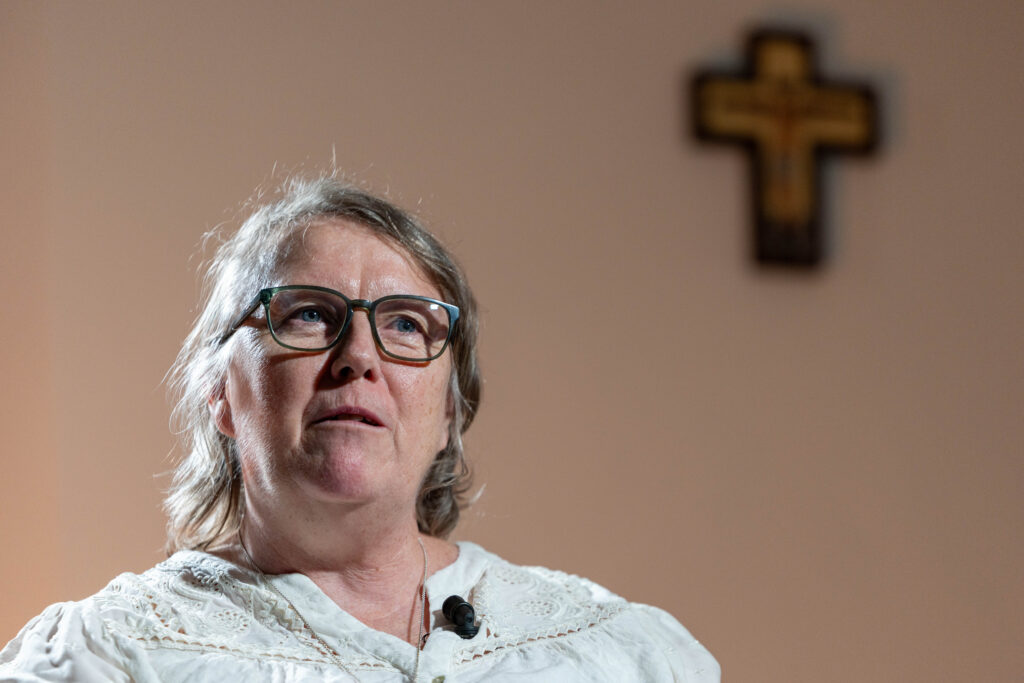
Karen King Discusses Mary Magdalene as a Leader

Karen King Discusses Mary Magdalene as a Leader
Today we remember St. Brigid of Kildare, a woman whose life continues to inspire contemporary disciples of Jesus to become living reflections of divine compassion, generous hospitality, mutual partnership, and deep love for creation.
Brigit lived the spirit of Jesus with remarkable courage and tenderness. Like Jesus of Nazareth, she welcomed women as full disciples, embraced the poor and the outcast, challenged unjust authority, and made hospitality a sacred act. The stories passed down about Brigit tell us of her radical generosity—food multiplied for the hungry, land shared with the poor, animals protected, and strangers welcomed as Christ himself. These are not quaint legends; they are Gospel truths embodied in a woman’s life.
Brigit’s inclusivity echoes the ministry of Jesus who dined with tax collectors and sinners, who crossed boundaries of gender, class, and purity, and who revealed a God whose love knows no limits. In Brigit’s world—and in ours—belonging is not earned. It is given. Her life proclaims that everyone belongs at the Banquet Table of Love, no matter who you are or where you come from. Here, we are loved totally, tenderly, and passionately in the heart of God.
In this way, Brigit stands in holy continuity with the first disciples—Mary Magdalene, Peter, and the many unnamed women and men who followed Jesus through the ages. Together, they remind us that discipleship has never been about uniformity, hierarchy, or exclusion. It has always been about relationship, courage, and love poured out for the life of the world.
According to early hagiographical sources, St. Brigid of Kildare was consecrated by Bishop Mel, who—according to tradition—mistakenly read the episcopal ordination prayers over her. Rather than retracting the rite, Bishop Mel is said to have affirmed that Brigit received episcopal authority from God. Together with Conleth, Brigit exercised mutual partnership as spiritual leaders of the double monastic community at Kildare.¹
Brigit also calls us into right relationship with creation. Her reverence for the land, for animals, for the rhythms of nature reflects a deeply incarnational faith—one that recognizes the sacred in all that God has made. In a time of ecological crisis, her witness urges us to live gently on the earth, to protect what is vulnerable, and to see creation itself as a partner in praising God.
We have come full circle in our own time. In contemporary inclusive communities, we are reclaiming Jesus’ original vision of discipleship—one rooted in baptismal equality, shared leadership, and mutual blessing. Like Brigit, we are called to trust our God-given gifts and to use them boldly for healing, justice, and reconciliation.
May St. Brigit of Kildare encourage us to open wide our doors, our tables, and our hearts. May her life remind us that Gospel hospitality is not optional—it is the very shape of love. And may we, like her, become radiant reflections of God’s compassion in a world longing to know that it truly belongs.
¹ This account appears in early medieval Irish hagiography, particularly in the Vita Sanctae Brigitae attributed to Cogitosus (7th century), which emphasizes Brigit’s spiritual authority and leadership at Kildare. While historians debate the literal historicity of Brigit’s episcopal consecration, many scholars agree that the story reflects the extraordinary authority Brigit held in the early Irish Church, where abbesses—especially at Kildare—often exercised leadership that surpassed that of bishops. See Cogitosus, Life of St. Brigid; Lisa M. Bitel, Land of Women: Tales of Sex and Gender from Early Ireland (Cornell University Press, 1996); and Joan Chittister, The Liturgical Year (Thomas Nelson, 2009). Feminist theologians interpret this tradition as evidence of early Christian models of shared, non-hierarchical leadership and women’s sacramental authority in the Celtic Church.
“The Beatitudes as a TED Talk”
Matthew 5:1-12a
February 1, 2026
Are you familiar with TED Talks? You can download an app or listen to them on YouTube. I’ve listened to many TED Talks over the years. In its simplest form, TED Talks are short, powerful presentations where a speaker shares one big idea—something meant to inform, inspire, or challenge the audience’s thinking. They are designed to make you walk away seeing the world a little differently.
So, imagine the Beatitudes not as ancient blessings spoken on a hillside, but as a modern TED Talk, consisting of a curious audience and a speaker who knows they’re about to flip the room’s assumptions upside down. Here goes . . .
The title of my TED Talk today is “Eight Surprising Clues to a Meaningful Life. I want to share eight ideas—eight startling truths that have shaped people’s lives for centuries.
They come from a teacher who looked at a crowd of ordinary people and said, “You are more blessed than you think.” He said this not because life was easy. Not because they were powerful.But because they were open. Let’s explore what he meant.
I call this “the power of admitting we don’t’ have it all together.” We live in a culture obsessed with confidence. But what if the real breakthrough comes when we admit our limits? When we say, “I don’t know,” we create space to learn. When we say, “I need help,” we create space for connection. Humility isn’t a deficit. It’s a doorway.
This means that grief is not a failure. We treat sadness like a malfunction. But grief is proof that we’ve loved deeply. This blessing isn’t about celebrating pain. It’s about recognizing that healing begins when we stop pretending we’re fine. Comfort finds us when we stop running from our own hearts.
This refers to strength without aggression. Meekness isn’t weakness. It’s strength under control. It’s the quiet person who doesn’t need to dominate the room. It’s the leader who listens before speaking. In a world full of noise, gentleness is disruptive.
This is about the courage to want a better world. Some people are satisfied with “good enough.” Others feel a deep ache for justice, fairness, and integrity. That ache is a blessing. It means you haven’t gone numb. The world changes because of people who refuse to stop caring.
Doesn’t this suggest compassion is a superpower? Mercy is the choice to see a person instead of a mistake. It’s the courage to forgive when revenge would be easier. Mercy doesn’t erase accountability. It simply refuses to dehumanize. And every act of mercy makes the world a little less cold.
This refers to living without a hidden agenda. We have nothing to hide. Imagine interacting with people who don’t manipulate, posture, or perform. Imagine being that person. Purity of heart isn’t about perfection. It’s about alignment—your actions matching your values. When your inner and outer life match, clarity follows.
Peace is something you build. Peace isn’t passive. It’s not the absence of conflict. It’s the presence of courage. Peacemakers step into tension with empathy, not hostility. They build bridges where others build walls. They don’t avoid hard conversations—they redeem them.
Jesus wants us to stand firm even when it costs us. If we stand for something meaningful, someone will push back. That’s not a sign we’re failing. It’s a sign we’re living with conviction. This blessing honors those who choose integrity over approval.
These eight ideas form an upsidedown vision of what it means to live well. You are blessed not when life is perfect, but when your heart is open, your compassion is active, your courage is alive, and your integrity is costly. The world doesn’t need more impressive people. It needs more blessed ones.
![]() |
| With my sister- in-law Valerie |
![]() |
| Jim Marsh ARCWP and Joan Chesterfield ARCWP |
![]() |
| Dotty Shugrue ARCWP and Mary Theresa Streck ARCWP |
![]() |
| Joan Pesce ARCWP |
![]() |
| Kathryn Shea ARCWP |
![]() |
| Jim Marsh ARCWP |
![]() |
| Mary Theresa Streck ARCWP |
![]() |
| Bridget Mary Meehan ARCWP with Sofia |
![]() |
| Dotty Shugrue ARCWP |

St. Patrick isn’t the only saint that gets a day of global celebration. Ireland’s second-most beloved saint, Brigid, has her special day on February 1. Brigid is associated with many miracles related to healing, and it's fitting that the day to commemorate her is also the traditional first day of spring in Ireland. Celebrations have been going on in Ireland for centuries, and in recent years have spread to the Irish diaspora.
How much do you know about this inspiring saint? Here are a few of our favorite facts about St. Brigid:
St Brigid was born in 451 in Dundalk in Ireland and died in 525. Born to a Christian slave who had been baptized by St. Patrick and a father who was both pagan and a wealthy chieftain in Leinster, she shares a name with the Celtic pagan Goddess of fire. She was a slave from birth, and was returned to her father as a child to be his servant. There is some controversy over whether she existed at all, with some speculating that she was invented to Christianize the old Celtic goddess, while others suggesting she was simply named after her.
Known for her generous nature, Brigid was freed from a life of bondage after her father, named Dubhthach, tired of her giving away his possessions to the needy. Dubhthach had brought Brigid to the King of Leinster, intending to sell her. While her father spoke to the king, Brigid gave away Dubhthach’s jeweled sword to a leper, enraging her father but prompting the Christian king to recognize her holiness. The king declared that her father should leave her alone, “for her merit before God is greater than ours”, freeing Brigid to follow her faith.
Brigid would go on to become a nun, and a disciple of St. Patrick. She founded several monasteries, including a vital center of religion and learning in Kildare, as well as a school of art that taught metalwork and illumination. The ornate beauty of an illuminated manuscript done by the scholars of Kildare prompted a medieval scholar to say “all this is the work of angelic, not human, skill”; sadly, the book has been lost for centuries. But today, the cathedral of Kildare stands on the site of one her early churches.
February 1 was originally celebrated as a pagan festival called Imbolc, marking the midpoint between the winter equinox and spring solstice, and the arrival of longer, warmer days. February 1 is when the daffodils start to bloom, the evenings start to lengthen, and the gloom of winter goes on its way. Brigid would be symbolically welcomed in Irish homes on the day, with a symbolic offering of food and drink. It is also traditional to make St. Brigid’s crosses out of rushes (a straw-like plant); people believed in olden days that these crosses would protect their thatched homes from fire.
But that’s not all – she’s also the patron saint of midwives, newborns, Irish nuns, fugitives, blacksmiths, dairymaids, boatmen, chicken farmers, cattle, scholars, sailors, and no doubt many more. She is also, along with Patrick and Columcille, one of the three patron saints of Ireland.
Like many women of her time, Brigid was a brewer of ale, and several of her miracles are associated with beer. In those days, beer was regarded as a sanitary, more nutritious alternative to water. Once asked for help by a party of thirsty lepers, Brigid spotted some bathwater being prepared; after she blessed the water it was transformed into beer. Similarly, she once transformed dirty bathwater into clean beer for visiting priests.
Her fondness for beer is commemorated in this delightful poem from the 10th century, in the voice of Brigid:
I'd like to give a lake of beer to God.
I'd love the heavenly
Host to be tippling there
For all eternity.
I'd love the men of Heaven to live with me,
To dance and sing.
If they wanted, I'd put at their disposal
Vats of suffering.
White cups of love I'd give them
With a heart and a half;
Sweet pitchers of mercy I'd offer
To every man.
I'd make Heaven a cheerful spot
Because the happy heart is true.
I'd make the men contented for their own sake.
I'd like Jesus to love me too.
I'd like the people of heaven to gather
From all the parishes around.
I'd give a special welcome to the women,
The three Marys of great renown.
I'd sit with the men, the women and God
There by the lake of beer.
We'd be drinking good health forever
And every drop would be a prayer.
Museum.ie
Our rural ancestors celebrated the day with a festive meal and a host of customs, all aimed at securing St Brigid’s protection and promise of new life and abundance for the year ahead.
The ancient goddess Brigid was associated with the main deities of pre-Christian Gaelic Ireland, the mythical Tuatha Dé Danann. As a fertility goddess she had links to other spring deities across Europe associated with rebirth of nature.
The Christian church adopted the ancient Celtic feast days that were linked to nature and amalgamated them into the Christian calendar. St Brigid’s Day was one of the ‘quarter days’ that marked a transition from one season to the next.
There followed Bealtaine at the start of summer (May 1); Lúnasa, which heralded the harvest season (August 1); and Samhain(November 1) was the beginning of the dark season. These quarter days and many Irish calendar festivals were linked to dates near to solar cycles of solstices and equinoxes.
Brigid the holy woman was a member of the Fogharta sect and has strong connections to the Leinster counties of Kildare and Louth, with hills, wells, shrines and churches in Faughart, north Louth (where she was born) and throughout Kildare where she founded her church. The possible foundations of a fire temple which held an everlasting flame is located in the lands of Kildare Cathedral (a flame continues to burn in the Solas BhrÃde centre nearby).
Brigid the saint, along with the other patron saints of Ireland, Patrick and Columba, was never officially made a saint by any Pope (in 1999, however, Pope John Paul II declared another Brigid, St Bridget of Sweden, founder of the religious order of Bridgettines, a patron saint of Europe).
St Brigid in Ireland is associated with nurturing, caregiving and protection from illness - attributes inherited from her ancient namesake.
The interlacing and merging of the characteristics of the goddess and the pagan symbolism of fire and water into those of the saint is similar to the weaving of the natural materials to form the St Brigid crosses.
Irish feast days were most often (or mostly) celebrated on the eve of the day itself as this was considered a very liminal time when the otherworld was very close and appeals for protection and blessing were most effective.
The festive meal in honour of the saint was a supper of potatoes and freshly churned butter; colcannon was made by adding chopped cabbage to the mashed potatoes.
Family members would take turns at pounding the potatoes. This was thought to bring luck and is prevalent in folk traditions, like taking a dash of a churn when making butter.
The feast meal was in thanksgiving for the previous year’s crops, tempered with hope and protection sought for the vegetable crops still to be sown. Afterwards the family made their St Brigid’s crosses.
The St Brigid’s Cross, pinned up above the front door or in the kitchen, is still a familiar feature in many Irish homes. The most recognisable cross is the four-armed St Brigid’s cross (popularised since 1961 by its use as an emblem for the national broadcaster RTÉ). This style was much favoured in the north of Ireland, yet the most popular throughout all of Ireland were variations of diamond-shaped crosses.
Regional styles and variations of St Brigid’s crosses existed and often numerous styles were made in each home. Traditional designs were diamond, interlaced or wheel-shaped and could have two, three or four arms.
The simplest crosses consisted of two strips of wood or straw plaits tied together to form a cross. Straw, rushes and reeds were the most common materials used but grass, hay, wood, goose quills, wire and fabric were also employed, and even sheaves of ripe corn and potatoes. The material was sprinkled with holy water before been made into a cross, while a prayer to welcome the saint into the home was often recited.
St Brigid’s Crosses were also hung in animal sheds. Leftover materials were sprinkled on the crops or incorporated into ropes or bedding for animals to invoke the saint’s blessing as she passed through the country on the eve of her feast day.
The previous year’s cross was often left in its place and the new one placed beside it or the old dried out one broken into fragments and scattered over the land or animals. Newlyweds or those with a new home were often gifted a St Brigid’s Cross for protection and to wish the couple well in starting a family.
On the eve of St Brigid’s day, a cake of bread or a piece of cloth or ribbon (Brat BrÃde or RibÃn BrÃde) was left outside on the windowsill or near the door. It was believed it would be touched by St Brigid on her travels and have the power to ward off illness and pain in both humans and animals. The material was safely kept and used for healing, or incorporated into clothing to offer protection to the wearer.
As for St Brigid’s brat (mantle or cloak); legend has it that in Co Kildare the local king agreed to give Brigid the amount of land that her cloak covered. Once laid, her cloak expanded over much of the county and the king had to forgo much of his land! (A relic of St Brigid’s cloak is kept in St Saviour’s Cathedral in Bruges, Belgium).
Spring, the season of hope, brought better weather and longer days. With it came new life on the farm and new growth on the land. St Brigid offered protection towards fertility for the household, farm, and land, and safeguarded people from illness and disease.
Communities venerated the saint and there were processions where her effigy was paraded represented as a doll. ‘Biddy Boys’ (or girls) went from house-to-house with ‘Biddy’, often a straw doll in a veil (like a bride) and cloak, collecting money and food for a St Brigid’s party, while reciting a rhyme similar to this one:
Here is Brigid dressed in white.
Give her something for the night.
She is deaf, she is dumb,
For God’s sake, give her some.[i]
The Biddy Boys were especially popular in Co Kerry where the dressed straw BrÃdeogs(brides) were almost life-size and were carried through the streets in elaborate parades.
In parts of Connacht, the Biddy Boys would carry a large plaited straw belt (Crios BrÃde) often with incorporated straw crosses. The inhabitants of each home passed through the circle of the belt while reciting a prayer to St Brigid in the hope of gaining the saint’s protection from illness during the coming year.
The belt was raised over the heads of the women and dropped down for them to step out of it. The male occupants had to go through sideways from left to right – arm, leg, head, then the other leg and arm.
This idea of passing through a portal is replicated at many of the holy wells dedicated to St Brigid. One can be found at Brideswell, Co Roscommon. The well was reconstructed in 1625 by the Earl of Antrim, Randal Mac Donnell (he had come with his wife and she partook of the spring waters and later became pregnant with their first child). The stone enclosure around the well allowed for pilgrims to make a stepped journey, as through a portal, to the depths of the well.
Holy wells are found all over Ireland. They are often located by a tree where votive offerings, usually of ribbons and rags are left by pilgrims, in the hope that their prayers will be remembered. It was traditional to visit these holy wells the evening before or on St Brigid’s feast day.
Blessed water from the wells was believed to be a cure for infertility, and for eye cures, based on the legend of St Brigid removing her eye so as not to be married to a suitor.
Beannachtaà na Féile BrÃde oraibh go léir!
[i] Danaher, Kevin, The Year in Ireland, Cork, 1972, p30
Danaher, Kevin, “The Year in Ireland”, Cork, 1972.
O’Dowd, Anne, “Straw Hay and Rushes in Irish Folk Tradition”, Dublin, 2015.
Ó Dúinn, Seán, “The Rites of Brigid, Goddess and Saint”, Dublin, 2005.
Ó’hÓgáin, DáithÃ, “Myth, Legend and Romance - An encyclopedia of Irish Folk Tradition”, London, 1990
https://www.vatican.va/content/john-paul-ii/en/motu_proprio/documents/hf_jp-ii_motu-proprio_01101999_co-patronesses-europe.html
McClintock, H. F. “The ‘Mantle of St. Brigid’ at Bruges.” The Journal of the Royal Society of Antiquaries of Ireland, vol. 6, no. 1, Royal Society of Antiquaries of Ireland, 1936, pp. 32–40.
Connolly, Sean, and J. M. Picard. “Cogitosus’s ‘Life of St Brigit’ Content and Value.” The Journal of the Royal Society of Antiquaries of Ireland, vol. 117, Royal Society of Antiquaries of Ireland, 1987, pp. 5–27,
I should like a great lake of beer for the King of Kings.
I should like the angels of Heaven to be drinking it through time eternal.
I should like excellent meats of belief and pure piety.
I should like the people of Heaven at my house.
I should like barrels of peace at their disposal.
I should like for them cellars of mercy.
I should like cheerfulness to be their drinking.
I should like Jesus to be there among them.
I should like the three Marys of illustrious renown to be with us.
I should like the people of Heaven, the poor, to be gathered around from all parts.
Image by Br Mikey McGrath OSFS
https://www.sacredheartmillhill.com/post/st-brigid-the-lake-of-beer
Liturgy in honor of St. Brigid of Kildare https://bridgetmarys.blogspot.com/2026/01/liturgy-for-st-brigid-of-kildare.html?m=1
![]() |
| Some members of Mary Mother of Jesus Inclusive Catholic Community gather for lunch in January 2026 |
What is named in the article “The Church is not (only) the Archbishop” is not unique to Asturias. It reflects a lived ecclesial reality found in grassroots communities across the global Church, including the inclusive communities we serve as Roman Catholic Women Priests. These communities embody a synodal Church grounded not in hierarchical control, but in shared prayer, discernment, and collective responsibility for living the Gospel.
In my own community, Mary Mother of Jesus Inclusive Catholic Community, members from Florida, Missouri, Illinois, California, and Connecticut gather weekly by Zoom for communal prayer and Eucharistic liturgy. Five women priests and one male priest serve in partnership with a liturgical team. All are welcomed to the table, homilies are dialogical, and decisions are made by consensus in a community of equals. This is not an alternative model of Church—it is the Church, alive among the People of God.
The Church is the People of God—baptized equals—women and men, lay and ordained, communities discerning together how to live the Gospel in their concrete social, political, and spiritual realities.
This vision is not new. It is rooted in the renewal of Second Vatican Council, which proclaimed that the joys and hopes, griefs and anxieties of the world—especially of the poor and afflicted—are the joys and hopes of the Church itself.
The voices of these grassroots Christians are the same longing that gave birth to the movement of Roman Catholic Women Priests:
When bishops in the institutional church speak in ways that stigmatize the “other,” or deflect responsibility from institutional harm, they do not speak for the whole Church. They speak from a position of power that has too often confused itself with the Gospel. As this article rightly names, this narrowing of the Church’s voice to the bishop silences the rich plurality of faith lived at the grassroots.
As a woman priest I am especially attentive to what is named here about the systematic exclusion of women in ordained ministry in the Church. This exclusion is not of divine origin. It is a product of history, culture, and fear of shared power. Baptism—not gender—is the foundation of Christian dignity and vocation. A Church that continues to deny women full participation in decision-making and sacramental leadership wounds its own credibility and betrays the inclusive praxis of Jesus of Nazareth.
I am hopeful that this article does not end in despair. Across Asturias, Spain, and the world, inclusive Catholic communities continue to gather around kitchen tables, parish halls, living rooms, and simple altars—breaking bread, praying, organizing, accompanying the wounded, and keeping faith alive. This is the Church rising in the Spirit of love for justice and equality.
Like these grassroots communities, women priests and our inclusive communities are living a new model of accountability, and shared responsibility. We are creating a Church that reflects the compassion, courage, and justice of Jesus—not one reduced to a single hierarchical voice.
We walk in hope with all who believe that another way of being Church is not only possible, but already unfolding.
A Church that is not with those who suffer ceases to be a Church of the people of God.
Article:
The Church is not (only) the archbishop
Grassroots Christians in Asturias are advocating for a social and synodal faith in opposition to the official discourse.
January 31, 2026
Photo: David Aguilar Sánchez.
Recommended
A graduate in Journalism, he has written for La Voz de Avilés, Atlántica XXII, El Norte de Castilla, and El Salto. He was co-editor and writer for the short film magazine Cortosfera.
The palace of Alfonso II could be in the area where traffic is planned to be diverted in La Vega
January 31, 2026
The Church is not (only) the archbishop
January 31, 2026
Don Vito lets loose and speaks his mind
January 31, 2026
Immigrants and trains. Illumination and hallucination.
January 31, 2026
In a stark room of the La Milagrosa parish in Gijón , there are hardly any decorations. A simple table, several chairs, papers, underlined books, and a radiator turned on, trying to ward off the afternoon chill. On one of the walls, a discreet crucifix receives the dim light of a day that threatens rain, though it hasn't yet arrived . The scene seems suspended, observed in silence.
Here meet José Manuel, MarÃa José —“Choche”— and Iñaki , three grassroots Christians who agree to talk to the journalist without haste, without slogans and without any intention of confrontation, but with a clear idea: the Church they live and believe in is not reduced to the voice of the archbishop of Oviedo, Jesús Sanz Montes.
They are not here to refute headlines or settle personal scores. What they want is to make visible a reality that, they say, remains hidden: in Asturias there is an organized, critical, and socially engaged Christianity that does not recognize itself in the archbishop's most recent public statements, especially on issues such as migration, Gaza, or the handling of sexual abuse in the Church.
Among grassroots Christians in Asturias, there are those who completely disagree with the opinions expressed by the Archbishop of Oviedo. Photo: David Aguilar Sánchez.
Who are they and where are they speaking from?
José Manuel, MarÃa José, and Iñaki do not represent a closed or homogeneous organization. They are part of a broad and diverse space , made up of lay people, priests, women and men from parishes, Catholic Action movements, Christian communities, and social associations. They define themselves as Christians for a synodal Church in Asturias , a network rather than a structure, a meeting point rather than an acronym.
“Grassroots Christians ,” they explain, doesn’t mean being outside the Church, but rather being at its base , living the faith in small communities, horizontally, sharing decisions, reflections, and commitments. “The Church isn’t just priests and bishops,” they insist. “If it stops there, it becomes nothing.”
Horizontality versus verticality: a historical tension
The word “horizontality” comes up early in the conversation. And with it, the acknowledgment of a tension they don't hide. The Catholic Church is a structurally vertical institution , but it also contains—or should contain—a horizontal, communal, and participatory dimension.
“The polarization we see in society also occurs within the Church,” they acknowledge, “and it is not only a theological issue, but also an organizational and ideological one.”
They don't speak of internal democracy in the strict sense, but of co-responsibility , of a Church where decisions don't come solely from the top, but arise from shared discernment. "In any human group there have to be responsibilities," explains José Manuel, "but it's another thing entirely whether authority is exercised as service or as power."
In this sense, they emphasize that the Church is not immune to the dynamics that affect any human organization, such as concentration of power, resistance to change, and conflicts between the rank and file and leadership. “The polarization we see in society also occurs within the Church,” they acknowledge, “and it is not only a theological issue, but also an organizational and ideological one.”
Vatican II: Living Memory and Point of Reference
Much of their discourse is anchored in an event they consider foundational: the Second Vatican Council . For them, it is not past history, but a living reference point. They recall the impetus for renewal ( aggiornamento ), the openness to the world, the changes in the liturgy, and, above all, a key idea: that the Church is not outside the world, but is part of it .
Iñaki quotes, reading from the beginning of Gaudium et Spes (Second Vatican Council) : “The joys and the hopes, the griefs and the anxieties of the men of this age, especially those who are poor or in any way afflicted, these are the joys and hopes, the griefs and anxieties of the disciples of Christ.”
For them, that text continues to point the way. The way of a Church incarnate in social reality, capable of rejoicing and suffering with ordinary people.
They acknowledge that the conciliar momentum initiated by John XXIII gradually slowed. And they point out, without mincing words, that the long pontificate of John Paul II was a period of stagnation , marked by the marginalization of liberation theology and the strengthening of more conservative ecclesial movements. “In 27 years, there’s time to appoint many bishops,” Iñaki notes. And those appointments, they say, leave their mark.
The arrival of Pope Francis was, for them, a surprise and a partial recovery of that spirit. The word synodality —walking together—appears as an update of Vatican II, not as a break. “It’s the same, but in today’s language,” José Manuel summarizes.
However, they acknowledge that the Pope's initiative clashes with the concrete reality of each diocese. In the Church, they say, each bishop governs his territory with considerable autonomy . And that is where they locate the current problem in Asturias .
“It’s not just about ideas,” they explain, “but about pastoral styles .” A bishop can encourage faith or discourage it. He can open spaces for participation or close them. He can facilitate dialogue or limit it to mere formalities. In their experience, the current management of the diocese relies much more on the “vertical stick” than on the horizontal.
“Jesús Sanz Montes speaks on behalf of Jesús Sanz Montes,” one of them summarizes, “not on behalf of the Church of Jesus of Nazareth.”
When the institutional voice prevails over the community
The name of the Archbishop of Oviedo inevitably comes up in the conversation, but José Manuel, MarÃa José, and Iñaki take care to put it in its proper perspective. They don't question his right to have an opinion or to express personal convictions. What they question is the position from which he speaks and the effect that has when the speaker does so on behalf of an institution that isn't solely his own .
“ Jesús Sanz Montes speaks on behalf of Jesús Sanz Montes,” one of them summarizes, “not on behalf of the Church of Jesus of Nazareth.” The problem, they explain, is that from his episcopal position his words are automatically projected as the voice of the entire Asturian Church , narrowing a much more pluralistic and diverse reality.
Sanz Montes at the blessing of the bouquet. Photo: Pablo Lorenzana
This unease stems not from an isolated statement, but from an accumulation of messages that, in their view, shift the pastoral focus toward a political and confrontational framework . This has occurred with migration , when the archbishop has questioned the regularization of foreigners, citing the impossibility of "welcoming everyone," even distancing himself from the position of the Episcopal Conference; with the "unbearable" massacre in Gaza , which the bishop once reduced to a "squabble" while discrediting humanitarian initiatives; and with Islam , through his use of expressions that many considered derogatory and stigmatizing. It has also happened with abuse, when he criticized, in an opinion column in the newspaper ABC, the agreement between the State and the Church for the recognition and reparation of victims of pedophilia within the Spanish clergy. This article prompted four victims' associations to ask the Pope to remove Jesús Sanz Montes from his position.
In all three cases—Gaza, migration, and abuse—grassroots Christians have made their position public, based on a principle they consider essential: standing with those who suffer . “It’s not ideology,” they insist. “It’s the Gospel.” They emphasize that the preferential option for the poor and marginalized is not a temporary political stance, but a central tenet of the Christian message.
The clash deepens when it comes to the treatment of sexual abuse within the Church. For these grassroots Christians, minimizing the scope of the problem or shifting the focus to external comparisons not only hurts the victims but also directly contradicts the path of recognition and reparation that the Church itself has begun to forge. According to the Ombudsman's report (2023), based on a public opinion survey, 1.13% of the adult population in Spain claims to have suffered sexual abuse in a religious setting , which, extrapolated to the entire population, represents approximately 440,000 people .Meanwhile, the database compiled by El PaÃs —which only includes known and documented cases —counts 2,948 victims of abuse within the Catholic Church in Spain .
These are different magnitudes—a population estimate and a count of documented cases—but both explain why, for José Manuel, MarÃa José, and Iñaki, the debate is not “media-driven” or ideological, but structural . When institutional discourse stops siding with those who suffer and instead focuses on protecting its image or power, they conclude, the Church moves away from its evangelical core. It is not a matter of sensitivities, “but of fidelity to the message of Jesus of Nazareth . ”
Self-criticism, power, and the exclusion of women
Far from adopting a defensive stance, José Manuel, MarÃa José, and Iñaki acknowledge that the Church is experiencing profound social disrepute and accept some responsibility. “We must have done something wrong,” they state clearly. They don't point solely to external factors, nor do they blame secularization or politics. They look inward.
They conclude that the exclusion of women is not part of the original message of Jesus of Nazareth, but rather a consequence of the institution's later evolution.
They list, without euphemism, some of the failings that, in their view, have eroded the institution's credibility: for example, the handling of sexual abuse, the alienation from the poor and those living on the margins, the reliance on empty rituals, and the obsession with maintaining power and influence. But among all of them, there is one they consider especially revealing: the systematic exclusion of women from decision-making spaces .
The role of women takes center stage in the conversation for a while, especially for MarÃa José. They denounce a historical discrimination that, they maintain, cannot be explained by sound theological reasons , but rather by cultural inertia and deeply entrenched power structures. They speak not only of access to the priesthood, but of something prior and more fundamental: dignity and shared responsibility .
Almudena GarcÃa, from the Women's Revolt in the Church. Photo: David Aguilar Sánchez
They reiterate that baptism is the same for men and women and that, from this foundation, there is no evangelical basis for structural inequality. The exclusion of women, they conclude, is not part of the original message of Jesus of Nazareth, but rather a consequence of the institution's subsequent evolution. And as long as this contradiction persists, they add, the Church will continue to struggle to regain credibility in a society that no longer accepts hierarchies without justification.
Discouragement, abstention, and loss of community
The conflict isn't just ideological. It has practical consequences. They speak of discouragement, of people quietly withdrawing, of a kind of ecclesial abstention. Believers who don't break away, but neither do they participate. "They stay home," they summarize.
The loss of generational succession exacerbates the situation. The Church is aging, and, they say, it's not enough to blame secularization. "The question is, what are we offering?" Iñaki asks.
This silent withdrawal coincides with a sustained decline in religious identification in Spain. According to the CIS Barometer of April 2025, around 55% of the population identifies as Catholic , and fewer than one in five consider themselves practicing . The gap between cultural affiliation and actual involvement is widening.
This is not a recent phenomenon. Long-term comparative data shows that, in the mid-1970s, almost nine out of ten Spaniards identified as Catholic. Today that proportion is around half, and among young people, it falls to just over 30% . Regular attendance at religious services has also steadily declined in recent decades.
Against this backdrop, the “abstention” that José Manuel, MarÃa José, and Iñaki speak of is not only a personal experience, but the everyday expression of a broader disaffection that the Church does not always manage to interpret without looking for culprits outside.
A Church beyond the archbishop
Despite everything, they don't project defeat. They insist that the Church is more than its hierarchy , more than a specific archbishop, more than an ideological line. It is community, it is assembly, it is encounter. And from that perspective, they want to continue working, without polarization, without sterile confrontations, but without abandoning dialogue.
“We are not asking for privileges,” they conclude. “We are asking for recognition that there are other voices, other ways of living the faith, and that the Church in Asturias not be identified with a single way of thinking.”
“A Church that is not with those who suffer ceases to be a Church,” adds MarÃa José.
The conversation ends and the room gradually returns to its usual silence. The radiator turns off. The light goes out too. A faint light filters in from the far window. Evening is turning into night. It hasn't rained yet. In one of the corners, almost hidden against the wall, the crucifix remains. It will still be there when they leave and close the door.