 |
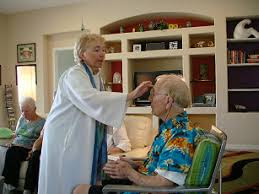
| Some members of Mary Mother of Jesus Inclusive Catholic Community gather for lunch in January 2026 |
What is named in the article “The Church is not (only) the Archbishop” is not unique to Asturias. It reflects a lived ecclesial reality found in grassroots communities across the global Church, including the inclusive communities we serve as Roman Catholic Women Priests. These communities embody a synodal Church grounded not in hierarchical control, but in shared prayer, discernment, and collective responsibility for living the Gospel.
In my own community, Mary Mother of Jesus Inclusive Catholic Community, members from Florida, Missouri, Illinois, California, and Connecticut gather weekly by Zoom for communal prayer and Eucharistic liturgy. Five women priests and one male priest serve in partnership with a liturgical team. All are welcomed to the table, homilies are dialogical, and decisions are made by consensus in a community of equals. This is not an alternative model of Church—it is the Church, alive among the People of God.
The Church is the People of God—baptized equals—women and men, lay and ordained, communities discerning together how to live the Gospel in their concrete social, political, and spiritual realities.
This vision is not new. It is rooted in the renewal of Second Vatican Council, which proclaimed that the joys and hopes, griefs and anxieties of the world—especially of the poor and afflicted—are the joys and hopes of the Church itself.
The voices of these grassroots Christians are the same longing that gave birth to the movement of Roman Catholic Women Priests:
- a Church grounded in synodality, not clericalism
- a Church where authority is exercised as service, not domination
- a Church that stands unequivocally with migrants, victims of violence, survivors of abuse, and all who suffer
- a Church that listens, discerns, repents, and changes
When bishops in the institutional church speak in ways that stigmatize the “other,” or deflect responsibility from institutional harm, they do not speak for the whole Church. They speak from a position of power that has too often confused itself with the Gospel. As this article rightly names, this narrowing of the Church’s voice to the bishop silences the rich plurality of faith lived at the grassroots.
As a woman priest I am especially attentive to what is named here about the systematic exclusion of women in ordained ministry in the Church. This exclusion is not of divine origin. It is a product of history, culture, and fear of shared power. Baptism—not gender—is the foundation of Christian dignity and vocation. A Church that continues to deny women full participation in decision-making and sacramental leadership wounds its own credibility and betrays the inclusive praxis of Jesus of Nazareth.
I am hopeful that this article does not end in despair. Across Asturias, Spain, and the world, inclusive Catholic communities continue to gather around kitchen tables, parish halls, living rooms, and simple altars—breaking bread, praying, organizing, accompanying the wounded, and keeping faith alive. This is the Church rising in the Spirit of love for justice and equality.
Like these grassroots communities, women priests and our inclusive communities are living a new model of accountability, and shared responsibility. We are creating a Church that reflects the compassion, courage, and justice of Jesus—not one reduced to a single hierarchical voice.
We walk in hope with all who believe that another way of being Church is not only possible, but already unfolding.
A Church that is not with those who suffer ceases to be a Church of the people of God.
Article:
The Church is not (only) the archbishop
Grassroots Christians in Asturias are advocating for a social and synodal faith in opposition to the official discourse.
January 31, 2026
Photo: David Aguilar Sánchez.
Recommended
A graduate in Journalism, he has written for La Voz de Avilés, Atlántica XXII, El Norte de Castilla, and El Salto. He was co-editor and writer for the short film magazine Cortosfera.
The palace of Alfonso II could be in the area where traffic is planned to be diverted in La Vega
January 31, 2026
The Church is not (only) the archbishop
January 31, 2026
Don Vito lets loose and speaks his mind
January 31, 2026
Immigrants and trains. Illumination and hallucination.
January 31, 2026
In a stark room of the La Milagrosa parish in Gijón , there are hardly any decorations. A simple table, several chairs, papers, underlined books, and a radiator turned on, trying to ward off the afternoon chill. On one of the walls, a discreet crucifix receives the dim light of a day that threatens rain, though it hasn't yet arrived . The scene seems suspended, observed in silence.
Here meet José Manuel, María José —“Choche”— and Iñaki , three grassroots Christians who agree to talk to the journalist without haste, without slogans and without any intention of confrontation, but with a clear idea: the Church they live and believe in is not reduced to the voice of the archbishop of Oviedo, Jesús Sanz Montes.
They are not here to refute headlines or settle personal scores. What they want is to make visible a reality that, they say, remains hidden: in Asturias there is an organized, critical, and socially engaged Christianity that does not recognize itself in the archbishop's most recent public statements, especially on issues such as migration, Gaza, or the handling of sexual abuse in the Church.
Among grassroots Christians in Asturias, there are those who completely disagree with the opinions expressed by the Archbishop of Oviedo. Photo: David Aguilar Sánchez.
Who are they and where are they speaking from?
José Manuel, María José, and Iñaki do not represent a closed or homogeneous organization. They are part of a broad and diverse space , made up of lay people, priests, women and men from parishes, Catholic Action movements, Christian communities, and social associations. They define themselves as Christians for a synodal Church in Asturias , a network rather than a structure, a meeting point rather than an acronym.
“Grassroots Christians ,” they explain, doesn’t mean being outside the Church, but rather being at its base , living the faith in small communities, horizontally, sharing decisions, reflections, and commitments. “The Church isn’t just priests and bishops,” they insist. “If it stops there, it becomes nothing.”
Horizontality versus verticality: a historical tension
The word “horizontality” comes up early in the conversation. And with it, the acknowledgment of a tension they don't hide. The Catholic Church is a structurally vertical institution , but it also contains—or should contain—a horizontal, communal, and participatory dimension.
“The polarization we see in society also occurs within the Church,” they acknowledge, “and it is not only a theological issue, but also an organizational and ideological one.”
They don't speak of internal democracy in the strict sense, but of co-responsibility , of a Church where decisions don't come solely from the top, but arise from shared discernment. "In any human group there have to be responsibilities," explains José Manuel, "but it's another thing entirely whether authority is exercised as service or as power."
In this sense, they emphasize that the Church is not immune to the dynamics that affect any human organization, such as concentration of power, resistance to change, and conflicts between the rank and file and leadership. “The polarization we see in society also occurs within the Church,” they acknowledge, “and it is not only a theological issue, but also an organizational and ideological one.”
Vatican II: Living Memory and Point of Reference
Much of their discourse is anchored in an event they consider foundational: the Second Vatican Council . For them, it is not past history, but a living reference point. They recall the impetus for renewal ( aggiornamento ), the openness to the world, the changes in the liturgy, and, above all, a key idea: that the Church is not outside the world, but is part of it .
Iñaki quotes, reading from the beginning of Gaudium et Spes (Second Vatican Council) : “The joys and the hopes, the griefs and the anxieties of the men of this age, especially those who are poor or in any way afflicted, these are the joys and hopes, the griefs and anxieties of the disciples of Christ.”
For them, that text continues to point the way. The way of a Church incarnate in social reality, capable of rejoicing and suffering with ordinary people.
Photo: David Aguilar Sánchez
They acknowledge that the conciliar momentum initiated by John XXIII gradually slowed. And they point out, without mincing words, that the long pontificate of John Paul II was a period of stagnation , marked by the marginalization of liberation theology and the strengthening of more conservative ecclesial movements. “In 27 years, there’s time to appoint many bishops,” Iñaki notes. And those appointments, they say, leave their mark.
The arrival of Pope Francis was, for them, a surprise and a partial recovery of that spirit. The word synodality —walking together—appears as an update of Vatican II, not as a break. “It’s the same, but in today’s language,” José Manuel summarizes.
However, they acknowledge that the Pope's initiative clashes with the concrete reality of each diocese. In the Church, they say, each bishop governs his territory with considerable autonomy . And that is where they locate the current problem in Asturias .
“It’s not just about ideas,” they explain, “but about pastoral styles .” A bishop can encourage faith or discourage it. He can open spaces for participation or close them. He can facilitate dialogue or limit it to mere formalities. In their experience, the current management of the diocese relies much more on the “vertical stick” than on the horizontal.
“Jesús Sanz Montes speaks on behalf of Jesús Sanz Montes,” one of them summarizes, “not on behalf of the Church of Jesus of Nazareth.”
When the institutional voice prevails over the community
The name of the Archbishop of Oviedo inevitably comes up in the conversation, but José Manuel, María José, and Iñaki take care to put it in its proper perspective. They don't question his right to have an opinion or to express personal convictions. What they question is the position from which he speaks and the effect that has when the speaker does so on behalf of an institution that isn't solely his own .
“ Jesús Sanz Montes speaks on behalf of Jesús Sanz Montes,” one of them summarizes, “not on behalf of the Church of Jesus of Nazareth.” The problem, they explain, is that from his episcopal position his words are automatically projected as the voice of the entire Asturian Church , narrowing a much more pluralistic and diverse reality.
Sanz Montes at the blessing of the bouquet. Photo: Pablo Lorenzana
This unease stems not from an isolated statement, but from an accumulation of messages that, in their view, shift the pastoral focus toward a political and confrontational framework . This has occurred with migration , when the archbishop has questioned the regularization of foreigners, citing the impossibility of "welcoming everyone," even distancing himself from the position of the Episcopal Conference; with the "unbearable" massacre in Gaza , which the bishop once reduced to a "squabble" while discrediting humanitarian initiatives; and with Islam , through his use of expressions that many considered derogatory and stigmatizing. It has also happened with abuse, when he criticized, in an opinion column in the newspaper ABC, the agreement between the State and the Church for the recognition and reparation of victims of pedophilia within the Spanish clergy. This article prompted four victims' associations to ask the Pope to remove Jesús Sanz Montes from his position.
In all three cases—Gaza, migration, and abuse—grassroots Christians have made their position public, based on a principle they consider essential: standing with those who suffer . “It’s not ideology,” they insist. “It’s the Gospel.” They emphasize that the preferential option for the poor and marginalized is not a temporary political stance, but a central tenet of the Christian message.
The clash deepens when it comes to the treatment of sexual abuse within the Church. For these grassroots Christians, minimizing the scope of the problem or shifting the focus to external comparisons not only hurts the victims but also directly contradicts the path of recognition and reparation that the Church itself has begun to forge. According to the Ombudsman's report (2023), based on a public opinion survey, 1.13% of the adult population in Spain claims to have suffered sexual abuse in a religious setting , which, extrapolated to the entire population, represents approximately 440,000 people .Meanwhile, the database compiled by El País —which only includes known and documented cases —counts 2,948 victims of abuse within the Catholic Church in Spain .
These are different magnitudes—a population estimate and a count of documented cases—but both explain why, for José Manuel, María José, and Iñaki, the debate is not “media-driven” or ideological, but structural . When institutional discourse stops siding with those who suffer and instead focuses on protecting its image or power, they conclude, the Church moves away from its evangelical core. It is not a matter of sensitivities, “but of fidelity to the message of Jesus of Nazareth . ”
Self-criticism, power, and the exclusion of women
Far from adopting a defensive stance, José Manuel, María José, and Iñaki acknowledge that the Church is experiencing profound social disrepute and accept some responsibility. “We must have done something wrong,” they state clearly. They don't point solely to external factors, nor do they blame secularization or politics. They look inward.
They conclude that the exclusion of women is not part of the original message of Jesus of Nazareth, but rather a consequence of the institution's later evolution.
They list, without euphemism, some of the failings that, in their view, have eroded the institution's credibility: for example, the handling of sexual abuse, the alienation from the poor and those living on the margins, the reliance on empty rituals, and the obsession with maintaining power and influence. But among all of them, there is one they consider especially revealing: the systematic exclusion of women from decision-making spaces .
The role of women takes center stage in the conversation for a while, especially for María José. They denounce a historical discrimination that, they maintain, cannot be explained by sound theological reasons , but rather by cultural inertia and deeply entrenched power structures. They speak not only of access to the priesthood, but of something prior and more fundamental: dignity and shared responsibility .
Almudena García, from the Women's Revolt in the Church. Photo: David Aguilar Sánchez
They reiterate that baptism is the same for men and women and that, from this foundation, there is no evangelical basis for structural inequality. The exclusion of women, they conclude, is not part of the original message of Jesus of Nazareth, but rather a consequence of the institution's subsequent evolution. And as long as this contradiction persists, they add, the Church will continue to struggle to regain credibility in a society that no longer accepts hierarchies without justification.
Discouragement, abstention, and loss of community
The conflict isn't just ideological. It has practical consequences. They speak of discouragement, of people quietly withdrawing, of a kind of ecclesial abstention. Believers who don't break away, but neither do they participate. "They stay home," they summarize.
The loss of generational succession exacerbates the situation. The Church is aging, and, they say, it's not enough to blame secularization. "The question is, what are we offering?" Iñaki asks.
This silent withdrawal coincides with a sustained decline in religious identification in Spain. According to the CIS Barometer of April 2025, around 55% of the population identifies as Catholic , and fewer than one in five consider themselves practicing . The gap between cultural affiliation and actual involvement is widening.
This is not a recent phenomenon. Long-term comparative data shows that, in the mid-1970s, almost nine out of ten Spaniards identified as Catholic. Today that proportion is around half, and among young people, it falls to just over 30% . Regular attendance at religious services has also steadily declined in recent decades.
Against this backdrop, the “abstention” that José Manuel, María José, and Iñaki speak of is not only a personal experience, but the everyday expression of a broader disaffection that the Church does not always manage to interpret without looking for culprits outside.
A Church beyond the archbishop
Despite everything, they don't project defeat. They insist that the Church is more than its hierarchy , more than a specific archbishop, more than an ideological line. It is community, it is assembly, it is encounter. And from that perspective, they want to continue working, without polarization, without sterile confrontations, but without abandoning dialogue.
“We are not asking for privileges,” they conclude. “We are asking for recognition that there are other voices, other ways of living the faith, and that the Church in Asturias not be identified with a single way of thinking.”
“A Church that is not with those who suffer ceases to be a Church,” adds María José.
The conversation ends and the room gradually returns to its usual silence. The radiator turns off. The light goes out too. A faint light filters in from the far window. Evening is turning into night. It hasn't rained yet. In one of the corners, almost hidden against the wall, the crucifix remains. It will still be there when they leave and close the door.
No comments:
Post a Comment