Translate

Monday, August 22, 2016

Homily by Donna Rougeux ARCWP, "Dance and Talk at the Same Time"

Donna Rougeux ARCWP 
at Gethsemane Monastery where Thomas Merton is buried


Jeremiah 1:4-19
Luke 13:10-17
Dance and Talk At The Same Time
By Donna Rougeux

We are shaped by what other people think of us. There are rules in our families and in our communities that shape us. This is a good thing when our culture shapes us with life-giving and healthy influences of encouragement and nurturing. This is devastating when we are shaped by those who want to be in control and are motivated by hate, fear and greed.

I have always wanted to learn ballroom dancing. I took a free lesson last year and I was amazed what happened in that 45 minute lesson. The instructor gave me a pattern to follow and I focused intently on the pattern but as I was trying to focus on the pattern the instructor started asking me questions so as to learn more about me. I told him that I couldn't talk because I would mess up the pattern that I was trying to remember. To my amazement before the 45 minute lesson was over I was able to talk and dance at the same time!

In today’s gospel Jesus breaks the pattern of the faithful Pharisees by healing on the Sabbath. In a way Jesus is teaching the Pharisees to dance and talk at the same time. The Pharisees seemed to think the rules about the Sabbath were more important than healing the bent over woman. The Pharisees could only focus on the pattern. They could not talk and dance at the same time. When rules and patterns dominate our thinking we are unable to dance or to live fully and well.

The woman in today’s gospel was bent over and imprisoned by a sprit that kept her from living fully and well. The oppressive powers of an evil spirit kept her eyes toward the ground and she was unable to be who God created her to be. It seems that she was being oppressed by a culture that wanted to control her using hate, fear and greed. This kept her bent over for eighteen years.

The passage from Jeremiah is the call story of this prophet. Jeremiah tells God that he is too young to be called. Jeremiah is afraid of this call and tells God that he will not have the words he needs to be a prophet. God touches Jeremiah’s lips and encourages him to let go of his fear so that God can work through him. God even tells Jeremiah that he will face great challenges and destruction but God will deliver him.

 The call to live our lives to the fullest in a way of becoming our true selves often  involves a struggle. We have to learn the patterns but not be controlled by them. We have to speak the words that God gives us so we can be part of bringing the kingdom to earth as it is in heaven. The great news is we are not alone in learning to live fully and well and in answering our call from God to be our true self. Jesus touches our wounds and heals us so that we can stand up and praise God the way the woman did.

God says to Jeremiah, “They will fight against you; but they shall not prevail against you, for I am with you, says the Lord, to deliver you.”

What evil spirit is keeping you bent down? What call does God have for you? Are you, like Jeremiah telling God that you are unworthy of the call? Does it feel like the culture around you is encouraging you or destroying you? Are you trapped by trying to follow certain patterns or can you dance and talk at the same time?

Hear the words that God says to Jeremiah and that God says to you:

“They will fight against you; but they shall not prevail against you, for I am with you, says the Lord, to deliver you.”


Be healed by the touch of Jesus so that you can live fully and well the life you are created to live. If you stand up like the woman in the Gospel and allow Gods words to be your words like Jeremiah then you will be able to talk and dance at the same time. You will be free to be who God created you to be. Trust God who will deliver you. Stand up to the evil spirits so that you can praise God and be used by God to bring the kindom to earth as it is in heaven.

Sunday, August 21, 2016

Donna Rougeux ARCWP Officiates at Wedding in Lexington, KY


Congratulations to the brides Chassidy Runyon and Michelle Taylor
 in Lexington, Kentucky. Donna Rougeux ARCWP
(standing between two brides officiated at the 
at their wedding) 

Who Am I? by Rev. Dr. Barbara Billey, Priest ARCWP, Heart of Compassion International Faith Community (Windsor, Ontario, Canada), Aug 21, 2016


Who am I? While having a sense of who I am can help us find our way in the world as a young adult, this question seems less relevant as we deepen into our spiritual journey. It requires us to put ourselves and others in categories and to imagine differences, leading to all kinds of "isms" - sexism, racism, and ageism, as well as war and other violences. A more primary question might be: How are we receptive to a Loving God who breathes us?


Far removed from self-limiting, ego-identification, our true identity is one with Holy Essence. Jesus, our brother lived this knowing; the Cosmic Christ presences us in this reality. However, our tendency is to define God as God is defining us. How? Often by holding onto our favorite theologies, the doctrine and dogma of our faith tradition, and how we think we know God through our experience.


What does Divine Mystery seek? Twelfth century mystic, Meister Eckhart invites us to deconstruct our definitions of God: "The highest and loftiest thing that one can let go of is to let go of God for the sake of God."


When we limit God to absolute terms (e.g. God the Father), we limit our Divine potential and that of others. Separation from one another can become both soul suppressing and collective violence; surrendering is the antidote.


In her recent book, Come, Drink Deep of Living Waters: Faith Seeking Understanding in the 21st Century, theologian Barbara Fiand (2016) identifies with Holy Presence who "calls us from within even as it encounters us from without. We touch it as our center and from there are moved beyond ourselves. Unsolicited [and often] unexpected it embraces and holds us, and yet it sets us free. It grounds us and releases us simultaneously" (Fiand 60).


This Holy "It", a Living God, intimate but ineffable, is always re-conceiving us for new seeing and being. In truth, we can never fully know the answer to Who am I?


Barbara Billey, M.Ed., M.A., D.Min, Windsor, Ontario, Canada is a registered psychotherapist and art therapist who presences a wide range of youth and adults. As a priest with the Heart of Compassion International Faith Community, she facilitates inclusive liturgies using sacred arts as a bridge to the Sacred. An urban priest and compassion activist, Barbara is mobilizing citizens to seek adoption of the Charter for Compassion by her local municipal government. Through the Wisdom Women Circles of Compassion Initiative, she supports the empowerment of young women from several faith traditions using creative expression. She was ordained a priest with ARCWP on July 25, 2015.

Mary Mother of Jesus Inclusive Catholic Community Anoints Sally Brochu to prepare for surgery this week

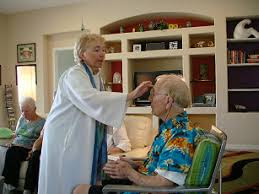
Janet Blakeley anoints Sally Brochu 
with holy chrism 
as community prays for healing for Sally,who is scheduled to have surgery this coming week. 
For the first centuries of the church's history, the community prayed for the sick and anointed them with oil. Anointing of the sick was a lay, not a clerical ministry. Only after the collapse of the Roman Empire, did the Frankish bishops succeed in creating a clerical anointing of the sick rite. It became an anointing of the dying, known as extreme unction. 
See pp. 288-290 in scholarly text: Deconstructing Sacramental Theology and Reconstructing Catholic Ritual by Joseph Martos, retired professor of theology and philosophy. 


Roman Catholic Woman Priest to Host Pink Smoke Over Vatican by Susan Olp, Billings Gazette

http://billingsgazette.com/lifestyles/faith-and-values/religion/lifelong-catholic-s-journey-leads-her-to-priesthood/article_64316700-32ef-540c-a171-23717262bead.html


"Lorello has never been one to shy away from living out her convictions. 

The lifelong Catholic partially credits that to her parents.


“My mother taught me prayer, my father taught me justice, 

and both (attributes) have been extremely helpful in my life,”
 Lorello said Wednesday in a telephone interview from her home in Long Island, N.Y.


Lorello, who has been a peace activist, has engaged in civil disobedience. 

But she’s always seen that as a final option.


“I didn’t get up and say ‘I think I’ll be arrested today,'” she said.

 “That’s a last resort, otherwise it contributes to the violence you’re trying to prevent.”


Lorello, 83, has master’s degrees in theology and pastoral counseling. 

Both aided her in her lay parish ministry over the years.


Much of her work was in adult formation, at one church teaching 

precepts of the faith, especially in the aftermath of Vatican II. 
Then she moved to another parish and took on other roles, “
but mostly in the teaching area.”


She earned a certification in spiritual direction and 

another as a midlife/long-life directions consultant.


“I did workshops on personal and spiritual growth in

 midlife and beyond not only locally but in other states,” Lorello said.
 “I even went to Ireland.”


Lorello, the mother of seven, has nine grandchildren, 

one great-grandson and another great-grandchild on the way. 
She never felt pulled toward the more traditional path for women — 
becoming a nun.

Lorello has many friends in different religious orders 

who are dedicated to their work, for whom 
she has tremendous respect. But it wasn’t for her.

“My call centered on bread, wine, oil and water,” Lorello said. 

“And those are the sacramental elements.”

The desire first arose in childhood. She struggled 

for a time not because of the call, but 
“I had doubt if this what God wanted me to do.”


Lorello put the thought aside during her teenage years. 

The turning point came while she was in college and she was given “The Seven Storey Mountain,” an autobiography by Thomas Merton, a Catholic monk.


The book focused on his journey through life in search 

of a faith, his conversion to Catholicism and his acceptance into the Trappist order. 
As Lorello read it, the book touched her soul on a very personal level.


And even though she never met Merton, who died in 1968, through 

his writings he became her mentor. 

It was after a visit to the Abbey of Gethsemani, where Merton lived,
 that Lorello finally knew the course she should take.


“It convinced me that my call was indeed a call from God for the priesthood,” she said.


Lorello called Roman Catholic Womenpriests and asked for an application, 

which she promptly put into a drawer. 
A year later, she submitted the paperwork, and she was ordained in 2013.


Lorello knew her ordination went against canon law, which states, 

“A baptized male alone receives sacred ordination validly.”


“Ecclesiastically, that’s an unjust law,” she said. “

According to Martin Luther King Jr. and Gandhi, an unjust law is no law.”


Lorello knew that her actions meant she would no longer be

 allowed to work in a Catholic parish. 
But she viewed the choice as a different kind of civil 
disobedience, a last option.


“I’ve waited through five popes and

 I’m going to be ordained as a last resort, to do the sacramental work I was called to do,” Lorello said.


She is among the more than 200 women who have been ordained since 2002.


"We're not a schismatic group," Lorello said. 

"We're about reforming the church, bringing inclusivity, bringing equality."


Lorello presides over a weekly house church. 

She also teaches spiritual direction, visits the sick, and 
conducts baptisms and wedding ceremonies.


She was pleased that Pope Francis recently called for the creation of 

a commission to study the possibility of allowing women to serve as
 deacons in the Catholic Church. 
It is uncertain what that study will conclude, but Lorello views it as a positive step.


“I won’t see it in my lifetime, the church ordaining women,” she said.

 “But it’s going to come, and this is a step in that direction."

Roman Catholic Woman Priest to Host Pink Smoke Over Vatican by Susan Olp, Billings Gazette

http://billingsgazette.com/lifestyles/faith-and-values/religion/lifelong-catholic-s-journey-leads-her-to-priesthood/article_64316700-32ef-540c-a171-23717262bead.html


"Lorello has never been one to shy away from living out her convictions. The lifelong Catholic partially credits that to her parents.
“My mother taught me prayer, my father taught me justice, and both (attributes) have been extremely helpful in my life,” Lorello said Wednesday in a telephone interview from her home in Long Island, N.Y.
Lorello, who has been a peace activist, has engaged in civil disobedience. But she’s always seen that as a final option.
“I didn’t get up and say ‘I think I’ll be arrested today,'” she said. “That’s a last resort, otherwise it contributes to the violence you’re trying to prevent.”
Lorello, 83, has master’s degrees in theology and pastoral counseling. Both aided her in her lay parish ministry over the years.
Much of her work was in adult formation, at one church teaching precepts of the faith, especially in the aftermath of Vatican II. Then she moved to another parish and took on other roles, “but mostly in the teaching area.”
She earned a certification in spiritual direction and another as a midlife/long-life directions consultant. 
“I did workshops on personal and spiritual growth in midlife and beyond not only locally but in other states,” Lorello said. “I even went to Ireland.”
Lorello, the mother of seven, has nine grandchildren, one great-grandson and another great-grandchild on the way. She never felt pulled toward the more traditional path for women — becoming a nun.
Lorello has many friends in different religious orders who are dedicated to their work, for whom she has tremendous respect. But it wasn’t for her.
“My call centered on bread, wine, oil and water,” Lorello said. “And those are the sacramental elements.”
The desire first arose in childhood. She struggled for a time not because of the call, but “I had doubt if this what God wanted me to do.”
Pause
Current Time0:00
/
Duration Time0:00
Loaded: 0%
Progress: 0%
0:00
Fullscreen
00:00
Unmute
Lorello put the thought aside during her teenage years. The turning point came while she was in college and she was given “The Seven Storey Mountain,” an autobiography by Thomas Merton, a Catholic monk.
The book focused on his journey through life in search of a faith, his conversion to Catholicism and his acceptance into the Trappist order. As Lorello read it, the book touched her soul on a very personal level.
And even though she never met Merton, who died in 1968, through his writings he became her mentor. It was after a visit to the Abbey of Gethsemani, where Merton lived, that Lorello finally knew the course she should take.
“It convinced me that my call was indeed a call from God for the priesthood,” she said.
Lorello called Roman Catholic Womenpriests and asked for an application, which she promptly put into a drawer. A year later, she submitted the paperwork, and she was ordained in 2013.
Lorello knew her ordination went against canon law, which states, “A baptized male alone receives sacred ordination validly.”
“Ecclesiastically, that’s an unjust law,” she said. “According to Martin Luther King Jr. and Gandhi, an unjust law is no law.”
Lorello knew that her actions meant she would no longer be allowed to work in a Catholic parish. But she viewed the choice as a different kind of civil disobedience, a last option.
“I’ve waited through five popes and I’m going to be ordained as a last resort, to do the sacramental work I was called to do,” Lorello said.
She is among the more than 200 women who have been ordained since 2002. 
"We're not a schismatic group," Lorello said. "We're about reforming the church, bringing inclusivity, bringing equality."
Lorello presides over a weekly house church. She also teaches spiritual direction, visits the sick, and conducts baptisms and wedding ceremonies.
She was pleased that Pope Francis recently called for the creation of a commission to study the possibility of allowing women to serve as deacons in the Catholic Church. It is uncertain what that study will conclude, but Lorello views it as a positive step.
“I won’t see it in my lifetime, the church ordaining women,” she said. “But it’s going to come, and this is a step in that direction."

Gazette.

"Focus on Preaching, Key to Ending Clericalism" by Jim Purcell, National Catholic Reporter


"What we need in today's Roman Catholic church is a redistribution of power and authority. Pope Francis' openness to the possibility of having women deacons is not nearly enough to achieve this essential organizational revolution.
Yes, opening the diaconate to women would be a good and much-needed change. But as some commentators have pointed out, it still leaves women in a "secondary" position to priests.
Some of those same commentators argue that women need to be ordained priests to level the playing field. While I support the ordination of women as priests, I would argue for a different and more important change first.
Francis should change canon law so one does not have to be a priest to be the "pastor" of a parish. Give qualified lay men and women and male and female deacons real power and authority to lead some of our faith communities.
This change would have two important consequences. It would disconnect the roles of priest and pastor and significantly change the culture of clericalism that Francis rightly deplores.
Perhaps more significant, it would have the potential to shift the emphasis of pastoral leadership from the celebration of the Eucharist back to the preaching of the kingdom.
In 1970, as part of the implementation of the Second Vatican Council's Constitution on the Sacred Liturgy, the Congregation for Divine Worship issued its General Instruction on the Roman Missal. Chapter 1 of this document says: "The celebration of the Mass ... is the center of the whole Christian life for the universal Church, the local Church and for each and every one of the faithful."
As a young priest ordained in 1965, I embraced this description of the Mass and its place in the life of the church. Even after resigning from ordained ministry in 1972 to marry the love of my life, I continued to see Mass as central to my spiritual life. However, over time, and especially in the last 10 years, my views have changed significantly.
For Jesus, preaching had a much greater emphasis in his ministry than presiding at the Eucharist. The Gospels only record two instances of Jesus presiding at a special meal between the time he began his public ministry and his resurrection and ascension into heaven: the Last Supper and the post-Resurrection encounter on the road to Emmaus.
Reflecting on other New Testament writings has also influenced my changing viewpoint on the place of the Eucharist in my life.
  • Jesus preached the coming of the kingdom of God, not himself (quite different from the emphasis on the consecration of the bread and wine and his "real presence" -- that developed over time).
  • Jesus taught his disciples the "Our Father," not how to "preside at the Eucharist" or "say Mass."
  • In John's Gospel account of the Last Supper, there is no mention of the bread and wine becoming the body and blood of Christ. The "washing of the feet" is all about a kingdom of servant leadership and discipleship.
  • In the Acts of the Apostles, the emphasis is on living a Christian life -- sharing everything, including daily bread. The special breaking of the bread ceremony was only one piece of this life.
  • Deacons were created not so that the apostles could preside at the Eucharist more frequently but so that the apostles (the "priests") could spend more time preaching the word. Deacons were asked to pay special attention to the needs of the sick and the poor.
My life as a believing Catholic is a faith journey. The Eucharist is a very special food for my journey, but the journey is primary, not the food. There are many sources of spiritual food for my journey of faith and we are blessed with many women of faith whose leadership capabilities qualify them to help lead this journey.
The RCIA journey is a good paradigm. It is an adult journey where the Eucharist plays an important part. However, what happens both before and after the reception of first Eucharist is all about the journey and how the Holy Spirit is also a source of energy/nourishment for the journey. Focusing on the sacramental theology of baptism, confirmation and the Eucharist as a moment in time instead of as "food for the journey" would be a mistake.
How many RCIA programs do women of faith lead? These women (and many laymen) have already demonstrated they have the talent to lead faith communities.
So how do we reconcile the perspective I have outlined above with the more common understanding of the Eucharist as central to the Christian Catholic life? Why the shift in emphasis, over time, from a celebration of the paschal mystery as food for the journey to an emphasis on the "real presence," "transubstantiation" and the power of the ordained priest to "confect" the body and blood of Christ ex opere operato?
This shift came about as part of the development of and changes in the church's understanding of ordained priesthood and its connection to the Eucharist (and the development of clericalism and a centralization of power in ordained clerics that accompanied this change), along with a growing lack of appreciation for the importance of preaching the Gospel.
The "power" to change bread and wine into the body and blood of Christ is intoxicating, and for too many priests, this power has overshadowed or eclipsed the importance of preaching the kingdom in word and deed.
This hierarchy of power has developed over two millennia and is little changed since the Middle Ages. In fact, its monarchical structure, with a pope and bishops, is a mirror image of the kings, emperors and feudal lords who ruled during the Middle Ages.
It is time for us, as a church, to emphasize more the need to recruit and form disciples committed to living a Gospel life and emphasize less the need to ordain more celibate men to the priesthood. Many women of faith are capable of leading the effort to recruit and form disciples. And this effort needs to happen most of all at the parish level.
We also need to change the formation of our faith journey leaders to give primacy to the roles of teaching and preaching in ways that would call people to true discipleship. This formation needs to emphasize more the knowledge and skills needed to lead faith communities, as opposed to the current emphasis on the power to "say Mass," "forgive sins," and hand on the "deposit of faith."
Imagine the impact on clericalism if priests and deacons were studying and growing spiritually alongside future lay leaders of our faith communities.
Francis is to be applauded for his critique of clericalism and careerism and his emphasis on the Gospel call to bring peace and justice into everyone's life, especially that of the poor. But if he and others do not make significant changes in the Catholic church's current power structure and help us return to an emphasis on its mission to call people to discipleship by preaching peace and justice, I believe his efforts will fall far short of what we and the world need from us and our church today.
We need some big changes in our church and the time is now. "
[Jim Purcell, an NCR board member, worked for many years for Catholic Charities in San Francisco and San Jose. He recently retired after 18 years at Santa Clara University where he served as vice president for university relations and special assistant to the president.]