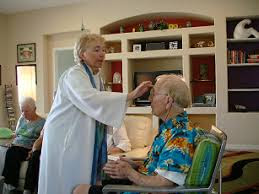

Recently, George, a member of my Florida retirement community, asked me to create and preside at a Celebration of Life for his beloved wife, Nancy, who had died after living with Alzheimer's disease.
As I listened to George share his loving memories of Nancy and prepared a service to celebrate her life, I experienced a beautiful realization about my own journey as a Roman Catholic woman priest.
My ministry had grown far beyond the walls of a church or the boundaries of a Catholic congregation. I had become a priest for anyone and everyone who reached out to me—whether to celebrate Eucharist, anoint someone who was ill, share a prayer, grieve the loss of a loved one, or simply find comfort in a listening heart.
I realized once again that priesthood is not about institutional authority or religious status. It is about being present to people with the compassionate love of Christ, wherever they are, especially in life's most tender and difficult moments.
I experience this same joy in our inclusive Catholic community, where we gather every week on Zoom to celebrate Eucharist together. Our members join us from Florida, California, Arizona, Illinois, Missouri, and Ireland. Though separated by many miles, we are united in faith, friendship, prayer, and love.
We listen to the Scriptures, share our reflections in dialogue homilies, pray for one another, and celebrate God's loving presence in the breaking of bread. Around our Eucharistic table, everyone is welcome, everyone has a voice, and everyone belongs.
For me, this is the heart of the Gospel and the kind of priesthood Jesus calls us to live—a ministry without walls, a community without barriers, and a table where no one is excluded.
This is the Church I love. This is the Church we are becoming. And this is the joyful, hope-filled vision that Roman Catholic Women Priests are bringing to life today.
The Spirit Is Calling Us to Something New
Something wonderful is happening in our Church!
Women and people of all genders are answering God's call to priestly ministry, proclaiming the Gospel, celebrating the sacraments, and nurturing inclusive Catholic communities where everyone is cherished.
For centuries, women have sustained the life of the Church. They have taught our children, cared for the sick, comforted the grieving, proclaimed God's love, challenged injustice, and kept communities alive through extraordinary acts of faith and compassion.
Yet women continue to be excluded from ordained priestly ministry in the institutional Roman Catholic Church.
In his 1994 apostolic letter Ordinatio Sacerdotalis, Pope John Paul II reaffirmed the official teaching that the Catholic Church has no authority to ordain women as priests. The argument rests principally on Jesus' selection of twelve male apostles and the Church's understanding of its continuous tradition.
As Roman Catholic Women Priests, we respectfully but firmly challenge that conclusion. We believe that the Holy Spirit calls people of all genders to ordained ministry and that no human institution can place limits on God's gifts.
We are not rejecting our Catholic faith. We are embracing its deepest values: love, justice, compassion, equality, and the sacred dignity of every person.
And we are not alone in this conviction.
Decades of biblical scholarship, historical research, and feminist theology invite us to rediscover the remarkable contributions of women to Christianity and to reconsider the theological arguments used to exclude them.
This scholarship does not answer every historical question or settle every theological disagreement. But it opens our eyes to a much richer story of Christian ministry than many of us were taught.
Jesus Welcomed Women as Disciples and Leaders
When I read the Gospels, I am continually inspired by the way Jesus welcomed women, listened to their wisdom, and entrusted them with important responsibilities.
Luke tells us that Mary Magdalene, Joanna, Susanna, and other women traveled with Jesus and supported his ministry (Luke 8:1–3).
Mary of Bethany sat at Jesus' feet as a disciple, learning from her teacher (Luke 10:38–42).
The Samaritan woman engaged Jesus in a profound theological conversation and then invited her neighbors to encounter him (John 4).
And Mary Magdalene became the first person commissioned to announce the resurrection in John's Gospel (John 20:11–18).
What an extraordinary responsibility Jesus entrusted to her!
Mary Magdalene, remembered as the Apostle to the Apostles, reminds us that women were not simply standing on the sidelines of Jesus' ministry. They were disciples, witnesses, and proclaimers of the Good News. (See my book The Impossible Circle: Encounters with Women of the Bible.
In her groundbreaking book In Memory of Her: A Feminist Theological Reconstruction of Christian Origins (1983), Elisabeth Schüssler Fiorenza demonstrates the importance of women's leadership in the earliest Christian movement. Her scholarship invites us to recover a discipleship of equals rooted in mutual service, shared responsibility, and the liberating message of Jesus.
Biblical scholar Karen L. King, in The Gospel of Mary of Magdala: Jesus and the First Woman Apostle (2003), examines an early Christian text portraying Mary Magdalene as a visionary teacher whose authority is challenged by male disciples.
Although the Gospel of Mary is not part of the New Testament, it reveals that questions about women's spiritual authority were being debated among early Christians.
These discoveries touch my heart because they remind me that women's leadership is not foreign to Christianity.
Women were there from the beginning, proclaiming the Good News, building communities, and witnessing to the transforming love of God.
If Jesus entrusted Mary Magdalene with announcing the resurrection, why should women today be excluded from proclaiming the Gospel and presiding at the Eucharist?
Remembering the Women Who Helped Build the Church
The letters of Paul and the Acts of the Apostles introduce us to women whose contributions were essential to the growth of Christianity.
Phoebe was identified by Paul as a diakonos of the church at Cenchreae and a benefactor of many, including Paul himself (Romans 16:1–2).
Junia was described, together with Andronicus, as prominent among the apostles (Romans 16:7).
Priscilla, together with Aquila, instructed Apollos in the Christian faith (Acts 18:26).
Lydia opened her home to a community of believers (Acts 16:14–15, 40).
Nympha hosted a church in her home (Colossians 4:15).
Euodia and Syntyche were recognized by Paul as coworkers who struggled alongside him in the work of the Gospel (Philippians 4:2–3).
These women were not merely helping from the margins. They were teaching, organizing, supporting, and sustaining Christian communities.
Carolyn Osiek, Margaret Y. MacDonald, and Janet H. Tulloch, in A Woman's Place: House Churches in Earliest Christianity (2006), demonstrate the importance of women's homes, resources, relationships, and leadership in the growth of early Christianity.
Historian Gary Macy, in The Hidden History of Women's Ordination: Female Clergy in the Medieval West (2008), examines how the meaning of ordination changed over centuries and documents women who exercised recognized religious ministries.
Macy does not claim that all these ministries were identical to the contemporary Catholic priesthood. Rather, his research challenges the assumption that the Church's understanding of ordination and women's relationship to ordained ministry has always remained unchanged.
Historian Ute E. Eisen, in Women Officeholders in Early Christianity (2000), studies inscriptions and literary evidence identifying women with ministerial titles such as diakonos, presbytera, and episcopa.
The meaning of some inscriptions remains debated. Certain titles may refer to actual ministries, while others may describe family relationships or honorary status.
Nevertheless, these sources reveal a more complex history of women's religious leadership than is often acknowledged.
Phyllis Zagano, in Holy Saturday: An Argument for the Restoration of the Female Diaconate in the Catholic Church (2000), provides important historical and theological evidence concerning women deacons.
The evidence for women serving as deacons is more direct than the evidence for women exercising a priesthood equivalent to today's Catholic presbyterate. Recognizing this distinction strengthens, rather than weakens, the integrity of our historical inquiry.
For me, the significance of this scholarship is deeply spiritual.
When we recover the stories of women whose ministries have been forgotten or diminished, we restore something precious to the memory of the Church.
We honor their faith. We celebrate their courage. And we recognize that the Holy Spirit has been working through women throughout Christian history.
The Church becomes more faithful to its own story when it remembers the women who helped build it.
Ida Raming and Iris Müller: Courageous Scholars Who Opened the Way
Among the women whose courage helped make our movement possible, Ida Raming and Iris Müller hold a special place in my heart.
Long before the historic ordinations on the Danube River in 2002, these two Catholic theologians were challenging the historical and theological arguments used to exclude women from priesthood.
During the Second Vatican Council, they prepared a theological appeal calling for women's admission to ordained ministry. Their contribution appeared in Gertrud Heinzelmann's 1964 collection Wir schweigen nicht länger!—We Will No Longer Remain Silent!
What a prophetic title!
At a time when women had little influence over official Church deliberations, Raming and Müller were asking courageous questions.
Was the exclusion of women from priesthood truly God's will? Or had centuries of cultural prejudice shaped the Church's understanding of women's spiritual authority?
Ida Raming pursued these questions in her pioneering historical and canonical research, published in English as The Exclusion of Women from the Priesthood: Divine Law or Sex Discrimination? (1976).
She examined how assumptions about women's inferiority had influenced canon law and theological arguments. Her scholarship challenged the idea that the exclusion of women could simply be accepted as an unchanging divine command.
Iris Müller explored discrimination against women in theological education and religious leadership. Her work challenged the barriers that prevented women from fully contributing their gifts to the Church.
Together, they helped establish an essential principle of feminist Catholic theology: our traditions must be examined in the light of the Gospel whenever they appear to deny the dignity and equality of God's people.
But their witness did not end with scholarship.
After decades of research, prayer, and advocacy, Ida Raming and Iris Müller answered their own call to priesthood.
On June 29, 2002, they were among seven women ordained on the Danube River.
Imagine the joy of that moment!
Two women who had spent so many years studying and challenging the exclusion of women were now participating in a historic act of faith and courage.
Their scholarship had become prophetic action.
For those of us who followed them into ordained ministry, their example remains a wonderful source of inspiration.
They remind us that theology is not simply about ideas. It is about transforming lives, challenging injustice, and helping God's people experience the fullness of divine love.
Ida Raming and Iris Müller did more than question a closed door. Through their faithful witness, they helped open that door for generations of women called to priestly ministry.
God Calls Us All: A Theology of Gospel Equality
At the heart of my theology is a simple but profound conviction: every person is created in the image of God, and every person is loved beyond measure.
Genesis 1:27 proclaims that humanity is created in God's image.
This sacred truth is the foundation of our dignity and equality.
No gender possesses a greater capacity to reflect God's wisdom, compassion, holiness, or love.
Feminist theologian Elizabeth A. Johnson, in She Who Is: The Mystery of God in Feminist Theological Discourse (1992), challenges the tendency to identify God primarily with masculine images and authority.
Her work invites us to encounter the Holy Mystery beyond the limitations of human gender and to recognize that women's experiences and spiritual wisdom are essential to a fuller understanding of God.
If God is not male, why should being male be considered essential to representing Christ in priestly ministry?
I believe that Jesus' humanity, not his masculinity alone, is central to our understanding of how Christ reveals God's love.
When a woman preaches the Gospel, comforts someone who is grieving, anoints a person who is ill, or presides at Eucharist, she can reveal Christ's healing and compassionate presence.
The apostle Paul proclaims in Galatians 3:28 that divisions of ethnicity, social status, and gender do not determine our unity in Christ.
Although this passage does not directly address ordination, it offers a powerful vision of baptismal equality.
Rosemary Radford Ruether, in Sexism and God-Talk: Toward a Feminist Theology (1983), challenges patriarchal assumptions that have shaped Christian theology and calls for a faith that promotes the liberation and flourishing of all people.
These feminist theological insights resonate deeply with my understanding of Jesus' ministry.
Jesus did not establish a community in which some people were more sacred than others.
He welcomed those who were excluded, shared meals with people considered unworthy, healed the suffering, and challenged religious practices that placed burdens on people's lives.
He washed his disciples' feet and taught them that leadership means service (John 13:1–17).
For me, Gospel equality is not simply a theological principle. It is a way of loving, serving, and being Church together.
Priesthood as Divine Accompaniment and Loving Service
I believe we need a renewed theology of priesthood that moves beyond clerical privilege and institutional power.
Priesthood is not about standing above God's people. It is about walking with them.
It is about being present when a family welcomes a new child, when a loved one is dying, when someone is struggling with illness, when people gather around a Eucharistic table, or when a person simply needs someone to listen.
This is what I mean by divine accompaniment.
God is not a distant ruler demanding obedience from afar. God is the loving Presence who walks with us through every joy and sorrow, inviting us into healing, communion, and transformation.
The ministry of Jesus reveals this divine companionship in profoundly human ways.
He touches those who suffer. He shares meals with those who are excluded. He listens to people whose voices have been ignored. He calls his followers to love one another as he has loved them.
Susan A. Ross, in Extravagant Affections: A Feminist Sacramental Theology (1998), explores the ways God's grace becomes visible through embodied relationships, love, and human experience.
Ilia Delio, in The Unbearable Wholeness of Being: God, Evolution, and the Power of Love (2013), offers a dynamic vision of divine love drawing creation toward deeper relationship and wholeness.
These insights enrich my understanding of sacramental ministry.
God's presence is not confined to a sanctuary or limited to the actions of an ordained minister.
We encounter divine love in the breaking of bread, in the healing touch of a friend, in the kindness of a neighbor, in the beauty of creation, and in the courage of people who work for justice.
The Eucharist celebrates this sacred reality.
When we gather around the table, we remember Jesus' life, death, and resurrection. We give thanks for God's abundant love and commit ourselves to becoming the Body of Christ in our world.
Our calling is not simply to receive Christ's presence but to become that presence for others.
That is why an open Eucharistic table matters so deeply to me.
The table belongs to Christ, whose love is offered freely. Our calling is to make that love visible, not to place barriers around it.
From the Danube to a Growing International Movement
The contemporary Roman Catholic Women Priests movement began on June 29, 2002, when seven courageous women were ordained priests on a boat on the Danube River near Passau, Germany.
They were Iris Müller, Ida Raming, Pia Bruner, Dagmar Celeste, Adelinde Roitinger, Gisela Forster, and Christine Mayr-Lumetzberger.
Their ordination by Bishop Rómulo Antonio Braschi challenged the Catholic Church's prohibition against ordaining women.
The Vatican responded by declaring the women excommunicated. The women, however, understood their actions as an expression of fidelity to God's call and to the Gospel's vision of equality.
In 2003, Christine Mayr-Lumetzberger and Gisela Forster received episcopal ordination from male bishops whose identities have remained confidential. Patricia Fresen was ordained a bishop in 2005.
Our movement affirms that its episcopal lineage preserves apostolic succession. The Vatican, however, does not recognize the sacramental validity of women's ordinations.
These differing understandings remain a serious theological and ecclesial disagreement.
Yet the women continued to answer God's call, and the movement spread.
My Own Journey into Priesthood
On July 31, 2006, I was blessed to be among eight women ordained priests in Pittsburgh, Pennsylvania.
That day was one of the most joyful moments of my life.
For many years, I had experienced God's call to priestly ministry. My ordination affirmed that call and opened new possibilities for serving God's people.
On April 19, 2009, I was ordained a bishop in Santa Barbara, California, along with Andrea Johnson, Regina Nicolosi, and Joan Houk.
I understood episcopal ministry not as a promotion to greater power but as a call to accompany, encourage, and support others in their vocations.
The joy of priesthood and episcopal ministry, for me, has always been found in relationships—with people who are searching, suffering, celebrating, praying, and discovering God's presence in their lives.
The Birth of ARCWP: A Community of Equals
On October 21, 2010, the Association of Roman Catholic Women Priests (ARCWP) emerged as a distinct branch of the international Roman Catholic Women Priests movement.
Our vision was not simply to ordain women into existing clerical structures.
We wanted to help renew the Church itself.
We embraced a model of leadership rooted in baptismal equality, consensus decision-making, mutual trust, and shared responsibility.
In our community of equals, bishops are members of the circle, not rulers standing above it.
Priests serve alongside the people rather than exercise exclusive control over their spiritual lives.
All members are encouraged to share their gifts, participate in discernment, and contribute to the mission of the community.
Our mission is to spiritually prepare, ordain, and support women and people of all genders for renewed priestly ministry in inclusive communities of equals.
This vision is deeply connected to the Second Vatican Council's understanding of the People of God in Lumen Gentium.
The Council affirmed the dignity and vocation of all the baptized and the universal call to holiness.
We believe that these principles invite the Church to explore more fully how baptismal equality can shape ministry, leadership, and sacramental life.
Growing Across Continents
Our movement continues to grow through the dedication of women serving in different cultures and communities.
In September 2015, ARCWP celebrated the episcopal ordinations of Michele Birch-Conery and Mary Eileen Collingwood for North America and Olga Lucía Álvarez Benjumea for Latin America.
On June 24, 2025, Christina Moreira was ordained a bishop in Spain, an important milestone for our movement in Europe.
On December 8, 2026, we plan to celebrate the episcopal ordinations of Blanca Azucena Caicedo and Lucero del Socorro Arias Manco for ministry in Latin America.
I rejoice in the faithful witness of these women and the communities that have called them to serve.
Their ministries reflect the beautiful diversity of our international movement.
In Latin America, inclusive Catholic communities are drawing on rich traditions of grassroots faith, liberation theology, pastoral accompaniment, and shared leadership.
These communities remind us that priesthood flourishes when it is rooted in the lives and struggles of ordinary people.
The Spirit is calling women across continents, cultures, and generations to help bring a renewed Church to life.
Living Gospel Equality in Our Inclusive Communities
One of the greatest blessings of my ministry has been witnessing how inclusive Catholic communities flourish when people are free to share their spiritual gifts.
In our Mary Mother of Jesus Inclusive Catholic Community, we celebrate Eucharist every week with people joining us from different parts of the United States and Ireland.
Our liturgies include shared prayer, inclusive language, dialogue homilies, and active participation by community members.
We listen to one another's experiences of Scripture and discover how the Gospel speaks to our daily lives.
We pray for the sick, comfort the grieving, celebrate life's blessings, and support one another through difficult times.
Some members have felt excluded from institutional churches. Others are searching for a spiritual home where their questions, experiences, and gifts are welcomed.
What brings us together is not agreement on every theological question.
It is our shared desire to follow Jesus and grow in love.
We welcome divorced and remarried Catholics, LGBTQ+ people, seekers, doubters, and people from different religious backgrounds.
No one needs to prove that they are worthy of God's love.
Our Eucharistic table is open because we believe that God's love is already embracing us all.
I often think how much Jesus would delight in such a gathering!
People sharing their stories, praying together, breaking bread, and caring for one another.
For me, this is not a departure from Catholic spirituality.
It is a beautiful expression of the Gospel at its heart.
Women's Equality in the Church and Beyond
The movement for women's ordination is about much more than who may stand at the altar.
It is about the dignity of women, the transformation of religious authority, and the kind of world we want to create for future generations.
For centuries, religious institutions have influenced how people understand gender, leadership, and power.
When women are excluded from ordained ministry because of gender, it can reinforce the assumption that spiritual authority belongs naturally to men.
But when women preach, preside at Eucharist, offer pastoral care, and lead communities with wisdom and compassion, something beautiful happens.
People begin to see new possibilities.
I think especially of young girls who witness a woman priest celebrating Eucharist.
What a wonderful message they receive!
Their voices matter. Their gifts are sacred. Their dreams are worthy of respect. God may call them to any form of ministry, including priesthood.
And boys, too, learn something important: spiritual leadership is not about male privilege but about loving service.
I believe women's equality in the Church and women's equality in society are deeply connected.
When religious communities model mutual respect and shared leadership, they offer a powerful witness to human dignity in families, workplaces, and society.
This is why I am so hopeful about the Roman Catholic Women Priests movement.
We are not simply challenging an exclusionary rule.
We are helping to create communities where the gifts of the whole People of God can flourish.
An Invitation to Walk Together
I know that many Catholics have questions about women's ordination.
Some sincerely believe that the Church's present teaching must remain unchanged. Others support women's ordination but wonder how renewal can take place within Catholic tradition.
I welcome these conversations.
We do not have to agree on every theological question to listen to one another with respect, pray together, and recognize the presence of the Holy Spirit in one another's lives.
I invite bishops, priests, deacons, religious sisters, theologians, and all Catholics to get to know Roman Catholic Women Priests and the inclusive communities we serve.
Come and experience a dialogue homily where everyone's insights are welcomed.
Come and pray with us around an open Eucharistic table.
Come and discover a community where leadership is shared, questions are encouraged, and people accompany one another with love.
We are not asking people to abandon the Catholic faith they cherish.
We are inviting them to imagine how that faith can become even more life-giving, inclusive, and faithful to Jesus.
Our Catholic tradition is rich with stories of saints, prophets, reformers, and courageous disciples who listened to the Spirit and helped the Church grow.
We believe that this same Spirit is inviting us into renewal today.
The Church We Are Becoming
When George asked me to preside at Nancy's Celebration of Life, he reminded me of something beautiful and essential about priesthood.
God's call to love and serve does not stop at the doors of a church.
It reaches into our homes, hospitals, retirement communities, neighborhoods, and every place where someone longs for compassion, healing, and hope.
That is the priesthood I believe Jesus calls us to live.
And it is the vision of Church that gives me so much joy.
I am deeply grateful to the courageous women who came before us, especially Ida Raming and Iris Müller, whose scholarship, faith, and prophetic witness helped open the way for our movement.
I rejoice with all who are answering God's call today, bringing their wisdom, compassion, creativity, and love to God's people.
And I look forward with hope to the generations who will follow us.
I dream of a day when a young Catholic girl who feels called to priesthood will hear her Church say, "We will walk with you as you discern God's call."
I dream of a Church where people of all genders share fully in sacramental ministry and leadership, where authority is expressed through loving service, and where no one is excluded from God's abundant love.
But here is the wonderful news: We are not waiting for permission to live Gospel equality. We are living it now!
Every time we gather around an open Eucharistic table, welcome someone who has been excluded, accompany a person in sorrow, or celebrate the gifts of women in priestly ministry, we are helping to bring a renewed Church to life.
Our invitation is open to everyone who shares this hope.
Come, walk with us! Bring your gifts, your questions, your hopes, and your dreams. There is room for you at the table.
Together, with joyful hearts and courageous faith, we are not simply dreaming of a more inclusive Church.
We are becoming that Church—one loving act, one welcoming community, and one courageous step at a time.
The Spirit is already moving among us. Love is leading us forward.
And I believe with all my heart that the best is yet to come.
For nothing is impossible with God. (Luke 1:37)
Scholarly Sources and References
Pioneering Scholarship on Women's Ordination
- Raming, Ida, and Iris Müller. “Kritische Auseinandersetzung mit den Gründen der katholischen Theologie betreffend den Ausschluß der Frau vom sakramentalen Priestertum.” In Gertrud Heinzelmann, ed., Wir schweigen nicht länger! Frauen äußern sich zum II. Vatikanischen Konzil. Zurich: Interfeminas, 1964.
- Raming, Ida. The Exclusion of Women from the Priesthood: Divine Law or Sex Discrimination? Translated by Norman R. Adams. Scarecrow Press, 1976.
- Müller, Iris. Die Misere katholischer Theologinnen in den deutschen Universitäten. Deutscher Studien-Verlag, 1987.
- Raming, Ida, and Iris Müller, with Mechtilde Neuendorff, eds. Aufbruch aus männlichen “Gottesordnungen”. Deutscher Studien-Verlag, 1998.
- Raming, Ida. 55 Years of Struggle for Women's Ordination in the Catholic Church: A Pioneer Looks Back. LIT Verlag, 2020.
- McGrath, Elsie, Bridget Mary Meehan, and Ida Raming, eds. Women Find a Way: The Movement and Stories of Roman Catholic Women Priests. Virtualbookworm, 2008.
- Meehan, Bridget Mary. Living Gospel Equality Now. Virtualbookworm, 2010.
Feminist Biblical Scholarship and Christian History
- Schüssler Fiorenza, Elisabeth. In Memory of Her: A Feminist Theological Reconstruction of Christian Origins. Crossroad, 1983.
- King, Karen L. The Gospel of Mary of Magdala: Jesus and the First Woman Apostle. Polebridge Press, 2003.
- Osiek, Carolyn, Margaret Y. MacDonald, and Janet H. Tulloch. A Woman's Place: House Churches in Earliest Christianity. Fortress Press, 2006.
- Macy, Gary. The Hidden History of Women's Ordination: Female Clergy in the Medieval West. Oxford University Press, 2008.
- Eisen, Ute E. Women Officeholders in Early Christianity: Epigraphical and Literary Studies. Liturgical Press, 2000.
- Zagano, Phyllis. Holy Saturday: An Argument for the Restoration of the Female Diaconate in the Catholic Church. Crossroad, 2000.
- Meehan, Bridget Mary. The Impossible Circle, 2026, KDP/Amazon
- Meehan, Bridget Mary. Creating an Inclusive Catholic Community, 2026. KDP/Amazon
Feminist, Sacramental, and Contemporary Theology
- Johnson, Elizabeth A. She Who Is: The Mystery of God in Feminist Theological Discourse. Crossroad, 1992.
- Ruether, Rosemary Radford. Sexism and God-Talk: Toward a Feminist Theology. Beacon Press, 1983.
- Ross, Susan A. Extravagant Affections: A Feminist Sacramental Theology. Continuum, 1998.
- Delio, Ilia. The Unbearable Wholeness of Being: God, Evolution, and the Power of Love. Orbis Books, 2013.
Church Teaching and Movement History
- Second Vatican Council. Lumen Gentium: Dogmatic Constitution on the Church. 1964.
- Pope John Paul II. Ordinatio Sacerdotalis. 1994.
- Association of Roman Catholic Women Priests. A Brief History of the Association of Roman Catholic Women Priests. https://arcwp.org/
- Marquette University, Raynor Memorial Libraries. Association of Roman Catholic Women Priests Records, 1994–2016.
- Roman Catholic Womenpriests-USA. Our History and Movement. https://www.romancatholicwomenpriests.org/
Learn More
Association of Roman Catholic Women Priests: https://arcwp.org/
Roman Catholic Womenpriests-USA: https://www.romancatholicwomenpriests.org/
Books and Resources by Bridget Mary Meehan: https://bridgetmarymeehan.author-pages.com/
No comments:
Post a Comment