Translate

Saturday, October 2, 2021

Mary Mother of Jesus Inclusive Catholic Community, Feast of Saint/Pope John XXIII and 59th Anniversary of Vatican Council II (October 11, 1962, Andrea Seabaugh & Michael Rigdon Presiding Readers: Cheryl & Jim Brandi, Lee Breyer, Janet Blakeley IT: Peg Bowen Music: Linda Lee Miller),

Zoom link for video - 4:00 PM Eastern Daylight Time

https://us02web.zoom.us/j/85108095506       

ID 851- 0809-5506, Passcode 1066

Dial 1-929-436-2866 

Meeting ID: 851 0809 5506

Password: 1066      


Welcome! (Andrea) We warmly welcome you to our inclusive Catholic community, Mary Mother of Jesus in Sarasota, Florida. All are welcome here. We invite you to pray the liturgy where it says, All, and to sing your heart out! Many of you will unmute to read one of the four readings or one of the prayers, then mute again. Also during our shared homily and prayers of the community, we invite you to unmute to contribute, then mute again. Please have bread and wine or juice with you as we pray the Eucharistic Prayer.


Liturgy Introduction. (Michael) At MMOJ we have celebrated the anniversary of the beginning of Vatican Council II and the feast of Pope John XXIII in October many times. Since 2013 we have celebrated the official elevation of Papa Giovanni to the ranks of the saints!

Our opening prayer is the one Papa Giovanni offered at the opening of the Council on October 11, 1962. Our first reading will be from his introductory comments to those gathered for the opening session of the council. And our other three readings will be selected passages from three of the important documents approved by the Council—The Constitution on the Church, the Constitution on the Sacred Liturgy, and the Constitution on the Church in the Modern World. Today’s theme can best be expressed in our opening song: The Spirit Is A-movin’.


🎶 The Spirit is a-movin’.   


https://youtu.be/ywgN3HPQqCg

(refrain) The Spirit is a-movin all over, all over this land. (x2)

People are gatherin’, the church is born;

The Spirit is a-blowin’ on a world reborn. R.

Filled with the Spirit, we are sent to serve.

We are called out together, we are called to work. R.


(Andrea) In the name of God our creator, Jesus our brother, and the Spirit our wisdom. All: Amen. 

Let us offer one another a sign of Christ’s peace. All: Namaste! The Holy One in me greets the Holy One in you! Namaste!


🎶 Prayer of St Francis 


https://youtu.be/pSnSZ1vtmZM

Make me a channel of your peace. 

Where there is hatred, let me bring your love. 

Where there is injury, your pardon, God, 

and where there is doubt, true faith in you. 

Make me a channel of your peace.

Where there’s despair in life, let me bring hope. 

Where there is darkness only light, 

and where there’s sadness ever joy. 

Oh God, grant that I may never seek 

so much to be consoled, as to console, 

to be understood as to understand, 

to be loved, as to love with all my soul. 

Make me a channel of your peace. 

It is in pardoning that we are pardoned, 

in giving of ourselves that we receive

And in dying that were born to eternal life


Reconciliation Rite. (Andrea & All): We pause now to remember times when false messages of our unworthiness have clouded our vision of the infinite Love within us. Let us imagine our imperfections, the chaos and messes of our lives all brightly lit by a love that heals and transforms us as we evolve and grow in awareness of our divinity and

our humanity. (Pause briefly. Then extend hand over heart.) 

I love you. Thank you. I’m sorry. I forgive you. Thank you. I love you. 


(Andrea) 59 years ago, Pope John XXIII offered this prayer at the

opening of the Second Vatican Council, Oct 11,1962:


Let us pray: Almighty God! In you we place all our confidence,

Look down kindly on these people of your Church.

May the light of your grace help us

in making decisions and in making laws.

Graciously hear the prayers which we offer you with unanimity of faith, voice, and mind.

O Mary, help of Christians, help of bishops,

arrange all things for a happy and helpful outcome.

With your spouse, St Joseph; the holy apostles, Peter and Paul;

St John the Baptist; and St John the Evangelist,

intercede to God for us.

Jesus Christ, our loving redeemer, to you be love and glory forever.  All: Amen


Liturgy of the Word

(Michael) We have four readings from Vatican Council II. Our response to each reading will be 🎶 The Spirit is a-movin all over, all over this land. (x2) 


(Cheryl) 1st Reading: Papa Giovanni’s Introductory Comments at the Second Vatican Council (Oct 11, 1962)

Ecumenical councils like this, whenever they gather,

are an occasion for the celebration once again

of the unity between Christ and the Church….

I confidently trust that under the light of this council

the Church will become richer in spiritual matters

and, with this new energy, will look to the future without fear,

bringing itself up-to-date where needed.

As I go about my daily work as pope, I sometimes have to listen,

with much regret, to voices of persons who,

though burning with zeal, 

are not endowed with too much sense of discretion or measure.

These people can see nothing but a decline of truth

and the ruin of the Church in these modern times.

They say that our era, in comparison with past ones, is getting worse, 

and they behave as though they had learned nothing from history,

which is, nonetheless, the teacher of life.

I feel I must disagree with these prophets of gloom

who are always forecasting disaster

as though the end of the world was at hand.

In fact, at the present time, Divine Providence is leading us 

to a new order of human relations 

which, by the very effort of the people of this time, 

is directed toward the fulfillment of God’s great plans for us.

Everything, even human differences, 

leads to a greater good for the Church….

The council now beginning rises in the Church

like daybreak, a forerunner of most splendid light.

It is now only dawn.

And already, at this first announcement of the rising day,

how much sweetness fills our heart!

(Let’s pause for a few moments to reflect)

(Michael) These are the inspired words of Papa Giovanni, and we respond 🎶


(Jim) 2nd Reading: Constitution on the Church, Christ is the Light of the nations

The most central and clear message we have for all people

emerges from the metaphor where we come to understand

that we are family.

We who claim to be the Church,

we who claim to be the Body of Christ,

must resemble Christ as much as possible.

We must take the part of the poor whenever we can;

we must defend those without power;

we must avoid seeking our own glory

and act with humility and self-sacrifice for the good of all.

The Church itself is always in need of being renewed and forgiven,

purified for its mission.

Laypeople have the obligation to constantly develop 

a more profound grasp of their Christian faith.

There are times when laypeople have a serious obligation to express

their opinions and insights about the Church.

Laypeople should be open to all the different

talents, gifts, and experiences they bring to the Church.

In order to receive what they really need,

they must express their needs and wants openly.

Pastors must give real responsibility to parishioners 

and encourage them to take initiative in their parishes.

Such authentic trust and cooperation between the laity and their spiritual leaders holds great potential for the Church.

(Let’s pause for a few moments to reflect)

(Michael) These are the inspired words of Vatican Council II, and we respond 🎶


(Lee) 3rd Reading: The Constitution on the Sacred Liturgy

The Liturgy is the summit toward which

the Christian life is directed

and the very source of that life to begin with…

In the Eucharist, the eternal covenant

between God and humankind is renewed

and Christ’s love is rekindled in us.

Precisely because it is so central to us,

and so important in the Christian journey,

the faithful who come to Liturgy

must be well disposed,

ready to participate, 

and actively engaged in the rites.

It is not enough simply to follow the letter of the law,

making sure that our liturgies 

are “correct” and “proper.”…

Because of their baptisms,

all the faithful have both a right and a duty

to full and active participation in the Liturgy…

There is to be more reading from Scripture,

with more variance and suitability.

Sermons should be drawn mainly from Scripture

and should proclaim God’s wonderful works,

the mystery of Christ

and the wonderful moment

that we share together at Mass…

The use of Latin is preserved

but the use of the mother tongue,

which may be of great advantage to the people,

is also permitted when requested by the local bishops…

The Church does not wish to impose

a rigid uniformity in matters where it is not necessary,

and local customs may be introduced into the Liturgy

provided they are not based on superstition or error….

We hereby call for all to enter into 

the promotion and restoration of the Liturgy with zeal!

(Let’s pause for a few moments to reflect)

(Michael) These are the inspired words of the Council fathers, and we respond 🎶 


(Janet) 4th Reading: Constitution on the Church in the Modern World

The joy and hope, the grief and anxiety of the people of this age,

especially of those who are poor or in any way afflicted:

this is the joy and hope, the grief and anxiety,

of the followers of Christ.

Indeed, nothing genuinely human

fails to raise an echo in their hearts.

The Christian community

is, after all, a community of women and men

truly linked with humankind and its history,

bearing a message of salvation

intended for all people.

This council, therefore,

having already looked in depth at the Church itself,

now turns its attention on the whole of humanity.

We want to state clearly our understanding

of the presence and function of the Church

in the world of today.

The Christian vision is that the world was created

and is sustained by God.

It was freed from the slavery of sin by Christ.

It is now being re-created and brought to its destiny

under the Holy Spirit.

We now offer to the world

the honest assistance of the Church

in fostering human harmony which is our destiny.

In this, we follow our teacher, Christ, 

who came to give witness to truth

and to serve and not be served….

In language understandable for each generation,

the Church should be able to give

a meaningful answer to questions people have

about life: both now and after death.

We must, in other words, read the signs of the times.

One of those signs

is the profound and rapid change

that is everywhere….

History speeds along on so rapid a course

that one can scarcely keep abreast of it,

and we humans have now passed

from a rather static understanding of reality

to one much more dynamic and evolutionary!

Because change occurs so rapidly today

and thought patterns differ so widely,

the Church needs to increase the activity 

of adapting herself to this age.

To do this, she calls for help

from the people living in the world

who understand these times so well….

In all this,

the Church’s assistance to the world

and the world’s assistance to the Church

there is one single intention on our part:

that God’s Reign be established

and that all men and women

be made whole.

(Let’s pause for a few moments to reflect)

(Michael) These are the inspired words of the Council fathers, and we respond 🎶


Shared Homily 

(Michael) You heard Papa Giovanni in his comments to begin the Council:

“I confidently trust that under the light of this council

the Church will become richer in spiritual matters

and, with this new energy, will look to the future without fear,

bringing itself up-to-date where needed.”

He was a joyful, hopeful, confident Church reformer. We all remember him throwing open the windows of the church to let the world in—and the Spirit out!

After 59 years, we still need his hope as we continue to reform our Church!

And a sentence from our 4th reading from the Church in the Modern World:

“Because change occurs so rapidly today

and thought patterns differ so widely,

the Church needs to increase the activity 

of adapting herself to this age.

To do this, she calls for help

from the people living in the world

who understand these times so well….”

What a remarkable new path to progress—a reciprocal process in which the Church not only teaches the world, but also learns from the world! 

Those are a few of my thoughts. Please add your comments about today’s celebration or any other thoughts you want to share with the community. 


Profession of Faith. (Cheryl & All): 

We believe in God, the creator of all, whose divinity infuses life with the sacred. 

We believe in Jesus the Christ who leads us to the fullness of humanity.

Through Christ we become new people, lifted to the fullness of life. 

We believe in Spirit Sophia, the breath of God on earth,

Who keeps the Christ vision present and infuses energy into weary spirits. 

We believe in God who is life. 

Amen to courage, to hope, to the partnership and equality all people in God’s plan. 

We believe in justice and peace for everyone. 

We surely believe in all this!


Prayers of the Community (Joan M) A few moments of silence before we bring our community prayers and offerings to the table.

We bring to the table prayers for our community and the world. (Response: Christ, you graciously hear us!) 

We bring to the table our MMOJ members who aren’t with us today. In this time of physical distancing may we find ways to remain close and connected to our family, our friends, and our community. We pray. R 

We bring to the table MMOJ members with serious and chronic health conditions, especially Diane, Mary Kay, and Donna. We pray. R

The covid pandemic continues to rage across the country. We bring to the table public health professionals and government leaders responsible for public health. May they collaborate to make wise decisions to protect our physical, emotional, and economic health. We pray. R

We bring to the table our fellow citizens who work to address our national pandemic of racism and police violence. May we support efforts to promote justice for all who suffer from systemic racism. We pray. R 

We bring to the table today the many people suffering the ravages of the fires on the west coast. We remember those who have died, those who have lost their homes and possessions, those whose health is damaged by the smoke. May we support their efforts to rebuild their lives. We pray. R 

Who and what else shall we bring to the table today? 

(Please turn your mic on to offer a prayer, then mic off.) 

Christ, we will be your presence in the world today and every day of our lives. All: Amen


Offering of Our Gifts at the table 🥖 🍷

🎶 Seed Scattered and Sown.


https://youtu.be/r7CWT7q5ybQ


Eucharistic Prayer. (Michael) Let us begin our Eucharistic prayer in song:

🎶🎶 We are holy.


https://youtu.be/orKBBIj5LZA


(Jim & All): Merciful God, send your Spirit now to settle on this bread and wine, and fill them with the fullness of Jesus.

And let that same Spirit rest on us, converting us from the patterns of this passing world, until we conform to the shape of Jesus whose food we now share. Amen


We Remember Jesus (hand extended in blessing). (Janet & All): On the night before he died, while at supper with his friends, Jesus took bread 🥖 , said the blessing, broke the bread and gave it to them saying, “Take this, all of you, and eat. This is my body which will be broken for you.” (Pause) In the same way, Jesus took the cup of wine🍷. He said the blessing, gave the cup to his friends and said, “Take this all of you and drink. This is the cup of my life-blood. Do this to remember me.” 


(Lee & All): Remember, gracious God, your Church throughout the world. Make us open to receive all believers. In union with all people, may we strive to create a world where suffering is diminished, and where all people can live in health and wholeness.

Thru Christ, with Christ, in Christ, in union with the Holy Spirit, all glory is yours, gracious God.   🎶 The Great Amen. 


https://youtu.be/Dy76fpfkNsg


(Cheryl) Let us pray as Jesus taught his companions to pray:

(Cheryl & All): O Holy One, you are within, around, and among us.

We celebrate your many names. 

Your wisdom come, your will be done, unfolding from the depths within us.

Each day you give us all we need. 

You remind us of our limits, and we let go. 

You support us in your power, and we act with courage. 

For you are the dwelling place within us, the empowerment around us,

And the celebration among us, now and forever. Amen


(Jim & All): This is Jesus who liberates, heals and transforms us and our world. All are invited to partake of this banquet of love. We are the Body of Christ.      (All receive)


 🎶 Irish blessing, Across the Water, Bill Leslie 


https://youtu.be/AaLQuVNrh2Q


Prayer of Thanksgiving (Didache, Instruction, 100CE) (Michael introduction)

(Janet & All): For the thanksgiving, give thanks this way: First, for the cup: We thank you, Abba God, for the sacred vine of David your son, whose meaning you made clear to us through our brother Jesus, yours ever be the splendor. 

And for the bread fragment: We thank you, Amma God, for the life and wisdom whose meaning you made clear to us through Jesus, yours ever be the splendor. 

As this fragment was scattered high on hills, but by gathering was united into one, so let your people from earth’s ends be united into your single reign, for yours are splendor and might through Jesus Christ down the ages.


Prayer after Communion (Andrea)

We give you thanks and praise, O Holy One,

for blessing us with Papa Giovanni,

peasant by birth 

and by choice, servant of your servants,

worker for peace on earth,

brother to all people of good will.


In baptism, John put on Christ:

to love the world, to be of good cheer,

to undo the arrogant and lift up the lowly,

to speak new words to the weary.


How he lived that gospel word:

“Be cunning as serpents, simple as doves.”

How he preached the gospel word—

not proclaiming doom

but rushing—in love—to the world’s side.


Raise up in us, your people the church,

the Spirit that filled blessed John:

modest for ourselves, but bold for you,

setting off unafraid for places we have never been

and ever seeking our peace in your will.


We ask this in the name of Jesus, our brother. All: Amen.


(Michael) Prayers of Thanksgiving. Introductions. Announcements.


Mutual blessing (Michael) Please raise your hand in blessing 🎶         

Rejoice and be glad! Blessed are we, holy are we! 

Rejoice and be glad! Ours is the kindom of God! x2


(Andrea) Go in the peace of Christ, let our service continue! All: Thanks be to God.

Concluding 🎶 Everyday God. 


https://youtu.be/F1oNP4vaW_c


_____________________________________________________________________

If you want to add an intercession to our MMOJ Community Prayer book, please send an email to Joan Meehan jmeehan515@aol.com  


If you want to invite someone to attend our liturgy, please refer them to the day’s liturgy at MaryMotherofJesus.org      


To support our community, please send your check to:

Mary Mother of Jesus Inclusive Catholic Community

St Andrew UCC, 6908 Beneva Rd, Sarasota, FL 34238

Jill Striebinger ARCWP Presides at Vespers Service : "Believing Women, A Study of Mary Magdalene"

 All Faiths Chapel, September 29, 2021 5:30 pm

https://maryqueenheavenearth.com/church-gatherings/


St. Mary Magdalene


Gathering Music


Welcome & Announcements from Fripp Chapel

Presider’s Welcome and Introduction

Welcome! And thank you for inviting me here to share with you in prayerful community.  I am Jill Striebinger.  As many of you know, I was ordained in your beautiful chapel in August as a priest with the Association of Roman Catholic Women Priests.  The Roman Catholic Women Priests Movement is a renewal justice movement within the Catholic Church.  Currently women are forbidden to become ordained in the Catholic Church.  We choose to answer our calling as we serve God and not a hierarchal structure.  Additionally, we are called to be co-leaders with our community as we do not believe that priests are any more special than people who are not priests.  Believing priests to be spiritually special is called clericalism.  Our group is a non-clerical movement that offers the church, the people, an equal partnership within the community of the baptized. Our group is also inclusive of everyone including the LGBTQ community and people who are divorced and remarried.  Anyone called to the table is welcome.  

Beginning Hymn: Thou Gracious God, Whose Mercy Lends #152

Opening Prayer: (From MMOJ)

Nurturing God, you became human in Jesus and showed us how to live life to the fullest. You know what it means to laugh and cry, walk and talk, love and be loved. You also know what it feels like to be rejected and marginalized. We know that your mothering presence is always with us. May we, like Mary, the mother of Jesus, live in hope and expectation of your coming and may we recognize your presence within all creation in everything we say and do.  ALL: Amen

Today’s Theme:

The theme of today’s prayerful contemplation is Believing Women, A Study of Mary Magdalene.  Before I begin, I’d like to see a show of hands, who has heard about Mary Magdalene in the Bible?  Who knows anything about her?  What have you heard?  That she was Jesus’ companion, his wife, or even that she was a converted prostitute?  Who has heard any of this?  Originally when I prepared for this evening, I wanted to go right into where we find Mary Magdalene in the gospels; however, because Mary isn’t really discussed nor mentioned in prayer services and liturgies, I wanted to make sure I address some of the outstanding questions or common thoughts.  Why do I want to talk about Mary Magdalene at all?  Theologian Cynthia Bourgeault says it best, so we can reclaim Mary Magdalene’s role as a teacher and apostle…as she is the one who best catches the full and unitive meaning of Jesus’ teachings. (Bourgeault, x)

I’ll start easy, Is Mary Magdalene a prostitute? No.  Only the Western church has said that Mary Magdalene was a prostitute. The Eastern church has always honored her as an apostle, noting her as the “apostle to the apostles,” this based on the Gospel of John which has Jesus calling her by name and telling her to give the news of his resurrection to the other disciples.  In the Western Church it was Pope Gregory who was the one who declared her to be a prostitute based on theology that associated her with the woman who anoints Jesus.  Assumptions about the anointing woman’s status were faulty as well.  But I do want to say this.  I am not condemning the women or people who are prostitutes, nor denying that any person who may have identified that way could not be as worthy as Mary Magdalene.  We are all worthy of Christ’s love no matter what.  All I am saying is that it looks like the scholarship does not bear out that she was a prostitute.

Was Mary Magdalene married to Jesus?  I’ll cut this short by stating that we do not know, there are mixed views by theologians.  Personally, I think that it does not matter one way or the other.  I do believe, at this point in time, that she was not married nor in a sexual relationship with Jesus.  I have other thoughts about this but I will leave it here.

Was Mary Magdalene an apostle?  It’s quite obvious that she was a leader and teacher in Jesus’ movement.  Do we call her an apostle?  Is she more than an apostle?  I will leave it at that for right now.  So, let’s look at Mary Magdalene in the Gospels but first, I want to introduce you all to the non-canonical gospel of Mary herself.


Gospel Readings:

Bless my thoughts that guide me, Bless my voice that pronounces, Bless my heart that knows truth when fully centered

A Reading from the Holy Gospel according to Mary: (A New New Bible Hal Taussig p. 225-226)

10 1 But Andrew responded and said to the brothers and sisters, “Say what you will about what she said, 2 I do not believe that the Savior said this, for certainly these teachings are strange ideas.” 3 Peter responded and spoke concerning the same things. He questioned them about the Savior, “Did he really speak to a woman without our knowing about it? 4 Are we to turn around and all listen to her? Did he choose her over us?”

5 Then Mary wept and said to Peter, “My brother, Peter, what are you thinking? 6 Do you think that I have thought this up myself in my heart, or that I am telling lies about the Savior?” 7 Levi responded and said to Peter, “Peter you have always been an angry person. 8 Now I see you contending against the woman like the adversaries. 9 But if the Savior made her worthy, who are you, then, to reject her?” 10 Surely the Savior’s knowledge of her is trustworthy.  That is why he loved her more than us. 11 Rather, let us be ashamed.  We should clothe ourselves with the perfect Human, acquire it for ourselves as he commanded us. 12 and proclaim the good news, 13 not laying down any other rule or other law beyond what the savior said.”

14 After he has said these things, they started going out to teach and proclaim. 

15 The Good News according to Mary.

A reading from the Holy Gospel according to Matthew: (Matthew 28:1,10)

1After the Sabbath, at dawn on the first day of the week, Mary Magdalene and the other Mary went to look at the tomb(…)

10Then Jesus said to them, “Do not be afraid. Go and tell my brothers to go to Galilee; there they will see me.”

A reading from the Holy Gospel according to John: (John 20:11,17-18)

11 Mary Magdalene remained weeping outside the tomb(…) Jesus said to her, “Mary!” She turned and said to him in Hebrew, “Rabbouni!” (which means “Teacher”).

17 Jesus then said to her, “Do not hold on to me, because I have not yet ascended to my Father. But go to my brethren and tell them, ‘I am ascending to my Father and your Father, to my God and your God.’ ” 18 Mary Magdalene then went and announced to the disciples, “I have seen the Lord,” and repeated what he had said to her.

A reading from the Holy Gospel according to Luke: (Luke 24:1-12)

1On the first day of the week, very early in the morning, the women took the spices they had prepared and went to the tomb 2 They found the stone rolled away from the tomb, 3 but when they entered, they did not find the body of Rabbouni Jesus. 4 While they were wondering about this, suddenly two men in clothes that gleamed like lightning stood beside them. 5 In their fright the women bowed down with their faces to the ground, but the men said to them, “Why do you look for the living among the dead? 6 He is not here; he has risen! Remember how he told you, while he was still with you in Galilee: 7 ‘The Son of Man must be delivered over to the hands of sinners, be crucified and on the third day be raised again.’ ” 8 Then they remembered his words.

9When they came back from the tomb, they told all these things to the Eleven and to all the others. 10It was Mary Magdalene, Joanna, Mary the mother of James, and the others with them who told this to the apostles. 11But they did not believe the women, because their words seemed to them like nonsense. 12Peter, however, got up and ran to the tomb. Bending over, he saw the strips of linen lying by themselves, and he went away, wondering to himself what had happened.

A reading from the Holy Gospel according to Mark: (Mark 16:9–11)

9 Now after He had risen early on the first day of the week, He first appeared to Mary Magdalene, from whom He had cast out seven demons. 10 She went and reported to those who had been with Him, while they were mourning and weeping. 11 And when they heard that He was alive and had been seen by her, they refused to believe it.

Homily: 

Early manuscripts of Mark end at 8, which is the passage before this one.  Where did this longer ending come from that was approved by the Council of Trent that was prompted by the Reformation?  Why was it important that this information be clarified at this time and what documents were used in supporting the clarification? I’ll read it again, “And when they heard that He was alive and had been seen by her, they refused to believe it.”

Both the gospels of John and Matthew just end with the risen Christ, telling Mary to go and tell the others.  In the Gospel of Luke, which we know is a later gospel that is derived from Mark, Luke only has Mary (and some other women) hearing about the Risen Christ from an angel.  It is in this gospel that the women are not believed and Peter takes a bigger role by going back to the tomb to investigate.  Does this later addition to Mark and the gospel of Luke draw on another source and could that source be The Gospel of Mary?

What are the reasons that this information about Mary (and the women) was not believed by way of the telling in Mark and in Luke?  In John and Matthew, they just skip right over it and go to Jesus showing up to the apostles later.  What message is trying to be relayed by disbelieving that Jesus first appeared to Mary? What’s the big deal?  To me the big deal might be that what Mary had to say wasn’t just that she had seen Jesus, but maybe Mary was told other things, those things being the information that is contained in the first part of Mary’s gospel.  (Which I did not read tonight.  The content of what was said is for another time.) 

It has been my experience as a woman in this world, especially in a professional work environment, that when men do not understand the nuances around certain topics, instead of asking questions, especially if they are in a senior position, they try to avoid being seen as not “all-knowing.”  They shut down and attempt to discount what the woman is saying.  And it is not with providing input to her information but by claiming a better relationship with perhaps the superior that relayed the knowledge to her in the first place.  Then they draw in other subordinate men in to take their side.  This is not unlike what Andrew and Peter did here in Mary’s Gospel.  Both do not offer any direct feedback to what Mary presented, instead they claim a power position by stating that since they have never heard this information it must be false, implying that Jesus would have told them because they warrant knowing more.  Peter goes further by calling out that she is a woman, and therefore she should not be believed.  He then attempts to get the others to take his side.  I think even the men tonight can see how likely this would happen as I’ve no doubt everyone in here has been in a group like this with these same attitudes towards women and these same group dynamics, all over big egos. I believe that it is enough to say that it was this information Mary presented that was the real reason for the disbelief and not that she was the first to see him.

So Mary’s gospel.  What is this? Where did it come from? 

It is important when beginning a study of non-canonical texts like The Gospel of Mary, to affirm the authenticity of the texts to include speculation as to why it may have not been included and even actively suppressed.  It is also imperative at the onset to point out why these works are significant and relevant today.  

Three copies of the Gospel of Mary were found:

1. Codex Berolinensis 8502 (Berlin Codex) discovered near Akhmim in upper Egypt. Purchased in Cairo in 1896. Written in Coptic. 5th century. Published 1955,

2. Paprus Ryland 463, a fragment found in Egypt. Written in Greek. Dated as 3rd century. Provided no additional content, minor variants. Published 1938, and

3. Papyrus Oxyrhynchus 3525 a fragment found in Egypt. Written in Greek. Dated early 3rd century. Published 1985.

Additionally, manuscripts from in Nag Hammadi, known as the Gnostic Gospels, contain two books: The Apocryphon of John and The Sophia of Jesus Christ.  These two books were also found with The Gospel of Mary in the Berlin Codex.  (King, Leloup, Bourgeault) Finding these documents together adds credence to their authenticity.  The documents found in Nag Hammadi also support and give context to The Gospel of Mary. (Watterson)

As noted above, there are minor variants in the documents dated from the 3rd century and the Berlin Codex dated 5th century.  They relate mostly to Mary’s role as teacher. “For example, the Greek fragments seem to presume that the leadership of Mary Magdalene as a woman is not under debate; only her teaching is challenged. Changes in the Coptic version, however, point toward a situation in which women's leadership as such is being challenged and requires defense. The changes in the text may reflect the historical exclusion of women from their earlier leadership roles in Christian communities.” (King)

To put this in historical context, in the 3rd century, 325 AD, Constantine called the bishops together in Nicaea to make decisions about which documents would become standard or “Cannon.” Any bishops who disagreed with Constantine were exiled on the spot. Documents not deemed canonical were suppressed. (Leloup) Constantine’s objective was to unify the church into a structure that would control a narrative within a military state.   It is significant to recognize that women in Rome at that time were considered in the same class as slaves, having little autonomy, if any.  It is logical that Theologian Karen King would come to the conclusion that the changes regarding Mary Magdalene in the later dated scripture would contain a change to a more restrictive view of Mary’s authority. 

Mary Magdalene is mentioned many times in the canonical documents, the recently found documents “in no way contradict the picture already available in the canonical gospels. (Matthew, Mark, Luke, and John).” (Bourgeault) Even in these documents, Bourgeault goes on to state that there is more than enough information to revise our view of Mary Magdalene.  Primarily, is Mary Magdalene’s role as the first witness to the resurrection from Matthew 28:1-10, Mark 16:1-20. Luke 24: 1-12, John 20: 1-18.

When digging into all the versions and all the different books of Jesus appearing to Mary Magdalene at the tomb, it is not hard to imagine that there was a much longer telling of this story of Mary Magdalene being the first person to encounter the risen Christ that would have given Mary an even larger role in the telling of the Resurrection of Jesus.  Given the social climate during the development of what is now defined as canonical gospels, it is not surprising that a gospel attributed to a woman, ended up on the cutting room floor.  What’s to be left for another time, is what else Mary may have been told by the risen Christ to go and tell the others in addition to the message that Jesus had risen.  Could it be that the clues added to Mark and then encountered in Luke are accidental sign posts?

It is undeniable that Mary was the first person to encounter the risen Christ.  But why wasn’t she believed about something as little as Jesus has been resurrected?  They all expected that.  Yes, it is believable that they are upset that He chose her to be first. But then why do the other two gospels not make a big deal out of that? Is there something more to it? Why was Mary’s Gospel purged?  Why was it suppressed in such an incredible way if the knowledge contained therein didn’t have the power to change a paradigm of thought? What would happen if we all read what Jesus said to Mary in the beginning part of this Gospel?  Would we have another understanding of what the resurrection means? 

I’ve told you a little history, an imagining of a conclusion based upon my experience of being a woman in the world, and have only left you all with questions.  I think this is what all teachers should do.  I invite you to contemplate and take into yourselves what you have heard about Mary Magdalene tonight.  Place this into prayerful discernment based upon your own life’s experiences.  I hope that I have piqued your curiosity this evening.  And perhaps in the future, we can unpack more interesting information about Mary Magdalene.

Offertory Hymn: O Breath of Life #88

Final Blessing: (from MMOJ)

Presider: God be with you.   All: and also with you.

Presider: Everyone please extend your hands in mutual blessing

All: May our loving God fill us with radiant joy. May our liberating God fill us with deep peace, and may our compassionate God bless us always with strength to serve the broken and excluded. Amen

Presider: As we leave here in the peace of Christ and the joy of God, let us be the joyful and compassionate people that God created us to be. And let our service continue!

All: Thanks be to God. Let it be so!

Exit/Closing Song: To be announced


Sources and Recommended Reading:

Bourgeault, Cynthia. The Meaning of Mary Magdalene. Shambhala Publications.2010

King, Karen L. The Gospel of Mary Magdala. Polebridge Press. 2003

Leloup, Jean-Yves, and Joseph Rowe. The Gospel of Mary Magdalene. Inner Traditions, 2002. 

Taussig, Hal. A New New Testament. Mariner Books, 2015. 

Watterson, Meggan. Mary Magdalene Revealed. Hay House. 2019


For upcoming workshops and book studies on topics like this one, please sign up for the newsletter on my website at:

https://maryqueenheavenearth.com/


Celebrate St. Therese of Lisieux, Patron of Women's Ordination


 St Thérèse of Lisieux , picture from her sister, Selena

Patron Saint of Women’s Ordination “I feel in me the vocation of PRIEST; with what love I would carry you in my hands when, at my words you would descend from Heaven” –St Thérèse of Lisieux (Story of a Soul 8 Sept 1896)

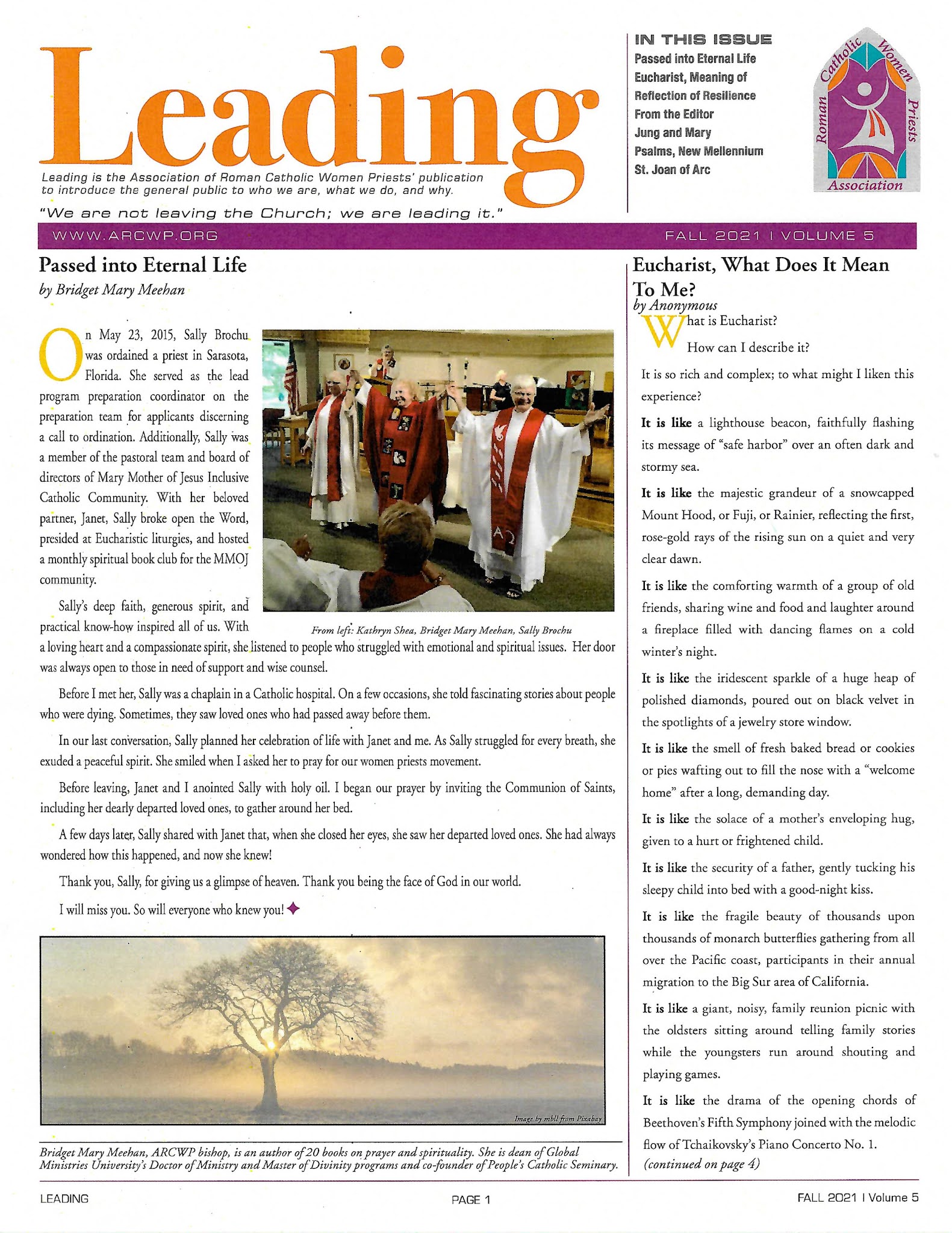
ARCWP Fall Newsletter: LEADING


Sunday, September 26, 2021

When God Gave Up on Humans by Jan Phillips

It came to pass, in the 21st century, that God gave up on the human race. He scrawled his message across the sky in words that were understood by every tribe and nation:

“You are on your own. In 20 centuries, you have failed to love each other. You use me as a reason to hate and kill. You endanger your children. You poison your planet. I am done with you. You’ll have to find me in each other from now on.”

The people on earth wept and worried. “What will become of us?” they wondered. “Who will we run to? Who will provide for us? How will I find my car keys?” they asked, throwing up their arms in despair.

Over the years, even the adults had become like children in their notions of God. While every holy book encouraged them to find God in themselves and each other, they insisted on keeping God up in the heavens. They made God responsible for everything, saying ” God did this” and “God did that.” As long as God was the Heavenly Father, they could act as children, and they did.

Even when great teachers came to tell them they were one with God, they were the hands and arms and legs of God, they were the breath of God, they would not grow up, for growing up would mean they would have to change their ways-and they did not want to.

When the sky bulletin came, people flocked to the churches and temples to see what to do. But no one there had an answer, for they, too, had kept God high upon a cloud, referring to God as “up there” or “out there.” It was God who made miracles, they preached. God who made the rules, God who punished, God who gave men all the power. They, too, were like children and were lost without God.

Years passed, seasons changed, and life on earth changed dramatically when God left the people on earth. There was a great sadness, except for the few who claimed they had felt all along that God dwelt within them. Those people had no sadness, and in fact, quite the opposite occurred. They were secretly relieved that the people stopped calling out God’s name for their reasons to hate and hurt others. Once God disappeared, people stopped fighting over what God meant in the Bible or the Koran. There was no point in fighting over God if God wasn’t even around. If there was no God, there was nobody condemning anyone’s behavior, no more infidels, no reason to take “an eye for an eye.”

People stopped seeking out priests and caliphs, rabbis and ministers, for there was no God for them to mediate. They sought out, instead, the people who were joyful and calm in this time of abandonment, thinking they must know something special and secret to be so happy.

One such person was a woman who sat under a tree in a village.

“How can you be so happy when God has left us?” a villager asked her.

“Only that God who was far away has left,” she answered. “The spark inside still remains. It is our breath. That, to me, is God. It is the love within. If I am breathing, I am being breathed by God. For that, I am joyful, for I am not alone.”

A soldier came to the woman, put down his gun and sat beside her.

“I have been a patriot. I have gone to war for God and my country. I do not understand why God has left me. I do not know what to do.”

She smiled and took his hand. “Those ideas in your head, you have learned from someone else. Have you learned to listen to the voice within?

“I do not know what the voice inside me has to say,” he said.

“Then you must sit with someone and tell your story, for only then will you hear it. And when you are done with your story, listen to the story of the one who heard you. Be real when you speak, and be ready when you listen, for it is in that conversation that you will find the answer for your next move.”


The wise woman under the tree counseled people through the day, as did all the wise women in towns and villages around the world. They addressed the people’s fears of living without God and reminded everyone that God lived right inside them. Over and over, they held the hands of fearful people saying “an old myth is dying but a new one is being born.”

They helped people grow up with a view of the Holy One deep within. They passed on secrets about finding the sacred in the sap of a maple, the flow of a river, the majesty of a mountain, and the people, in time, grew reverent toward the Earth.

They stopped asking questions like “What is your religion?” or “Have you been saved?” for everyone knew the other was holy and a spark of that Flame they once called God.

People learned to share their stories, to listen to their hearts and help each other. They changed their ways, replenished the soil, cleaned the waters, and harnessed the powers of Wind and Sun.

Over time, the people grew up and saw the light. Wars stopped as Allah/God was welcomed home in the hearts of the people.

Once they found God in themselves and each other, the people rejoiced and were glad. They were free at last, bowing in joy to the Earth and all creatures.

THE END

©2015 Jan Phillips