Translate

Sunday, December 10, 2023

Don't succumb to Synod fatigue! by Miriam Duignan


Janice Sevre- Duszynska ARCWP, Miriam Duignan, Fr. Roy Bourgeois 


In a document published on November 17th, the Bishops of England and Wales issued a plenary resolution arising from their post Synodal discussions . The document is called ‘Steps towards renewal’ but yet the content feels more like a plea to drop the demands for radical reform that were heard loud and clear during the pre-Synodal listening sessions.

30,000 people in England and Wales took part in Synodal discussions during the two years leading up to the meeting in Rome in October. The four signatories of the plenary resolution are three Bishops and one priest who were present as voting participants at the Synod.

These men spent one whole month in Rome listening to delegates discussing the most urgent issues facing the Church. But upon their return from this history making meeting they have declared their main area of focus to be a call to prayer, and decidedly not a call to action:

“We invite every parish to look anew at how the adoration of the Lord, not least through Eucharistic Adoration, and the service of the Lord in people in need, can be better connected and reinvigorated. How can we create and promote space and time for prayer, for spiritual communion, for adoring God, and for listening and responding to God? How can we deepen and broaden opportunities for people to participate in the prayer of adoration, linking this to the service of others? How can our experiences of prayer, of thirsting and longing for God, and of gratitude and wonder, give a missionary witness and invitation that is attractive to others?”

Our bishops seem very eager for us to sit quietly and pray. But it is safe to assume that the thousands of parishioners who contributed to the synodal sessions expected their bishops to do more than prescribe Eucharistic Adoration to address the Church’s ailments. So what is it about the process that has led them to make such an anti-synodal statement?

Policies and practices

Synodality means the community of Catholics should discern together. That includes free and open discussion including questioning Church policies and practises that cause harm and are not based on our true tradition. And so we must guard against Synod fatigue and not give up hope or lose momentum in demanding urgent change from our bishops and keep pushing for justice.

The Synod’s final report acknowledges the wounds inflicted on the Church by “clericalism, a chauvinist mentality and inappropriate expressions of authority”. It calls for “a profound spiritual conversion as the foundation for any effective structural change… the abuse of power and authority continue to cry out for justice, healing and reconciliation”.

When reading the output from the Bishops of England and Wales, this sentiment is one they clearly do not want us to focus on. And yet it is that abuse of authority that must urgently be addressed.

Prayer alone will not provide justice for women still rendered second class citizens by the Church. Silent prayer will not take away the hurt of divorced and remarried Catholics still being told they are living in sin.

Prayer does not change the reality of LGBTQ people whose lives and love are still dismissed as sinful by official teaching. Eucharistic Adoration will certainly not help the thousands of children abused by priests – the single most horrendous example of the utter mishandling of authority in the Church.

We must address and root out the underlying causes of why so many priests were able to commit these crimes and must challenge the ongoing suppression of the victims’ suffering ‘to save the reputation of the Church’.

Our bishops need to know that we will not stand by as they still defend the concept of clerical immunity and deny full accountability.

Mutual listening

Pope Francis said back in 2015 that: A synodal Church is a listening Church, knowing that listening “is more than feeling”. It is a mutual listening in which everyone has something to learn… The synodal process starts by listening to the people, according to a principle dear to the Church of the first millennium: “Quod omnes tangit ab omnibus tractari debet” – what concerns all needs to be debated by all.

And so we must continue to raise our voices in further diocesan listening sessions leading up the second Synodal meeting in October 2024 so that it fulfils its potential to bring about meaningful change that goes beyond the banality of our Bishops’ appeal for passive obedience – the days of pray, pay and obey are over.

Miriam Duignan Executive Director,
Wijngaards Institute for Catholic Research.


A plea for funds
The Wijngaards Institute relies on the donations of friends and supporters who believe we can bring about real change in the Catholic Church. A big thank you to all our donors who do donate regularly but more is needed for us to carry out our work.
Your generous gift will help build a modern and inclusive Church to be proud of.
To donate click here DONATE

Perhaps you might consider leaving a legacy to the Wijngaards Institute. to find out how click here LEGACYYour legacy will help build a modern Church for the next generation of Catholics.

Wishing you a happy and blessed Christmas


Copyright © 2023 Wijngaards Institute for Catholic Research, All rights reserved.
You are receiving this email because you subscribed to our newsletter through our website or because one of your contacts forwarded it to you.

Our mailing address is:

Wijngaards Institute for Catholic Research
13 Mildred AvenueNortholt, Middlesex UB5 4LG
United Kingdom
Add us to your address book


Wednesday, December 6, 2023

Ann Harrington ARCWP and Activists in North Carolina Demonstrate for alternatives to the Death Penalty


Association of Roman Catholic Women Priest Ann Harrington and Activists in North Carolina meet to demonstrate for alternatives to the Death Penalty


Ann Harrington and Activists in North Carolina meet to demonstrate for alternatives to the Death Penalty

The rain held off in Raleigh yesterday for the North Carolina Coalition for

Alternatives to the Death Penalty Rally and Ann Harrington and I joined over
100 folks to demand Government Cooper commute all of NC's deaths sentences
before leaves office.
NC Death Penalty
by the Numbers
136 people on death row.
60% are people of color.
Nearly half were sentenced by overwhelmingly white juries.
2 times more likely to be sentenced to death if victim of the murder is
white.
12 innocent people exonerated.
11 exonerees are people of color.
43 people executed since 1976.
2006: the last year someone was executed.
2023: the last year someone was sentenced to death.
10 capital trials are scheduled for 2023.
$2.16 million average additional cost for each case resulting in execution
vs. sentenced to life in prison.
I met one exonerated gentleman who has dedicated his energy to advocate for
the elimination of the death penalty and Nick whose 2  Spoken Word pieces
were incredible. I felt honored to be among people advocating for Justice.


Monday, December 4, 2023

Pope Francis says he wants a less masculine church, all he has to do is ordain women and he will get his wish!

 https://international.la-croix.com/news/religion/pope-francis-says-he-wants-a-less-masculine-church/18787


Pope Francis says he wants a "less masculine" Church
In a meeting with some of the world's leading theologians, the Jesuit pope extolled the "feminine" character of the Church

 Pope Francis can solve the problem of an overly masculine Church by ordaining women priests.

Bridget Mary Meehan - Address on Women Priests foot Spirit Unbounded in Rome on October 13,2023

Austro-Brazilian bishop on the synod on synodality: “Nothing will come of it”

 https://infovaticana.com/2023/12/04/obispo-austro-brasileno-sobre-el-sinodo-de-la-sinodalidad-no-saldra-nada-de-ahi/

| 

Sunday, December 3, 2023

Blanca Azucena Caicedo, ARCWP Presbytera - Priest in Colombia Led Reflection for the Elimination of Violence Against Women- "Releasing Chains of Violence Against Women"

Blanca Azucena Caicedo, ARCWP Presbytera


Blanca Azucena Caicedo ARCWP ( with microphone- leading Prayer Service) 


 I share with you the message that I gave at the vigil within the framework of 25N, international day for the elimination of violence against women, making visible the religious violence against women that has been carried out systematically for centuries.

On one occasion a child wanted to test the wisdom of a wise man, asking:

“If you are so wise, tell me, is what I have behind me in my hand alive or dead?”

Well... that boy had a bird in his hands and thought: if the wise man says that it is alive, I squeeze my hand and grab it, but, if the wise man says that it is dead, I let it fly.

So the wise man looked at the face of that child and sighed to respond:
“THE LIFE OF WHAT YOU HAVE IN YOUR HAND, ONLY DEPENDS ON YOU. LIFE, FREEDOM, RESPECT, GRATITUDE... ONLY DEPENDS ON YOU."


It is up to you to BE HAPPY and seek help,

It is up to you to BE FREE and stay away from those who want to tie up your dreams,

It's up to you to SPEAK and report in time...


It depends on you,

It is recognizing that the life of that other person is also in our hands, and there is the wisdom to make decisions at the right time.


Today we are here... to tell you:WOMAN

You are the tenderness of someone who caresses other people's wounds,

You are the sweet fragrance of those who sense the need of others,

You are that bouquet of roses that is delivered without conditions...


Because if you look in the mirror you will find a gift of love,

You are the mischievous smile when it flirts with life, with time,

You are the melodious word to the ears of your loved ones...

Because you can't lose the gift of being in the here and now,

because you can't let the dreams that you build to get ahead fly away,

because you can't expect things to change if you leave everything for later...


Because first you must recognize yourself as a treasure, as a diamond, which is only acquired to the extent that you decide to give it.


Today say, Lord, here I am like the woman of the Gospel who says: “Behold the servant of the Lord, but not the servant who kneels to humiliate herself but the one who knows what is best, who respects the steps of others, who knows how to walk.” in the midst of obstacles... “They don't have wine”, he senses the needs of others, he anticipates events, he feels pain for which he cries and anguishes and above all he has a solution to other people's problems, he knows how to respond , how to act at the right moment, knows that you are hungry, that you need shoes, that you do not understand the task, that you fight with true and wise arguments... “they don't have wine” and you need your distance to be respected and you need to be heard or heard.


Here we are, Lord, with the firm position of standing, even though we have had to fight for the position that rightfully belongs to us...


–                                     fight against social discrimination, where jobs are exclusive, believing that decent work is one that does not need preparation, because according to the imagination of sexist society, men are more capable than women and therefore earn more, and In response to this, only laws are created and nothing happens.


–                                     fight against sexual violence, because dignity has been reified, and even selling a pencil requires her to bare her body, and they are hired depending on their figure and body for the sole fact of selling products, women who are raped, groped, touched without not knowing that on many occasions the main executioners are in their homes, and sometimes we see those in the park who undress our girls with vulgar looks and words... and nothing happens.


- fight against verbal, emotional, psychological violence, where grotesque words seem to be the daily bread in many families, in thousands of relationships that nullify dignity and degrade the condition of being a woman, and in the face of it, nothing happens. ..


-fight against religious violence, because in the midst of a sexist society it is believed that men have the divine word, they have the power to discern even the Gospel and we return to the time of the Inquisition where the systematic persecution and punishment of the so-called heretics and religious dissidents, believing that its only purpose is to purify and sanctify a single creed and word interpreted by men, and in the face of this, nothing happens.


- fight against intellectual violence, where only men believe they have a greater capacity to acquire knowledge and many women end up studying other careers because according to their IQ, it does not matter, and nothing happens.


- fight against workplace violence, just look at the positions in our competent entities, men are entrusted with positions of power and women with positions of service, and nothing happens.


- fight against the violence of “NO”… you cannot, you should not, you are not capable, it is not enough,


- fight against gender violence... where some believe they limit the freedom of their sexual condition, for the simple fact of having a different orientation to traditions, because to wear someone else's shoe you have to feel the skin of the person It demands and demands respect from those who raise their voices even if they go against the supposed hypocritical principles of those who believe themselves to be pure from their convictions, and in the face of this, nothing happens.


Unfortunately, in the OSPS publication, it is highlighted that the population groups most vulnerable to domestic violence are women and minors, with the home being the main place where the events occur, and men being the main perpetrators. Likewise, it was evident that in Santander there are 4,554 cases of violence against women, domestic and sexual, distributed as follows: physical violence (1,473); psychological violence (170); deprivation and neglect (2,265); sexual violence (645).


In addition to these results, it stands out that the maximum level of education of 80% of the aggressors is primary and/or secondary, with men being the main aggressors in cases of physical violence (72.3%), psychological violence (74, 7%) and sexual abuse (97.3%); while women were mainly responsible in cases of deprivation and neglect (80%).

Likewise, in Santander for every male victim there are two women attacked, and 33.0% of the cases occur in children under 6 years of age.

Alarming figures, even more so knowing that Santander occupies 2nd place in domestic violence and the first places in sexual violence in children and adolescents --- and Lebrija, where are we?...

The cases that are reported are not always resolved cases, and there is no guarantee of being protected by the State. We see years-old cases that remained on paper and the route was activated... and they end up archived as paper stories. , but still, many girls continue to live with the executioner, in the same places where for years and years they have suffered violence and the abuser continues to walk through our streets with the freedom of not having been touched.


It is time for us to wake up, to know that we are not alone, that the State must guarantee our rights, that we are the voice of those who have remained silent, that our flag joins the flag of all those who follow seeking justice and truth.


Friday, December 1, 2023

The December Issue of The Review- RCWP Canada


 The December 1st issue of Roman Catholic Women Priests Canada's online magazine, The Review, at

 rcwpcanada.altervista.org, features the following original and linked articles:

  • Associate Member of RCWP Canada joins CNWE delegation to Synod Assembly
  • My final day of preparation for the Synod Assembly 2023 — or What to do on a Sunday in Florence?
  • Moving “Church”
  • Drug Free Kids: Watch the video to find out more about who we are and what we do!
  • Lack of a definitive answer generates deeper thought
  • Comments to the Editor form

  • Synod  2021 - 2024
Synod coverage
Synod Documents
Complete 41-page Synthesis Report
The Catholic Synod Offers Little Hope for Real Change in the Church
Synthesis Report hints at inviting married priests back into ministry
'Excuse me, Your Eminence, she has not finished speaking'

  • Reflections and Homilies on the Sunday Readings of the Roman Missal and the Revised Common Lectionary
  • Francis Comics
  • StatCounter.com for the previous issue of The Review (November 15 to November 30, 2023):
  • RCWP Canada Bishop's Message:  Welcome Advent

  • EcoJustice
Laudate Deum: the Pope’s cry for a response to the climate crisis
Text of Apostolic Exhortation Laudate Deum
COP28 to have first-ever 'Faith Pavilion' at a UN climate summit
More on COP28 from the National Catholic Reporter

  • The New Cosmology
The World Will Change by Creating a New One

Felix Kryzanowski
Editor, RCWP Canada's The Review

Monday, November 27, 2023

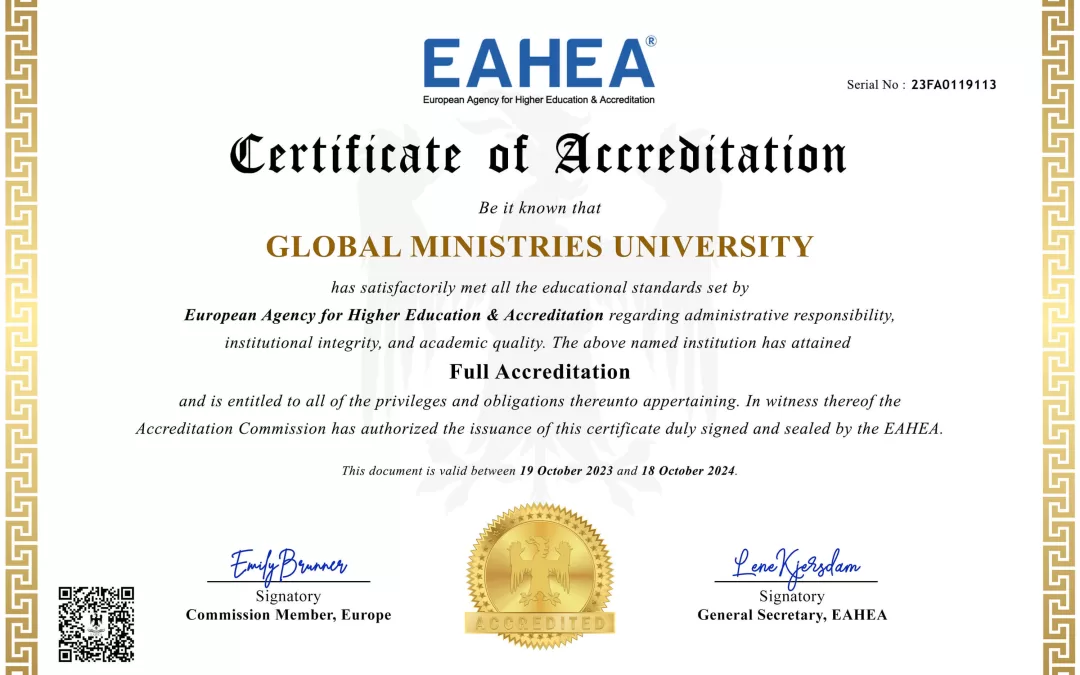
Global Ministries University Receives Accreditation from the European Agency for Higher Education

https://www.globalministriesuniversity.org/gmu-receives-full-accreditation-from-eahea/


GMU Receives Accreditation from the European Agency for Higher Education

The European Agency for Higher Education Accreditation has granted Global Ministries University a grade of "A - Full Accreditation." EHAEA evaluated GMU's Administrative Responsibility, Institutional Integrity, and Academic Quality.


EAHEA accreditation focuses primarily on educational quality from a global and international perspective, not national interests.

Read the complete audit report.


The European Agency for Higher Education Accreditation has granted Global Ministries University a grade ” A-Full Accreditation.” EHAEA evaluated GMU’s “Administrative Responsibility, Institutional Integrity, and Academic Quality.”

EAHEA accreditation focuses primarily on educational quality from a global and international perspective, not national interests. EAHEA is aware of the differences among countries that may arise regarding fulfilling the quality standards set forth, so EAHEA follows a non-discriminatory policy and examines each higher education institution respecting their institutional autonomy.

Due to this global policy, the EAHEA is not part of any country’s governmental agencies. Accredited institutions’ academic mobility and credit transferability will always be subject to the receiving country’s or institution’s policies.

While accreditation with EAHEA may not meet the requirements of some US employers and academic institutions, it increases GMU’s stature in the global community. Since many of GMU’s students now come from Africa and Asia, it is important for GMU to be accredited by an international agency.© 2023 Global Ministries University

The Overwhelming Case to Restore Women to Ordained Ministry Alongside Men as their Equals

 https://www.thetablet.co.uk/blogs/1/2617/the-overwhelming-case-to-restore-women-to-ordained-ministry-alongside-men-as-their-equals-

By Miriam Duignan published in the Tablet

The overwhelming case to restore women to ordained ministry alongside men as their equals


by Miriam Duignan
email sharing button
facebook sharing button
twitter sharing button
pinterest sharing button
linkedin sharing button


A fresco believed to show a woman priest in the early church, in the Catacombs of Priscilla in Rome, Italy.
Abaca Press/Alamy Live News

“We are still hopeful, but not particularly optimistic.” This was the response of the campaign group, Catholic Women’s Ordination, to the first synodal meeting in Rome.

During the synodal process, Church leadership heard Catholics everywhere express a strong desire to see women recognised for their vocations to ministry and for the priestly work they do in parishes everywhere. In so many of our churches, it is women preparing families for baptisms, marriages and funerals and, in the absence of a male priest, they conduct Communion services on a Sunday. Women are chaplains in hospitals where they care for the sick and the dying, but must call for a male priest to administer the last rites or hear confession. This glaring and illogical injustice can no longer be ignored.

And yet, the topic of women priests was banned at the Synod. Instead, after one month of discussions and constant edits, the summary document’s paragraph on the female diaconate (a question that was allowed) was a watered down, vague statement about the need for further study. If yet another study were to be taken up, this would be the third go-around in seven years to examine the case to restore the women’s diaconate. We have to ask, how much longer can this possibly take?

The vocation to be a deacon is undoubtedly a valid calling for those who do not want the responsibility of running a parish or holding other roles of responsibility in the leadership of the Church. CWO is hopeful that this ministry will soon be opened up for women who feel called to serve as a deacon, the way Catholic men can now. But a Deacon cannot celebrate mass or consecrate the Eucharist, the central sacrament of Catholicism, the heart of church life and of which parishes are in desperate need. The lack of priests has reached a critical stage and most clergy are now exhausted and overworked. The Church hierarchy is excluding a group of willing and able women workers who have the skills and experience to officiate today.

Our ambivalence about the possibility of women deacons also stems from the fear it would entail “bolting us on” to  current hierarchical structures in a way that limits the vocations of women and continues to render them as inferior to men. The post-synodal signs point to the desire of the Church hierarchy to create a lay ministry of women deacons that strictly rules out ordination. This would mean women won’t be sacramentally recognised as having a commitment to a life of ministry. CWO is concerned women would therefore not qualify to receive the same training as male deacons and would lack formal confirmation of a permanent role within parishes. We suspect that female lay deacons’ ability to preside at baptisms, weddings and funerals would always be subject to the goodwill and whims of local priests and bishops.

This continued restriction of the Sacrament of Holy Orders to men only (“permanent” deacons included) is a blatant discrimination that has no basis in tradition or theology. There is overwhelming evidence that women were sacramentally ordained as deacons in the early church. To allow this tradition to be denied would be to pander to the prejudicial desire to ensure that no woman will ever be recognised as the peer of a man.

We often hear that the body of evidence proving women were deacons means this is the only ministry women can claim to hold. But this is mistaken. Christ instituted an equal baptism for women and men, indicating openness to all sacraments including ordination. And at the Last Supper, women were present when Jesus said: “Do this in memory of me.” When Jesus sent out his apostles and disciples, he blessed them – men and women – with his authority for their mission. Whatever men did in the early Church, women did too, as equals and not subordinates. It was only in the fourth century that we first see a separate hierarchical rank of ordained male priests when the Roman culture of excluding women from leadership roles took hold. And so, for as long as priesthood exists as a role and a requirement to run parishes, administer all sacraments and participate in decision-making about how the Catholic Church is run and what it teaches, women can and must be among their number.

We welcome Synod discussions about tackling what Pope Francis calls “the scourge of clericalism”. But those opposed to any ministry for women are increasingly using this term to position women’s vocations in a negative light. To associate women’s genuine call to ministry with abuse of power and suggest that their ministry would be corrupt before it even starts, is a judgment never levelled at men who claim a vocation to priesthood. Those who claim concern about clericalism should note that this affliction often arises when priests believe they are a superior caste of men, because no woman can ever be their peer. And so, the most effective way to diminish clericalism and start to reform the priesthood would be to restore women to ministry alongside men as their equals.

CWO envisages flourishing,  inclusive, active Eucharistic communities, where women will be ordained to sacramental and pastoral care. We are confident that the Synod’s lack of meaningful commitments to act on equality will galvanise Catholics to demand their local dioceses have further listening sessions. This would increase the pressure on the Vatican to not only give the illusion of inclusion with vague references to study women but actively to include women in the leadership structure of the church. Our hierarchy needs to act now because the very future of our church is at stake. Any further delay only exacerbates the pastoral crises that leave the dying neglected, the vulnerable with no support, and parishes adrift. These communities are desperate for priestly service and leadership – the very care that women are already offering and are ready to give more fully.


Miriam Duignan is Executive Director of the Wijngaards Institute for Catholic Researchwhich is dedicated to bringing about reform in the Catholic Church via educational websites as well as multi-disciplinary reports by academics on the most disputed areas of church teaching. Miriam was born in England to Irish parents, educated by Dominican nuns and completed post graduate studies at the Jesuit School of Theology in Berkeley, California.  

email sharing button
facebook sharing button
twitter sharing button
pinterest sharing button
linkedin sharing button